
Class L Fire Extinguishing Agent
Advanced Lithium Battery Fire Protection Using HMS Technology
The widespread adoption of lithium-ion batteries in electric vehicles, energy storage systems, transport infrastructure and backup power applications has created a new category of fire risk. These fires—often referred to as Class L fires—require specialized suppression methods that go beyond conventional extinguishing agents.
To address this evolving hazard, LIFEGUARD® LiON-EX Fire Extinguishers utilize an advanced Class L fire extinguishing agent: HMS (Hydrated Mica Suspension), specifically designed for lithium battery fire suppression.
What Is a Class L Fire Extinguishing Agent?
A Class L fire extinguishing agent is a specialized medium formulated to control fires involving:
- Lithium-ion batteries
- Battery energy storage systems
- Electric vehicles and e-mobility infrastructure
- UPS and inverter batteries
- Portable electronic battery packs
These fires require an agent capable of:
- Rapid cooling
- Surface encapsulation
- Electrical insulation
- Prevention of re-ignition
Traditional agents such as water, foam or dry powder are often insufficient to address all these requirements simultaneously.
Why Lithium Battery Fires Require Specialized Agents
Lithium battery fires behave differently from conventional fires due to thermal runaway, a chain reaction that can rapidly escalate and spread between cells.
Key challenges include:
- Extremely high temperatures
- Internal chemical reactions
- Release of flammable gases
- Risk of delayed re-ignition
- Electrical hazards
Because of these characteristics, an effective Class L fire extinguishing agent must act both physically and chemically to stabilize the fire.
HMS – Hydrated Mica Suspension
LIFEGUARD’s Specialized Class L Fire Extinguishing Agent
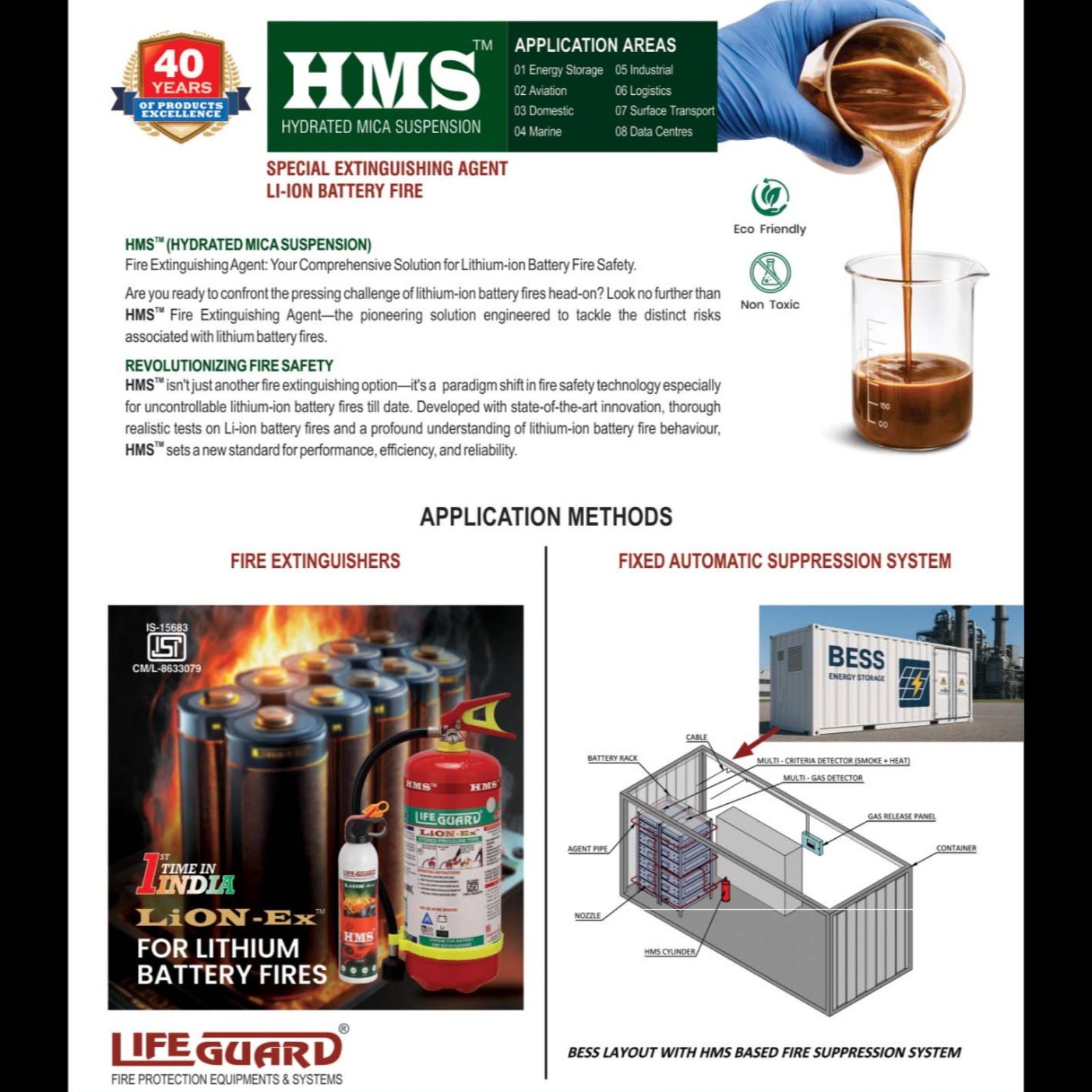
HMS (Hydrated Mica Suspension) is an advanced extinguishing medium engineered specifically for lithium battery fires and used in the LiON-EX Fire Extinguisher range.
HMS functions through multiple fire-control mechanisms:
Rapid Cooling
Absorbs heat quickly, reducing battery temperature and slowing thermal runaway.
Encapsulation
Forms a protective mica-based layer that isolates burning surfaces from oxygen.
Electrical Insulation
Enhances operator safety and reduces conductivity risks.
Re-Ignition Resistance
Helps prevent secondary ignition, a common challenge in lithium battery fires.
This multi-action capability makes HMS highly effective for Class L fire protection.
Advantages of HMS Over Conventional Fire Extinguishing Agents
HMS offers several key advantages when compared to traditional suppression agents.
Compared to Water
- Water provides cooling but limited encapsulation
- HMS provides both cooling and barrier formation
Compared to Dry Powder
- Powder suppresses flames but provides limited cooling
- HMS controls heat and reduces re-ignition risk
Compared to Foam
- Foam is effective for liquid fires but less effective on battery cells
- HMS is designed specifically for lithium battery chemistry
These advantages make HMS particularly suitable for modern fire risks involving energy storage.
LiON-EX Fire Extinguishers by LIFEGUARD®
The LiON-EX product range integrates HMS technology into portable and mobile fire extinguishers designed for lithium battery applications.
These extinguishers are suitable for:
- Electric vehicles and charging areas
- Battery rooms and UPS installations
- Public transport fleets
- Laboratories and testing facilities
- Warehousing and logistics operations
LiON-EX extinguishers are designed to provide rapid response and effective early-stage suppression.
Applications Across Key Sectors
High-Rise Buildings
Lithium battery risks are increasing in:
- EV parking basements
- Battery backup systems
- Electrical rooms
- Data centers
HMS-based extinguishers help control fires before escalation.
Buses and Electric Fleet Operations
Electric buses and hybrid vehicles contain large battery packs that require specialized protection.
LiON-EX extinguishers help:
- Control battery compartment fires
- Reduce risk of vehicle loss
- Improve passenger safety
Railways and Metro Systems
Battery installations in signalling systems and rolling stock present unique fire risks.
HMS-based extinguishers provide:
- Effective suppression in confined spaces
- Reduced re-ignition risk
- Faster response capability
Hospitals and Healthcare Facilities
Hospitals rely on:
- UPS systems
- Portable battery equipment
- Emergency vehicles
Fire incidents in such environments require immediate and reliable suppression.
Public Gathering Places
Facilities such as malls, airports and exhibition centers increasingly deploy:
- EV charging infrastructure
- Backup power systems
- Battery storage installations
HMS-based extinguishers provide critical protection in high-occupancy areas.
Importance of Early Intervention in Class L Fires
Early suppression is crucial in lithium battery incidents.
Using a Class L fire extinguishing agent in the initial stages can:
- Interrupt thermal runaway
- Protect adjacent cells
- Reduce smoke and gas release
- Prevent large-scale incidents
This makes LiON-EX extinguishers essential for modern fire safety planning.
Integrated Fire Protection Strategy
For maximum safety, Class L fire extinguishers should be part of a layered protection system that includes:
- Fire detection and alarm systems
- Thermal monitoring
- Automatic suppression where required
- Emergency response planning
- Staff training
Layered protection ensures both prevention and response.
Why Choose LIFEGUARD® LiON-EX HMS Solutions
LIFEGUARD provides:
- Specialized Class L fire extinguishing agents
- Portable and mobile lithium fire extinguishers
- Fire safety audits and risk assessments
- Installation and commissioning support
- Training and AMC services
Our solutions are engineered to meet emerging fire risks associated with electrification and energy storage.
Technical Comparison of Lithium Battery Fire Suppression Agents
HMS vs Watermist vs Foam vs Dry Powder
Lithium-ion battery fires behave differently from conventional fires. Selecting the correct extinguishing agent is critical to cooling, containment and prevention of re-ignition.
The following comparison explains the performance differences between commonly used extinguishing media and HMS (Hydrated Mica Suspension) used in LiON-EX Fire Extinguishers by LIFEGUARD®.
Performance Comparison Table
Parameter
HMS (Hydrated Mica Suspension)
Watermist
Foam
Dry Powder
Designed for Lithium Battery Fires
✔ Specifically engineered
⚠ Limited effectiveness
✖ Not designed
✖ Not designed
Cooling Capability
✔ Very High
✔ High
⚠ Moderate
✖ Low
Thermal Runaway Control
✔ Effective
⚠ Partial
✖ Ineffective
✖ Ineffective
Surface Encapsulation
✔ Forms protective mica layer
✖ None
⚠ Limited
✖ None
Re-Ignition Resistance
✔ High
⚠ Moderate
✖ Low
✖ Very Low
Electrical Safety
✔ Good insulation properties
✔ Safe when applied correctly
⚠ Depends on formulation
✔ Non-conductive
Toxic Gas Reduction
✔ Helps reduce spread
⚠ Limited
✖ Minimal effect
✖ Minimal effect
Residue Impact on Equipment
⚠ Moderate (washable)
✔ Minimal
⚠ Moderate
✖ Heavy residue
Suitability for EV Battery Fires
✔ Highly Suitable
⚠ Limited
✖ Not suitable
⚠ Temporary suppression only
Suitability for Energy Storage Systems
✔ Highly Suitable
⚠ Limited
✖ Not suitable
✖ Not suitable
Re-Ignition Prevention
✔ Designed for it
⚠ Partial
✖ No
✖ No
Why HMS Performs Better in Class L Fires
Lithium battery fires require three critical actions:
- Rapid heat removal
- Isolation of reacting cells
- Prevention of oxygen access and re-ignition
HMS addresses all three simultaneously:
- Absorbs heat rapidly
- Forms a mica-based barrier
- Slows chemical reaction
- Reduces risk of flare-up
Traditional extinguishing agents typically address only one of these factors.
Limitations of Conventional Agents in Lithium Fires
Watermist
Watermist provides cooling but:
- Does not encapsulate battery cells
- May not prevent re-ignition
- Requires sustained application
Best suited for:
- Electrical fires
- Surface cooling
Foam
Foam is designed primarily for:
- Flammable liquid fires
Limitations in lithium fires:
- Limited penetration into battery packs
- Ineffective in stopping thermal runaway
Dry Powder
Dry powder:
- Knocks down flames quickly
- Does not remove heat effectively
- Does not prevent re-ignition
Powder is often a temporary suppression method rather than a complete solution for lithium battery incidents.
Where HMS-Based LiON-EX Extinguishers Are Most Effective
HMS technology is recommended for:
- Electric vehicles and charging stations
- Battery energy storage systems (BESS)
- UPS and inverter rooms
- Electric buses and depots
- Railways and transport infrastructure
- Data centers and telecom installations
- High-rise EV parking basements
Layered Protection Approach Recommended by LIFEGUARD®
For optimal lithium fire safety:
Risk Area
Recommended Protection
Small battery devices
Portable LiON-EX HMS
EV charging areas
Portable or wheeled HMS
Bus depots
Wheeled or trailer HMS
Battery rooms
Automatic detection + suppression
BESS installations
Fixed suppression systems
Conclusion
Lithium-ion battery fires represent one of the most significant emerging fire risks in modern infrastructure. Effective suppression requires specialized technology designed specifically for these hazards. Lithium-ion battery fires are fundamentally different from traditional fires and require suppression agents specifically designed to manage:
- Thermal runaway
- High heat release
- Re-ignition risk
HMS-based Class L fire extinguishing agents used in LiON-EX Fire Extinguishers provide a multi-action suppression mechanism i.e. rapid cooling, encapsulation and re-ignition resistance—making them a reliable solution for lithium battery fire protection and makes them highly effective for Class L fire risks.
Organizations that proactively adopt specialized suppression solutions significantly improve safety and operational resilience.
SEO Keyword Bank
Primary Keywords
Class L Fire Extinguishing Agent
Lithium battery fire extinguishing agent
Secondary Keywords
HMS fire extinguishing agent
LiON-EX fire extinguisher
Lithium battery fire suppression
Long-Tail Keywords
Best extinguishing agent for lithium battery fires
Fire extinguishing agent for EV battery fire
HMS lithium fire suppression technology
Class L fire protection for buildings and transport
Meta Title
Class L Fire Extinguishing Agent | HMS LiON-EX Lithium Fire Protection – LIFEGUARD
Meta Description
Discover HMS, the advanced Class L fire extinguishing agent used in LIFEGUARD LiON-EX fire extinguishers, designed for lithium-ion battery fire protection in buildings, EVs, hospitals and transport systems.
Contact Information
United Fire Equipments Pvt. Ltd.
Manufacturer of ISI Certified Fire Safety Equipment
📞 8048034226
📧 ufe126@gmail.com, info@lifeguardindia.in