
Class L Fire Extinguisher — Advanced Protection for Lithium-Ion Battery Fires
As modern infrastructure shifts toward electrification, lithium-ion batteries have become the backbone of mobility, energy storage, medical systems, and critical operations. From electric vehicles in basement parking to battery banks in hospitals and rail networks, the benefits are enormous—but so are the fire risks.
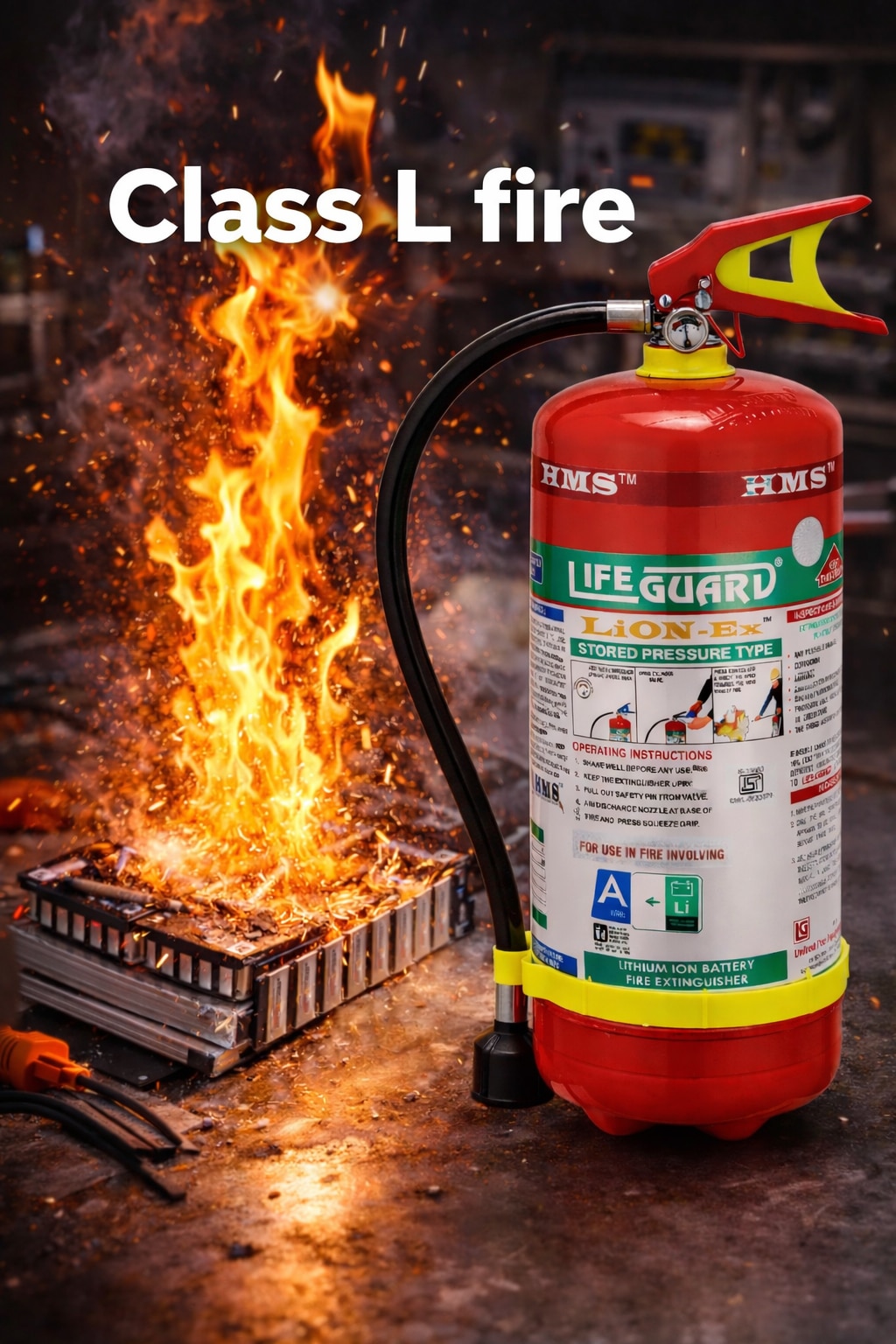
Traditional fire classifications were never designed to address the unique behavior of lithium battery fires. This gap has led to the emergence of Class L Fires — a specialized category for fires involving lithium-ion batteries characterized by thermal runaway, rapid heat release, toxic gases, and dangerous re-ignition.
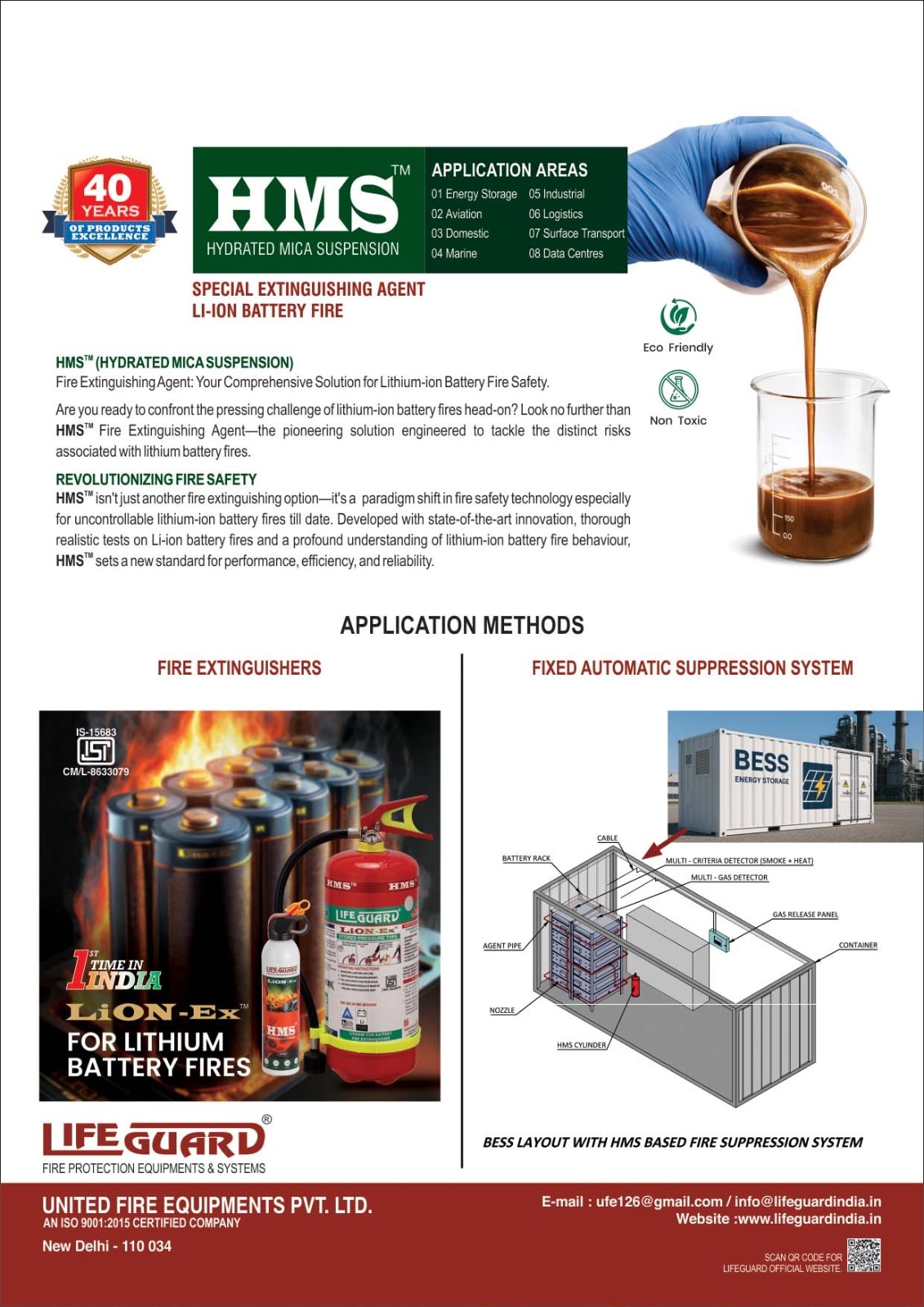
To address this new hazard, the Class L Fire Extinguisher has become an essential safety solution for high-risk environments. Among available technologies, HMS (Hydrated Mica Suspension)—used in LIFEGUARD® LiON-EX extinguishers—represents one of the most effective agents engineered specifically for lithium battery incidents.
What Is a Class L Fire?
A Class L fire involves energy storage systems based on lithium-ion chemistry, including:
- Electric vehicle batteries
- E-bus and rail traction batteries
- UPS and inverter banks
- Energy Storage Systems (ESS/BESS)
- Portable electronics and mobility devices
- Medical battery equipment
- Industrial robotics and automated systems
Unlike conventional fires, lithium battery fires are driven by internal chemical reactions, not just external fuel combustion.
Key Characteristics of Class L Fires
- Thermal runaway chain reaction between cells
- Extremely high temperatures (often exceeding 800–1,000 °C)
- Release of flammable and toxic gases
- Jet-like flames and explosive venting
- Electrical hazards due to energized systems
- Persistent re-ignition even after apparent extinguishment
These features make Class L fires fundamentally different from Classes A, B, C, or even D.
Why Conventional Extinguishers Are Not Sufficient
Traditional extinguishing agents struggle against lithium battery incidents because they do not address the root cause—internal heat generation.
Conventional Agent | Limitation in Class L Fires |
Water (jet) | May spread burning electrolyte; electrical risk |
CO₂ | No cooling effect; fire re-ignites |
Foam | Ineffective against sealed battery cells |
Dry Powder | Knocks down flames but not thermal runaway |
Clean Agent | Insufficient heat absorption |
A fire may appear extinguished but can reignite minutes or hours later.
Class L Fire Extinguisher — Purpose-Built Solution
A true Class L fire extinguisher must deliver multiple simultaneous actions:
✔ Rapid cooling of battery cells
✔ Suppression of flames
✔ Electrical safety
✔ Containment of toxic emissions
✔ Prevention of re-ignition
✔ Ability to penetrate battery pack surfaces
HMS technology is designed to achieve all of these.
HMS (Hydrated Mica Suspension) — The Core Advantage
HMS is a water-based suspension containing engineered mica particles that transform during application to form a heat-resistant barrier.
How HMS Works on Lithium Battery Fires
- Rapid Heat Absorption
Large thermal capacity cools cells below runaway temperature. - Encapsulation Layer Formation
Mica particles create a physical barrier isolating oxygen and heat. - Electrical Insulation
Reduces shock risk when applied to energized systems. - Re-Ignition Prevention
The barrier stabilizes affected cells and adjacent modules. - Surface Sealing of Battery Packs
Limits propagation to nearby components.
HMS vs Conventional Agents for Class L Fires
Performance Factor | HMS | Conventional Agents |
Cooling Capability | ⭐⭐⭐⭐⭐ | ⭐–⭐⭐ |
Thermal Runaway Control | ✔ Effective | ❌ Limited |
Re-Ignition Resistance | ✔ High | ❌ Poor |
Electrical Safety | ✔ High | ⚠ Varies |
Surface Encapsulation | ✔ Yes | ❌ No |
EV Battery Suitability | ✔ Excellent | ❌ Limited |
HMS does not merely extinguish flames—it stabilizes the battery.
Applications Across High-Risk Environments
🏢 High-Rise Buildings
- EV parking basements
- Charging stations
- Residential energy storage
- Elevator backup systems
Lithium fires in enclosed basements can produce dense toxic smoke and rapid vertical spread. HMS extinguishers provide early containment before evacuation becomes difficult.
🚌 Electric Buses & Fleet Depots
- High-capacity traction batteries
- Overnight charging bays
- Maintenance facilities
Vehicle battery fires threaten passengers, infrastructure, and adjacent vehicles. Portable and wheeled Class L extinguishers enable rapid response.
🚆 Railways & Metro Systems
- Battery-powered rolling stock
- Signalling backup systems
- Station energy storage
Confined tunnels and platforms demand agents that suppress heat without spreading smoke or conductive hazards.
🏥 Hospitals & Healthcare Facilities
- Critical care equipment
- UPS systems
- Medical mobility devices
- Emergency power storage
In oxygen-rich environments, fire escalation can be catastrophic. HMS provides controlled suppression without heavy collateral damage.
🏟️ Public Gathering Places
- Airports and transit hubs
- Shopping malls
- Stadiums and exhibition centers
- Charging infrastructure
High footfall areas require immediate suppression capability to prevent panic and mass evacuation incidents.
Portable, Wheeled, and Fixed Class L Solutions
LIFEGUARD® LiON-EX HMS extinguishers are available in configurations suited to risk intensity:
- Portable units for quick response
- Wheeled units for large battery installations
- Fixed automatic systems for critical infrastructure
- Integration with detection and alarm systems
This scalability ensures protection from small device fires to large energy storage events.
Why Early Intervention Is Critical in Class L Fires
Once thermal runaway propagates through multiple cells, suppression becomes extremely difficult. The goal of a Class L extinguiser is early control before escalation.
Early application of HMS can:
- Prevent explosion or venting
- Limit fire spread to adjacent modules
- Reduce structural damage
- Protect evacuation routes
- Minimize downtime and losses
Compliance and Modern Fire Safety Strategy
Forward-looking facilities are updating fire protection plans to address lithium risks in accordance with evolving guidelines from building codes, transport authorities, and global standards bodies.
A layered approach typically includes:
- Detection systems
- Specialized extinguishers
- Compartmentalization
- Ventilation strategies
- Training and emergency procedures
Class L extinguishers are a critical component of this strategy.
Why Choose LIFEGUARD® LiON-EX HMS Class L Fire Extinguishers
LIFEGUARD® (United Fire Equipments Pvt. Ltd.) offers solutions engineered for modern electrical fire risks:
✔ Designed specifically for lithium-ion battery incidents
✔ Suitable for EV infrastructure and energy storage
✔ Rapid cooling and encapsulation technology
✔ Reduced re-ignition probability
✔ Scalable for diverse applications
✔ Supported by training, installation, and AMC services
These systems protect not just assets—but lives and continuity of operations.
The Future of Fire Protection Is Lithium-Ready
As electrification accelerates, Class L fire protection is no longer optional. Facilities that rely on legacy systems face increasing risk from battery-driven hazards.
A Class L fire extinguisher using HMS technology represents a forward-compatible solution designed for the realities of modern energy systems.
Protect What Powers the Future
Lithium batteries are transforming the world—but they demand specialized safety.
Class L Fire Extinguishers with HMS technology ensure that progress does not come at the cost of protection.
United Fire Equipments Pvt. Ltd.
Manufacturer of ISI Certified Fire Safety Equipment
📞 8048034226
📧 ufe126@gmail.com | info@lifeguardindia.in
🌐 www.lifeguardindia.in
Upgrade to lithium-ready fire protection with LIFEGUARD® LiON-EX HMS solutions.
