
HOSPITAL SMOKE DETECTION
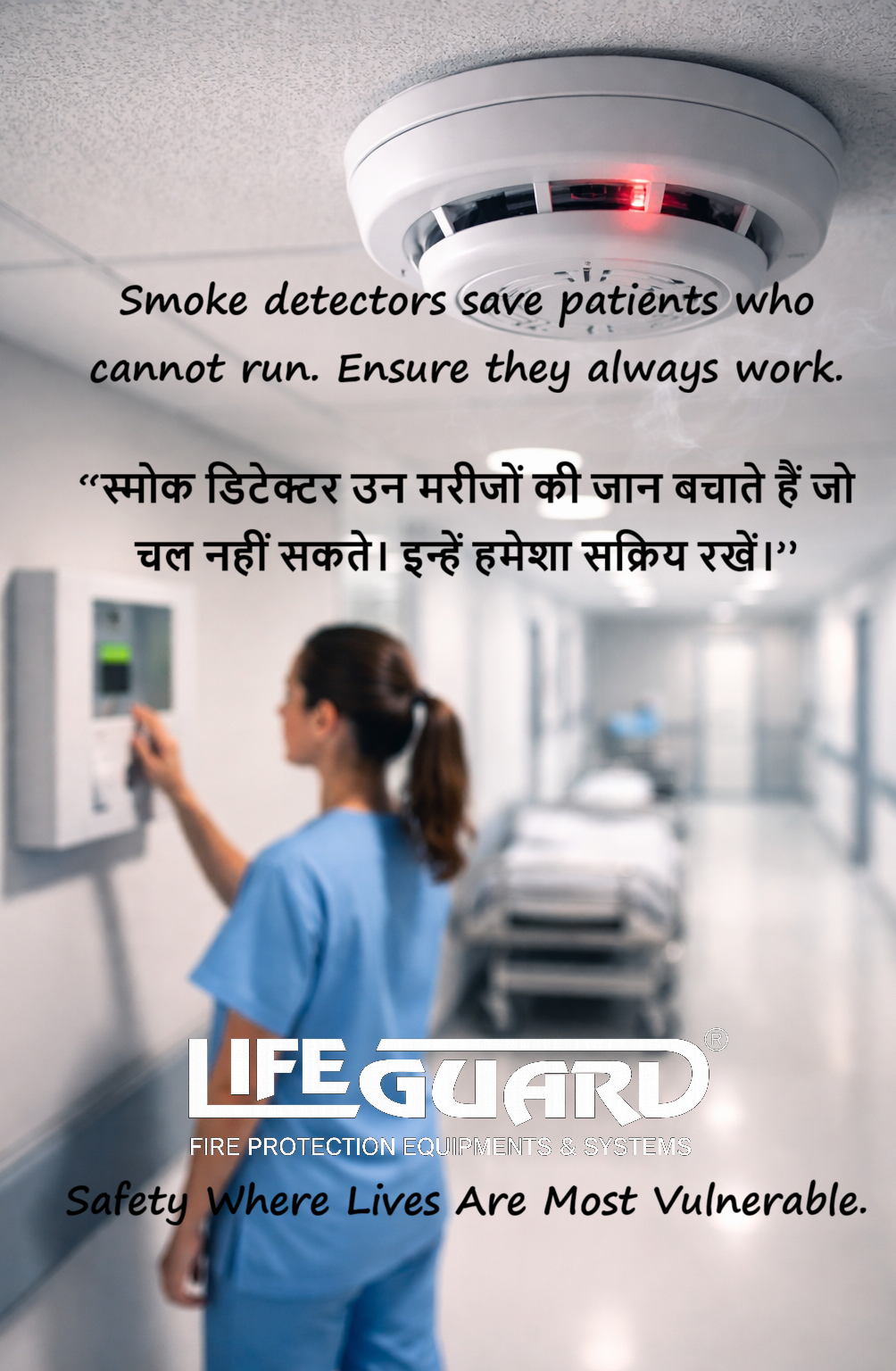
Smoke Detectors Save Patients Who Cannot Run
Ensure They Always Work
In a fire emergency, seconds decide survival. For many people—especially patients, elderly individuals, children, persons with disabilities, and critical-care occupants—running is not an option. Their safety depends entirely on early warning systems that detect fire before smoke becomes deadly.
That is why smoke detectors are not just devices.
They are life-saving sentinels.
At LIFEGUARD® (United Fire Equipments Pvt. Ltd.), we emphasize one uncompromising truth:
Smoke detectors save patients who cannot run. Their reliability must never be optional.
Why Smoke Detectors Are Critical in Life-Safety Environments
Fire does not kill primarily by flames—it kills by smoke inhalation. Toxic gases can incapacitate a person within minutes, especially in enclosed spaces.
Smoke detectors provide:
- Early warning before flames spread
- Time for assisted evacuation
- Activation of alarms and suppression systems
- Critical response window for staff and first responders
For people who cannot move quickly or independently, early detection is the only chance for survival.
Where Smoke Detectors Save the Most Lives
🏥 Hospitals & Healthcare Facilities
Patients in:
- ICUs, NICUs and CCUs
- Operation theatres (under anesthesia)
- Recovery rooms
- Wards with immobile or sedated patients
depend entirely on staff response triggered by smoke detectors.
A non-functional detector here is a silent killer.
🏢 High-Rise Residential & Commercial Buildings
- Elderly residents
- Children
- Night-time occupants asleep
- People trapped above fire floors
Smoke detectors ensure:
- Early evacuation alerts
- Stairwell and alarm activation
- Timely fire brigade response
🚌 Buses & Public Transport
Passengers:
- Seated, asleep, or unaware
- Children, elderly, differently abled
Smoke detection enables:
- Early driver alerts
- Automatic suppression activation
- Safe evacuation before smoke fills the cabin
🚆 Railways & Metro Systems
- Passenger coaches
- Sleeper compartments
- Driver cabins and equipment rooms
Smoke detectors protect people who cannot escape instantly from a moving or enclosed vehicle.
🏟️ Public Gathering Places
- Malls, auditoriums, stadiums, airports
- Crowded environments where movement is slow
Early smoke detection prevents panic, stampede, and mass casualties.
What Happens When Smoke Detectors Fail
Fire audit investigations repeatedly reveal:
- Detectors disabled due to nuisance alarms
- Dead batteries
- Covered or painted detectors
- Poor maintenance and no testing
- Faults ignored on control panels
The result?
🚫 Delayed detection
🚫 Delayed response
🚫 Lives lost—especially those who cannot run
Types of Smoke Detectors & Their Applications
🔔 Photoelectric Smoke Detectors
- Best for smouldering fires
- Ideal for hospitals, homes, hotels
- Fewer false alarms
🔔 Ionization Smoke Detectors
- Faster response to flaming fires
- Suitable for industrial or utility areas
🔔 Multi-Sensor Detectors
- Combine smoke and heat detection
- Higher reliability in complex environments
LIFEGUARD recommends application-specific selection, not one-size-fits-all.
Ensuring Smoke Detectors Always Work — Best Practices
✔ Installation
- Install in corridors, patient rooms, cabins, control rooms
- Avoid dead air spaces and vents
- Follow national standards and spacing guidelines
✔ Testing & Maintenance
- Weekly / monthly testing as per occupancy risk
- Battery replacement where applicable
- Panel fault rectification immediately
- Annual professional inspection
✔ Integration
- Connect detectors to:
- Fire alarm panels
- Audible & visual alarms
- Automatic fire suppression systems
- Central monitoring stations
Compliance & National Safety Expectations
Smoke detector systems should align with:
- National Building Code (NBC) fire detection guidelines
- BIS standards for fire alarm systems
- Healthcare fire safety norms
- Transport and public safety regulations
LIFEGUARD systems are designed to support audit readiness and statutory compliance.
Fire Safety Is a Moral Responsibility
When occupants cannot evacuate on their own, the responsibility lies with:
- Facility owners
- Hospital administrators
- Transport authorities
- Safety officers
A working smoke detector is not just compliance—it is compassion backed by engineering.
How LIFEGUARD® Supports Reliable Smoke Detection
LIFEGUARD provides:
- ISI-certified smoke detectors
- Addressable & conventional fire alarm systems
- Integration with suppression and evacuation systems
- AMC, testing & training services
- Fire audits and risk assessments
Our focus is reliability where failure is not an option.
A Message That Must Be Remembered
Smoke detectors save patients who cannot run.
Ensure they always work.
Lives depend on this discipline—every day, every night.
SEO Keyword Bank
Primary Keywords
- Smoke detectors save lives
- Smoke detectors in hospitals
Secondary Keywords
- Fire detection systems
- Smoke detector maintenance
- Fire safety for patients
Long-Tail Keywords
- Importance of smoke detectors in hospitals
- Why smoke detectors are critical for patient safety
- Smoke detection systems for public buildings
- Fire safety for immobile occupants
Meta Title & Meta Description (SEO Optimized)
Meta Title:
Smoke Detectors Save Patients Who Cannot Run | Fire Detection Safety – LIFEGUARD
Meta Description:
Smoke detectors save patients who cannot run. Learn why reliable smoke detection is critical for hospitals, high-rise buildings, buses, railways and public places—and how to ensure detectors always work.
Take Action—Lives Depend On It
United Fire Equipments Pvt. Ltd.
Manufacturer of ISI Certified Fire Safety Equipment
📞 8048034226
📧 ufe126@gmail.com, info@lifeguardindia.in
📌 Upgrade Smoke Detection Systems | Schedule Testing & AMC | Request Fire Safety Audit