Electrical rooms, control cabinets, switchgear spaces and process machinery need fire protection that will not soak equipment or leave powder in contacts and ventilation paths. By the end, you will know where CO2 suppression fits, how a fixed installation operates, what the design must account for, and which life-safety controls determine whether it is appropriate.
Key takeaways
- CO2 is suitable for energized electrical equipment and some flammable-liquid fires.
- Calculate agent quantity from enclosure volume, leakage, hazard type and required concentration.
- Install alarms, time delays, abort switches and room evacuation controls before CO2 discharge.
- Choose another agent when occupied spaces cannot be reliably evacuated before discharge.
Why CO2 suits some electrical and flammable-liquid hazards
CO2 fire suppression suits energized electrical equipment because carbon dioxide is a nonconductive extinguishing agent. It does not create a conductive path across live components, and it leaves no water, foam, or powder residue on switchgear, control panels, or sensitive machinery. That reduces cleanup and secondary equipment damage.
It also suits certain Class B flammable-liquid fires in enclosed hazards. A total-flooding discharge suppresses combustion by reducing the surrounding oxygen concentration, with additional cooling as the gas expands. The required concentration depends on the fuel and hazard; selecting a generic percentage is not a safe design method.
Treat CO2 as the wrong choice when:
- The power source remains live after discharge. CO2 does not remove electrical energy from an arc, fault, or overheated component, so the fire can persist or reignite and the shock hazard remains.
- The enclosure cannot hold the required concentration. Open doors, unsealed cable penetrations, failed dampers, or operating ventilation can defeat suppression.
- The fuel reacts adversely with CO2, supplies its own oxygen, or involves reactive materials. Check the chemistry before specifying it for process equipment, laboratories, or battery materials.
- The hazard contains deep-seated Class A materials that can reignite after CO2 disperses.
The system also needs an approved application, suitable nozzles, supervised detection, warning and release controls, and engineered power isolation. Confirm that the equipment and enclosure fall within the system listing and NFPA 12 design basis before treating CO2 as protection.
How a fixed CO2 system detects and suppresses a fire
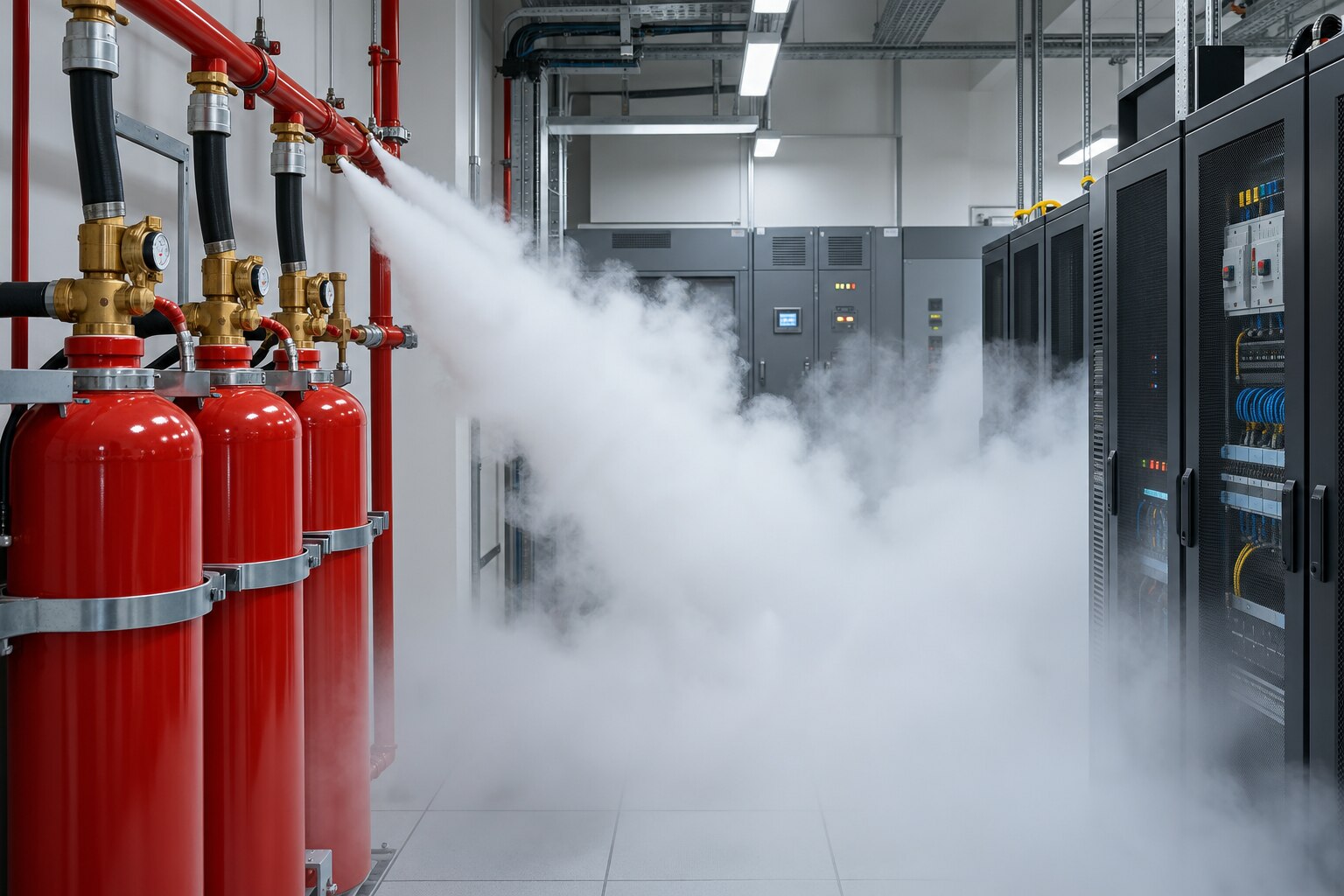
A fixed system starts when smoke detectors, heat detectors or flame detectors send a signal to the releasing panel. The configured logic confirms the alarm, sounds the fire alarm and pre-discharge alarm, shuts down ventilation and air-conditioning, and closes required dampers. A time delay allows evacuation before the release circuit opens the CO2 valves.
The gas then travels through pipework to calibrated nozzles and reaches the design concentration. CO2 reduces oxygen around the fire and adds cooling as it expands. It does not remove electrical energy, so the protected circuit needs separate automatic or manual isolation.
Total flooding and local application use the same agent but protect different geometries.
| Option | What it means | When it applies |
|---|---|---|
| Total flooding | CO2 fills a sealed room, enclosure or defined volume to a fuel-specific design concentration | Protecting rooms containing switchgear, generators or other equipment |
| Local application | Nozzles discharge directly onto a machine, cabinet, tank or process hazard without filling the entire room | Protecting a defined hazard inside a larger space |
A total-flooding system needs enclosure integrity, controlled openings and a discharge delay; leakage can leave the fire burning. Do not choose a generic CO2 percentage or rely only on an oxygen target.
After discharge, keep people out until the atmosphere is tested and ventilated: CO2 can collect in pits, trenches and cable voids even after alarms stop. An audible release alarm and warning signs do not prove the room is safe.
The enclosure and quantity calculations that make suppression work
Engineers must verify the hazard dimensions, enclosure integrity, design concentration, discharge time and pipe-and-nozzle performance before selecting CO2 cylinders. A cylinder bank sized from room area alone can leave a fire under-treated or create damaging overpressure.
1. Measure the protected volume: room length, width and height, then subtract the volume of fixed equipment that CO2 cannot occupy. Record open doors, cable penetrations, ducts, dampers, raised floors, ceiling voids and connected spaces. These openings affect both the quantity and whether the enclosure can retain concentration.
2. Identify the protection method. A total-flooding system protects an enclosed volume, so the calculation uses the fuel-specific design concentration and required hold time. A local-application system protects a machine, tank or process; engineers measure its length, width, height, fire surface and surrounding obstructions instead of treating the whole room as the hazard.
3. Establish the design basis from the applicable edition of NFPA 12 and the system listing. Do not substitute a generic CO2 percentage or an oxygen target. Fuel, enclosure temperature, altitude, ventilation and the hazard’s fire behaviour affect the required mass of CO2.
4. Verify the hydraulic design: cylinder quantity, storage arrangement, pipe lengths and diameters, elevation changes, branch balance, nozzle orifices, discharge rate and nozzle locations. The network must deliver the calculated mass within the specified time.
Rapid discharge also requires engineered pressure-relief venting. Check door and panel strength, nozzle clearances, cold-discharge effects and ventilation shutdown; an unsealed enclosure or improvised vent can defeat suppression or damage equipment.
The life-safety controls required before anyone releases CO2
A CO2 release in a normally occupied room is a life-safety event, not merely an alarm response. The occupancy classification determines the warning, interlock and evacuation provisions, while cross-zoned or supervised detection helps prevent one detector fault from opening the release valve.
- On a confirmed fire signal, sound the evacuation alarm and illuminate pre-discharge warning signs inside and outside the enclosure. Stop ventilation and close dampers where the design requires it.
- Start a time delay long enough for every occupant to reach safety. Do not treat the delay as permission to investigate; leave immediately.
- Place a manual release station outside the hazard, clearly marked and accessible to trained responders. Locate the abort control where an evacuating person can use it safely, and use it only as the approved hold function during the pre-discharge period.
- Supervise cylinders, releasing circuits, valves, detectors and shutdown interfaces. A fault must produce a distinct trouble signal rather than an unnoticed loss of protection.
- Isolate the electrical source through separately engineered shutdown controls. CO2 does not remove arc energy, so an energized fault can continue or reignite after discharge.
- Keep people out after release. Isolate the enclosure, control ventilation through a planned procedure, and test carbon dioxide and oxygen levels before entry, including pits, trenches and cable voids.
- Re-enter only under an authorized rescue plan with suitable respiratory protection and a trained standby team. Visual confirmation that flames have stopped is not evidence of safe atmosphere; CO2 at 40,000 ppm is immediately dangerous to life or health.
How to decide whether CO2 belongs in your protection strategy
Reject CO2 if the hazard depends on cooling, contains reactive chemistry, or cannot be isolated safely. Before specifying it, verify these five points:
1. Identify every protected load, enclosure and fuel. Check that the equipment is covered by the system listing and NFPA 12 design criteria, and that ordinary combustibles will not reignite after the gas dissipates.
2. Engineer electrical isolation separately. CO2 does not remove power from an arc, fault or overheated component; arrange automatic or manual shutdown, then confirm the isolation sequence prevents shock, arc-flash and reignition hazards.
3. Treat a lithium-ion battery fire as a separate engineering problem. CO2 can suppress flames without stopping cell heating or propagation, so battery rooms and charging areas need battery-specific detection, cooling, isolation and controlled re-entry measures.
4. Submit unusual fuels and processes for a chemistry review. Reactive metals, oxygen-producing materials and substances that react adversely with CO2 fall outside a simple gas-discharge decision; document the fuel data and the NFPA 12 limitation that governs it.
5. Audit the installation provider’s design package, not just its cylinder count. Require enclosure-integrity testing, concentration and hold-time calculations, nozzle and equipment-clearance checks, pressure-relief venting, ventilation shutdown, commissioning records and a documented release sequence. United Fire Equipment Pvt Ltd can be assessed against those deliverables rather than judged by equipment supply alone.
If doors, dampers, cable penetrations or pressure vents defeat concentration retention, the system will fail even with adequate cylinders. An unengineered discharge can also damage panels, doors or sensitive components through pressure and cold gas.
Frequently asked questions
Why does CO2 suit electrical and flammable-liquid hazards?
CO2 is electrically nonconductive and leaves no water, foam or powder residue on protected equipment. It also suppresses some flammable-liquid fires by reducing oxygen concentration.
How does a fixed CO2 system detect and suppress a fire?
Detection devices send a signal to the releasing panel, which activates alarms and safety interlocks before opening the CO2 release circuit. Once the programmed delay ends, actuators discharge CO2 through fixed piping and nozzles.
What determines the amount of CO2 required?
The calculation uses the protected enclosure volume, hazard classification, design concentration, temperature, openings and leakage. The design also accounts for hold time and the location of storage cylinders and discharge nozzles.
Which life-safety controls must a CO2 system have?
Provide pre-discharge alarms, warning signs, a discharge time delay, manual release controls, abort switches where specified, ventilation shutdown and door or access controls. Evacuate and account for everyone before discharge.
When is CO2 the wrong choice?
Do not use total-flooding CO2 where people could remain inside during discharge or escape cannot be confirmed. Select another system when the enclosure cannot retain the design concentration or when the fire risk needs cooling after extinguishment.