An EV facility must prepare for more than flames from a vehicle: the hazard may involve a traction battery, charging cable, charger cabinet, electrical distribution equipment or nearby combustibles. By the end, you will be able to match an extinguisher to each work area, test supplier evidence, and build a response plan that addresses cooling, reignition and post-fire isolation.
Key takeaways
- Map vehicles, chargers, batteries, cables and nearby combustibles before buying.
- Choose an extinguisher for the specific task, not its litre capacity.
- Prioritise cooling and electrical safety, then assess cleanup requirements.
- Demand model test evidence, batch details and a documented service trail.
Map every fire hazard before choosing an extinguisher
Map the EV workshop fire hazards before selecting an extinguisher: identify every item that could burn, arc, leak, or continue heating after flames disappear. Good charging facility fire safety covers more than the vehicle connector.
| Area or equipment | Protect against | Why it matters |
|---|---|---|
| Vehicle service bay | Traction battery, plastics, insulation, tires and spilled flammable liquids | A small surrounding fire can spread to the vehicle or battery pack. |
| Charging point | Charging connector and cable, charger cabinet, plugs and cable insulation | Overheating, damaged conductors and arcing can ignite nearby materials. |
| Electrical room | Distribution boards, switchgear, transformers and energized wiring | This is an electrical hazard, not a battery-specific fire class. |
| Battery work area | A removed traction battery, modules, tools, packaging and stored cells | A damaged pack can reignite after visible flames are knocked down. |
| Quarantine area | Damaged vehicles, batteries and combustible surroundings | Heat, smoke and venting can affect adjacent equipment before open flames appear. |
Treat the extinguisher as first-response equipment for burning cable insulation, plastics, tires or nearby combustibles. It may not stop thermal runaway inside hot or damaged cells; isolate the area and follow the facility’s cooling, monitoring and emergency procedures.
Class C identifies an energized electrical hazard and does not mean “lithium battery.” After isolation, classify the burning material. Do not choose Class D merely because the pack contains lithium compounds; Class D targets combustible metals such as magnesium, sodium and titanium.
Match the extinguisher to the task, not the litre capacity
A 9-litre extinguisher is not automatically better than a 6-litre unit. EV fire extinguisher selection should start with access, expected fire, discharge reach and duration, then check agent conductivity, residue, operating-temperature range and cleanup.
| Area | Suitable arrangement | Why it fits |
|---|---|---|
| Mobile repair bay | One compact, nonconductive first-response extinguisher secured to the service vehicle, plus access to a larger cooling-water supply | Space and weight are limited; the extinguisher handles early flames, not continuing cell failure |
| Two-wheeler service area | A portable battery-rated unit at each work zone, with water-mist or hose access for surrounding plastics and tyres | Multiple small packs can be moved quickly, while nearby combustibles need separate coverage |
| Car charging bay | Extinguishers at charging-cluster exits, covering energized electrical equipment and ordinary vehicle materials; provide a water supply for pack cooling | A connector fault, burning cable and thermal-runaway pack are different tasks |
| Battery storage room | Detection, separation and facility-scale suppression are primary; keep portable units at the entrance for incipient fires | A portable discharge cannot control a densely stored battery fire |
| Damaged-battery quarantine area | Isolated, access-controlled storage with remote handling, thermal monitoring and a dedicated cooling or containment method; place a first-response unit outside | A damaged pack can release flammable gas and reignite after flames disappear |
Do not label every lithium-ion incident Class D: that class covers combustible metals such as magnesium and sodium, not ordinary traction cells. UL 9540A evidence describes propagation testing for energy-storage systems; it does not prove that a portable extinguisher works on that battery. Keep both claims separate.
Compare agents by cooling, electrical safety and cleanup
Cooling separates a useful first-response extinguisher from a product that only removes flames. A portable unit can suppress burning cable insulation or plastics while hot cells inside a pack continue thermal runaway and reignite.
| Option | Cooling | Electrical safety and cleanup |
|---|---|---|
| Water or water mist extinguisher | Water provides the strongest sustained cooling for a traction battery; mist uses less water and may have shorter reach. Use only with site procedures for energized equipment and isolation. | Water leaves little chemical residue but can damage electronics and create runoff. |
| Foam | Cools surface fires and limits vapour release, but rarely reaches enclosed cells. | Use an electrically rated product before isolation; expect wet, sticky cleanup and possible corrosion. |
| Lithium battery extinguisher agent | Performance varies sharply by formulation, discharge time and agent quantity. Demand evidence on the relevant battery pack. | Check the electrical-use rating; residue and cleanup depend on the formulation. |
| Dry chemical powder | Knocks down external flames quickly but provides little battery cooling. | Nonconductive for listed electrical use, yet powder contaminates chargers, connectors and electronics and is difficult to remove. |
| Carbon dioxide extinguisher | Gives almost no lasting cooling inside a pack and fails as a universal traction-battery solution. | Clean, nonconductive discharge; ventilation is essential because CO2 can displace breathable air. |
| Clean agent | Leaves no residue and works on accessible incipient fires, but offers limited cooling and poor penetration into an enclosed pack. | Nonconductive when listed; verify enclosure, ventilation and re-ignition controls. |
Choose by cooling capacity, reach, discharge duration, temperature range and cleanup—not the “EV” label alone.
Separate flame knockdown from thermal-runaway control
A portable extinguisher can knock down flames around an EV, but it does not automatically stop thermal runaway inside the battery pack. Its first-response value is controlling burning cable insulation, plastics, tyres or nearby combustibles long enough to protect people and limit fire spread.
| Hazard | What the extinguisher can do | What remains necessary |
|---|---|---|
| Surrounding fire | Suppress flames on cables, vehicle materials or nearby combustibles | Isolate electrical equipment, remove people and check for concealed heat |
| Battery pack in thermal runaway | Reduce visible flames and slow external fire spread | Sustained EV battery cooling, exclusion, temperature monitoring and specialist response |
| Flames that have disappeared | Remove the immediate flame hazard | Watch for battery reignition, continuing gas release and renewed heating |
Treat a pack that has burned, been crushed, flooded or exposed to severe heat as an ongoing incident after flame knockdown. Establish an exclusion zone, prevent charging or vehicle movement, and keep the pack under observation with thermal imaging where trained responders have it. Do not assume a second discharge proves the cells are safe.
Battery smoke and off-gases can contain toxic and flammable compounds. Use ventilation, gas monitoring where appropriate and respiratory protection for trained responders; never use the extinguisher as a substitute for those controls.
Move a compromised removable pack only under a documented procedure and place it in the designated damaged battery quarantine area. Record the incident and hand the battery to a qualified recovery or disposal provider. UL 9540A describes propagation testing for energy-storage systems, not proof that a portable extinguisher can extinguish an EV pack.
Verify the model, test evidence and service trail before purchase
“EV fire extinguisher” on a label is not a recognised fire class or performance certification. Ask for the model’s approval or listing, tested fire classes and ratings, agent quantity, discharge duration, discharge range and operating temperature range.
| Document or marking | What it establishes | What it does not establish |
|---|---|---|
| IS 15683 and ISI mark verification | The extinguisher conforms to the claimed Indian standard; verify the licence number against the BIS database. | It does not prove control of thermal runaway in every vehicle pack. |
| Fire extinguisher test certificate | Records the model tested, agent, fire rating and test conditions. | A certificate for ordinary combustibles or a small cell test does not cover an installed, damaged pack. |
| Safety data sheet | Identifies agent hazards, handling, storage, cleanup and material compatibility. | It is not an extinguishing-performance approval. |
| Electrical-safety test or listing | Supports use near energised charging equipment at the stated voltage and conditions. | The word “water” does not prove dielectric safety. |
| Battery test report | Names the cell format, pack enclosure, module layout, state of charge and damage condition tested. | UL 9540A evidence describes battery fire-propagation behaviour; it is not an extinguisher rating. |
| Service trail | Matches the serial number to manufacture, inspection, maintenance, recharge and pressure-test records. | A current tag cannot repair a missing or mismatched test history. |
For any model supplied by United Fire Equipment Pvt Ltd, match these records to the exact cylinder, not merely to the product family. Reject missing serial numbers, altered labels, broken seals, unreadable gauges or instructions that omit post-fire cooling and re-ignition control.
Related products
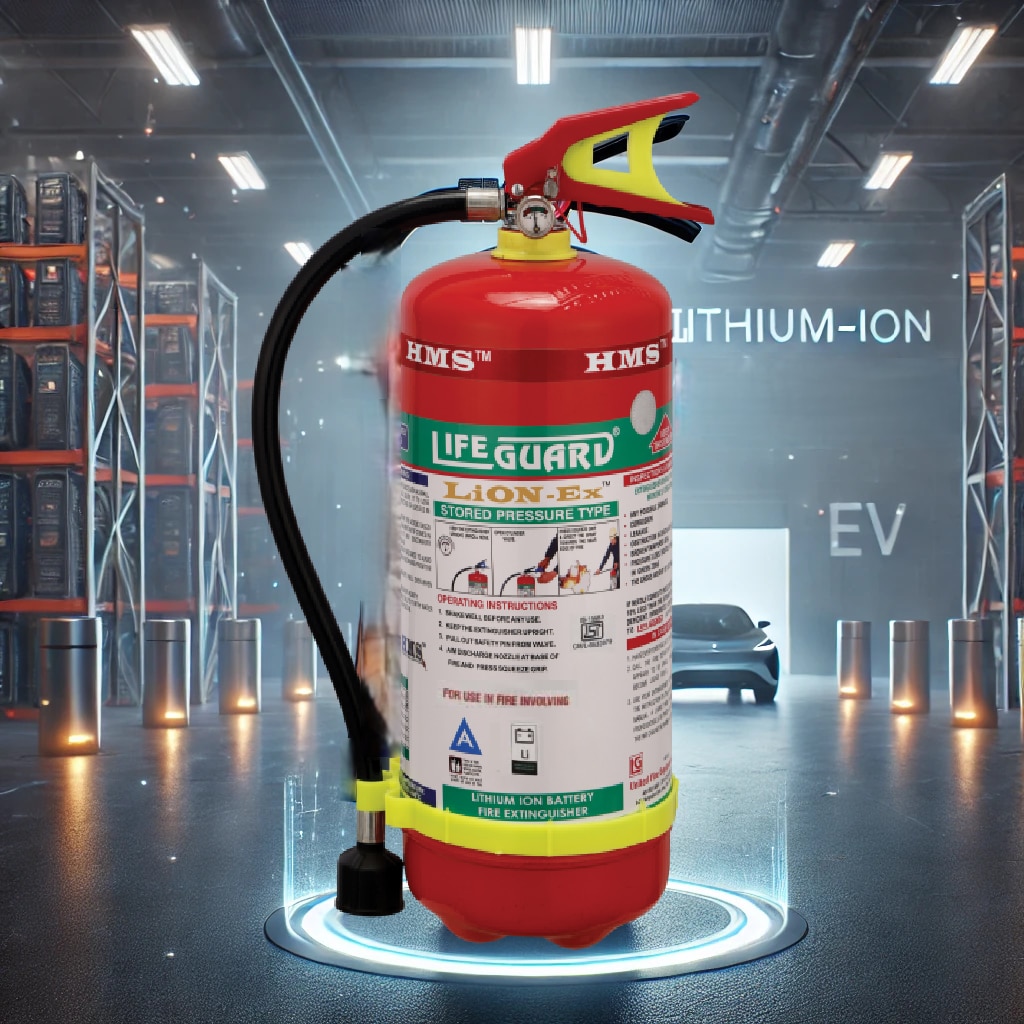 | EV FIRE EV FIRE EXTINGUISHER ₹54000 Lifeguard EV Fire Extinguisher Manufacturer – Complete Safety for Electric Vehicles The future of mobility is electric. |
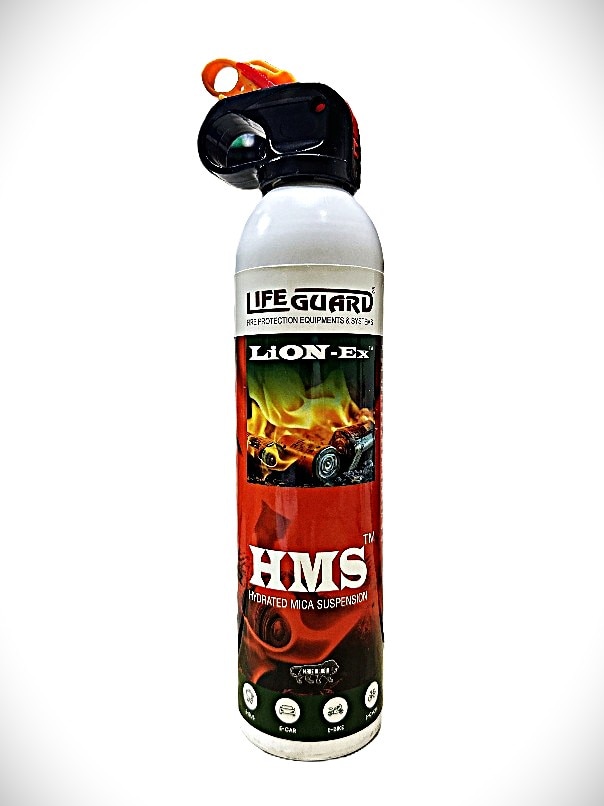 | Lithium Ion Fire Extinguisher EV Battery fire extinguisher ₹4500 Lifeguard EV Fire Extinguisher Manufacturer – Complete Safety for Electric Vehicles The future of mobility is electric. |
Frequently asked questions
What hazards must you map before choosing an EV fire extinguisher?
Inspect vehicles, lithium-ion batteries, charging equipment, connectors, cables, electrical panels, workshop machinery, leaked fluids and nearby combustible materials. Record hazards that can arc, burn, leak or continue heating after flames disappear.
Should you choose an EV extinguisher by litre capacity?
No. Match the extinguisher to the task and hazard. A larger cylinder does not automatically provide the right agent, discharge pattern, cooling performance or access for a charger cabinet or vehicle bay.
How should you compare extinguisher agents for EV facilities?
Compare how each agent cools the hazard, performs around energised electrical equipment and affects cleanup. Check whether residue could damage electronics, contaminate work areas or create a disposal problem.
Does flame knockdown control lithium-ion battery thermal runaway?
No. Extinguishing visible flames does not prove that damaged cells have stopped heating. Select equipment and procedures that address re-ignition and residual heat, then verify the model's test evidence.
What should you verify before purchasing an EV fire extinguisher?
Check the exact model, intended hazard, test evidence, identification markings, batch or manufacturing details and service trail. Confirm that inspection, refilling and replacement arrangements exist before installation.
Related products
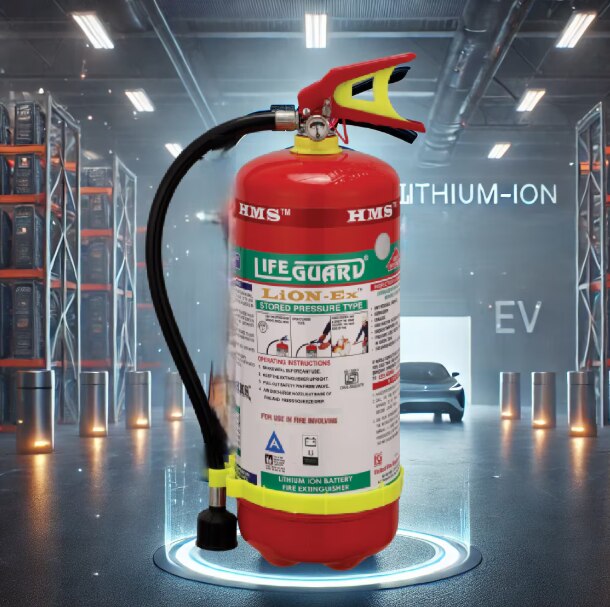
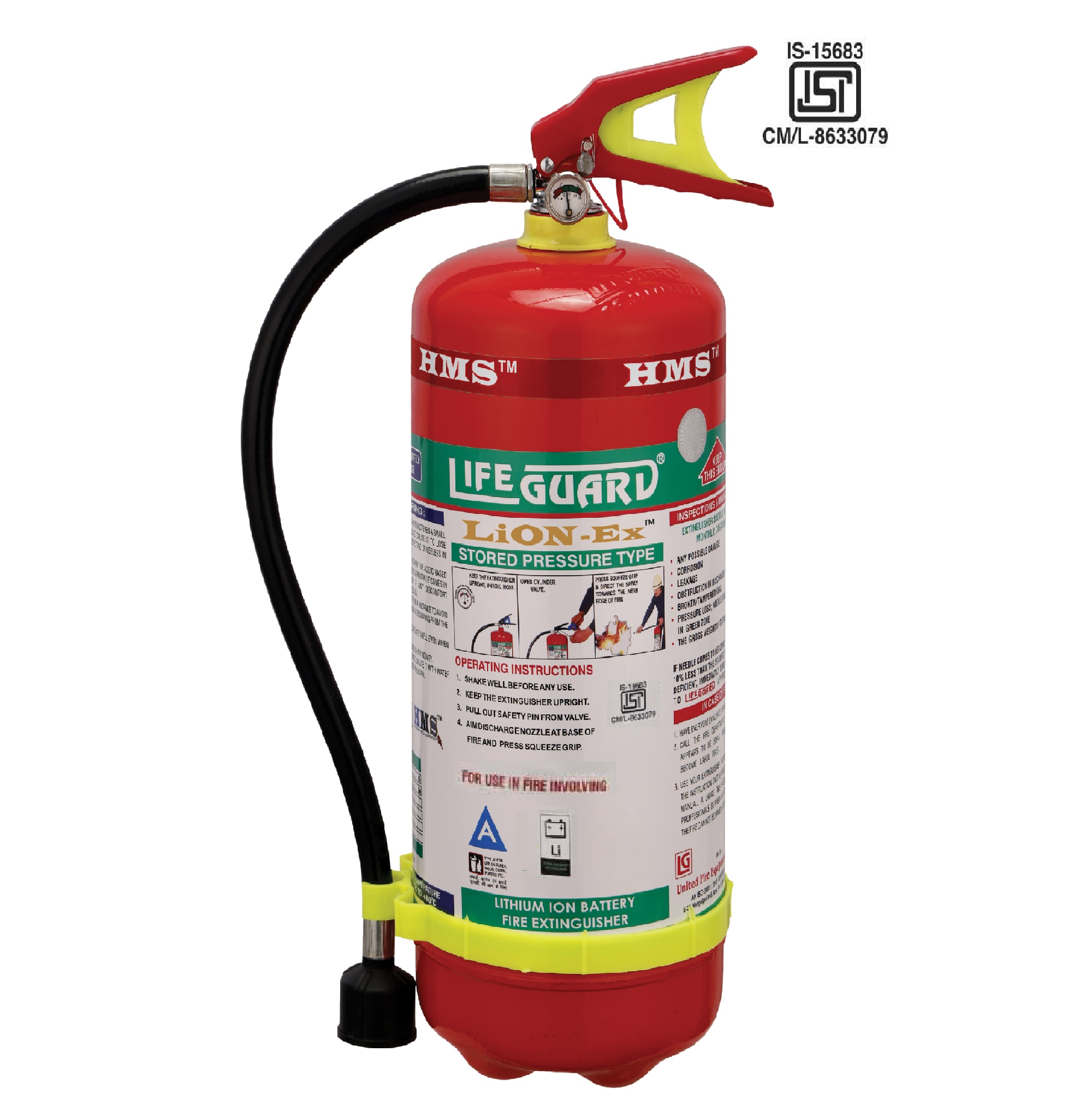 | Lithium Ion Fire Extinguisher LiON-Ex 9 Liters Lithium Fire Extinguisher ₹72000 LiON-Ex Fire Extinguisher for Lithium Ion Battery fire, capacity 9 liters filled with HMS agent, duly ISI marked, tested as per IS : 15683. |
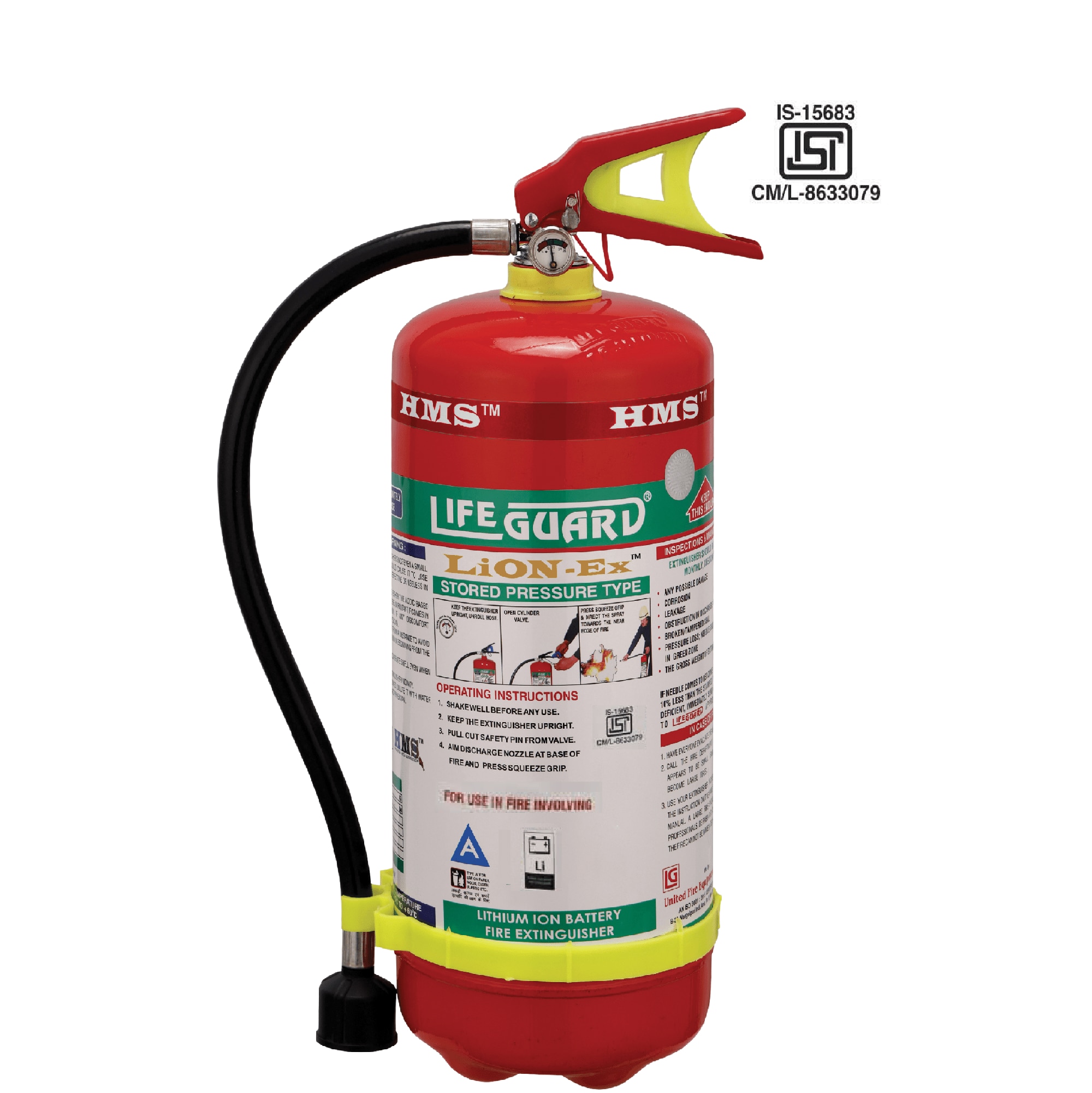 | Lithium Ion Fire Extinguisher LiON-Ex 6 Liters Lithium Battery Fire Extinguisher ₹58500 LiON-Ex Fire Extinguisher for Lithium Ion Battery fire, capacity 6 liters. |
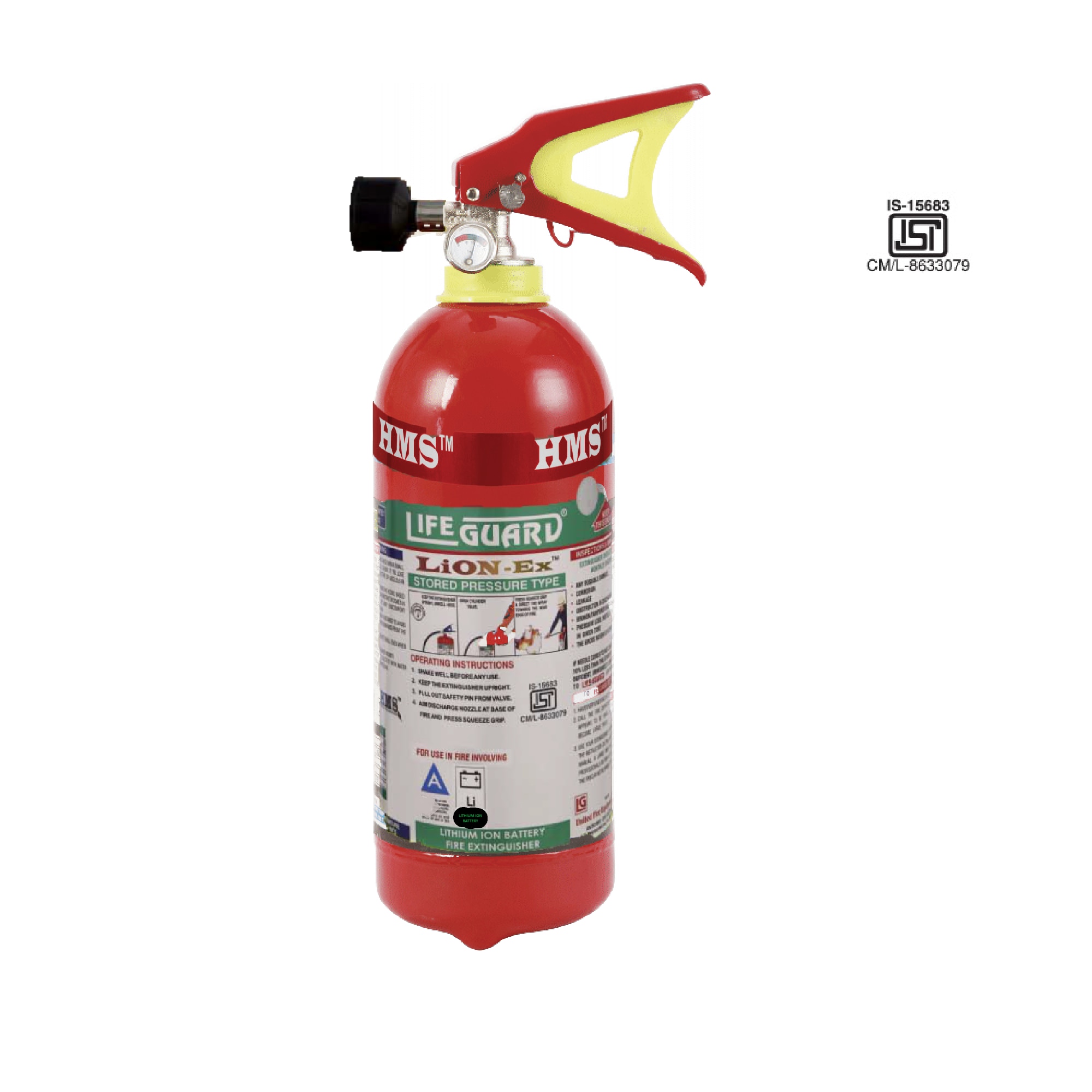 | Lithium Ion Fire Extinguisher LiON-Ex 2 litres ₹18000 LiON-Ex Fire Extinguisher for Lithium Ion Battery fire, capacity 2ltrs. filled with HMS agent, duly ISI marked, tested as per IS : 15683. |
 | Lithium Ion Fire Extinguisher LiON-Ex ₹6500 Fire Extinguisher for Lithium Ion Battery fire, capacity 500 ml filled with HMS agent, duly tested as per IS : 15683. |