A depot must protect more than the bus that is charging: thermal runaway can begin in a parked vehicle, spread to neighbouring buses and produce hazardous gases after visible flames disappear. By the end, you will have a practical method for zoning the site, selecting detection and suppression measures, training staff and setting evidence requirements for equipment.
Key takeaways
- Separate charging bays, parked buses and damaged-battery holding areas.
- Keep emergency access routes clear and isolate damaged vehicles from the main fleet.
- Match response equipment to thermal runaway, electrical faults and surrounding fires.
- Coordinate smoke control, detection and fire-service access before commissioning the depot.
Divide the depot into distinct battery-fire risk zones
A bus can enter thermal runaway while parked, so electric bus depot fire risk does not begin when a plug is connected. Crash damage, water intrusion, manufacturing defects, electrical faults or latent cell damage can trigger a parked electric bus hours or days later. Divide the site by hazard, not by one generic garage layout.
| Zone | Ignition sources and contents | Occupants and smoke | Isolation points and exposure targets |
|---|---|---|---|
| Parked buses | Stored battery energy; seats, tyres and plastics | Drivers nearby; smoke can enter offices | Vehicle disconnect; protect adjacent buses and buildings |
| Active charging bay | Charger, cable and connector faults; bus battery | Operators; smoke follows ventilation and cable routes | EVSE emergency stop; isolate chargers and nearby buses |
| Battery room or stationary storage | Cells, racks and battery-management equipment | Restricted staff; vent gases need engineered exhaust | Room isolation; assess battery room fire protection separately |
| Maintenance area | Damaged packs, tools and welding; oils and parts | Technicians; smoke enters workshops | Controlled access, high-voltage procedures and disconnects; protect depot structure |
| Driver and welfare spaces | Cooking, appliances and nearby bus fire | High occupant density; protect escape routes from smoke migration | Rapid evacuation routes; isolate ventilation where designed |
| Electrical room | Transformer, switchgear and cable faults | Few occupants; smoke can spread through services | Electrical isolation; protect control rooms and exits |
The protection strategy must cover parking, charging, maintenance, quarantine and disposal, not only plugged-in operation. NFPA 855 can inform stationary-storage planning, but it is not a complete standard for mobile bus batteries. Give fire services pack locations, disconnects and platform-specific response information.
Build the site layout around separation, access and isolation
Draw the site plan at full bus scale. Mark each bus’s length, width, battery-pack locations, charger position and cable path, then set the bus separation distance under the adopted building and fire codes. Keep emergency exits usable with buses connected, and preserve unobstructed fire-apparatus access around the charging and parking areas.
Use the plan to define a charging-isolation zone around every bay and a larger cordon for a smoking, damaged or re-igniting bus. Capacity alone is not a placement plan: extinguisher quantity and location must match bus size, battery chemistry, fleet count, charging power, enclosure type and travel distance to each hazard.
Provide exposure protection between buses, chargers, canopies and the depot structure.
- Mark fire-service access, hydrant or other water-supply points, manual service disconnects, each charger emergency disconnect, tow routes and an outdoor EV quarantine area.
- Keep one credible route for unaffected vehicles to leave without passing the incident area. Do not move a smoking bus unless the emergency plan and fire service authorise it; movement can worsen damage and expose personnel.
- Show every battery-pack location, isolation point, charger and transformer, plus roof and underfloor hazards, in the pre-incident file. Supply bus-specific emergency-response information when platforms or battery chemistries differ.
- Design sprinklers from bus dimensions, ceiling height, obstructions, vehicle spacing, charging state and available water supply—not ordinary vehicle-garage assumptions.
Test the plan with parked, charging and maintenance scenarios. Verify that cables, parked buses and cordons never block exits or responder routes.
Match the response to the fire source and warning signs
Identify the fire source before choosing tactics: an EV battery fire response is not the same as a charger, switchgear or ordinary vehicle fire.
| Source | Likely clues | First response |
|---|---|---|
| EV battery thermal runaway | Rapid temperature rise, hissing, venting gas, unusual smoke, popping, cell rupture or repeated heating | Evacuate, call the fire service, provide prolonged cooling and exposure protection; expect re-ignition |
| Charger or cable fire | Burning EVSE, plug, connector or cable; battery shows no warning signs | Isolate EVSE and associated equipment, then use equipment-specific firefighting procedures |
| Transformer or switchgear fire | Arcing, electrical noise, smoke or flame from electrical equipment | Apply electrical-fire procedures and restrict approach until isolation is confirmed |
| Ordinary vehicle fire | Fire confined to tyres, plastics, fluids or the engine area | Use the vehicle-fire procedure; this does not automatically indicate battery failure |
Thermal runaway releases flammable and toxic gases, including carbon monoxide and hydrogen fluoride. Smoke or flame detection alone can arrive too late for a large pack, so match temperature, off-gas detection, hydrogen or carbon-monoxide sensors to the enclosure, ventilation pattern and nuisance sources.
Use this sequence:
- Stop charging if safe.
- Isolate EVSE and associated electrical equipment without approaching a live hazard.
- Evacuate, call the fire service and move upwind.
- Establish a cordon and monitor for re-ignition.
- Never open a battery enclosure, touch a damaged high-voltage cable or apply water to energised equipment.
A charger disconnect removes power from the equipment, not energy stored in the bus battery.
Set realistic expectations for extinguishers, water and fixed systems
Water is the primary medium for cooling cells and adjacent modules during thermal runaway. Dry chemical, carbon dioxide and similar agents can suppress visible flames, but they may leave enough heat for cell-to-cell propagation or battery fire re-ignition.
1. Use a portable extinguisher for an incipient fire, escape-route protection or cooling accessible surfaces only when its instructions and site procedure permit. EV fire extinguisher limitations matter: a 9-litre cylinder is not proof that it can control an entire bus battery pack. Do not approach a damaged high-voltage system or open its enclosure.
2. Treat water cooling thermal runaway as a prolonged operation, not a quick flame knockdown. A hydrant, sprinkler, fire-service water supply, isolation procedure and outdoor quarantine plan remain essential. Hidden heat can produce renewed flames after apparent extinguishment, so responders need thermal imaging and extended monitoring.
3. Judge a fixed-agent system by evidence for the actual bus pack, enclosure and installation geometry. Ask for full-scale or appropriately scaled results covering cooling, cell-to-cell propagation and re-ignition, not only exterior flame suppression.
For a range such as those supplied by United Fire Equipment Pvt Ltd, verify the tested configuration, agent limitations, operating distance, discharge duration, inspection interval and quantity required at each hazard.
Fixed systems face the same test: they must control heat and propagation, not merely hide flames. A supplier’s small-cell or electronics-cabinet result does not establish performance inside a full bus pack.
Related products
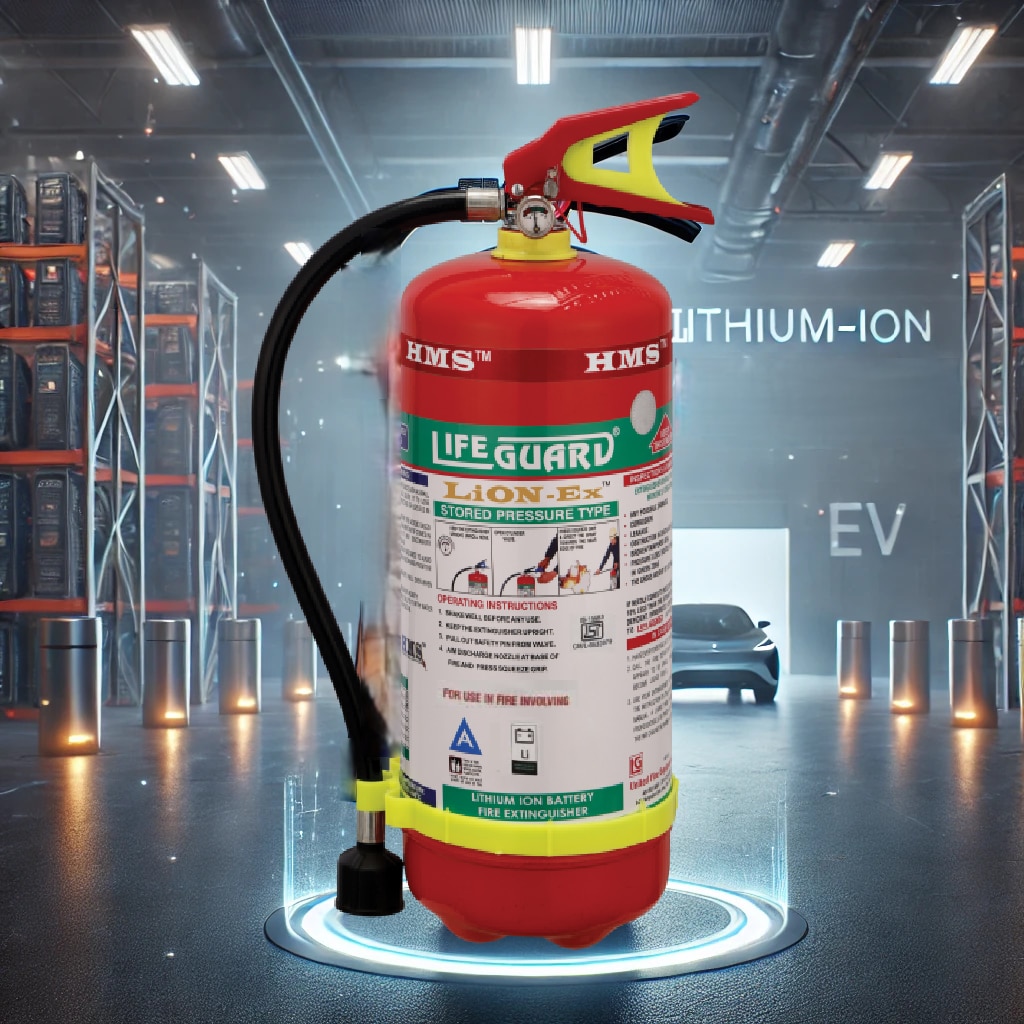 | EV FIRE EV FIRE EXTINGUISHER ₹54000 Lifeguard EV Fire Extinguisher Manufacturer – Complete Safety for Electric Vehicles The future of mobility is electric. |
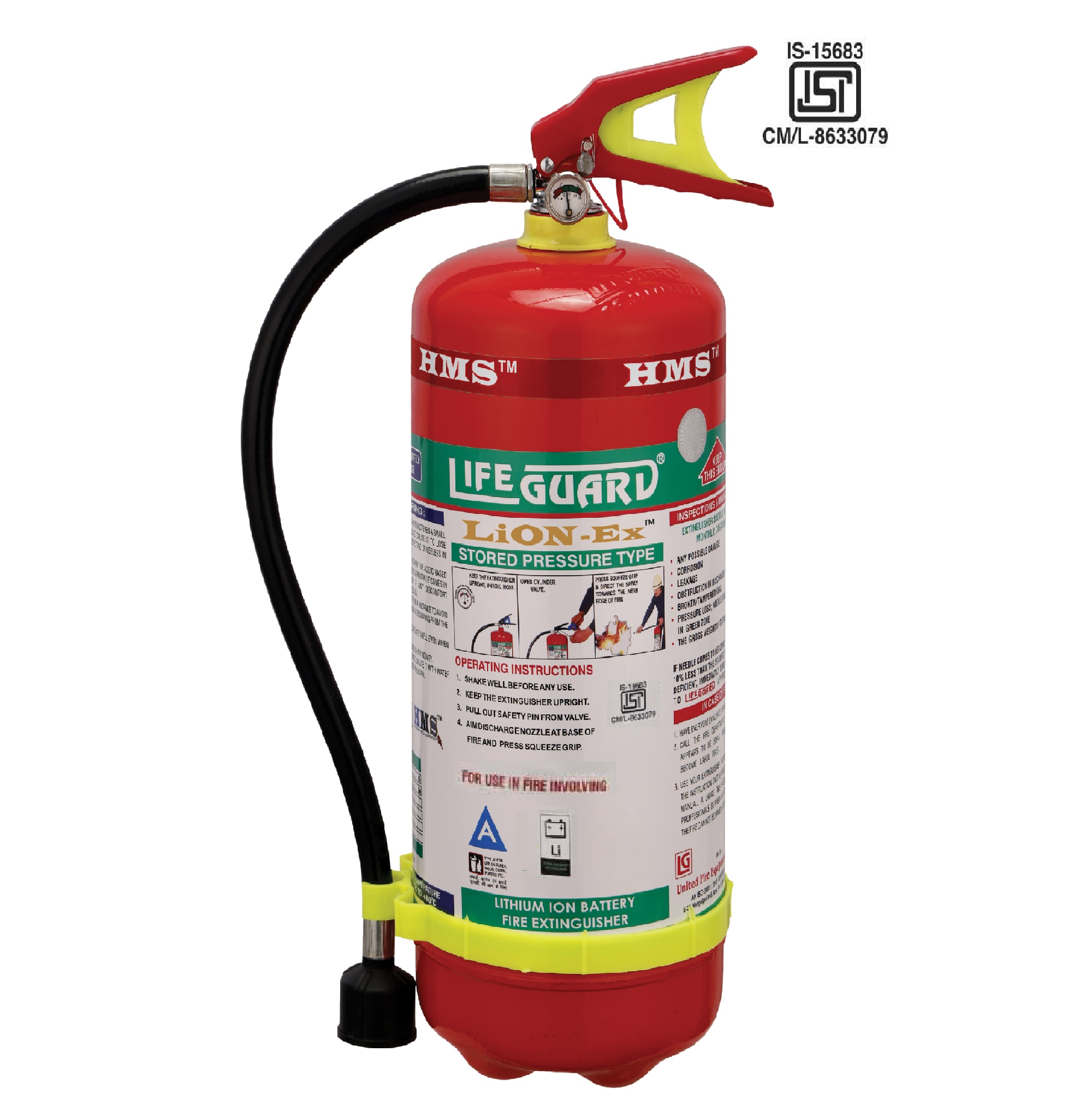 | Lithium Ion Fire Extinguisher LiON-Ex 9 Liters Lithium Fire Extinguisher ₹72000 LiON-Ex Fire Extinguisher for Lithium Ion Battery fire, capacity 9 liters filled with HMS agent, duly ISI marked, tested as per IS : 15683. |
Engineer smoke control, detection and fire-service coordination together
1. Design depot smoke control with suppression, detection, gas detection, structural protection and responder access as one system. Exhausting smoke and flammable gases can improve tenability and reduce accumulation; uncontrolled airflow can feed the fire or drive carbon monoxide, hydrogen fluoride and other toxic products into driver spaces and escape routes.
Keep escape paths tenable and protect structural members from heat exposure.
2. Define alarm thresholds and sensor locations against the bus-pack enclosure, ceiling height, airflow pattern and nuisance sources such as exhaust, dust and charging vapour. Use smoke and flame detection with temperature, off-gas, hydrogen or carbon-monoxide sensing where the engineered assessment supports it.
Detection based only on smoke or flame can arrive too late for a large pack.
3. Build the fire-service pre-incident plan around the actual fleet. Show every battery-pack location, manual service disconnect, charger and transformer isolation point, water supply, appliance access route, roof and underfloor hazards, tow procedure, outdoor quarantine area and each battery platform.
An EVSE emergency disconnect removes power from the charger and related equipment; it does not remove energy stored in the bus battery. Record alarm tests, drills, isolation exercises and fire-service reviews.
4. Treat UL 9540A as configuration-specific evidence that characterises thermal-runaway and propagation behaviour, not universal approval for a vehicle, battery or depot. After an incident, require thermal imaging after EV fire and extended monitoring before declaring the event over; hidden heat can trigger re-ignition. Recheck ventilation, isolation and access arrangements after every event.
Frequently asked questions
How should an electric bus depot be divided for battery-fire risk?
Create distinct zones for active charging, routine parking, damaged or suspect buses, battery storage and emergency response. Assess each zone for ignition sources, exposure to nearby vehicles and access for responders.
What site-layout features limit electric bus battery-fire spread?
Use separation between charging and parking areas, maintain clear emergency access, provide isolation points and prevent a damaged bus from being moved through occupied areas.
How should staff respond to an electric bus battery fire?
Identify whether the warning signs indicate thermal runaway, an electrical fault or a fire involving nearby materials. Use the response method and equipment designed for that source, and escalate to emergency services when the battery is involved.
Can extinguishers, water and fixed systems stop an EV battery fire?
They serve different purposes. Extinguishers can address accessible surrounding fires, while water and fixed systems may support cooling, exposure protection and fire control. Do not assume any one system will stop cell-to-cell thermal runaway.
What must be coordinated between detection, smoke control and fire services?
Design detection and smoke movement controls together, then give fire services accurate site plans, isolation-point locations, battery holding areas, access routes and information about the fleet and charging equipment.
Related products
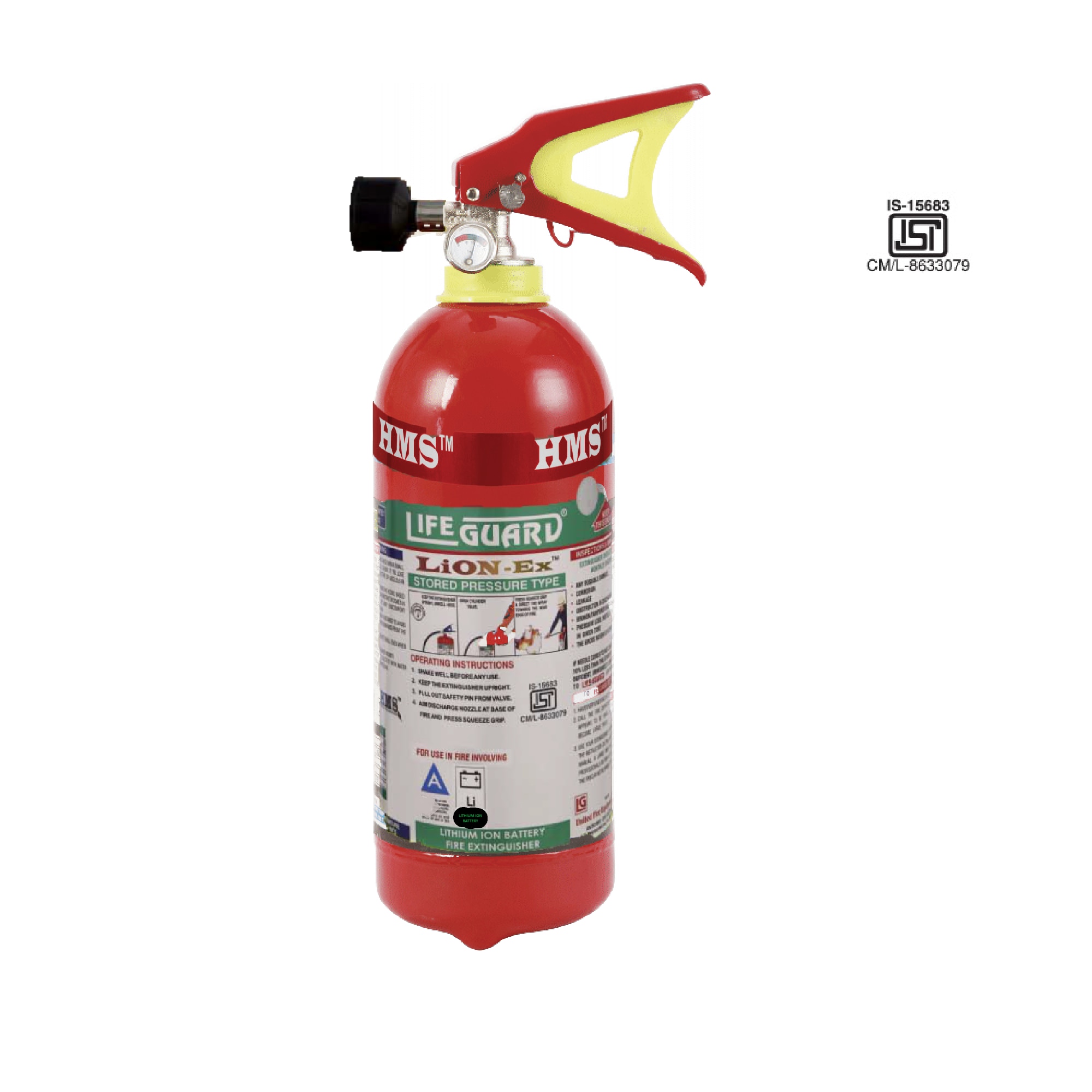 | Lithium Ion Fire Extinguisher LiON-Ex 2 litres ₹18000 LiON-Ex Fire Extinguisher for Lithium Ion Battery fire, capacity 2ltrs. filled with HMS agent, duly ISI marked, tested as per IS : 15683. |
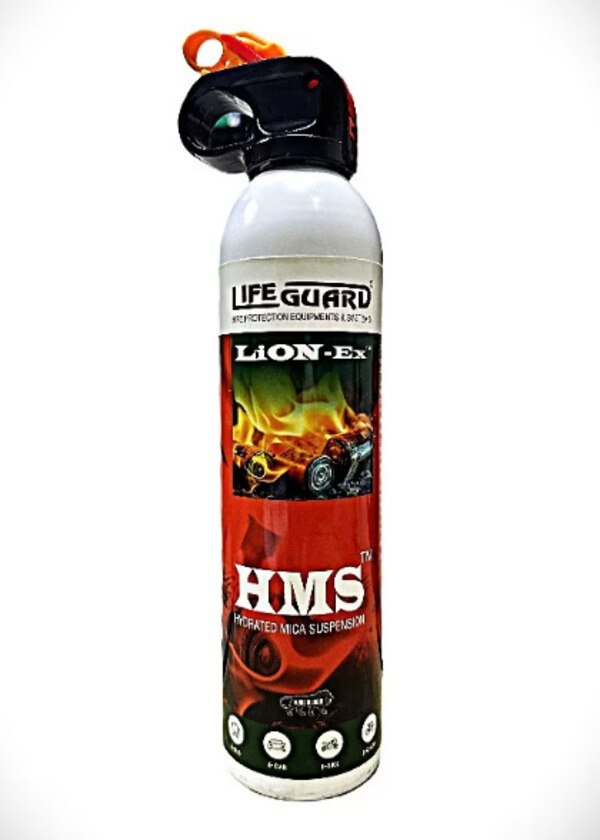
 | Lithium Ion Fire Extinguisher LiON-Ex ₹6500 Fire Extinguisher for Lithium Ion Battery fire, capacity 500 ml filled with HMS agent, duly tested as per IS : 15683. |
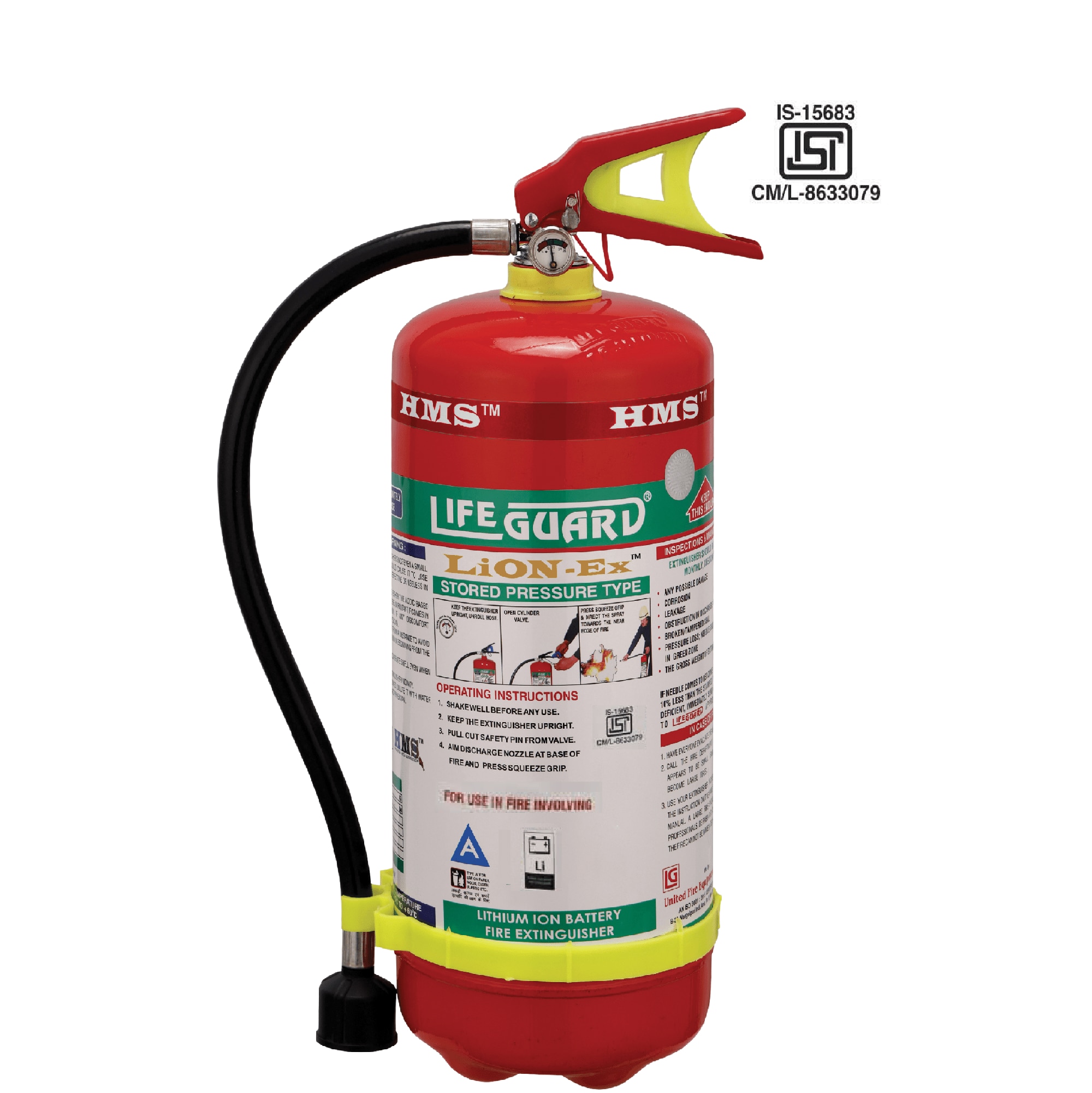 | Lithium Ion Fire Extinguisher LiON-Ex 6 Liters Lithium Battery Fire Extinguisher ₹58500 LiON-Ex Fire Extinguisher for Lithium Ion Battery fire, capacity 6 liters. |
 | Lithium Ion Fire Extinguisher LION-Ex 1 Liter ₹10000 LiON-Ex Fire Extinguisher for Lithium Ion Battery fire, capacity 1 Liter filled with HMS agent, duly tested as per IS : 15683. |