Choosing an extinguisher by litre capacity or the word “lithium” on the label can leave a charging station or battery room exposed to the wrong hazard. By the end, you will be able to separate lithium-ion battery risks from lithium-metal fires, size protection around the site, and specify a portable unit without treating it as a substitute for cooling, evacuation or fire-service response.
Key takeaways
- Identify cell chemistry, equipment and failure mode before selecting an extinguisher.
- Match charging-station protection to vehicles, chargers, cables and nearby combustibles.
- Design storage protection around battery quantity, layout, detection and access routes.
- Treat portable extinguishers as first-response tools, not complete thermal-runaway control.
Identify the battery and the fire before choosing an extinguisher
The correct choice depends on the material burning, not simply on the presence of a battery. Identify the cell chemistry, the equipment involved and the failure mode before selecting an extinguisher. “Lithium battery” is not a sufficient hazard description.
| Battery or equipment | Fire hazard to assess | Selection implication |
|---|---|---|
| Lithium-ion EV pack | Thermal runaway, burning plastics, electrolyte vapour and re-ignition | Use only a product with manufacturer evidence for this application; a Class D extinguisher is not automatically suitable |
| Lithium-metal battery | Exposed combustible metal after damage or rupture | A Class D extinguisher and specialised procedures may apply; confirm the metal and agent compatibility |
| Charger or control cabinet | Energised electrical components and wiring | Check the extinguisher’s electrical fire rating; a clean agent can protect electronics but will not provide sustained pack cooling |
Most rechargeable EV packs contain electrochemical materials, not a freely burning mass of lithium metal. There is no universally recognised “lithium-ion” portable-extinguisher class in the US classification system, so reject a product that relies only on words such as lithium, battery or encapsulator.
Assess the surrounding fire separately: ordinary combustibles, flammable liquids, vehicle interiors and charger electronics can each require different protection. Ask for the extinguisher’s listing, rating, application limits and test evidence. Do not treat a Class D label as proof that its powder controls a sealed or damaged lithium-ion pack.
A thermal-runaway fire also demands alarm, isolation and emergency response planning; an extinguisher may knock down flames without stopping re-ignition.
Select protection for an EV charging station by site exposure
Start with the exposure map, not the word “lithium” on a label. An EV charging station needs protection matched to the charger, vehicle and surrounding fire load; litre capacity alone cannot make that choice.
| Exposure | What to assess | Selection implication |
|---|---|---|
| Charging bays | Number of bays and spacing | Provide access to each risk without blocking evacuation routes. |
| Vehicle access | Vehicle size, parking movement and escape paths | Mount extinguishers where a parked or burning vehicle cannot obstruct retrieval. |
| Charger equipment | Charger output, switchgear and control cabinets | Confirm the extinguisher has the required electrical rating. |
| Surroundings | Indoor or outdoor placement, walls, roofs and nearby combustibles | Include protection for plastics, tyres, packaging and building contents. |
| Vehicles served | Battery sizes and vehicle types | Treat a passenger car, bus or commercial vehicle as different fire exposures. |
Choose a listed and rated extinguisher for each identified hazard. A product marketed as “lithium” or “battery” is not automatically suitable for energized equipment, ordinary combustibles or a vehicle fire.
Clean-agent units suit charger electronics and control cabinets where residue could damage components. They provide little sustained cooling to a battery in thermal runaway, so do not specify one as complete EV battery protection.
For every station, confirm that the plan also provides:
- A safe method to isolate charging power
- Fire-service access, water supply and drainage arrangements
- A controlled quarantine location for damaged, swollen, dropped or overheated batteries
- Restricted access and an escalation route for suspect vehicles or packs
- Mounting, identification and inspection positions visible from the charging bays
A portable extinguisher is an incipient-stage tool. It does not replace evacuation, separation, emergency response or prolonged cooling.
Design battery-storage protection around the installation, not the extinguisher count
A battery-storage area needs a system-level design because fire behaviour depends on stored energy, geometry and propagation—not simply floor area or extinguisher count. Apply NFPA 855 to the installation, with portable extinguishers supporting detection, separation, ventilation, emergency planning and fire-department access.
For each battery energy storage system, document:
- Rack layout, aisle width and access for responders
- Module and complete-pack energy, including the maximum energy in one rack
- Room volume, ceiling height and the distance to adjacent occupancies
- Ventilation, explosion-control provisions and thermal barriers
- Detection systems, alarm coverage and automatic shutdown points
- Whether the area holds cells, modules, complete packs or damaged batteries
Those facts determine exposure protection, cooling strategy, separation and response access. A compact cabinet and a high-ceiling room holding multiple racks do not justify the same selection.
Use UL 9540A results to understand thermal runaway and fire-propagation behaviour at cell, module, unit and installation levels. UL 9540A is not a portable-extinguisher approval, so it does not prove that one agent will control a fire in your room.
Specify portable units for incipient flames and nearby hazards, including charger electronics and ordinary combustibles. A clean-agent extinguisher limits residue on control cabinets but provides little sustained cooling to a runaway pack; water supply, drainage, isolation and emergency response remain essential. Damaged or swollen batteries also need a controlled quarantine location, not routine storage.
Know what a portable extinguisher can do during thermal runaway
A portable extinguisher provides initial flame knockdown; it does not usually remove enough heat from a lithium-ion pack to stop thermal runaway. Treat the discharge as a short-duration intervention that protects an escape route and nearby equipment while emergency response begins.
Use this thermal runaway response sequence:
- Isolate charger power only if you can do so without entering heat, smoke or flame.
- Raise the alarm, call the fire department and begin battery fire evacuation.
- Keep an exit behind you; approach only if trained, the fire is small and visible, and conditions remain tenable.
- Work from upwind where possible, aim at the base of visible flames, and discharge continuously as directed on the label.
- Withdraw after the initial knockdown and watch for re-ignition. Do not reopen, move or return a hot, swollen, dropped or damaged pack to service.
The extinguisher stops being an effective control when flames involve the pack’s cells, heat continues rising, gases accumulate, or the agent cannot reach the fire. Fire services commonly use substantial water application for prolonged cooling; a portable unit is not a substitute for that response, separation, detection, drainage or a suitable water supply.
Clean-agent units suit energized charger electronics and control cabinets, but offer little sustained battery cooling. UL 9540A describes propagation testing, not portable-extinguisher approval. Responders need site procedures for respiratory protection, post-fire monitoring and controlled quarantine.
Turn the selection into a labelled, maintained and site-ready specification
Do not approve a unit because its name contains “lithium” or “battery.” Match the extinguisher label and manual to the hazard, then record the decision in the site fire-safety plan.
1. Verify the electrical-use rating or listing, permitted voltage, standoff distance and operating limits. A fine water mist is not automatically safe near an energised charger. Reject a unit whose label does not state these limits.
2. Obtain the manufacturer’s test evidence for the exact battery hazard. Do not treat a Class D label as proof against a lithium-ion pack, and do not treat UL 9540A as a portable-extinguisher approval; UL 9540A evaluates thermal-runaway propagation at cell, module, unit and installation levels.
3. Record agent quantity, discharge duration, operating temperature range and the manufacturer’s application limits. United Fire Equipment Pvt Ltd can help document these points for a selected unit, but the site owner must confirm they match the charger, vehicle or storage installation.
4. Mount the extinguisher on a visible, unobstructed route, with its sign, inspection tag and operating instructions readable from the approach. Keep it outside the likely flame and smoke path, not inside a battery room where evacuation could be blocked.
5. Before relying on it, inspect the seal, pressure indicator, hose, nozzle, corrosion and service date. Train users to isolate power only when safe, raise the alarm, keep an escape route and apply agent continuously as directed; arrange fire-service cooling for re-ignition or sustained thermal runaway.
Related products
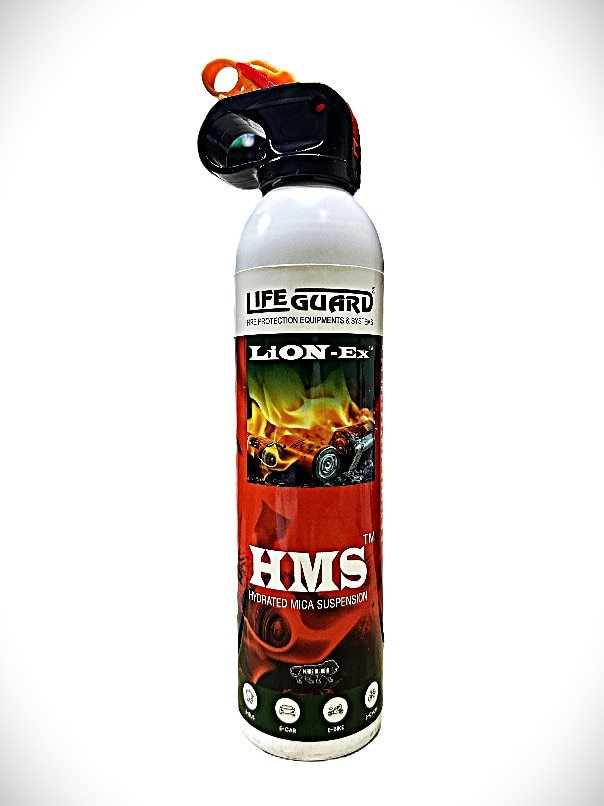 | Lithium Ion Fire Extinguisher EV Battery fire extinguisher ₹4500 Lifeguard EV Fire Extinguisher Manufacturer – Complete Safety for Electric Vehicles The future of mobility is electric. |
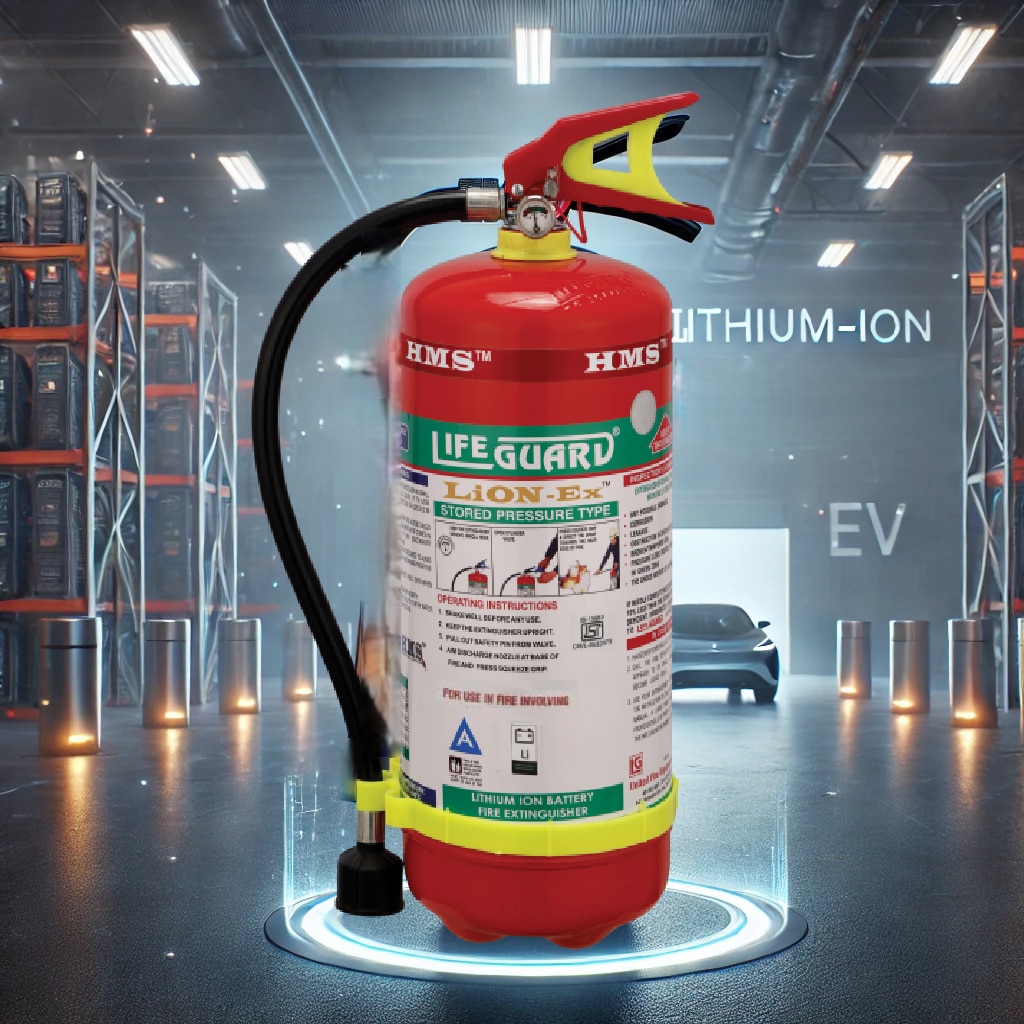 | EV FIRE EV FIRE EXTINGUISHER ₹54000 Lifeguard EV Fire Extinguisher Manufacturer – Complete Safety for Electric Vehicles The future of mobility is electric. |
Frequently asked questions
How do you choose an extinguisher for a lithium battery fire?
Identify the cell chemistry, burning material, equipment involved and failure mode first; “lithium battery” alone does not define the hazard.
How should you protect an EV charging station?
Assess the site exposure, including vehicles, chargers, cables, electrical equipment and nearby combustibles, then position suitable protection for rapid access.
Can a portable extinguisher stop battery thermal runaway?
A portable extinguisher can support first response, but it may not stop continued cell failure or prevent re-ignition during thermal runaway.
How should battery-storage protection be designed?
Base the design on the installation’s battery quantity, arrangement, enclosure, detection, separation, access and emergency response plan rather than extinguisher count alone.
Related products
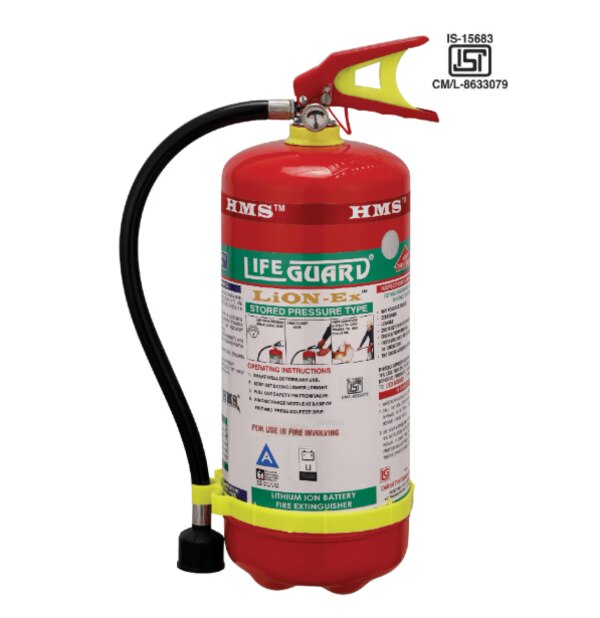
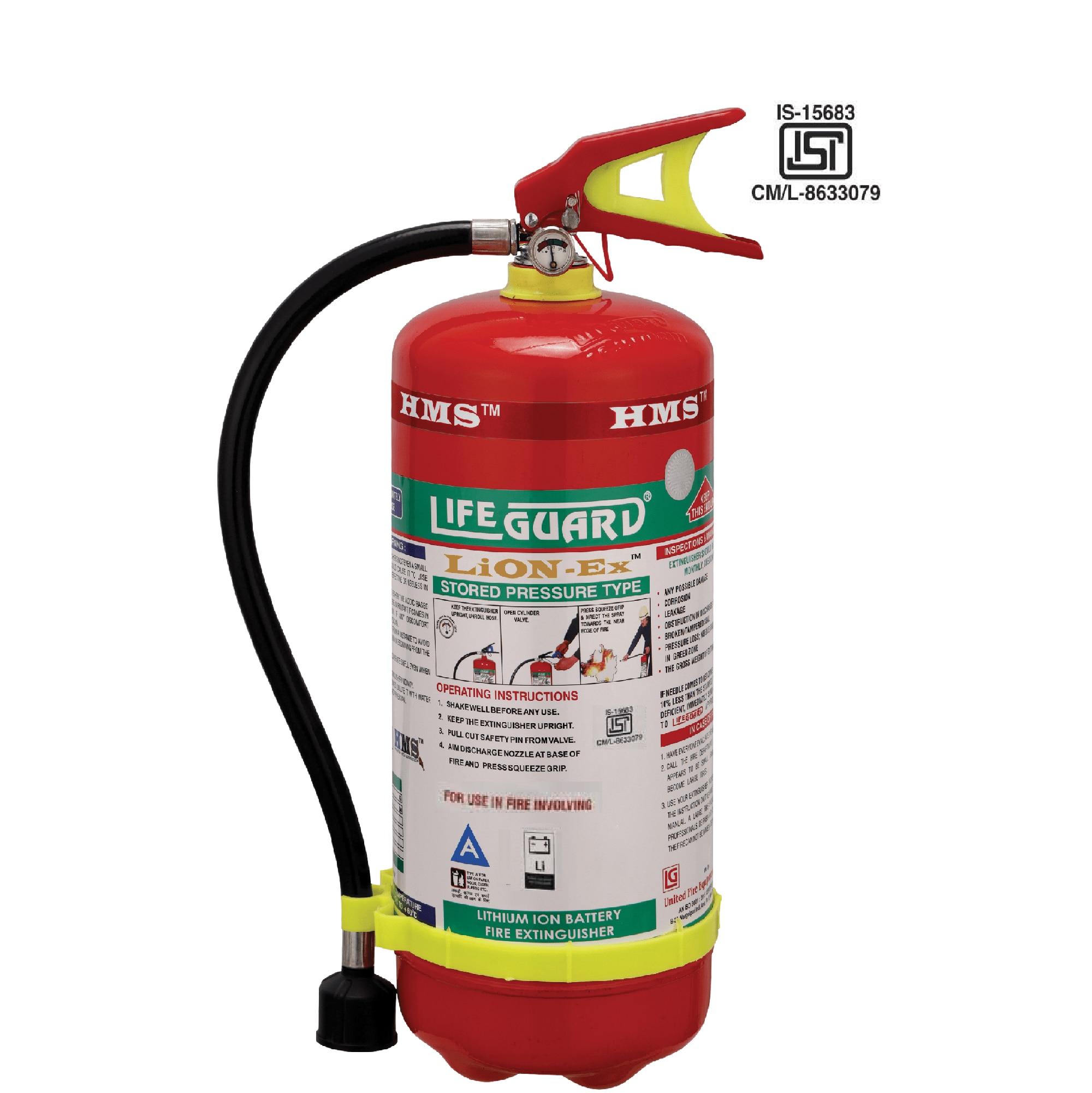 | Lithium Ion Fire Extinguisher LiON-Ex 6 Liters Lithium Battery Fire Extinguisher ₹58500 LiON-Ex Fire Extinguisher for Lithium Ion Battery fire, capacity 6 liters. |
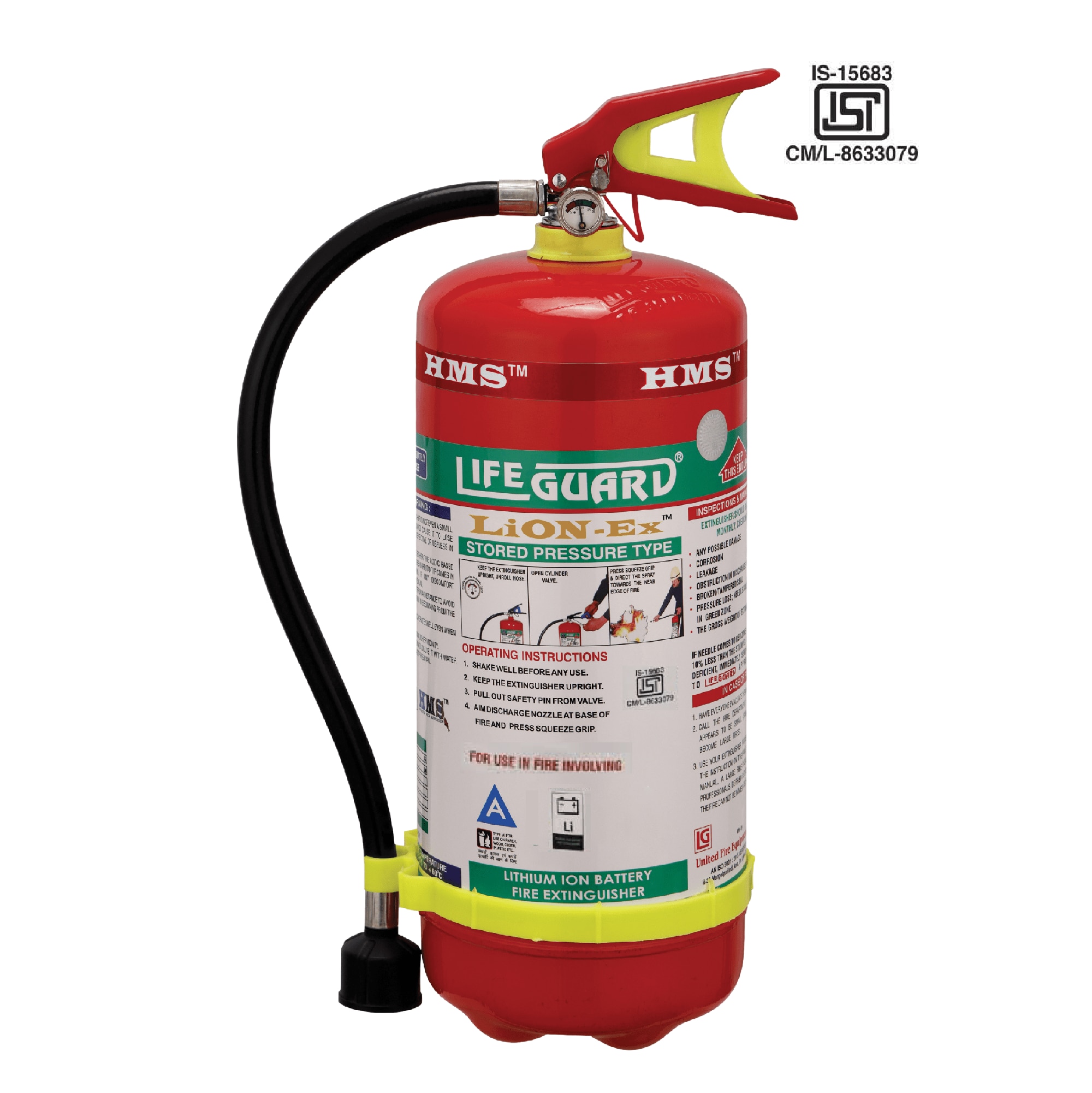 | Lithium Ion Fire Extinguisher LiON-Ex 4 Liters LITHIUM BATTERY FIRE EXTINGUISHER ₹36000 LiON-Ex Fire Extinguisher for Lithium Ion Battery fire, capacity 4 liters. filled with HMS agent, duly ISI marked, tested as per IS : 15683. |
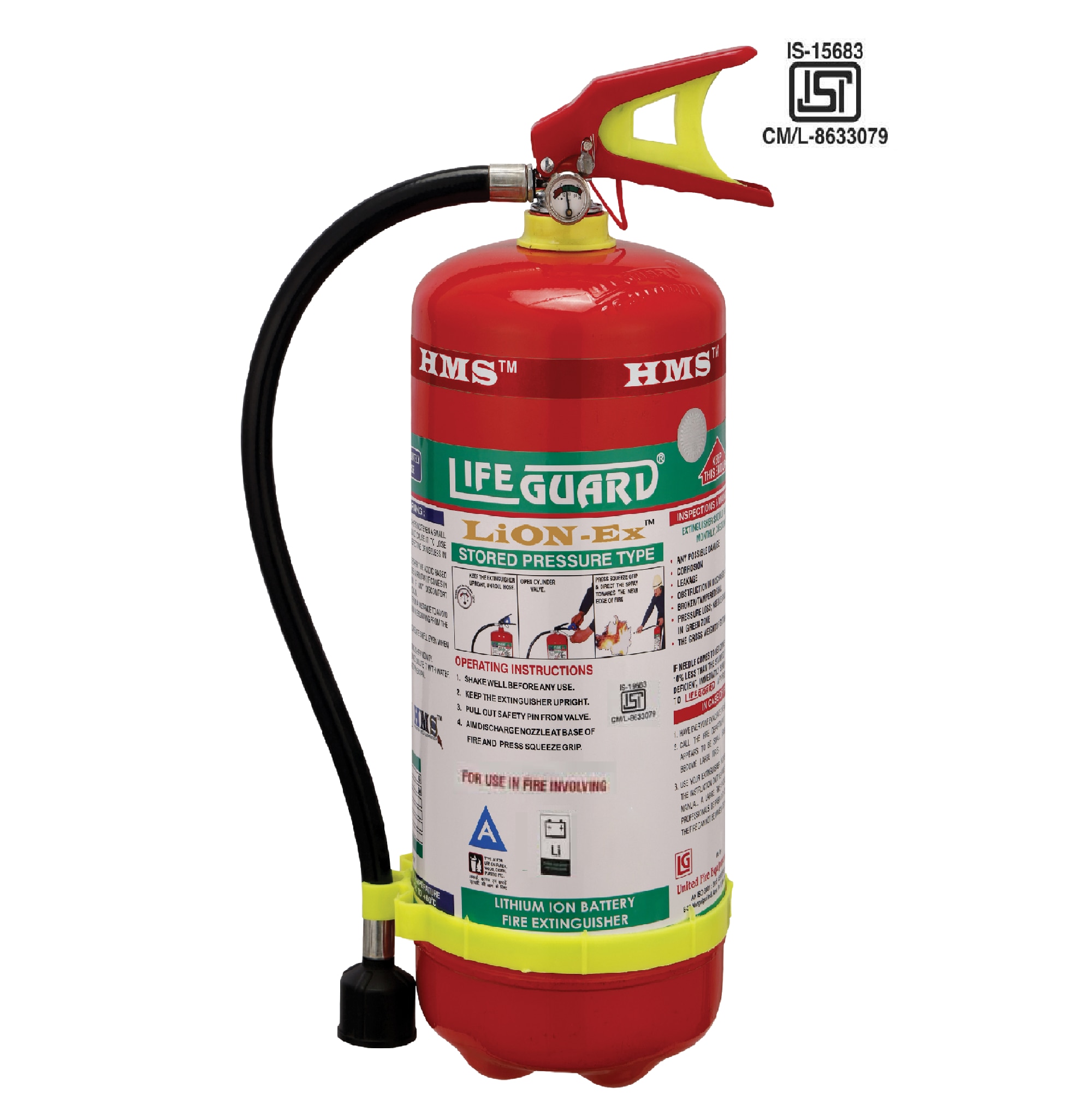 | Lithium Ion Fire Extinguisher LiON-Ex 9 Liters Lithium Fire Extinguisher ₹72000 LiON-Ex Fire Extinguisher for Lithium Ion Battery fire, capacity 9 liters filled with HMS agent, duly ISI marked, tested as per IS : 15683. |
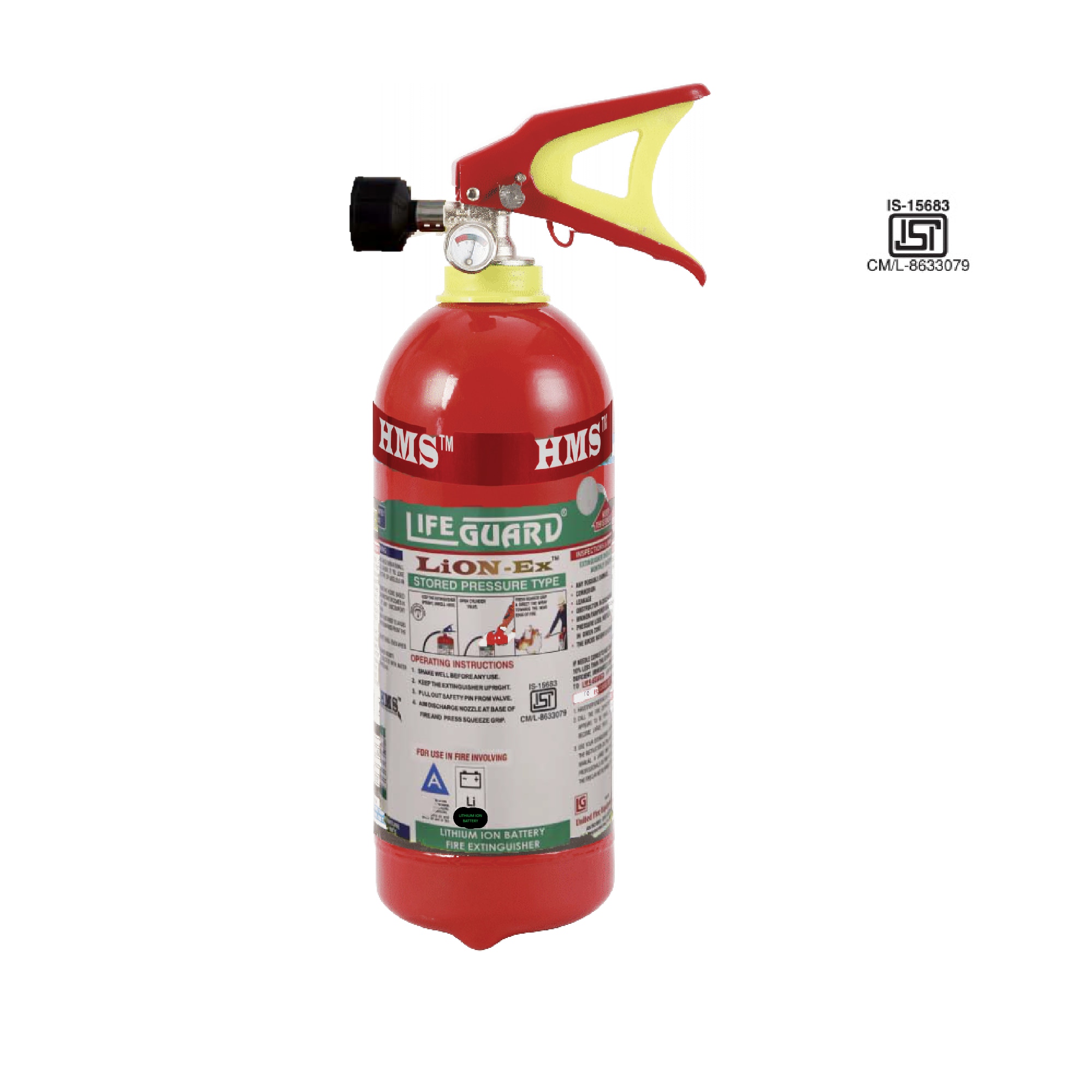 | Lithium Ion Fire Extinguisher LiON-Ex 2 litres ₹18000 LiON-Ex Fire Extinguisher for Lithium Ion Battery fire, capacity 2ltrs. filled with HMS agent, duly ISI marked, tested as per IS : 15683. |