
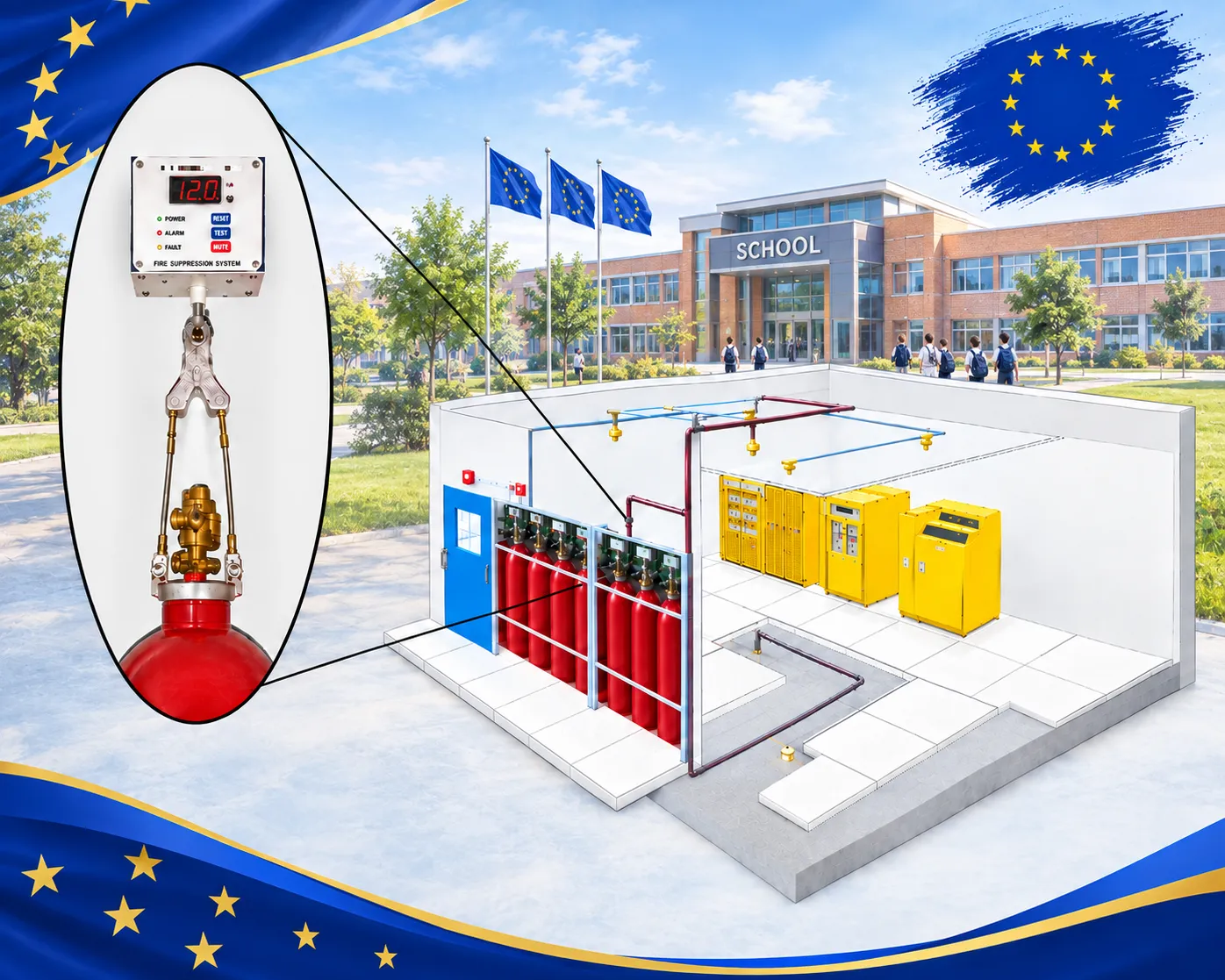
Airport Automatic Suppression System Provider Europe
Airports are among the most complex and safety-critical facilities in the world, combining passenger terminals, aircraft-support infrastructure, electrical rooms, data centres, baggage-handling systems, cargo facilities, control rooms, commercial kitchens, parking areas, utility buildings and specialised aviation facilities. Fire protection in such environments requires carefully engineered systems capable of detecting developing fires quickly, initiating suppression automatically and integrating with the airport's wider fire and building-management infrastructure.
LIFEGUARD® provides engineered airport automatic suppression system solutions for Europe, supporting applications where rapid fire detection, reliable suppression, equipment protection and minimal secondary damage are important. Our solutions can be developed for electrical and electronic rooms, server and communication rooms, control rooms, UPS rooms, switchgear rooms, technical spaces, archives, laboratories, baggage-system areas and other critical airport facilities.
European gaseous fire-suppression design commonly references the EN 15004 series, which addresses the design, installation, testing, maintenance and safety of gas extinguishing systems. The current EN 15004-1:2025 national implementations specify requirements for gaseous systems using electrically non-conductive extinguishants that do not leave residue after discharge. (NEN)
Airport Automatic Fire Suppression System Solutions
LIFEGUARD® airport fire suppression solutions can combine:
- Automatic fire detection
- Fire alarm and releasing control panels
- Smoke, heat and flame detection
- Cross-zoned detection logic
- Clean-agent storage cylinders
- Automatic releasing mechanisms
- Discharge piping and engineered nozzles
- Manual release stations
- Abort facilities where applicable
- Audible and visual pre-discharge warning
- HVAC shutdown interfaces
- Electrical and equipment interlocks
- Cylinder pressure monitoring
- Emergency power arrangements
- Pressure-relief provisions
- System monitoring and fault indication
An automatic gaseous suppression installation normally combines a detection/actuation arrangement with cylinders, piping and discharge devices. European system requirements also address safety, detection, operating devices, extinguishant supply and system design. (Kemeta)
Fire Protection for Critical Airport Areas
1. Airport Data Centres & Server Rooms
Airport IT infrastructure supports passenger processing, communications, security, baggage operations and other critical services. Conventional water discharge can create significant secondary damage to sensitive electronics.
Clean-agent suppression can therefore be considered for appropriately designed and enclosed technical spaces. The system can detect smoke at an early stage and initiate a controlled extinguishing sequence while avoiding the residue associated with conventional dry or wet extinguishing media.
2. Airport Control & Communication Rooms
Air traffic-support facilities, communication rooms, network rooms and operational control spaces require highly dependable fire protection.
LIFEGUARD® systems can be engineered around:
- Early fire detection
- Automatic suppression
- Manual release
- Pre-discharge warning
- Equipment shutdown interfaces
- HVAC shutdown
- Alarm transmission
- Cylinder pressure supervision
The final design should be coordinated with the airport authority, fire consultant, equipment manufacturer and applicable local regulations.
3. UPS & Battery Rooms
UPS systems and electrical energy-storage areas present specialised fire hazards. Suppression selection should consider battery chemistry, enclosure arrangement, ventilation, thermal runaway risks and the specific equipment involved.
For such applications, the suppression strategy should be based on a documented hazard assessment rather than simply applying a conventional clean-agent design.
4. Electrical & Switchgear Rooms
Electrical rooms can contain transformers, switchgear, MCC panels, control panels, cable systems and other ignition sources.
An engineered gaseous suppression system can provide automatic detection and suppression while helping protect critical electrical infrastructure from extensive fire and water damage.
5. Baggage Handling Areas
Modern airports depend on extensive automated baggage conveyors, motors, electrical panels, control systems and associated machinery.
Fire protection may involve a combination of detection, localised suppression, compartment protection and interfaces with conveyor controls. The appropriate system depends on the specific baggage-handling configuration and fire risk.
6. Airport Cargo & Logistics Facilities
Cargo terminals can contain diverse commodities and changing fire loads. Suppression requirements therefore vary considerably according to storage arrangement, materials, ceiling height, ventilation and operational activities.
LIFEGUARD® can support project-specific fire protection engineering for suitable enclosed hazards.
7. Airport Commercial Kitchens
Airport restaurants, lounges and catering facilities can present cooking-oil, grease and exhaust-duct fire hazards. Kitchen suppression requires a system specifically designed and listed/approved for the application rather than treating it as a conventional room total-flooding application.
European commercial kitchen systems may reference EN 17446, depending on the project and applicable national requirements. (Albkos Safety™)
Clean Agent Suppression for European Airports
For suitable enclosed airport hazards, clean-agent systems offer an alternative where protection of sensitive equipment and rapid restoration of operations are important.
Potential clean-agent technologies can include:
- FK-5-1-12 systems
- HFC-based clean-agent systems where permitted and appropriate
- Inert-gas systems such as nitrogen
- Other gaseous extinguishing technologies selected according to project requirements
The extinguishing agent must be selected based on the protected hazard, enclosure characteristics, required design concentration, occupancy, environmental considerations, applicable regulations and the relevant system approvals.
For example, EN 15004-1 covers gaseous fire-extinguishing systems and includes requirements relating to system design, installation, testing, maintenance and safety. It also distinguishes gaseous systems from CO₂ systems, which are covered by a separate European standard. (ELOT Eshop)
Automatic Detection & Suppression Sequence
A typical airport automatic suppression system can operate through a carefully coordinated sequence:
Step 1 – Fire Detection
Smoke, heat or flame detectors identify an abnormal condition.
Step 2 – Alarm Confirmation
Depending on the system philosophy, single- or multi-detector logic can be used to reduce unwanted releases.
Step 3 – Pre-Discharge Warning
Audible and visual notification devices warn occupants and personnel before discharge where applicable.
Step 4 – Equipment Interlocks
HVAC, ventilation, electrical equipment, dampers or other relevant systems may be controlled according to the approved cause-and-effect matrix.
Step 5 – Agent Release
The releasing panel activates the suppression system after the programmed conditions are satisfied.
Step 6 – Agent Distribution
The extinguishing agent is discharged through engineered pipework and nozzles to achieve the required concentration throughout the protected enclosure.
Step 7 – Post-Discharge Monitoring
Pressure monitoring, alarms and other system interfaces help operators identify system status and initiate emergency procedures.
Airport Fire Suppression System Engineering
Airport projects require considerably more than simply supplying cylinders and nozzles. A complete solution may involve:
Hazard Assessment
Identification of fire risks, equipment, fuel sources, room geometry, occupancy and operational conditions.
Room Integrity Assessment
Total-flooding systems depend on the enclosure retaining the required extinguishing concentration. Door openings, penetrations, ventilation and pressure-relief requirements must therefore be considered.
Agent Quantity Calculation
The required extinguishing-agent quantity is determined from the applicable design methodology, protected volume, temperature, hazard classification and selected agent.
Hydraulic / Flow Calculation
Pipe diameters, pipe lengths, fittings, nozzle characteristics and discharge times are evaluated through the applicable approved design methodology.
Detection Design
Detector type, spacing and detection logic are selected according to the protected hazard and applicable fire-alarm requirements.
Cause & Effect
The system can be integrated with:
- Fire alarm systems
- BMS
- HVAC
- Access control
- Electrical systems
- Generator/UPS systems
- Equipment shutdown
- Remote monitoring
Testing & Commissioning
Testing should verify detection, alarm, release logic, interlocks, supervision, notification and system interfaces before handover.
European Standards & Compliance
For European airport projects, compliance should be established on a project-by-project basis, considering the country, airport authority, consultant specification, insurer, competent authority and applicable national regulations.
Relevant standards may include:
- EN 15004 – Fixed firefighting systems – gas extinguishing systems
- EN 12094 – Components for gas extinguishing systems
- EN 54 – Fire detection and fire alarm systems
- ISO 14520 – Gaseous fire-extinguishing systems
- Applicable national fire-safety regulations
- Airport operator requirements
- Local authority requirements
- Manufacturer-specific installation requirements
The current European implementation of EN 15004-1 addresses design, installation, testing, maintenance and safety of gas extinguishing systems. (NEN)
For airport rescue and firefighting services (RFFS), additional aviation-specific requirements apply. For example, EASA guidance addresses the selection, storage, maintenance and testing of aerodrome extinguishing agents and requirements associated with firefighting foam performance. (EASA)
LIFEGUARD® – Airport Automatic Suppression System Provider
LIFEGUARD® offers fire-protection solutions for critical infrastructure where system reliability, engineering documentation and coordinated installation are essential.
Our airport-oriented capabilities can include:
- Automatic gaseous fire suppression
- Clean-agent fire suppression
- Detection and releasing systems
- Electrical-room protection
- Server-room protection
- UPS and control-room protection
- Data-centre fire suppression
- Communication-room protection
- Baggage-system fire protection
- Technical-room protection
- Kitchen suppression solutions
- System integration
- Engineering support
- Installation coordination
- Testing & commissioning
- Operation and maintenance support
Our approach is based on selecting the appropriate suppression technology for the specific hazard rather than applying a single system universally across an airport.
Airport Fire Suppression System for New Construction & Retrofit
LIFEGUARD® solutions can be considered for both new airport construction and existing-facility upgrades.
For new projects, early coordination with architects, MEP consultants, fire consultants, electrical contractors and airport operators helps establish:
- Cylinder-room requirements
- Pipe routes
- Nozzle locations
- Detector positions
- HVAC interfaces
- Pressure-relief requirements
- Electrical interfaces
- Access requirements
- Fire alarm integration
- Maintenance provisions
For retrofit projects, the existing building structure and operational requirements must be evaluated before system selection. This can include reviewing existing fire alarm infrastructure, room integrity, ventilation, available cylinder space, cable routes and shutdown interfaces.
Why Choose LIFEGUARD® for Airport Fire Protection?
LIFEGUARD® focuses on engineered fire-safety solutions for demanding commercial and industrial applications.
Key capabilities include:
Engineered Design
Project-specific system design based on the protected hazard and enclosure.
Automatic Detection & Release
Integration of detection, alarm and suppression release functions.
Critical Equipment Protection
Solutions for electrical, electronic, communication and control infrastructure.
Clean-Agent Technology
Options for applications where residue-free suppression is required.
System Integration
Coordination with HVAC, BMS, fire alarm and equipment shutdown interfaces.
Testing & Commissioning Support
Functional verification of detection, alarm, releasing and interlock sequences.
Technical Documentation
Support for drawings, calculations, product documentation, cause-and-effect matrices and commissioning records as required by the project.
Airport Automatic Suppression System Provider Europe – LIFEGUARD®
When selecting an airport automatic suppression system provider in Europe, the most important considerations are not only the extinguishing agent and cylinder capacity, but also system engineering, detection philosophy, enclosure integrity, equipment compatibility, approval requirements, safety provisions, installation quality and long-term maintenance.
LIFEGUARD® provides engineered fire suppression solutions for airport technical infrastructure, electrical rooms, data centres, control rooms, communication facilities, UPS rooms, baggage-related technical areas and other suitable enclosed hazards.
Our objective is to help airport operators and project stakeholders develop reliable, engineered and application-specific automatic fire suppression systems designed around the actual fire risk and applicable European requirements.
SEO Keywords
Primary Keywords:
airport automatic suppression system provider Europe, airport fire suppression system Europe, airport automatic fire suppression system, airport clean agent suppression system, airport fire protection system provider Europe
Secondary Keywords:
airport gaseous fire suppression system, airport clean agent fire suppression, airport automatic fire protection, airport server room suppression system, airport data centre fire suppression, airport electrical room fire suppression, airport UPS room fire suppression, airport control room fire protection, airport fire suppression company Europe, airport fire safety solutions Europe
Long-Tail Keywords:
airport automatic suppression system provider in Europe, clean agent fire suppression system for airports Europe, automatic gaseous fire suppression system for airport technical rooms, airport data centre automatic fire suppression system, airport electrical room clean agent suppression system, airport fire protection system manufacturer and provider Europe, engineered fire suppression solutions for European airports.
Suggested SEO Title:
Airport Automatic Suppression System Provider Europe | LIFEGUARD®
Suggested Meta Description:
LIFEGUARD® provides engineered airport automatic suppression systems in Europe for data centres, electrical rooms, control rooms, UPS rooms and critical airport infrastructure.
Suggested URL Slug:
/airport-automatic-suppression-system-provider-europe/
The wording above deliberately avoids making blanket claims that every LIFEGUARD® system is automatically compliant with every European country's requirements; approvals and compliance should be specified according to the individual airport project.
Keywords






