
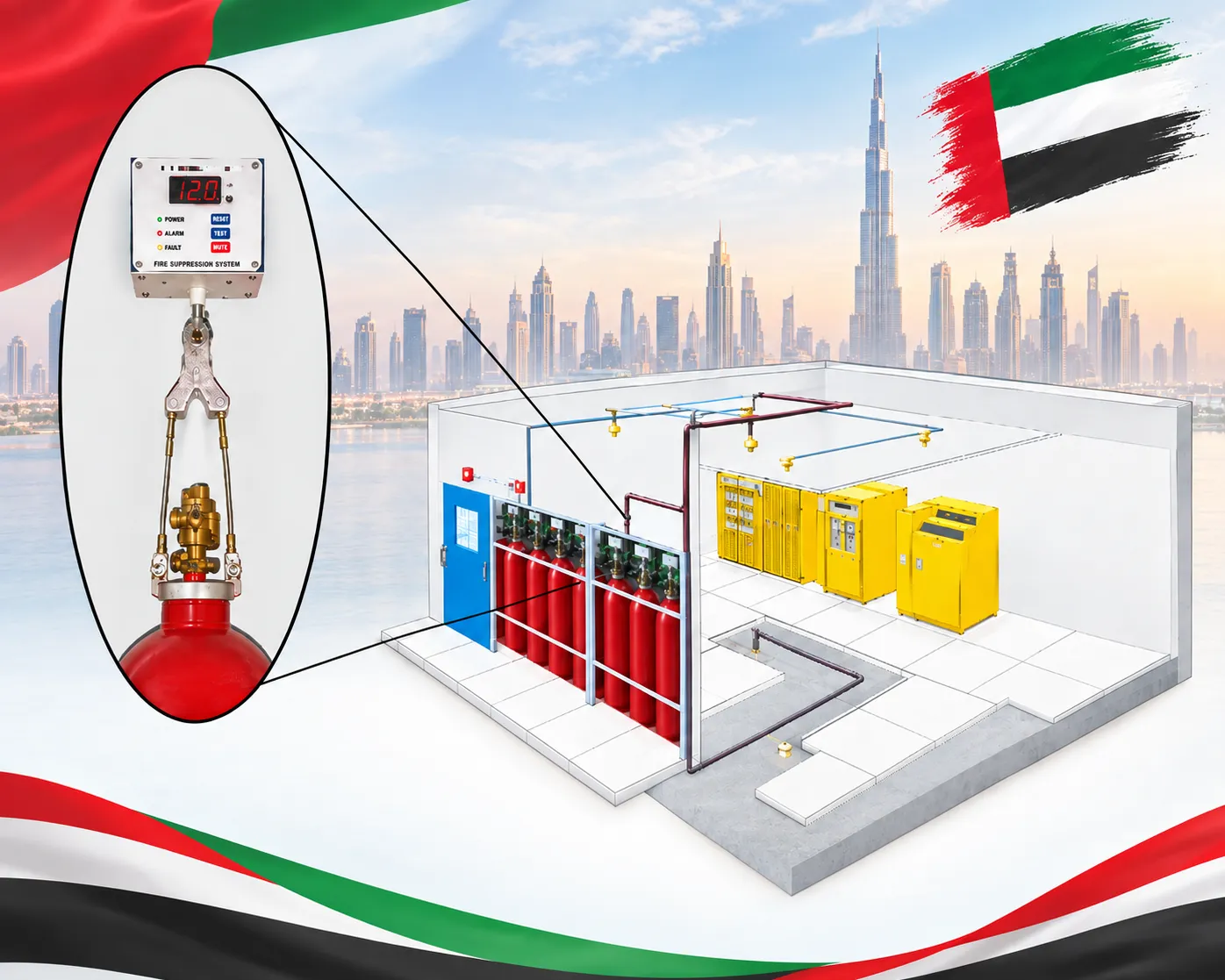
Airport Clean Agent Suppression Exporter UAE
LIFEGUARD® – Airport Clean Agent Fire Suppression Solutions Exported to the UAE
Modern airports depend on highly sophisticated electrical, electronic, communication, security and operational infrastructure. Protecting these critical assets requires fire suppression systems that can respond rapidly to fire while being appropriately engineered for sensitive equipment and enclosed technical spaces.
LIFEGUARD® is an experienced fire safety equipment manufacturer and exporter providing engineered clean agent fire suppression solutions for airport and aviation-related applications in the UAE.
Our clean agent suppression solutions can be considered for airport data centres, server rooms, communication rooms, electrical rooms, control rooms, UPS rooms, equipment rooms, security infrastructure and other critical enclosed facilities where a gaseous fire suppression solution is specified.
For UAE airport projects, system selection, design, installation and approval should be coordinated with the applicable project specifications, UAE Fire & Life Safety requirements, authority requirements and airport-specific standards. Dubai Airports' published requirements reference the UAE Fire and Life Safety Code of Practice and applicable NFPA codes and standards for fire protection and maintenance.
Airport Clean Agent Fire Suppression Exporter
LIFEGUARD® supplies fire safety equipment and engineered suppression solutions for international project requirements, supporting consultants, EPC contractors, MEP contractors, system integrators, airport infrastructure developers and fire protection companies.
Our approach to airport clean agent suppression focuses on the complete system rather than treating the extinguishing agent as an individual product.
A typical engineered solution may incorporate:
- Clean agent storage cylinders
- Clean agent extinguishing medium
- Automatic fire detection
- Releasing control panel
- Smoke and heat detection
- Manual release station
- Abort switch
- Audible and visual alarms
- Discharge nozzles
- Pipe network
- Pressure switches
- HVAC shutdown interfaces
- Damper interfaces
- Fire alarm integration
- BMS integration
- Cause-and-effect programming
- Room integrity considerations
- Testing and commissioning
- Technical documentation
The exact configuration depends on the protected hazard, agent, room volume, equipment layout, project specification and applicable approvals.
Why Airports Require Specialised Fire Suppression
An airport is effectively a large interconnected technical ecosystem. Passenger terminals are supported by data centres, communications, electrical infrastructure, security systems, baggage handling systems, operational control centres and numerous specialised technical rooms.
A fire affecting one critical technical facility can potentially interrupt systems supporting wider airport operations.
Dubai Airports describes its airport environment as involving extensive airside infrastructure and complex operational systems, while its published requirements emphasise fire prevention, maintenance, inspection and compliance with applicable UAE and international fire-safety standards.
This makes appropriate protection of enclosed critical rooms an important part of an airport's overall fire safety strategy.
Clean Agent Suppression for Airport Data Centres
Airport data centres contain servers, networking equipment, storage systems, power-management equipment and other electronic infrastructure.
For these applications, an engineered clean agent system may be specified where the project requires gaseous fire suppression instead of conventional water-based suppression within the protected enclosure.
A typical system includes:
Automatic Detection → Alarm → Pre-Discharge Sequence → Equipment Interlocks → Agent Release → Fire Suppression
The actual sequence is determined by the approved cause-and-effect matrix.
Clean agent systems can be engineered for:
- Server rooms
- Network rooms
- IT rooms
- Data processing rooms
- Communication centres
- Equipment rooms
- Technical control rooms
Airport Electrical Room Fire Suppression
Electrical rooms can contain switchgear, control panels, electrical distribution equipment, UPS systems and other critical components.
Depending on the hazard assessment and project specification, clean agent suppression can be considered for suitable enclosed electrical spaces.
The design should account for:
- Electrical equipment arrangement
- Room volume
- Occupancy
- Ventilation
- Cable penetrations
- Raised floors
- False ceilings
- Equipment heat load
- Agent concentration
- Discharge characteristics
- Enclosure integrity
The objective is to develop a suppression system appropriate to the actual hazard rather than simply selecting a cylinder based on room size.
Airport Control Room Clean Agent Suppression
Airport control and monitoring rooms contain critical electronic equipment and communication infrastructure.
LIFEGUARD® clean-agent solutions can be engineered for suitable enclosed control-room applications with integration between:
- Fire detection
- Releasing panel
- Manual release
- Abort switch
- HVAC controls
- Fire alarm system
- BMS
- Audible alarms
- Visual indicators
- Emergency interfaces
This integrated approach allows the fire suppression system to operate as part of the building's wider fire protection strategy.
Airport Communication and Telecom Room Protection
Communication infrastructure is essential to airport operations.
Telecommunications rooms, network rooms and communication equipment spaces can contain sensitive electronic equipment that requires carefully selected fire protection.
A clean-agent suppression system can provide an engineered gaseous suppression solution for appropriate enclosed telecom hazards.
The final system should be designed according to the applicable agent manufacturer's design methodology and the project requirements.
Airport UPS and Battery Room Fire Protection
UPS and energy-storage installations require specific consideration because the fire characteristics depend on the battery technology and installation configuration.
For these applications, the suppression strategy should be established following a detailed hazard assessment.
Important considerations include:
- Battery chemistry
- Battery capacity
- Room volume
- Ventilation
- Thermal characteristics
- Detection technology
- Fire propagation potential
- Emergency response strategy
- Applicable codes and standards
Clean agent suppression should not automatically be treated as a universal solution for every battery hazard; the appropriate protection strategy should be determined by the project fire-risk assessment and applicable requirements.
Airport Baggage Handling System Protection
Airport baggage systems use extensive conveyors, motors, control equipment, electrical panels and automation systems.
Clean agent suppression may be suitable for certain enclosed control and equipment rooms associated with baggage handling infrastructure.
The protected hazard should be individually assessed because baggage conveyor areas, machinery spaces and technical control rooms can have substantially different fire hazards.
Clean Agent Technologies for UAE Airport Projects
Depending on the project requirements, clean-agent technology may include chemical or inert-gas systems.
UAE Civil Defence guidance identifies both inert gases and chemical clean agents within its clean-agent system provisions and states that clean-agent systems are to be designed using DCD-approved manufacturer's design software and in accordance with the UAE Fire & Life Safety Code of Practice and manufacturer's instructions.
Potential technologies can include:
FK-5-1-12
FK-5-1-12 is a clean-agent technology used for suitable enclosed electronic and critical-equipment applications.
HFC-227ea / FM-200
HFC-227ea systems may be specified for appropriate total-flooding applications where the project specification and required approvals permit their use.
Inert Gas Systems
Inert gas systems use gases such as nitrogen, argon or approved mixtures and can be considered for suitable protected spaces.
Agent selection should always be based on the project specification, hazard assessment, applicable regulations and required approvals.
UAE Compliance and Airport Fire Safety
For an exporter supplying equipment into the UAE, compliance considerations are particularly important.
The UAE Fire & Life Safety Code framework and authority requirements need to be considered alongside the individual airport's specifications.
Dubai Civil Defence guidance states that clean-agent systems should be designed using DCD-approved manufacturer's design software and comply with the UAE Fire & Life Safety Code of Practice and manufacturer's instructions. It also addresses enclosure integrity and leakage compensation.
Dubai Airports' published conditions similarly require fire protection equipment to be maintained in accordance with the UAE Fire and Life Safety Code of Practice and applicable NFPA codes and standards, with regular inspection and servicing.
Therefore, LIFEGUARD® approaches UAE airport projects with attention to:
- Applicable UAE requirements
- Airport-specific specifications
- Authority requirements
- Agent manufacturer's design methodology
- Required product approvals
- System calculations
- Detection and releasing philosophy
- Installation requirements
- Testing and commissioning
- Maintenance requirements
Clean Agent System Design for Airport Projects
A professional airport clean-agent suppression system begins with engineering.
1. Hazard Assessment
The protected room is evaluated for:
- Room dimensions
- Volume
- Ceiling height
- Raised floor
- False ceiling
- Equipment configuration
- Occupancy
- Fire load
- HVAC arrangement
- Cable penetrations
- Door openings
- Ventilation
2. Agent Selection
The clean agent is selected according to:
- Fire hazard
- Occupancy
- Project specification
- Environmental considerations
- Required approvals
- Agent design limitations
3. System Calculation
The system is calculated using the applicable manufacturer's approved design software and methodology.
4. Cylinder Selection
Cylinder capacity and quantity are determined from the engineered system requirements rather than by using a generic room-size rule.
5. Pipe Network Design
The piping network is designed to deliver the required quantity of agent through appropriately positioned discharge nozzles.
6. Detection and Releasing
The fire detection and releasing sequence is established through the project-approved cause-and-effect matrix.
7. Interlocking
The system may interface with:
- HVAC
- Dampers
- Fire alarm
- BMS
- Access control
- Electrical systems
- Emergency equipment
8. Testing and Commissioning
Before handover, the system should be inspected, tested and commissioned according to the approved project procedures.
Airport Clean Agent Suppression System Components
A complete airport clean-agent suppression package may include:
Fire Detection System
Automatic detection identifies developing fire conditions and initiates the programmed alarm sequence.
Releasing Control Panel
The releasing panel controls detection, alarm, pre-discharge and agent-release functions.
Manual Release Station
A manual release station allows authorised personnel to initiate agent discharge when permitted by the approved system philosophy.
Abort Switch
An abort switch can be incorporated where required to temporarily interrupt or delay release during the pre-discharge sequence.
Clean Agent Cylinders
Cylinders store the extinguishing agent at the specified pressure and capacity.
Discharge Nozzles
Nozzles distribute the agent throughout the protected enclosure.
Distribution Pipework
The pipe network connects the storage cylinders to the discharge nozzles.
Alarm Devices
Audible and visual indicators warn occupants before and during system operation.
Pressure Monitoring
Pressure monitoring devices can provide cylinder/system status supervision where required.
Enclosure Integrity for Airport Clean Agent Systems
Total-flooding clean-agent systems rely on the protected enclosure retaining the extinguishing concentration for the required period.
Potential leakage paths include:
- Doors
- Cable penetrations
- HVAC openings
- Raised floors
- False ceilings
- Service penetrations
- Dampers
- Conduits
UAE Civil Defence guidance specifically requires hazard enclosure integrity to be ensured and provides for additional agent quantity where leakage compensation is necessary.
Consequently, room integrity is an important part of the overall clean-agent system design.
Airport Clean Agent Suppression Exporter from India to UAE
LIFEGUARD® operates as an Indian fire safety equipment manufacturer and exporter supporting international project requirements.
For UAE customers, export-oriented project support can include:
- Technical product information
- System specifications
- Datasheets
- Drawings
- Equipment schedules
- Technical submittals
- Compliance documentation
- Packing and dispatch coordination
- Export documentation
- Project-specific technical assistance
- Installation guidance
- Testing and commissioning support
The exact scope can be tailored for consultants, contractors, distributors, system integrators and project procurement teams.
Supporting UAE Airport Contractors and System Integrators
LIFEGUARD® can support different project stakeholders involved in airport fire protection.
Airport Owners and Operators
Technical assistance for evaluating suitable fire suppression solutions for critical enclosed facilities.
Consultants
Technical information, system configuration and documentation for project specifications and design coordination.
EPC Contractors
Equipment supply and technical coordination for airport infrastructure projects.
MEP Contractors
Clean-agent system components and engineering coordination.
Fire Protection Contractors
Equipment, system design support and project-specific technical documentation.
UAE Distributors
Export supply and channel support for suitable fire safety projects.
System Integrators
Integration of clean-agent suppression with fire detection, BMS and other building systems.
Airport Fire Protection Solutions for UAE Cities
LIFEGUARD® can support enquiries associated with airport and aviation infrastructure across the UAE, including:
- Dubai
- Abu Dhabi
- Sharjah
- Ras Al Khaimah
- Fujairah
- Ajman
- Umm Al Quwain
Potential project environments include airports, aviation technical facilities, airport logistics infrastructure, aircraft maintenance support buildings and associated critical infrastructure.
Why Choose LIFEGUARD® as an Airport Clean Agent Suppression Exporter?
LIFEGUARD® brings extensive experience in fire safety equipment manufacturing and engineered fire protection applications.
Our capabilities include:
Fire Safety Manufacturing
Fire protection equipment manufactured for domestic and international project requirements.
Engineered Suppression Solutions
Solutions developed according to the protected hazard and project requirements.
Critical Infrastructure Experience
Experience supporting fire suppression requirements for data centres, electrical facilities, technical rooms and other critical infrastructure.
International Project Support
Technical and commercial support for customers outside India.
System Integration
Coordination between detection, releasing, suppression and building-system interfaces.
Technical Documentation
Datasheets, technical information, drawings and project documentation according to scope.
Testing & Commissioning Support
Support for system inspection, testing and commissioning requirements.
LIFEGUARD® Airport Clean Agent Suppression Exporter UAE
Airports require fire protection systems that are carefully engineered around the protected hazard, equipment sensitivity, enclosure characteristics and operational requirements.
LIFEGUARD® provides clean-agent fire suppression solutions for suitable airport applications and supports UAE customers, contractors, consultants, distributors and system integrators with fire protection equipment and technical solutions.
From airport data centres and communication rooms to electrical rooms, control rooms, UPS facilities and critical technical spaces, LIFEGUARD® can support project-specific clean-agent suppression requirements.
Our approach combines:
Detection + Releasing + Clean Agent + Piping + Nozzles + Interlocking + Testing + Commissioning
For UAE airport projects, the final system design should be coordinated with the applicable UAE Fire & Life Safety Code, authority requirements, airport specifications and the relevant manufacturer's approved design methodology.
Frequently Asked Questions
Who is an airport clean agent suppression exporter in UAE?
LIFEGUARD® is an Indian fire safety equipment manufacturer and exporter offering engineered clean-agent suppression solutions for suitable airport and aviation applications in the UAE.
What airport areas can be protected with clean agent systems?
Potential applications include data centres, server rooms, communication rooms, control rooms, electrical rooms, UPS rooms, security rooms and other suitable enclosed technical spaces.
Can LIFEGUARD® export clean agent suppression equipment to UAE?
LIFEGUARD® supports international project requirements and can provide fire safety equipment and clean-agent suppression solutions for UAE customers, subject to project scope and applicable import, authority and approval requirements.
Which clean agent is used for airport fire suppression?
The appropriate agent depends on the protected hazard and project specification. Options may include FK-5-1-12, HFC-227ea and inert-gas technologies, subject to applicable approvals and design requirements.
Are clean-agent systems suitable for airport data centres?
Clean-agent systems are commonly considered for suitable enclosed electronic and data-processing environments. The final selection should be based on a detailed hazard assessment and project-specific engineering.
Is room integrity important for clean-agent suppression?
Yes. For total-flooding applications, enclosure integrity is an important design consideration because the protected space needs to retain the required extinguishing concentration. UAE Civil Defence guidance specifically addresses enclosure integrity and leakage compensation.
Can LIFEGUARD® support UAE airport contractors and consultants?
Yes. Depending on the project scope, LIFEGUARD® can support consultants, EPC contractors, MEP contractors, fire protection contractors, distributors and system integrators with technical information, equipment supply and project coordination.
Contact LIFEGUARD®
LIFEGUARD® – Manufacturer & Exporter of Fire Safety Equipment
For enquiries regarding:
- Airport clean agent suppression systems
- Airport data centre fire suppression
- Airport electrical room suppression
- Airport control room fire protection
- FK-5-1-12 systems
- HFC-227ea systems
- Inert gas suppression
- Clean-agent system components
- UAE airport fire protection projects
- Export supply and technical support
Email: ufe126@gmail.com | info@lifeguardindia.in
Website: www.lifeguardindia.in
LIFEGUARD® – Engineered Fire Protection for Critical Infrastructure.
Keywords






