
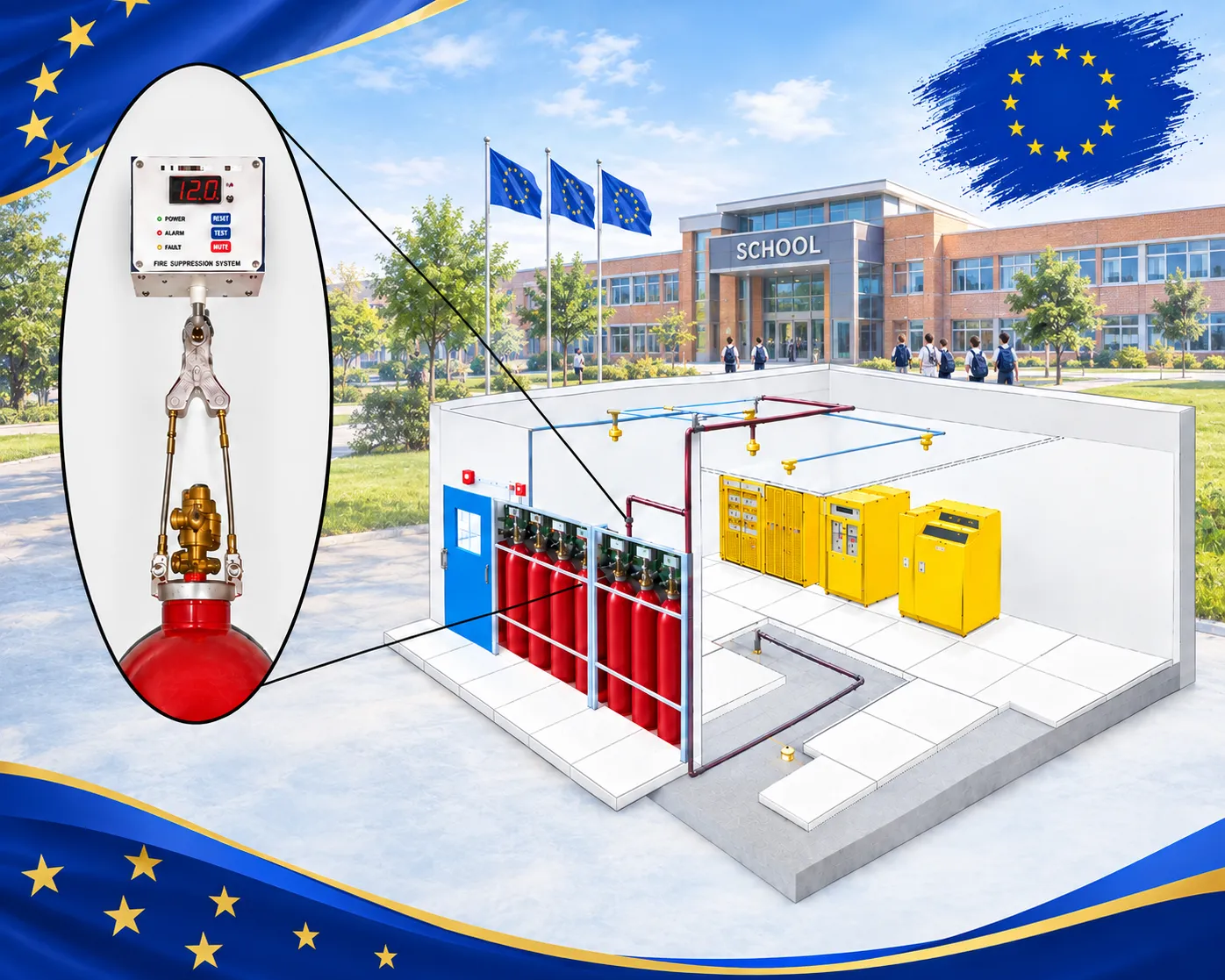
Airport Clean Agent Suppression Manufacturer Europe
Airports are among the most critical infrastructure environments, combining passenger terminals, airside operations, aviation support facilities, data centres, electrical rooms, baggage-handling systems, communication infrastructure, control rooms and other high-value assets. Fire protection in these areas requires carefully engineered solutions that can suppress fires rapidly while minimizing damage to sensitive equipment and reducing disruption to airport operations.
LIFEGUARD® provides engineered clean agent fire suppression solutions for airport applications, supporting the protection of critical electronic, electrical and mission-critical areas. As an experienced fire safety equipment manufacturer and system solution provider, LIFEGUARD® develops fire protection solutions for applications where conventional water-based suppression may not be appropriate.
European airport operators also work within structured aerodrome emergency and rescue-and-firefighting requirements. EASA's current Easy Access Rules for Aerodromes address aerodrome emergency planning, rescue and firefighting services, equipment, extinguishing agents, personnel and response arrangements. (EASA)
LIFEGUARD® – Airport Clean Agent Fire Suppression Solutions
LIFEGUARD® clean agent suppression systems are designed around the characteristics of the protected enclosure, fire hazard, equipment sensitivity and required extinguishing strategy.
Typical airport applications include:
- Airport data centres
- IT and server rooms
- Airport command and control centres
- Air traffic-related technical rooms
- Communication rooms
- UPS and electrical rooms
- MCC and electrical control rooms
- Baggage handling control rooms
- Security and surveillance equipment rooms
- Airport operation centres
- Telecom and network rooms
- Electrical switchgear rooms
- Critical equipment enclosures
- Aviation support facilities
- Control and monitoring rooms
- Equipment rooms within terminal buildings
The objective is to provide rapid fire suppression while avoiding the collateral damage associated with water discharge in sensitive electronic environments.
Why Clean Agent Suppression Is Important for Airports
Airport facilities contain equipment where even a relatively small fire can cause significant operational consequences. Server infrastructure, communication systems, security equipment, control electronics and electrical installations may be vulnerable to water, foam or powder residues.
A properly engineered gaseous suppression system can provide a different approach: the extinguishing agent is discharged into a suitably enclosed protected space to achieve the required design concentration.
For this reason, clean agent systems are commonly considered for:
Fire risk + high-value equipment + occupied/controlled enclosure + business continuity requirements.
However, system suitability must be established through an engineering assessment. Clean-agent systems are not a universal replacement for airport rescue and firefighting arrangements; European aerodrome requirements separately address airport rescue and firefighting services and the availability of appropriate extinguishing agents and equipment. (EASA)
Airport Clean Agent Suppression System Manufacturer
As an airport clean agent suppression manufacturer and fire protection solution provider, LIFEGUARD® can support projects from risk assessment and system selection through engineering, supply, installation, testing and commissioning, subject to project requirements.
A typical system may include:
1. Clean Agent Storage Cylinders
The extinguishing agent is stored in appropriately selected cylinders designed for the system's required capacity and operating pressure.
Cylinder selection depends on:
- Protected volume
- Design concentration
- Agent type
- Operating pressure
- Pipe-network configuration
- Discharge requirements
- Applicable approvals and project specifications
2. Automatic Fire Detection
High-quality detection is fundamental to early fire response.
Depending on the application, detection may incorporate:
- Smoke detectors
- Multi-sensor detectors
- Aspirating smoke detection
- Cross-zoned detection
- Manual release stations
- Alarm interfaces
For critical airport facilities, detection philosophy should be developed according to the fire risk, enclosure characteristics and project fire strategy.
3. Fire Suppression Control Panel
The suppression control panel coordinates:
Detection → Alarm → Pre-discharge warning → Release sequence → Agent discharge → Equipment interlocks
The panel may interface with:
- Fire alarm systems
- HVAC systems
- Air-handling units
- Dampers
- Access-control systems
- Electrical equipment
- Building management systems
- Remote monitoring systems
4. Release and Abort Arrangement
Where required by the approved design, the system can incorporate:
- Manual release station
- Abort switch
- Pre-discharge alarm
- Audible/visual warning
- Pressure switches
- Cylinder release mechanisms
- System status monitoring
These functions allow the suppression sequence to be integrated into the overall emergency response strategy.
Clean Agent Options for Airport Applications
The appropriate clean agent depends on the project design, environmental requirements, equipment sensitivity, enclosure volume, applicable standards and approval requirements.
Potential technologies may include:
FK-5-1-12 Systems
FK-5-1-12-based suppression technology is used in applications where a clean gaseous extinguishing agent is required for protection of sensitive equipment.
It can be considered for:
- Data centres
- Server rooms
- Control rooms
- Electrical rooms
- Telecom rooms
- Airport IT infrastructure
LIFEGUARD® can engineer clean-agent systems around the required protected volume and project specifications.
Inert Gas Systems
Inert-gas systems use gases such as nitrogen, argon or suitable blends to reduce oxygen concentration within the protected enclosure to a level capable of suppressing combustion, subject to the system's design criteria.
These systems can be considered for selected:
- Data centres
- Control rooms
- Electrical rooms
- Telecom facilities
- Critical infrastructure areas
Agent selection should always follow an application-specific fire engineering assessment.
Airport Terminal Fire Protection
Modern airport terminals contain a combination of public areas, commercial spaces, technical rooms, electrical installations and communication infrastructure.
LIFEGUARD® fire protection solutions can be engineered for selected enclosed technical spaces within airport terminals, including:
- Electrical rooms
- UPS rooms
- Server rooms
- Telecom rooms
- CCTV rooms
- Security control rooms
- Baggage system control rooms
- Technical equipment rooms
- Building management system rooms
Clean-agent suppression is particularly relevant where protecting the equipment and maintaining operational continuity are important design considerations.
Airport Data Centre Fire Suppression
Airport IT infrastructure supports critical operational functions. A fire affecting servers or network infrastructure can potentially interrupt airport systems and services.
A clean-agent system can be engineered to provide:
Early detection → Rapid alarm → Controlled release → Fire suppression → Equipment protection
Typical protection zones include:
- Server racks
- Network equipment
- UPS systems
- Storage systems
- Communication equipment
- Technical control rooms
For high-value IT environments, enclosure integrity and pressure-relief requirements are important parts of system engineering.
Airport Control Room Fire Suppression
Airport control and monitoring facilities contain sensitive electronic equipment and communications infrastructure.
LIFEGUARD® clean-agent systems can be designed for enclosed control-room applications where water discharge may be undesirable.
A typical system architecture can include:
Smoke Detection
↓
Fire Alarm Signal
↓
Pre-Discharge Warning
↓
HVAC / Equipment Interlock
↓
Clean Agent Release
↓
Fire Suppression
The final sequence should follow the approved fire strategy, applicable codes and project specifications.
Airport Electrical Room Fire Suppression
Electrical rooms may contain switchgear, control panels, UPS equipment, distribution boards and other energized equipment.
For suitable enclosed electrical hazards, clean-agent suppression can provide an alternative to conventional water-based extinguishing approaches.
The system design should consider:
- Electrical load
- Room volume
- Ventilation
- Cable penetrations
- False ceiling and raised-floor spaces
- Fire detection
- Emergency shutdown requirements
- Pressure relief
- Enclosure integrity
Airport Baggage Handling System Fire Protection
Baggage handling systems contain conveyors, motors, electrical panels, control equipment and automated machinery.
Fire protection requirements can vary considerably depending on the exact equipment and enclosure.
LIFEGUARD® can provide engineered fire protection solutions for suitable enclosed control and equipment areas associated with baggage handling infrastructure.
For open conveyor areas, the appropriate protection strategy may be different from a gaseous suppression system and should be determined through project-specific fire-risk assessment.
Airport Communication & Telecom Room Suppression
Reliable communication is essential to airport operations.
Telecommunication rooms may contain:
- Network switches
- Communication equipment
- Fibre-optic infrastructure
- Routers
- Power supplies
- Monitoring equipment
- Electronic control systems
Clean-agent suppression can help protect these sensitive assets without introducing water or powder residue into the protected room.
Airport Fire Suppression System Engineering
A professional airport suppression system requires more than simply selecting a cylinder and nozzle.
LIFEGUARD® engineering considerations can include:
Hazard Assessment
Identification of:
- Fuel sources
- Electrical hazards
- Equipment density
- Occupancy
- Ventilation
- Fire load
- Potential ignition sources
Protected Volume Calculation
The protected enclosure is assessed to establish the required agent quantity and system configuration.
Pipe Network Design
The piping network and discharge nozzles are selected and engineered to achieve the required agent distribution.
Detection & Control Logic
Detection, alarm and suppression-release sequences are developed according to the project fire strategy.
Enclosure Integrity
Doors, dampers, penetrations, cable entries and other openings are considered because gaseous suppression depends on maintaining the required agent concentration.
Pressure Relief
The discharge of gaseous agent can produce pressure changes inside the enclosure. Appropriate pressure-relief arrangements should therefore be considered during engineering.
European Airport Fire Safety Considerations
For projects in Europe, clean-agent suppression design should not be treated independently from the aerodrome's overall emergency-management framework.
EASA's aerodrome requirements address emergency planning and coordination, while rescue and firefighting provisions cover equipment, extinguishing agents and trained personnel. (EASA)
EASA guidance also addresses response arrangements, training and the application of extinguishing agents within aerodrome rescue and firefighting services. (EASA)
Therefore, an airport clean-agent system should be integrated with the project's:
- Fire alarm strategy
- Emergency response plan
- Evacuation philosophy
- HVAC controls
- Electrical shutdown strategy
- Building management system
- Airport operations
- Rescue and firefighting arrangements
- Applicable European and local requirements
Standards-Based Clean Agent System Design
Depending on the project specification and jurisdiction, clean-agent suppression systems may be engineered with reference to applicable standards such as:
- EN 15004
- ISO 14520
- NFPA 2001, where specified by the project
- Applicable European regulations
- Local fire authority requirements
- Airport operator specifications
- Equipment manufacturer's approved design criteria
The applicable standard should always be confirmed against the project's contractual specifications, authority requirements and selected extinguishing agent.
LIFEGUARD® Airport Fire Protection Capabilities
LIFEGUARD® can support airport fire protection projects with solutions covering:
Design
Application engineering and fire-risk-based system configuration.
Supply
Clean-agent cylinders, valves, detection and control components, piping and discharge accessories as specified.
Installation
Professional installation of suppression-system components according to approved drawings and project requirements.
Testing & Commissioning
Functional testing of detection, alarm, release logic, interlocks and associated system components.
Documentation
Project documentation, testing records, operating instructions and handover documentation as applicable.
Maintenance Support
Periodic inspection, testing and maintenance support according to the applicable system requirements.
Airport Clean Agent Suppression Manufacturer for Europe
LIFEGUARD® positions itself as a clean agent fire suppression manufacturer and engineered fire protection solution provider for airport and critical infrastructure applications.
Our solutions can be developed for airport projects requiring protection of sensitive electronic and electrical assets while maintaining a coordinated approach to fire detection, suppression, emergency response and business continuity.
From airport terminal technical rooms and data centres to communication facilities, control rooms and electrical infrastructure, LIFEGUARD® provides engineered fire protection solutions tailored to the individual risk.
Why Choose LIFEGUARD®?
- Manufacturer-focused fire safety expertise
- Engineered clean-agent suppression solutions
- Solutions for critical infrastructure
- Application-specific system design
- Integration with fire detection and alarm systems
- Suitable technologies for electronic equipment protection
- Design support for new and existing facilities
- Testing and commissioning support
- Project documentation and handover assistance
- International project-oriented approach
Airport Clean Agent Suppression Manufacturer Europe – SEO Keywords
Primary Keyword:
Airport Clean Agent Suppression Manufacturer Europe
Secondary Keywords:
- Airport fire suppression system manufacturer Europe
- Airport clean agent fire suppression system
- Airport clean agent suppression company Europe
- Airport gaseous fire suppression manufacturer
- Airport fire protection system manufacturer
- Airport data centre fire suppression Europe
- Airport server room fire suppression
- Airport control room fire suppression
- Airport electrical room fire suppression
- Airport telecom room fire suppression
- FK-5-1-12 airport fire suppression
- Inert gas fire suppression airport
- EN 15004 clean agent system
- ISO 14520 clean agent suppression
- Aviation facility fire protection
- European airport fire safety solutions
- Clean agent suppression OEM Europe
- Airport automatic fire suppression system
- Airport critical infrastructure fire protection
Suggested SEO Meta Title
Airport Clean Agent Suppression Manufacturer Europe | LIFEGUARD®
Suggested Meta Description
LIFEGUARD® provides engineered airport clean agent fire suppression solutions for data centres, control rooms, electrical rooms, telecom facilities and critical airport infrastructure across Europe.
Suggested H1
Airport Clean Agent Suppression Manufacturer Europe
Suggested URL Slug
/airport-clean-agent-suppression-manufacturer-europe
Keywords






