
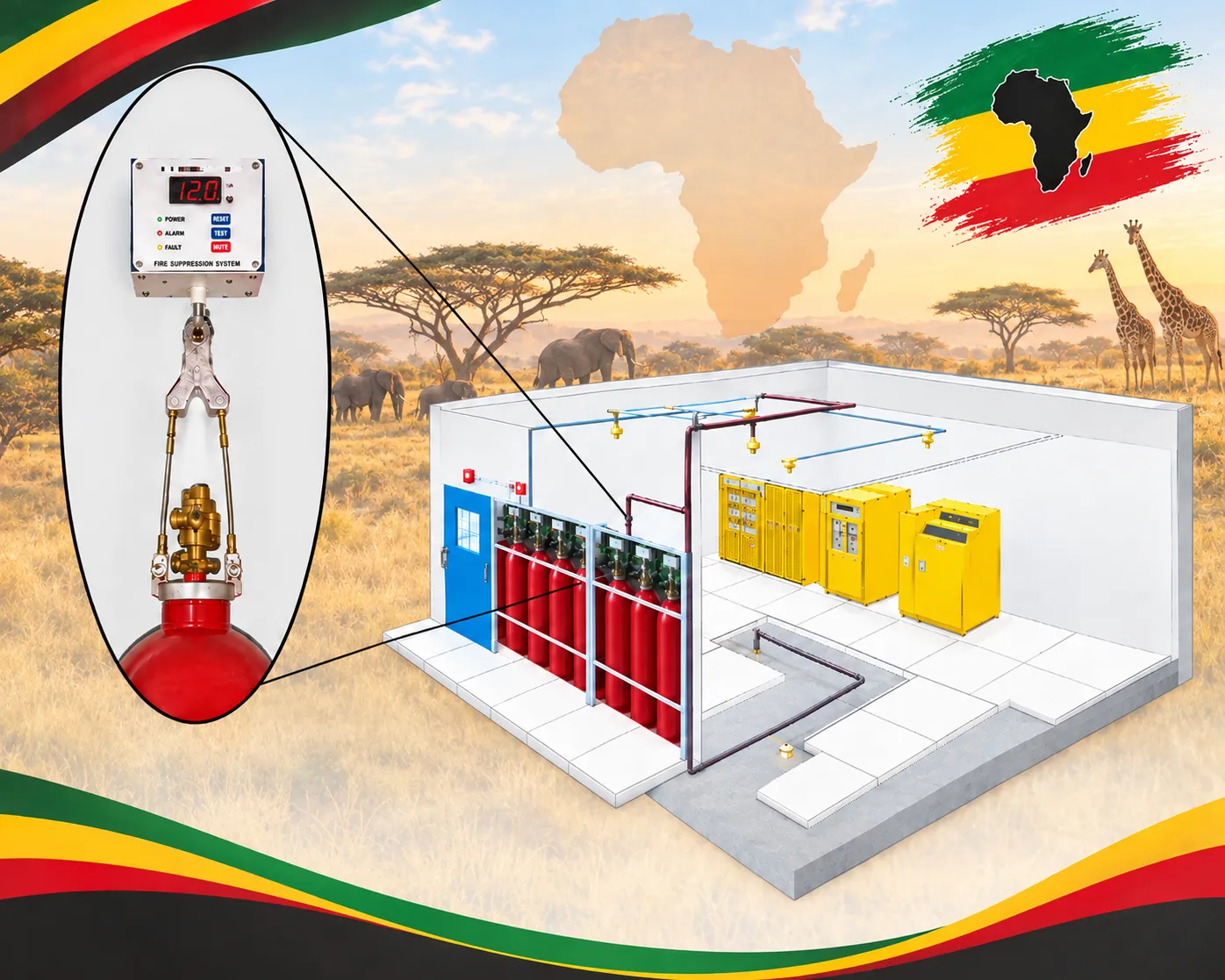
Airport Clean Agent Suppression Manufacturer in Africa
LIFEGUARD® – Airport Clean Agent Fire Suppression Systems for Critical Aviation Infrastructure
Airports are among the most operationally critical facilities in any country. Passenger terminals, air traffic control facilities, communication rooms, data centres, electrical rooms, UPS rooms, security control rooms, baggage handling systems and airport administration areas contain sensitive electrical and electronic equipment that requires rapid and carefully engineered fire protection. In such areas, conventional water-based suppression may not always be suitable because water discharge can damage critical equipment and interrupt airport operations.
LIFEGUARD® provides engineered clean agent fire suppression systems for airports and aviation facilities, designed for applications where rapid fire suppression, equipment protection, minimal residue and operational continuity are important. Clean-agent systems are commonly specified for sensitive airport spaces, and airport projects may require compliance with applicable NFPA, EN, ISO and local regulations. (Jordan E-Procurement System)
Airport Clean Agent Suppression Manufacturer – Africa
As an experienced fire protection equipment manufacturer and solution provider, LIFEGUARD® supports project requirements for automatic clean agent fire suppression systems for airport infrastructure across African markets.
Our solutions can be engineered for:
- International and domestic airports
- Airport terminals
- Air Traffic Control (ATC) facilities
- Control towers
- Communication rooms
- Airport data centres
- Server rooms
- IT and network rooms
- UPS and battery rooms
- Electrical and switchgear rooms
- Security and surveillance rooms
- Airport command and control centres
- Baggage handling control rooms
- Navigation equipment rooms
- Radar and communication facilities
- Equipment rooms
- Airport administration and operational facilities
A recent Kigali International Airport fire suppression specification, for example, called for protection of service and electrical rooms with automatic suppression, detection, alarms, manual release and abort switches, HVAC interlocks, testing and integration with the existing fire alarm system. (Rac)
Why Clean Agent Suppression Is Important for Airports
Airport infrastructure operates continuously and often contains high-value electronic equipment. A fire in a communication room, server room, electrical room or control centre can affect critical airport services.
A properly engineered clean agent system can provide:
Rapid Automatic Fire Suppression
Clean agent systems are designed to detect a developing fire and release the extinguishing agent rapidly after the configured detection and release sequence. The system is engineered to achieve the required extinguishing concentration throughout the protected enclosure.
No Water Damage
Clean agents are electrically non-conductive and leave little or no residue after discharge. This makes them particularly suitable for rooms containing computers, networking equipment, communication systems and electrical installations.
Protection of Critical Electronics
Airport control and communication infrastructure can contain sensitive electronics that cannot tolerate water or corrosive fire-extinguishing residues. Clean agent suppression provides an alternative method of protecting these assets.
Reduced Operational Downtime
An appropriately designed suppression system can help limit fire-related damage to critical equipment and support faster restoration of protected operations.
Integration With Airport Fire Safety Systems
Clean agent suppression can be integrated with:
- Addressable fire alarm systems
- Smoke and heat detection
- Aspirating smoke detection
- HVAC shutdown
- Damper control
- Access-control systems
- Building Management Systems
- Emergency alarms
- Audio-visual warning devices
- Manual release stations
- Abort switches
- Remote monitoring systems
Airport specifications commonly require coordinated detection, control, alarm and suppression functions rather than treating the clean-agent cylinder system as a standalone installation. (Los Angeles World Airports)
LIFEGUARD® Airport Clean Agent Fire Suppression Solutions
LIFEGUARD® can provide engineered clean-agent suppression solutions based on the characteristics of the protected hazard, enclosure volume, occupancy, equipment and applicable design standard.
Depending on project requirements, suitable clean-agent technologies may include:
FK-5-1-12 Clean Agent Systems
FK-5-1-12-based systems are used for protecting sensitive electrical and electronic environments where residue-free fire suppression is required.
Typical applications include:
- Airport server rooms
- Communication rooms
- Network rooms
- Control rooms
- UPS rooms
- Electrical equipment rooms
- Security systems rooms
- Data processing facilities
HFC Clean Agent Systems
HFC-based clean agent systems, where permitted by the applicable environmental and project requirements, can be considered for engineered total-flooding applications.
Selection should be based on the current applicable regulations, environmental requirements, system listing/approval and project specifications rather than simply selecting an agent by brand name.
Inert Gas Systems
Inert gas suppression technology may also be considered for selected airport applications where project requirements call for an inert-gas solution.
Agent selection should be undertaken through a proper fire risk assessment, enclosure assessment and hydraulic/design calculation.
Airport Control Room Fire Suppression
Airport control rooms and operations centres require particularly careful fire protection because they may contain personnel as well as mission-critical electronic equipment.
A typical clean-agent protection arrangement can include:
Early Smoke Detection → Fire Alarm → Cross-Zone Confirmation → Pre-Discharge Alarm → Time Delay → HVAC Shutdown → Agent Release → Nozzle Discharge → Fire Suppression
The actual sequence of operation must be established according to the approved design, authority requirements and project specifications.
For airport control rooms, the system may incorporate:
- Smoke detectors
- Multi-criteria detection
- Addressable releasing panel
- Clean-agent cylinders
- Discharge piping
- Engineered nozzles
- Manual release station
- Abort switch
- Pre-discharge sounder
- Visual warning indicator
- HVAC shutdown interface
- Fire alarm interface
- Emergency power arrangements
Clean Agent Protection for Airport Data Centres
Airport data centres are particularly important because they may support passenger processing, security, communications, surveillance, operational systems and other digital infrastructure.
Clean-agent suppression is widely used in critical IT environments because the suppression medium does not introduce the same water-related equipment exposure associated with conventional sprinkler discharge.
The system should be designed around:
- Room volume
- Ceiling height
- Raised-floor volume
- Equipment arrangement
- Agent concentration
- Discharge requirements
- Pipe network
- Nozzle arrangement
- Room integrity
- HVAC operation
- Pressure relief
- Detection zoning
- Occupancy
- Required hold time
NFPA 2001-based specifications commonly require enclosure integrity testing as part of acceptance of clean-agent systems. (AAI)
Airport Electrical Room Fire Suppression
Electrical rooms, switchgear rooms, UPS rooms and power distribution areas can contain significant ignition sources and high-value equipment.
LIFEGUARD® clean-agent systems can be engineered for such spaces where project requirements call for gaseous fire suppression.
Typical protected equipment may include:
- Electrical switchboards
- Control panels
- UPS systems
- Battery systems
- Power distribution equipment
- Automation equipment
- Communication equipment
- Control cabinets
The system design must consider the actual fire hazard, enclosure construction, ventilation and equipment configuration.
Standards for Airport Clean Agent Suppression Systems in Africa
The applicable standard depends on the country, airport authority, project specification and authority having jurisdiction.
NFPA 2001 is a major international reference for clean-agent fire extinguishing system design. African projects may additionally reference local standards and regulations.
For example, South African specifications can reference SANS 14520 for fixed firefighting gaseous extinguishing systems alongside NFPA 2001 and SANS 10400 requirements. (SANBI)
Airport projects may therefore require consideration of:
- NFPA 2001
- NFPA 72
- SANS 14520
- SANS 10400
- Applicable EN/ISO standards
- Local fire authority requirements
- Airport-specific engineering specifications
- Environmental regulations
- Authority Having Jurisdiction requirements
The final design should always be based on the latest applicable edition and the requirements of the relevant local authority.
Engineering and Design of Airport Clean Agent Systems
A professional airport clean-agent suppression system should not be selected simply according to room size. The complete system requires engineering evaluation.
1. Hazard Assessment
The first stage is identification of:
- Fire hazards
- Fuel types
- Electrical equipment
- Occupancy
- Ignition sources
- Ventilation
- Equipment density
- Room construction
2. Protected Volume Calculation
The protected enclosure is evaluated to determine the required agent quantity.
3. Agent Quantity Calculation
The quantity of extinguishing agent is calculated according to the selected agent, hazard classification, design concentration and applicable standard.
4. Hydraulic/Pipe Network Design
The piping system and nozzle arrangement are engineered to deliver the required quantity of agent within the specified discharge parameters.
5. Detection and Release Logic
The detection system, releasing panel and suppression equipment are coordinated to provide the specified alarm and release sequence.
6. Room Integrity
The protected room must be capable of retaining the extinguishing concentration for the required period. Door fan/enclosure integrity testing may therefore form an important part of commissioning. (AAI)
7. Pressure Relief
Where required, pressure-relief arrangements should be incorporated into the protected enclosure based on the engineered system design.
LIFEGUARD® Airport Suppression System Components
A complete airport clean-agent system can include:
- Clean agent cylinders
- Agent storage containers
- Cylinder valves
- Pressure gauges
- Actuation mechanisms
- Discharge piping
- Discharge nozzles
- Releasing control panel
- Smoke detectors
- Heat detectors
- Manual release switch
- Abort switch
- Pre-discharge warning devices
- Audio-visual alarms
- Pressure relief provisions
- HVAC shutdown interface
- Fire alarm interface
- Monitoring interface
- Cylinder brackets and supports
- System signage
The exact components depend on the approved system design and project requirements.
Airport Fire Suppression Installation, Testing & Commissioning
LIFEGUARD® airport clean-agent projects can be structured around the complete project lifecycle:
Survey → Hazard Assessment → System Design → Hydraulic Calculation → Engineering Drawings → Material Supply → Installation → Detection Integration → Functional Testing → Enclosure Integrity Testing → Commissioning → Training → Handover
Testing and commissioning should verify:
- Detection operation
- Alarm sequence
- Pre-discharge warning
- Manual release
- Abort function
- Release logic
- HVAC shutdown
- Fire alarm interface
- Cylinder/agent system readiness
- Nozzle installation
- Pipework integrity
- System monitoring
- Cause-and-effect sequence
- Enclosure integrity where applicable
Airport fire suppression specifications can also require as-built documentation, operation manuals, training and maintenance information as part of final handover. (Rac)
Clean Agent Suppression Manufacturer for African Airports
LIFEGUARD® can support clean-agent suppression requirements for airport projects throughout African markets, including:
South Africa | Kenya | Nigeria | Ghana | Rwanda | Tanzania | Uganda | Ethiopia | Zambia | Zimbabwe | Botswana | Namibia | Mozambique | Angola | Egypt | Morocco | Algeria | Tunisia | Senegal | Cameroon
Project requirements vary by country and airport authority. LIFEGUARD® can therefore support projects with application-specific engineering, technical documentation and system selection based on the applicable standards and specifications.
Why Choose LIFEGUARD®?
LIFEGUARD® combines fire protection manufacturing expertise with engineered suppression solutions for critical infrastructure.
Key capabilities include:
- Fire protection equipment manufacturing
- Clean-agent suppression solutions
- Automatic fire detection and suppression integration
- Engineered system design
- Technical documentation
- Project-specific system configuration
- Installation support
- Testing and commissioning
- Training and handover
- After-sales support
For international projects, the required product approvals, certifications and system listings should be confirmed against the specific project specification and applicable authority requirements.
Airport Clean Agent Suppression Manufacturer – SEO Conclusion
Airports require fire protection systems that address both life safety and business-critical infrastructure protection. Clean-agent fire suppression is particularly relevant for airport spaces containing sensitive electronics, communication systems, control equipment, IT infrastructure and electrical installations where rapid suppression and minimal residue are important.
LIFEGUARD® provides engineered airport clean agent fire suppression systems for Africa, supporting applications ranging from airport data centres and communication rooms to control rooms, electrical rooms, UPS rooms and other mission-critical facilities.
With properly engineered detection, releasing controls, agent storage, piping, nozzles, alarm interfaces, HVAC interlocks and enclosure integrity measures, a clean-agent system can form an important layer of protection for modern airport infrastructure.
LIFEGUARD® – Clean Agent Fire Suppression Systems for Airports, Aviation Infrastructure, Data Centres, Control Rooms and Critical Facilities across Africa.
Target SEO Keywords
Primary Keywords
- airport clean agent suppression manufacturer Africa
- airport clean agent fire suppression manufacturer Africa
- airport fire suppression system manufacturer Africa
- clean agent suppression system Africa
- airport fire suppression company Africa
Secondary Keywords
- airport clean agent system
- airport gas suppression system
- airport data centre fire suppression
- airport control room fire suppression
- airport electrical room fire suppression
- clean agent manufacturer Africa
- automatic fire suppression system Africa
- clean agent fire protection Africa
- aviation fire suppression system
- airport fire safety equipment manufacturer
Long-Tail Keywords
- airport clean agent suppression system manufacturer in Africa
- clean agent fire suppression solutions for African airports
- airport data centre clean agent suppression system Africa
- airport control room clean agent fire suppression manufacturer
- clean agent fire suppression company for airports in Africa
- automatic clean agent suppression system for airport communication rooms
- airport electrical room gas suppression system Africa
Keywords






