
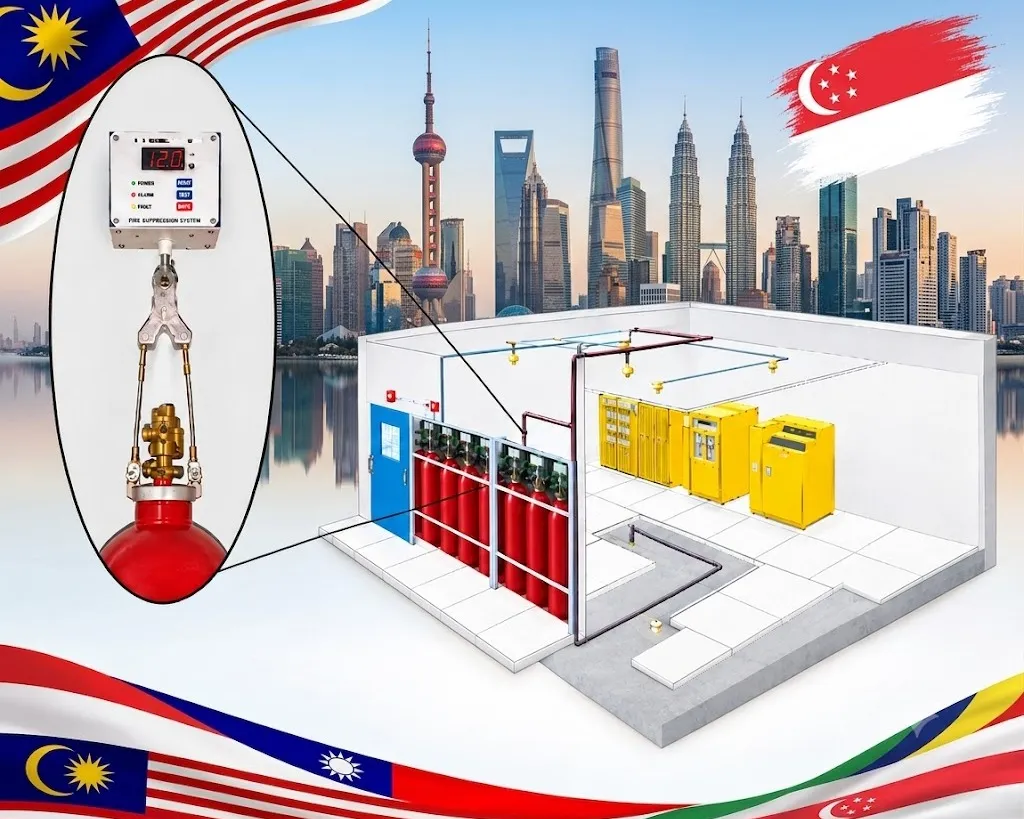
Airport Clean Agent Suppression Manufacturer in Asia
LIFEGUARD® is an experienced fire safety solutions provider offering engineered clean agent fire suppression systems for airports, aviation facilities, airport terminals, technical rooms, electrical rooms, data centres, communication rooms, control rooms, UPS rooms, server rooms and other critical airport infrastructure across Asia.
Modern airports are complex facilities where uninterrupted operations, passenger safety, critical electronics and business continuity must be protected simultaneously. Fire protection therefore needs to address not only conventional fire risks but also sensitive electrical and electronic equipment where the use of water or residue-producing extinguishing media may create additional damage.
As an airport clean agent suppression manufacturer and fire protection system provider in Asia, LIFEGUARD® develops and supplies engineered gaseous fire suppression solutions designed around the characteristics of the protected enclosure, fire risk, equipment, occupancy and applicable project requirements.
Our solutions can be engineered for applications where rapid automatic fire detection and clean-agent extinguishing are required to protect valuable assets while minimizing post-fire cleanup and equipment contamination.
Clean Agent Fire Suppression Systems for Airports
Airports contain a wide range of specialized areas with different fire hazards. Passenger terminals, baggage handling areas, electrical substations, IT infrastructure, security systems, air traffic-related equipment, communication systems, control rooms and utility facilities all require carefully planned fire protection.
A clean agent fire suppression system is particularly useful for enclosed spaces containing sensitive electronic and electrical equipment. Clean agents are electrically non-conductive and can be engineered for applications where protection of high-value assets and reduced cleanup are important considerations.
LIFEGUARD® can provide engineered solutions incorporating:
- Automatic fire detection
- Fire alarm and releasing control panels
- Clean agent storage cylinders
- Cylinder valves and actuation arrangements
- Pressure monitoring
- Discharge piping
- Engineered discharge nozzles
- Manual release stations
- Abort switches
- Audible and visual pre-discharge alarms
- HVAC shutdown interfaces
- Damper and door interlocking
- Equipment shutdown interfaces
- Fire alarm and BMS integration
- Pressure relief arrangements
- System monitoring and indication
The final configuration is selected according to the protected hazard, enclosure volume, agent selection, applicable standards and project-specific engineering requirements.
Why Airports Require Specialized Fire Suppression
Airport facilities operate continuously and contain a combination of people, electrical equipment, communication infrastructure, fuel-related hazards, commercial spaces and mission-critical systems.
ICAO's airport safety framework places significant emphasis on rescue and firefighting facilities and services. ICAO Airport Services Manual Part I provides guidance relating to airport rescue and firefighting, including protection levels, extinguishing agents, equipment and operating procedures.
However, airport fire protection is not limited to aircraft rescue and firefighting. Building and infrastructure protection within an airport also requires appropriately engineered systems for individual hazards.
For example, a technical room containing electrical or electronic equipment may require a different suppression strategy from an aircraft hangar, fuel facility, kitchen or passenger terminal.
This is where engineered clean-agent technology can play an important role.
LIFEGUARD® Airport Clean Agent Suppression Solutions
As an airport clean agent suppression manufacturer in Asia, LIFEGUARD® focuses on providing complete fire suppression solutions rather than treating the extinguishing agent as an isolated product.
Our engineering approach can include:
1. Hazard Assessment
The first stage is understanding the protected area, equipment, occupancy, fire risk and operational requirements.
The assessment may consider:
- Room dimensions
- Ceiling height
- Raised floor
- False ceiling
- Equipment layout
- Electrical load
- HVAC configuration
- Ventilation openings
- Door and damper arrangements
- Occupancy
- Fire risk
- Required response philosophy
- Agent storage location
2. Automatic Fire Detection
Early detection is essential for automatic suppression.
Depending on the application, suitable detection technology may include smoke detectors, heat detectors, multi-sensor detectors or other approved detection arrangements.
The detection philosophy can be engineered around the risk and project requirements, including suitable alarm verification and releasing logic.
3. Releasing Control
A dedicated fire suppression releasing panel can monitor detection devices and control the suppression sequence.
Typical functions may include:
- First-stage fire alarm
- Second-stage alarm
- Pre-discharge warning
- Countdown or time delay
- Automatic release
- Manual release
- Abort function
- Cylinder actuation
- HVAC shutdown
- Damper closure
- Equipment shutdown
- Fire alarm interface
- BMS monitoring
The exact cause-and-effect sequence should be established during project engineering and approved according to the applicable authority and project specification.
4. Clean Agent Storage
The required quantity of clean agent is calculated according to the protected volume, design concentration, agent characteristics, environmental conditions and applicable design methodology.
LIFEGUARD® can engineer cylinder arrangements according to project requirements, including main and standby configurations where required.
5. Piping and Nozzle Engineering
Clean-agent systems require properly engineered distribution networks.
The pipe network and discharge nozzles are selected and calculated according to the applicable system design requirements.
Important considerations include:
- Pipe diameter
- Pipe length
- Branch configuration
- Nozzle quantity
- Nozzle location
- Discharge characteristics
- Pressure
- Agent quantity
- Room volume
- Ceiling configuration
The objective is to achieve appropriate agent distribution throughout the protected enclosure.
Airport Areas Suitable for Clean Agent Protection
LIFEGUARD® clean agent fire suppression systems can be engineered for a variety of airport infrastructure applications.
Airport Data Centres
Airport data centres support essential digital infrastructure and may contain servers, networking equipment, storage systems and communication systems.
A clean-agent system can provide automatic fire suppression while avoiding the water damage associated with conventional water-based systems in appropriately designed applications.
Server and IT Rooms
Server rooms require rapid detection and suppression because even a relatively small fire can interrupt airport operations.
Clean-agent suppression can be integrated with fire detection, releasing panels, HVAC shutdown and building management systems.
Airport Control Rooms
Control rooms may contain sensitive electronic equipment and mission-critical systems.
Fire protection should be engineered to minimize equipment damage and operational interruption.
Communication Rooms
Airport communication infrastructure is essential for maintaining operational connectivity.
Clean-agent systems can provide protection for enclosed communication equipment rooms where gaseous suppression is appropriate.
UPS and Battery Rooms
UPS installations contain significant electrical equipment and require careful consideration of fire hazards, ventilation and system compatibility.
The suppression strategy should be selected following a detailed hazard assessment and applicable standards.
Electrical and Switchgear Rooms
Electrical rooms can contain high-value equipment where water discharge may create secondary damage.
Where permitted by the applicable design requirements, clean-agent suppression can provide an alternative fire protection approach.
Baggage Handling Control Rooms
Modern baggage systems rely on extensive automation, control equipment, electrical panels and communication infrastructure.
Critical control rooms associated with baggage handling can be evaluated for clean-agent protection.
Airport Security and Surveillance Rooms
Security control rooms and surveillance centres often contain servers, monitors, communication equipment and electronic systems operating continuously.
Clean-agent suppression can be engineered for these enclosed technical areas.
Airport Telecom Rooms
Telecommunication rooms containing switches, routers, servers and related equipment can benefit from an appropriately designed gaseous fire suppression solution.
Air Traffic and Navigation Support Facilities
Certain enclosed technical facilities associated with aviation infrastructure may require specialized fire protection because of the sensitivity and importance of electronic equipment.
The exact protection strategy must be established according to the specific facility, applicable aviation requirements and authority having jurisdiction.
How an Airport Clean Agent Suppression System Works
A typical automatic clean-agent suppression sequence can include the following stages:
Stage 1 – Fire Detection
Smoke, heat or other approved detection devices identify signs of a developing fire.
Stage 2 – Alarm
The fire alarm/releasing panel receives the detector signal and initiates the programmed alarm sequence.
Stage 3 – Pre-Discharge Warning
Audible and visual warning devices notify occupants that the suppression system is preparing for discharge.
Stage 4 – Equipment Interlocking
Where required, the system can initiate programmed interfaces such as:
- HVAC shutdown
- Damper closure
- Equipment shutdown
- Door interfaces
- Fire alarm notification
- BMS signals
Stage 5 – Agent Release
After the programmed release conditions are satisfied, the suppression system activates the cylinder valve and releases the clean agent.
Stage 6 – Agent Distribution
The clean agent flows through the engineered pipe network and is discharged through strategically positioned nozzles.
Stage 7 – Fire Suppression
The required agent concentration is established within the protected enclosure to suppress the fire according to the engineered design.
Stage 8 – Post-Discharge Monitoring
After discharge, the system can provide alarm and supervisory indications to facilitate emergency response, inspection, ventilation and system restoration.
Clean Agent Selection for Airport Applications
The choice of clean agent should never be based only on marketing preference. It should consider:
- Fire hazard
- Protected volume
- Occupancy
- Equipment sensitivity
- Design concentration
- Environmental conditions
- Agent availability
- Cylinder storage
- Applicable codes and standards
- Authority requirements
- Project specifications
- Manufacturer system limitations
Common gaseous suppression technologies used in appropriate applications include FK-5-1-12 and HFC-based clean agents, subject to project requirements and applicable regulations.
For airport projects, LIFEGUARD® can work with project consultants, airport operators, EPC contractors, MEP consultants and system integrators to identify an appropriate suppression configuration.
Airport Fire Suppression Engineering
Airport projects often involve strict coordination between multiple engineering disciplines.
LIFEGUARD® can support project requirements involving:
Fire Detection + Fire Alarm + Suppression + HVAC Interlocking + Electrical Shutdown + BMS Integration
The system design may include:
- Hydraulic/piping network design
- Agent quantity calculation
- Nozzle selection
- Cylinder selection
- Detection layout
- Cause-and-effect matrix
- Control panel configuration
- Interlock philosophy
- Installation drawings
- As-built documentation
- Testing and commissioning
- Operation and maintenance documentation
A clean-agent installation should be engineered specifically for the protected enclosure rather than treated as a generic package.
Standards and Compliance Considerations
Airport fire protection projects may involve multiple standards, regulations and authority requirements.
Depending on the project location and application, the design may need to consider standards and guidance such as:
- NFPA 2001 – Clean Agent Fire Extinguishing Systems
- NFPA 72 – National Fire Alarm and Signaling Code
- ICAO Annex 14
- ICAO Airport Services Manual
- Applicable national fire safety standards
- Civil aviation authority requirements
- Local building and fire regulations
- Project-specific airport specifications
ICAO Annex 14 identifies rescue and firefighting services as an important component of aerodrome safety, while national aviation authorities may establish additional requirements for airport facilities.
For example, Airports Authority of India states that its Airport Rescue and Fire Fighting services operate according to applicable DGCA and ICAO norms and guidelines.
Important: Compliance requirements vary by country, airport classification, protected hazard and project specification. Final system selection, design and certification should therefore be confirmed against the applicable authority and project requirements.
Why Choose LIFEGUARD® for Airport Fire Suppression?
LIFEGUARD® brings extensive experience in fire safety equipment and engineered fire protection applications.
Our capabilities include:
Indian Fire Safety Manufacturing Experience
LIFEGUARD® has been associated with fire safety equipment manufacturing in India for decades, serving industrial, infrastructure and institutional requirements.
Engineered Fire Protection
Airport projects require more than individual fire protection products. LIFEGUARD® supports engineered system solutions incorporating detection, control, suppression and interlocking.
Clean Agent Expertise
Our clean-agent solutions are intended for applications where protection of critical equipment, reduced residue and rapid automatic suppression are important considerations.
Project-Specific Design
Every airport facility has different room volumes, equipment arrangements, ventilation conditions and fire hazards. System design can therefore be customized to project requirements.
Integration Capability
Suppression systems can be coordinated with fire alarm panels, HVAC systems, electrical systems and BMS interfaces according to the approved cause-and-effect philosophy.
Testing & Commissioning
Proper commissioning is essential to verify detection, alarm, release logic, interlocks, supervision and system functionality before handover.
Airport Clean Agent Suppression Manufacturer and Supplier in Asia
Asia has some of the world's most rapidly developing aviation infrastructure, including international airports, regional airports, cargo terminals, airport cities, aviation maintenance facilities and integrated transportation hubs.
Airport development across countries such as:
- India
- UAE and the Middle East
- Singapore
- Malaysia
- Indonesia
- Thailand
- Vietnam
- Philippines
- Bangladesh
- Sri Lanka
- Nepal
- Maldives
- Saudi Arabia
- Qatar
- Oman
requires coordinated fire protection solutions adapted to local regulations and project specifications.
LIFEGUARD® can support airport fire protection requirements through project-based engineering, supply, installation support, testing and commissioning coordination, subject to project scope and location.
Airport Clean Agent Suppression OEM & System Integration
For airport EPC contractors, MEP consultants, fire protection contractors, system integrators and project developers, LIFEGUARD® can support OEM/system integration requirements.
Our project support may include:
- Technical submittals
- Product documentation
- System design support
- Technical calculations
- Datasheets
- GA drawings
- Installation drawings
- Cause-and-effect documentation
- Operation and maintenance manuals
- Testing and commissioning support
- Training and handover documentation
This approach enables project stakeholders to coordinate fire suppression requirements from design through commissioning.
Clean Agent Suppression for Airport Business Continuity
Airport infrastructure operates around the clock. Fire incidents in technical areas can potentially affect passenger processing, communications, security, baggage handling, information technology and other airport functions.
An appropriately engineered clean-agent system can provide rapid automatic suppression while helping minimize secondary contamination in suitable applications.
The objective is not simply to extinguish a fire. The overall fire protection strategy should aim to:
- Detect fire at an early stage
- Notify occupants and operators
- Initiate suppression quickly
- Protect critical assets
- Coordinate equipment shutdown
- Minimize secondary damage
- Support safe emergency response
- Facilitate faster system recovery
Partner with LIFEGUARD® for Airport Fire Protection
Whether you are developing a new airport terminal, upgrading an existing airport facility or protecting a specialized technical room, LIFEGUARD® can support your clean-agent fire suppression requirements.
Our team can evaluate project requirements and develop a suitable fire suppression concept based on:
Hazard → Room Volume → Detection → Agent → Cylinder → Piping → Nozzles → Control → Interlocks → Testing → Commissioning
For airport projects, early involvement of the fire protection specialist can help coordinate suppression requirements with architectural, electrical, HVAC, IT and BMS design.
Frequently Asked Questions
What is an airport clean agent fire suppression system?
An airport clean agent fire suppression system is an automatic fire detection and gaseous extinguishing system designed to protect suitable enclosed airport areas, particularly spaces containing sensitive electrical, electronic or high-value equipment.
Where are clean-agent systems used in airports?
They may be used in server rooms, data centres, communication rooms, electrical rooms, control rooms, UPS rooms, security rooms, telecom rooms and other enclosed technical spaces where a clean extinguishing medium is appropriate.
Is clean agent suitable for every airport fire risk?
No. Clean-agent systems are not a universal replacement for all airport fire protection systems. Aircraft rescue and firefighting, fuel hazards, kitchens, warehouses, hangars and other areas may require different fire protection technologies. The system should be selected through a hazard-specific engineering assessment.
Which standards are relevant to airport clean-agent systems?
Depending on the application and location, relevant requirements can include NFPA 2001, NFPA 72, ICAO guidance, national fire codes, aviation authority requirements and project-specific specifications.
Can LIFEGUARD® integrate clean-agent suppression with a fire alarm system?
Yes. A properly engineered system can incorporate detection, releasing control, audible/visual alarms and interfaces with HVAC, electrical equipment and BMS where required by the approved system philosophy.
Can LIFEGUARD® provide airport fire suppression systems outside India?
LIFEGUARD® can support international and Asian project requirements on a project-specific basis, subject to applicable local regulations, approvals, logistics and technical scope.
Does a clean-agent system leave residue?
Clean agents are generally selected for applications where minimizing residue and cleanup is important. However, system suitability, agent selection and installation requirements must be evaluated for the specific application.
Does the system require room integrity?
For total-flooding clean-agent systems, enclosure integrity is an important design consideration because the required agent concentration must be achieved and maintained for the specified design period.
Conclusion
Airports demand specialized fire protection because they combine high passenger occupancy, critical infrastructure, electronic systems and continuous operations. LIFEGUARD® provides engineered clean agent fire suppression solutions for suitable airport technical and critical infrastructure applications across Asia, combining automatic detection, suppression control, agent storage, engineered distribution and system integration.
From airport data centres and server rooms to communication facilities, electrical rooms, control centres and other sensitive technical spaces, LIFEGUARD® focuses on application-specific fire protection designed around the requirements of each protected enclosure.
LIFEGUARD® – Engineered Fire Safety Solutions for Airports, Aviation Infrastructure and Critical Facilities.
Contact LIFEGUARD® for airport clean agent fire suppression system design, technical consultation, project engineering, supply, installation support, testing and commissioning requirements.
Email: ufe126@gmail.com | info@lifeguardindia.in
Website: www.lifeguardindia.in
Keywords






