
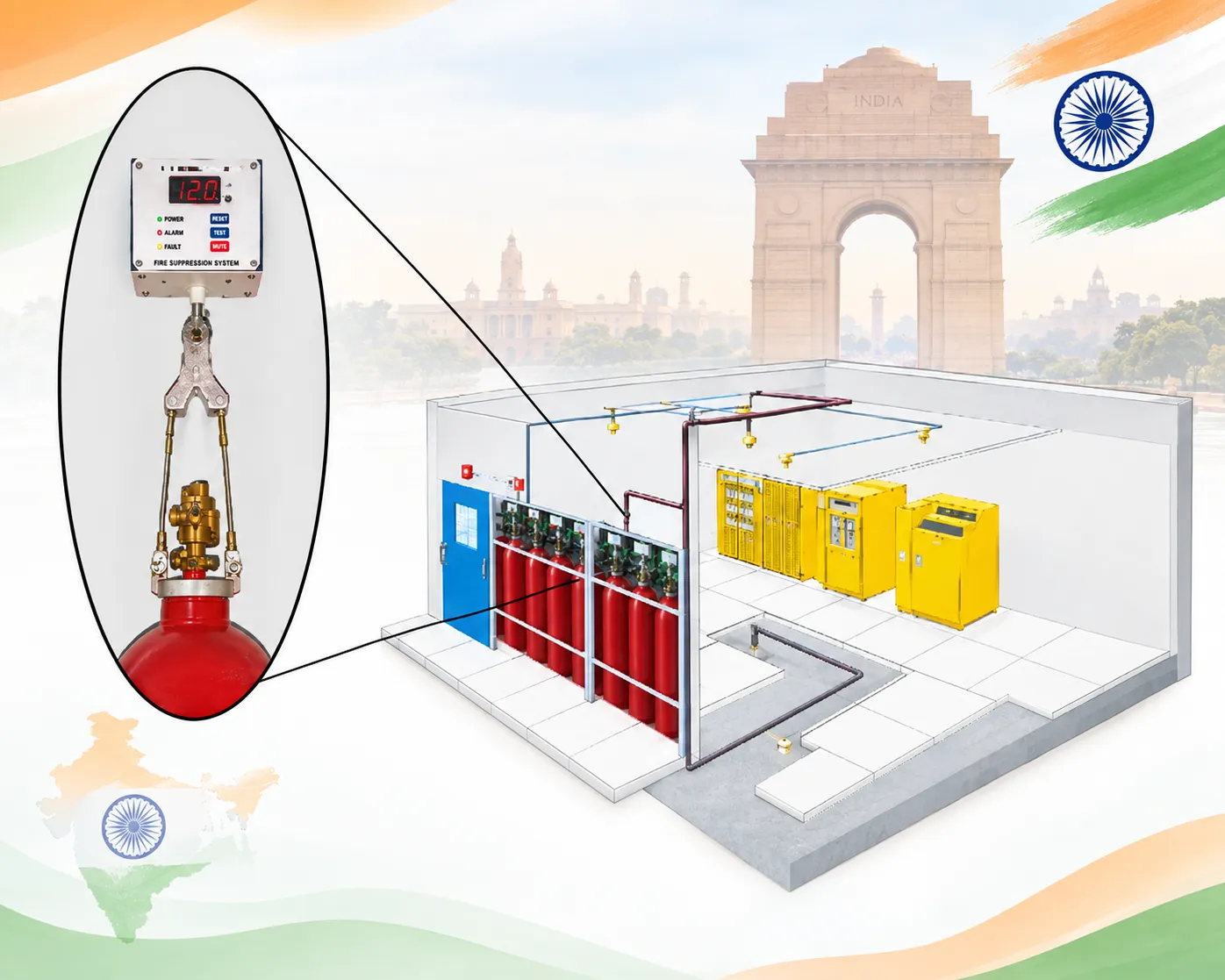
Airport Clean Agent Suppression Manufacturer in India
LIFEGUARD® – Advanced Clean Agent Fire Suppression Systems for Airports, Aviation Infrastructure & Critical Airport Facilities
Airports are among the most safety-critical facilities in the world, combining passenger terminals, aviation operations, data centres, electrical rooms, communication infrastructure, baggage systems, control rooms, server rooms, UPS rooms and other mission-critical installations. Fire protection in these environments requires more than conventional firefighting—it requires rapid detection, reliable suppression, minimal equipment damage and operational continuity.
LIFEGUARD® provides engineered clean agent fire suppression systems for airports in India, designed for applications where water or conventional extinguishing media may damage sensitive electrical and electronic equipment. Airport fire protection also operates within a highly regulated environment; AAI states that airport fire safety protection follows applicable ICAO and DGCA guidelines, while its ARFF services cover both aircraft operations and protection of terminal buildings and vital installations. (AAI)
Airport Clean Agent Fire Suppression Systems
A clean agent suppression system is an engineered fire protection solution that detects a developing fire and rapidly discharges an approved gaseous or clean extinguishing agent into a protected enclosure. The system is particularly suitable for areas containing high-value electronic and electrical equipment where discharge of water, foam or dry chemical could cause secondary damage.
LIFEGUARD® airport clean agent systems can be engineered for:
- Airport data centres and server rooms
- IT and network rooms
- Airport command and control centres
- Air Traffic Control (ATC) support facilities
- Communication rooms
- Electrical and control rooms
- UPS and battery rooms, subject to the applicable hazard assessment
- Baggage handling control rooms
- Security and surveillance rooms
- Airport operations centres
- Electrical substations and equipment rooms
- Aviation navigation-support infrastructure
- Telecom and equipment rooms
- Critical airport infrastructure and technical facilities
AAI procurement documentation demonstrates the importance of engineered clean-agent protection for critical airport infrastructure, including requirements for complete agent suppression systems, detection, cylinders, valves, discharge piping/accessories and compliance with applicable standards. (AAI)
Why Clean Agent Suppression is Important for Airports
Airport facilities cannot always rely exclusively on conventional water-based firefighting. Sensitive electronic infrastructure can be vulnerable to water damage, while some rooms require rapid fire suppression with minimal interruption to operations.
A properly engineered clean agent system can provide:
1. Rapid Fire Suppression
Clean agents are designed to act rapidly following confirmed fire detection. Early detection combined with automatic release can help control a fire before it develops into a larger incident.
2. Protection of Critical Electronics
Clean-agent systems are particularly useful in areas containing servers, control electronics, communication equipment and electrical systems where conventional extinguishing media may create substantial secondary damage.
3. Minimal Residue
Unlike dry chemical powder systems, gaseous clean agents are generally designed to leave little or no residue after discharge, reducing post-fire cleanup requirements for appropriately protected equipment.
4. Space-Efficient Engineering
Airport technical rooms frequently have valuable floor space occupied by electrical and electronic equipment. Clean-agent systems can be engineered around available cylinder storage, piping routes and protected enclosure requirements.
5. Integration with Fire Detection
A complete airport suppression installation can integrate:
Smoke/Fire Detection → Fire Alarm & Suppression Panel → Pre-Discharge Alarm → Time Delay → HVAC/Equipment Interlock → Agent Release → Discharge Alarm
AAI technical requirements for critical infrastructure include integration of fire detection and alarm systems with building systems and other interfaces, demonstrating the importance of coordinated fire protection engineering. (AAI)
LIFEGUARD® Airport Clean Agent Suppression Manufacturer
LIFEGUARD® develops and supplies engineered fire protection solutions for critical applications where reliability and controlled fire suppression are essential.
For airport projects, a clean-agent system may incorporate:
- Clean agent storage cylinders
- Agent cylinders and cylinder valves
- Automatic detection system
- Addressable fire alarm/suppression control panel
- Pressure switches
- Solenoid/electric actuators
- Manual release station
- Abort switch
- Discharge nozzles
- Discharge piping
- Flexible discharge hoses
- Pressure relief arrangements
- Audible and visual alarms
- Pre-discharge warning devices
- HVAC shutdown interface
- Damper/control interface
- Access-control interface where required
- Emergency/manual release facilities
- System monitoring and supervisory functions
The exact configuration should be determined through hazard assessment, enclosure volume, equipment layout, agent selection, design concentration, discharge requirements and applicable codes/standards.
Clean Agent Applications in Airport Facilities
Airport Data Centre Fire Suppression
Airport data centres are essential to modern aviation infrastructure. Servers, network equipment, storage systems, communication equipment and associated electrical systems require specialised fire protection.
A clean-agent system can provide automatic protection without relying on water discharge inside the server enclosure.
AAI documentation for a data-centre project specifies clean-agent suppression designed around NFPA 2001, with requirements covering cylinders, agent, detection and associated system components. It also addresses enclosure integrity and maintaining agent concentration following discharge. (AAI)
Airport Control Room Fire Suppression
Control rooms contain critical electronic equipment that supports airport operations. Fire detection and suppression systems can be engineered to provide rapid response while coordinating with HVAC, electrical and other building systems.
Airport Communication Room Protection
Communication infrastructure requires continuous availability. Clean-agent suppression can be considered for communication and telecom rooms where protection of electronic equipment is a priority.
Airport Electrical Room Protection
Electrical and control equipment can represent a significant fire risk. Depending on the specific hazard, equipment configuration and applicable engineering requirements, clean-agent protection can form part of the overall fire strategy.
Airport Baggage System Control Areas
Modern airports use extensive automated baggage handling systems. Control panels, electrical equipment and automation infrastructure can be protected using appropriately engineered fire detection and clean-agent suppression systems.
Airport Security & Surveillance Rooms
CCTV, access control, monitoring and security systems are essential airport infrastructure. Clean-agent systems can provide protection for enclosed technical rooms containing sensitive electronic equipment.
Airport Clean Agent System Design
LIFEGUARD® clean-agent suppression solutions can be engineered around the specific requirements of each airport facility.
A typical design process includes:
Site Survey → Hazard Identification → Room/Enclosure Assessment → Agent Selection → Hydraulic/Piping Design → Nozzle Calculation → Detection Design → Interlock Design → Installation → Testing & Commissioning → Handover
Important engineering considerations include:
- Protected enclosure volume
- Ceiling height
- Equipment arrangement
- Room leakage characteristics
- Ambient conditions
- Agent storage arrangement
- Cylinder location
- Pipe routing
- Nozzle positioning
- Required design concentration
- Detection coverage
- Pre-discharge warning
- HVAC shutdown
- Electrical interlocks
- Door/damper interfaces
- Manual release
- Abort functionality
- Pressure relief
- Enclosure integrity
- Agent retention
- Inspection and maintenance requirements
For enclosed clean-agent systems, enclosure integrity is especially important because leakage can affect agent concentration and retention. AAI's published technical requirements specifically reference enclosure integrity testing as part of acceptance for clean-agent systems. (AAI)
Standards & Compliance
Airport fire protection projects should be designed according to the project-specific specification and applicable statutory, aviation, fire and international standards.
Depending on the application, specifications may reference:
- NFPA 2001 – Clean Agent Fire Extinguishing Systems
- NFPA 72 – National Fire Alarm and Signaling Code
- NFPA 70 – National Electrical Code, where applicable
- Relevant ISO standards
- Applicable BIS/Indian Standards
- DGCA requirements
- ICAO guidelines
- Airport operator specifications
- Local fire authority requirements
- Project-specific engineering specifications
AAI's published requirements for critical infrastructure specifically reference NFPA 2001, NFPA 72, NFPA 70 or applicable ISO standards for clean-agent and fire detection systems. (AAI)
The applicable approval/certification requirements should always be confirmed against the project specification and the exact equipment/system configuration rather than assumed generically.
Environmentally Considered Clean Agent Solutions
Modern airport infrastructure increasingly considers environmental characteristics when selecting extinguishing agents.
For example, an AAI technical specification for a critical infrastructure project required a clean agent with zero ozone-depleting potential and global warming potential not exceeding one, together with compliance with its specified NFPA 2001 requirements. (AAI)
LIFEGUARD® can assist consultants, airport operators, EPC contractors and MEP/fire contractors in evaluating suitable clean-agent technologies based on:
- Environmental characteristics
- Fire hazard
- Occupancy
- Equipment sensitivity
- Required design concentration
- Cylinder capacity
- Available plant room space
- Piping distance
- Project specifications
- Applicable approvals and certifications
Automatic Detection and Suppression Sequence
A typical automatic airport clean-agent suppression system can operate through a carefully coordinated sequence:
Stage 1 – Fire Detection
Automatic smoke/heat detection identifies a developing fire.
Stage 2 – Alarm
The fire alarm/suppression panel generates a local and/or integrated alarm.
Stage 3 – Confirmation
Depending on system philosophy, cross-zoned or other approved detection logic can be used before automatic release.
Stage 4 – Pre-Discharge Warning
Audible and visual warning devices alert personnel before agent discharge.
Stage 5 – Equipment Interlock
HVAC or other designated equipment can be shut down through engineered interfaces.
Stage 6 – Agent Release
The suppression system activates the cylinder release mechanism.
Stage 7 – Agent Discharge
The clean agent is distributed through engineered piping and discharge nozzles.
Stage 8 – Fire Suppression & Retention
The design concentration is established and maintained for the required period, subject to the system design and enclosure integrity.
Stage 9 – Post-Discharge Response
The system remains under alarm/supervision and the airport emergency/fire response procedures are followed.
Airport Fire Safety: Beyond Aircraft Rescue & Firefighting
Airport fire protection is broader than aircraft emergency response. AAI describes ARFF responsibilities as including protection of airport terminal buildings and other vital installations, in addition to aircraft-related emergencies. (AAI)
This makes a comprehensive airport fire protection strategy important across:
Airside Infrastructure + Terminal Buildings + Technical Rooms + Electrical Infrastructure + IT/Communication Facilities + Operational Buildings
Clean-agent suppression forms one specialised component within this broader fire protection strategy.
Why Choose LIFEGUARD® for Airport Clean Agent Systems?
LIFEGUARD® brings experience in engineered fire protection and critical fire suppression applications, offering solutions that can be developed around project-specific requirements.
Key capabilities include:
- Engineered clean-agent suppression solutions
- Fire detection and suppression integration
- Automatic and manual release arrangements
- Cylinder and piping system engineering
- Critical-room fire protection
- System installation and commissioning
- Testing and documentation
- Preventive maintenance support
- System inspection and servicing
- Project-specific technical documentation
- OEM-oriented engineering and support
For airport projects, LIFEGUARD® can work with airport operators, consultants, EPC contractors, MEP contractors, system integrators and facility-management teams to develop an appropriate suppression architecture.
Airport Clean Agent Suppression System Manufacturer & Supplier in India
As an Indian fire safety equipment manufacturer and engineered fire protection solution provider, LIFEGUARD® offers clean-agent fire suppression solutions for critical infrastructure applications across India.
Whether the requirement is for a new airport terminal, airport expansion project, technical building, data centre, communication facility, electrical room or other mission-critical installation, the suppression system should be engineered according to the specific hazard, room characteristics, equipment layout, applicable standards and project specifications.
AAI also identifies fire fighting and detection systems among equipment/services associated with airport engineering procurement, reinforcing the importance of specialised fire protection infrastructure within airport projects. (AAI)
LIFEGUARD® – Your Partner for Airport Fire Protection
LIFEGUARD® provides engineered fire safety solutions for airports and other critical facilities, including clean agent fire suppression systems, fire detection integration and specialised fire protection equipment.
Our objective is to help airport infrastructure achieve a coordinated fire protection strategy that combines early detection, reliable suppression, equipment protection, system integration and maintainability.
Applications:
Airport Terminals | Data Centres | ATC Support Facilities | Communication Rooms | Control Rooms | Electrical Rooms | UPS Rooms | Baggage System Areas | Security Rooms | Technical Buildings | Critical Infrastructure
Keywords:
airport clean agent suppression manufacturer India, airport fire suppression system manufacturer, airport clean agent fire suppression system, clean agent system supplier India, airport fire protection company India, airport fire suppression manufacturer, clean agent fire suppression manufacturer India, airport data centre fire suppression, airport server room suppression system, airport fire safety solutions, clean agent system integrator India, aviation fire protection systems, airport automatic fire suppression system.
LIFEGUARD® – Advanced Fire Safety Solutions for Airports & Critical Infrastructure.
Keywords






