
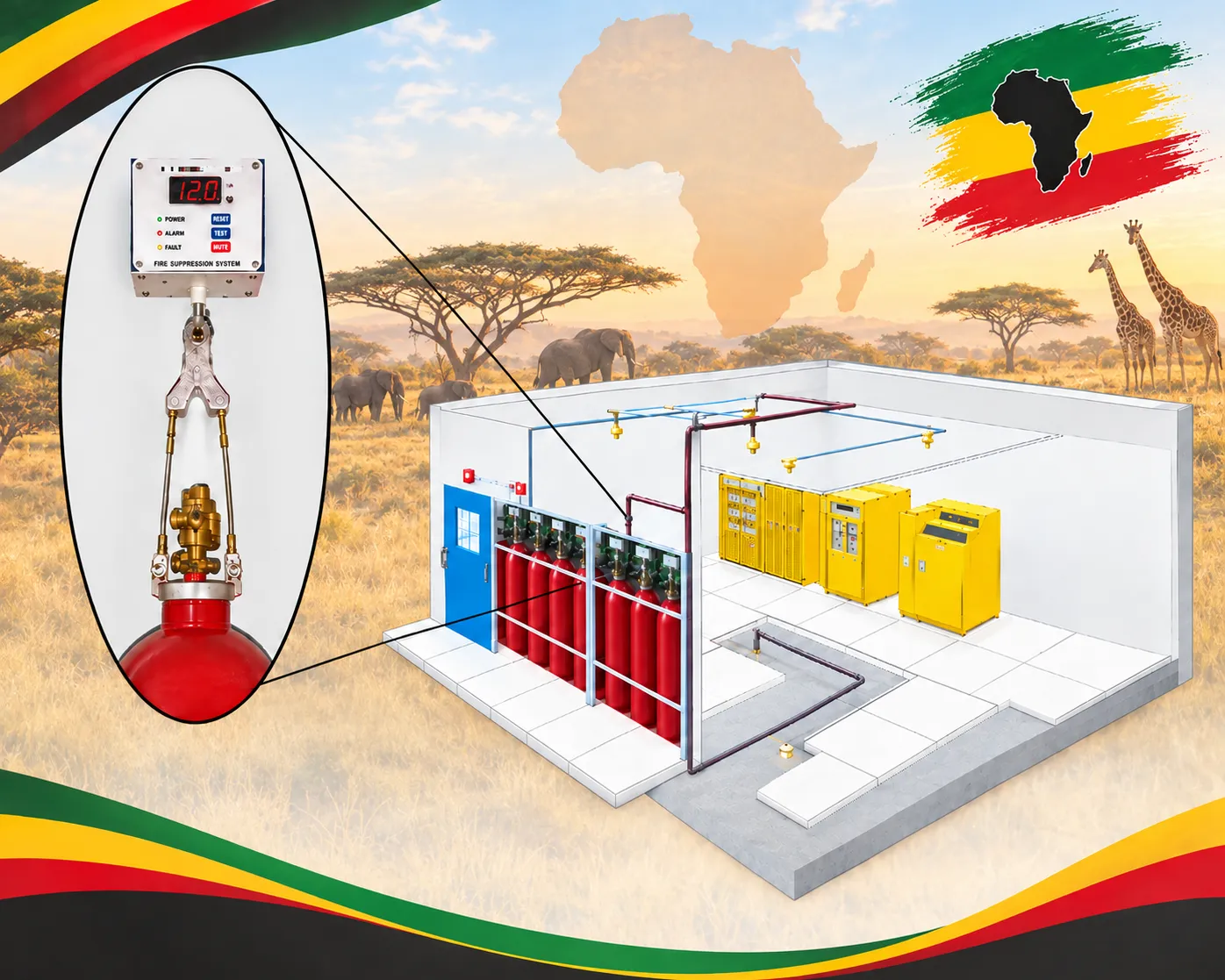
Airport Clean Agent Suppression OEM Manufacturer Africa
LIFEGUARD® – OEM Manufacturer of Airport Clean Agent Fire Suppression Systems for Africa
Airports are critical infrastructure facilities where fire protection must address sensitive electronics, communication networks, data centres, radar systems, control rooms, electrical equipment, UPS installations, technical rooms and other high-value assets. A fire in any of these areas can cause equipment damage, operational interruption and significant business continuity challenges.
LIFEGUARD® is an OEM manufacturer and fire-safety solutions provider offering engineered clean agent fire suppression systems for airport and aviation infrastructure in Africa. Our solutions are developed for applications where rapid fire detection and suppression are required while minimizing the secondary damage associated with conventional water-based firefighting.
Clean-agent systems are particularly relevant to enclosed areas containing sensitive electrical and electronic equipment. Airport fire-protection requirements also need to be coordinated with applicable aviation, fire-safety, building, electrical and AHJ requirements. ICAO materials identify specialized fire-safety considerations for airport facilities and reference standards including NFPA 415 for airport terminal buildings, NFPA 407 for aircraft fuel servicing and NFPA 409 for aircraft hangars. (ICAO)
Airport Clean Agent Fire Suppression OEM Manufacturer Africa
As an Airport Clean Agent Suppression OEM Manufacturer in Africa, LIFEGUARD® focuses on engineered systems rather than simply supplying individual cylinders or components.
Our OEM-oriented approach can cover:
- Clean agent storage systems
- Suppression cylinders
- Valve assemblies
- Discharge hoses
- Pipe networks
- Discharge nozzles
- Releasing control panels
- Fire detection interfaces
- Manual release stations
- Abort switches
- Audible and visual alarms
- Pressure monitoring
- HVAC shutdown interfaces
- Damper interfaces
- Fire alarm integration
- BMS interfaces
- System testing and commissioning support
The exact equipment configuration depends on the agent, hazard classification, protected volume, system design and applicable project specification.
What Is an Airport Clean Agent Suppression System?
An airport clean-agent suppression system is an engineered automatic fire-extinguishing system designed to detect and suppress fire within a protected enclosure.
A typical sequence is:
Fire Detection → Alarm → Pre-Discharge Warning → System Interlocks → Agent Release → Fire Suppression → System Monitoring
Clean agents are gaseous or gas-forming extinguishing media selected for applications where conventional water, foam or powder may create unacceptable secondary effects.
ICAO technical material concerning aircraft fire protection identifies characteristics such as clean gaseous agents, electrical non-conductivity and minimizing post-discharge cleanup as important considerations in fire-suppression technology. (ICAO)
For fixed airport facilities, however, agent selection must be based on the particular hazard and the applicable fixed-system design standard—not simply on the fact that an agent is described as 'clean.'
LIFEGUARD® Airport Clean Agent OEM Solutions
LIFEGUARD® can develop clean-agent suppression solutions for a variety of airport critical facilities.
1. Airport Data Centre Fire Suppression
Airport data centres contain servers, networking equipment, storage systems and digital infrastructure supporting airport operations.
A clean-agent system can be engineered around:
- Early smoke detection
- Clean-agent release
- Releasing control panel
- Pre-discharge warning
- HVAC shutdown
- Damper control
- Manual release
- Abort functionality
- Room integrity
- Alarm monitoring
Recent airport specifications demonstrate the practical importance of integrated detection, clean-agent suppression and building-system interfaces. For example, an Airports Authority of India specification for a data-centre project requires clean-agent suppression alongside detection, fire-alarm integration and system interfaces, with reference to NFPA 2001 and NFPA 72. (AAI)
2. Airport Server Room Clean Agent System
Server rooms are particularly sensitive to water and other residues.
LIFEGUARD® clean-agent systems can be considered for:
- Server rooms
- Network rooms
- IT rooms
- Communication rooms
- Data processing rooms
- Equipment rooms
- Disaster recovery rooms
The system can be integrated with the fire alarm and building-management architecture as required by the project.
3. Airport Radar Room Fire Suppression
Radar and air-navigation facilities contain highly sensitive electronic equipment.
LIFEGUARD® can provide engineered clean-agent system concepts for:
- Radar rooms
- Radar equipment shelters
- Navigation equipment rooms
- Communication facilities
- Electronic equipment rooms
- Air-traffic-support facilities
The suitability of clean-agent protection depends on the equipment, enclosure, fire hazards and project requirements.
4. Airport Control Room Fire Protection
Airport control rooms can contain communication, monitoring, computing and control equipment essential to airport operations.
Clean-agent protection may be considered for:
- Airport control rooms
- Technical control rooms
- Security control rooms
- Monitoring rooms
- Communication rooms
- Equipment-control rooms
The suppression system can be coordinated with detection, alarm, HVAC and other approved interfaces.
5. Airport UPS & Electrical Room Suppression
Airport electrical infrastructure can include:
- UPS systems
- Switchgear
- Distribution boards
- Electrical panels
- Control equipment
- Power-management equipment
The fire suppression technology should be selected according to the electrical equipment and actual fire hazard. Depending on the application, clean agent, water mist or another engineered technology may be appropriate.
LIFEGUARD® does not treat every electrical room as the same hazard. System selection should follow a project-specific engineering assessment.
6. Airport Communication Room Suppression
Communication systems are fundamental to airport operations.
Clean-agent suppression can be considered for enclosed rooms containing:
- Telecommunications equipment
- Network switches
- Routers
- Communication servers
- Radio equipment
- Electronic control systems
The system can be configured for automatic detection and controlled release while interfacing with the building's fire alarm system.
7. Airport Security & Surveillance Equipment Rooms
Airport security infrastructure can include CCTV servers, access-control equipment, monitoring systems and electronic security infrastructure.
These areas can benefit from application-specific fire protection designed to protect sensitive equipment without introducing unnecessary water or residue.
Potential applications include:
- CCTV rooms
- Security control rooms
- Access-control rooms
- Monitoring centres
- Security equipment rooms
- Electronic surveillance infrastructure
Clean Agent Technologies for Airport Applications
Depending on the project, clean-agent systems can be based on different agent families and system architectures.
Possible technologies include:
FK-5-1-12 Systems
FK-5-1-12-based systems are used in various sensitive electronic applications and can be considered where the system design, agent data and applicable approvals meet project requirements.
HFC Clean Agents
HFC-based systems such as HFC-227ea have historically been used for data centres, control rooms and electronic equipment. Their continued suitability should be evaluated against current environmental regulations and project specifications.
Inert Gas Systems
Inert-gas technologies such as IG-541, IG-55 and IG-100 can be considered for appropriate applications. These systems use gases naturally present in the atmosphere or combinations thereof and require specific cylinder storage and enclosure design.
Important: LIFEGUARD® recommends selecting the clean agent based on hazard analysis, applicable regulations, environmental considerations, occupancy, system approvals and project requirements rather than promoting one agent as universally suitable.
Airport Clean Agent Suppression System Components
A complete engineered system may include:
Clean Agent Cylinders
Storage vessels sized according to the required agent quantity and system design.
Cylinder Valves
Specialized valves control the release of stored extinguishing agent.
Discharge Hoses
Flexible discharge connections connect cylinder assemblies to the fixed piping network.
Piping Network
Engineered piping distributes the agent throughout the protected enclosure.
Discharge Nozzles
Nozzles are selected and positioned according to the system calculation.
Releasing Control Panel
The control panel supervises detection and controls the programmed suppression sequence.
Smoke Detectors
Appropriate detection technology identifies a developing fire.
Manual Release Switch
Provides manual system activation where specified.
Abort Switch
Provides controlled interruption of the release sequence where permitted by the approved system design.
Hooter / Sounder & Strobe
Provides pre-discharge and discharge warning to personnel.
HVAC Interface
The system may be interfaced with ventilation and air-conditioning equipment.
Pressure Relief
Appropriate pressure-relief provisions may be required for total-flooding systems.
Room Integrity
The enclosure must be capable of retaining the required agent concentration for the specified design period.
OEM Manufacturing Approach
Choosing an OEM manufacturer can provide advantages when a project requires consistent system configuration, technical documentation and equipment coordination.
LIFEGUARD®'s OEM-oriented approach can support:
Design
→ Hazard evaluation
→ System selection
→ Equipment configuration
→ Hydraulic/system calculations
→ Engineering drawings
Manufacturing & Supply
→ Cylinders and system components
→ Valves and accessories
→ Nozzles
→ Releasing equipment
→ Detection/interface components
Project Execution
→ Installation support
→ Testing
→ Commissioning
→ Documentation
→ Training
→ Maintenance support
Airport Clean Agent Suppression System Engineering
Clean-agent fire suppression is an engineered system. The quantity of agent, discharge arrangement and room conditions cannot safely be determined simply from the room's floor area.
Engineering considerations include:
- Protected-room volume
- Hazard classification
- Fire load
- Agent design concentration
- Minimum and maximum temperatures
- Occupancy
- Detection arrangement
- Cylinder quantity
- Cylinder pressure
- Pipe diameter
- Pipe length
- Nozzle configuration
- Discharge time
- Enclosure integrity
- HVAC operation
- Pressure relief
- Alarm sequence
- Manual release
- Abort functionality
- Equipment shutdown
- Applicable standards
The final system should be validated using the relevant manufacturer's design methodology and approved calculation procedures.
Airport Clean Agent System – Room Integrity
Room integrity is an important consideration for total-flooding clean-agent systems.
If the protected room has significant leakage, the required agent concentration may not be maintained for the required period.
Therefore, airport clean-agent projects may require:
- Door sealing
- Cable penetration sealing
- Pipe penetration sealing
- HVAC damper control
- Door fan testing
- Pressure-relief provisions
- Enclosure inspection
A properly designed clean-agent system should therefore be considered as a combination of suppression equipment + detection + controls + enclosure integrity.
Airport Fire Suppression System Integration
Airport fire protection frequently involves integration between several technical systems.
LIFEGUARD® clean-agent systems can be engineered for coordination with:
- Fire alarm systems
- Addressable fire alarm panels
- Building Management Systems
- HVAC systems
- Access-control systems
- Electrical shutdown
- Generator systems
- Security systems
- Central monitoring
- Emergency alarm systems
This integrated approach is important for airport facilities because the fire suppression system must operate as part of the wider building safety infrastructure.
Airport Clean Agent Suppression OEM Manufacturer for Africa
LIFEGUARD® can support airport projects across African markets, including:
South Africa | Kenya | Nigeria | Ghana | Tanzania | Uganda | Ethiopia | Rwanda | Zambia | Zimbabwe | Botswana | Namibia | Mozambique | Angola | Egypt | Morocco | Algeria | Tunisia | Senegal | Côte d'Ivoire | Cameroon
Projects should always be designed and supplied according to the applicable national regulations, airport operator specifications, AHJ requirements and relevant international standards.
Applications Across African Airport Infrastructure
Airport FacilityPotential ProtectionAirport Data CentreClean AgentServer RoomClean AgentNetwork RoomClean AgentRadar RoomClean AgentCommunication RoomClean AgentControl RoomClean AgentSecurity RoomClean AgentCCTV Equipment RoomClean AgentUPS RoomApplication-SpecificElectrical RoomApplication-SpecificTechnical Equipment RoomClean AgentBMS RoomClean AgentAviation Communication FacilityClean AgentIT Infrastructure RoomClean Agent
The final suppression technology should be determined by project-specific hazard assessment and applicable requirements.
Airport Clean Agent Suppression Standards
Depending on the application and project specification, airport clean-agent systems may reference:
- NFPA 2001 – Standard on Clean Agent Fire Extinguishing Systems
- NFPA 72 – National Fire Alarm and Signaling Code
- ISO 14520 – Gaseous fire-extinguishing systems
- EN 15004, where applicable
- Applicable national fire regulations
- Local electrical and building codes
- Airport operator specifications
- Civil aviation requirements
- AHJ requirements
ICAO guidance also identifies the importance of airport-specific fire-safety expertise and references aviation-related NFPA standards including NFPA 415, NFPA 407 and NFPA 409. (ICAO)
Why Select LIFEGUARD® as an Airport Clean Agent OEM Manufacturer?
OEM Manufacturing Capability
LIFEGUARD® offers an OEM-oriented approach to fire-suppression equipment and engineered fire-protection solutions.
Application-Specific Design
Airport facilities have different hazards. LIFEGUARD® develops solutions around the actual protected environment.
Critical Infrastructure Protection
Clean-agent systems can be considered for sensitive IT, communication, radar, control and electrical applications.
Integrated Fire Protection
Detection, suppression, alarms and building-system interfaces can be coordinated into one engineered solution.
Project Documentation
Airport projects commonly require technical submittals, drawings, calculations, equipment documentation, testing records and commissioning documentation.
Africa Project Support
LIFEGUARD® can work with airport operators, consultants, EPC contractors, MEP contractors, fire-protection contractors and system integrators involved in African aviation projects.
From OEM Manufacturing to Airport System Commissioning
LIFEGUARD® can support the complete project lifecycle:
01 – Consultation
Understand the airport facility and fire-protection requirement.
02 – Hazard Assessment
Identify the fire risks and protected equipment.
03 – System Selection
Determine the appropriate suppression technology.
04 – Engineering
Develop system design, calculations and equipment configuration.
05 – OEM Manufacturing & Supply
Provide the required system equipment and accessories.
06 – Installation Support
Coordinate installation requirements with project contractors.
07 – Testing
Verify detection, alarms, release circuits, interfaces and system functionality.
08 – Commissioning
Complete system commissioning according to the approved design.
09 – Handover
Provide relevant documentation and operator guidance.
10 – Maintenance
Support inspection, servicing and system lifecycle requirements.
LIFEGUARD® – Airport Clean Agent Suppression OEM Manufacturer Africa
LIFEGUARD® provides engineered airport clean agent fire suppression solutions for critical aviation infrastructure across Africa, including data centres, server rooms, radar facilities, communication rooms, control rooms, security rooms, UPS facilities and other sensitive technical environments.
Our OEM-oriented fire-protection approach combines engineering, system equipment, detection, suppression controls and project support to create application-specific solutions for modern airport infrastructure.
For airport projects requiring reliable protection of sensitive electronic and electrical assets, LIFEGUARD® offers a comprehensive approach from engineering and OEM manufacturing through supply, testing and commissioning support.
SEO Keyword Cluster
Primary Keyword:
Airport Clean Agent Suppression OEM Manufacturer Africa
Secondary Keywords:
- Airport clean agent fire suppression OEM Africa
- Airport clean agent system manufacturer Africa
- Airport fire suppression OEM manufacturer Africa
- Airport clean agent suppression manufacturer
- Airport fire protection manufacturer Africa
- Airport clean agent fire suppression system Africa
- Airport data centre fire suppression manufacturer
- Airport server room fire suppression Africa
- Airport radar room fire suppression system
- Airport control room clean agent system
- Aviation fire suppression system manufacturer Africa
- Clean agent fire suppression OEM
- Clean agent system manufacturer Africa
- Airport gaseous fire suppression system
- Airport fire protection solutions Africa
- Automatic clean agent suppression manufacturer
- Airport fire suppression equipment manufacturer
SEO Meta Title
Airport Clean Agent Suppression OEM Manufacturer Africa | LIFEGUARD®
SEO Meta Description
LIFEGUARD® is an airport clean agent suppression OEM manufacturer serving Africa, providing engineered fire suppression systems for airport data centres, server rooms, radar, control, communication and critical technical facilities.
Suggested URL
/airport-clean-agent-suppression-oem-manufacturer-africa/
Suggested H1
Airport Clean Agent Suppression OEM Manufacturer Africa
Suggested SEO Content Strategy
For stronger topical authority, this page can internally link to dedicated LIFEGUARD® pages for Clean Agent Fire Suppression System, FK-5-1-12 Fire Suppression, Fire Alarm & Releasing Panels, Data Centre Fire Suppression, Airport Fire Protection, Aircraft Hangar Fire Protection, and Water Mist Fire Suppression Systems.
Keywords






