
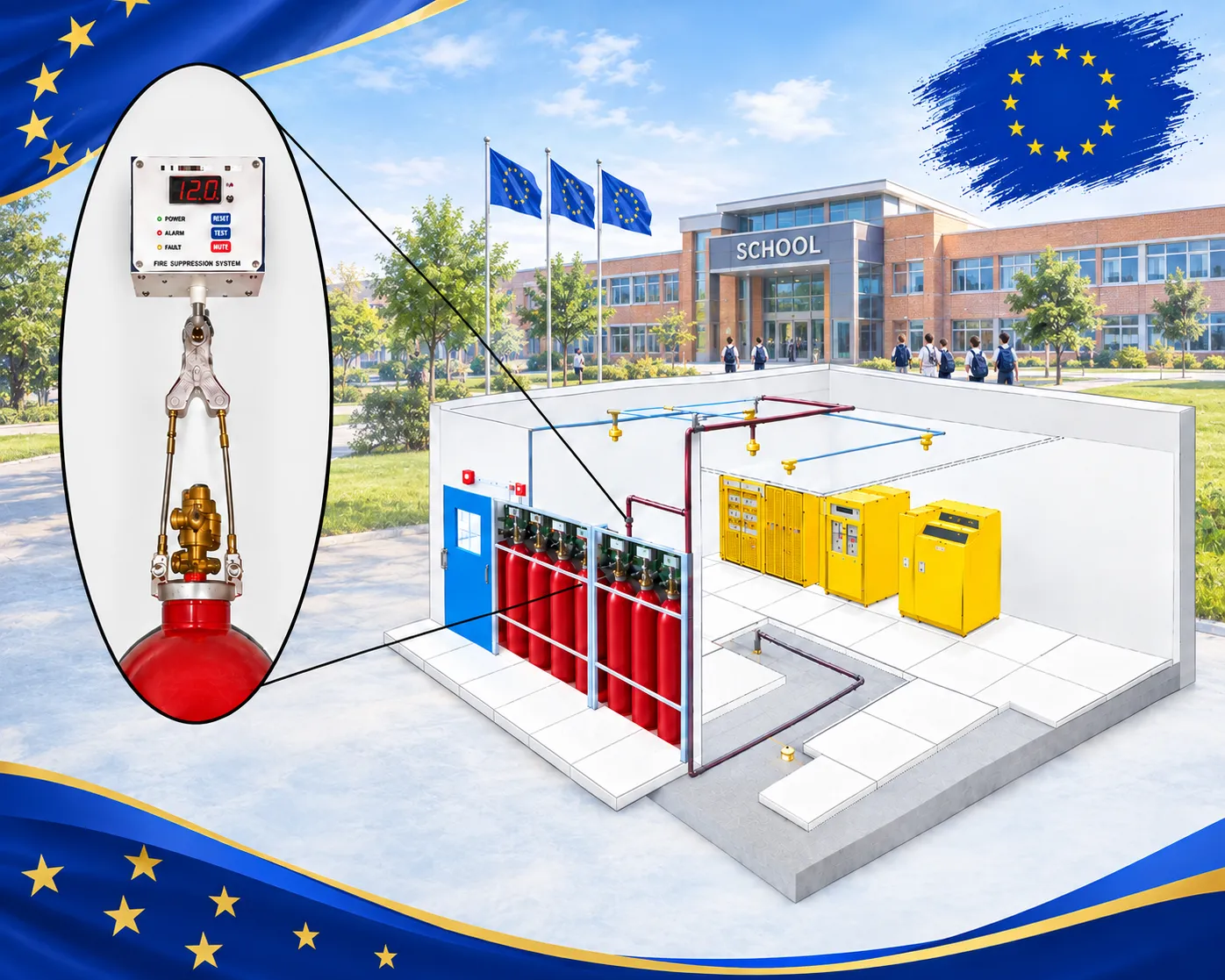
Airport Clean Agent Suppression OEM Manufacturer Europe
Airports are among the most demanding environments for fire protection. Passenger terminals, airport data centres, communication rooms, electrical substations, UPS rooms, control centres, baggage-handling infrastructure and other technical facilities contain valuable equipment where a fire can result in both physical damage and major operational disruption.
LIFEGUARD® is an OEM manufacturer and fire-safety solution provider offering engineered clean agent fire suppression systems for suitable airport applications in Europe. Our solutions can be developed for critical enclosed spaces where rapid fire detection, automatic suppression, protection of sensitive equipment and minimisation of post-discharge residue are important considerations.
European gaseous fire-suppression design is addressed by EN 15004-1, which covers the design, installation, testing, maintenance and safety of gas extinguishing systems and the characteristics of extinguishants within its scope. (Tienda AENOR)
LIFEGUARD® Airport Clean Agent Suppression Systems
LIFEGUARD® develops and supplies engineered fire suppression solutions designed around the specific hazard, protected enclosure and project requirements.
An airport clean agent system may incorporate:
- Clean agent storage cylinders
- Releasing control panels
- Smoke and heat detection
- Automatic fire detection
- Manual release stations
- Abort switches where required
- Audible and visual alarms
- Discharge nozzles
- Engineered pipe networks
- Pressure monitoring
- HVAC shutdown interfaces
- Damper-control interfaces
- Electrical interlocks
- BMS integration
- Remote alarm monitoring
- Emergency power arrangements
- Pressure-relief provisions
- Testing and commissioning
The system configuration is determined by the protected hazard, selected extinguishing agent, applicable standards, airport specifications and the approved fire-protection design.
Clean Agent Fire Suppression for European Airports
Clean agent suppression is particularly relevant to airport areas containing sensitive electronic, electrical or mission-critical equipment.
A properly engineered gaseous suppression system can extinguish or control a fire without introducing the type of liquid water discharge associated with conventional sprinkler protection.
Typical applications include:
Airport Data Centres
Airport data centres support critical operational, passenger-processing, communication and security functions.
LIFEGUARD® clean agent systems can be engineered for suitably enclosed:
- Server rooms
- Network rooms
- IT rooms
- Data-processing facilities
- Communication equipment rooms
- UPS areas
- Control equipment rooms
Airport Control Rooms
Control and monitoring rooms may contain critical electronic systems that require specialised fire protection.
A clean agent system can integrate detection, alarm, releasing, equipment shutdown and building-management interfaces according to the approved cause-and-effect sequence.
Airport Electrical Rooms
Switchgear, electrical distribution equipment, MCC panels and other electrical infrastructure can present significant fire risks.
For appropriate enclosed hazards, clean agent suppression can provide automatic fire protection without relying on water discharge directly onto sensitive electrical equipment.
Airport UPS Rooms
UPS equipment and associated electrical infrastructure can require dedicated fire protection.
System selection should consider the equipment configuration, battery technology, ventilation, enclosure characteristics and the specific fire scenario.
Airport Communication Rooms
Communication and network infrastructure is essential to modern airport operations. Clean agent suppression can be considered for appropriately enclosed communication facilities where equipment protection and rapid restoration are important.
Baggage Handling Infrastructure
Automated baggage systems contain conveyors, motors, electrical panels, control systems and other equipment.
Depending on the risk assessment, protection may involve detection, localised suppression, enclosure protection or a combination of fire-protection measures.
OEM Airport Fire Suppression System Manufacturer
As an OEM manufacturer, LIFEGUARD® can support projects from product selection and engineering through system supply, installation coordination, testing and commissioning.
An OEM-focused approach can provide airport contractors and system integrators with greater flexibility for project-specific requirements.
Our capabilities can include:
Product Engineering
Development and configuration of suppression equipment for the intended application.
System Engineering
Selection and configuration of cylinders, valves, piping, nozzles and releasing equipment.
Detection & Releasing Integration
Integration of automatic detection with the suppression-release sequence.
Project Documentation
Technical information, system drawings, equipment schedules and relevant project documentation.
System Integration
Interfaces with fire alarm, HVAC, BMS, electrical and other relevant building systems.
Testing & Commissioning
Functional verification of detection, alarms, release logic and system interfaces.
After-Sales Support
Maintenance, inspection and technical support according to the project requirements.
How an Airport Clean Agent System Operates
A typical automatic clean-agent suppression sequence may include the following stages:
Stage 1 – Fire Detection
Suitable smoke, heat or other approved detectors monitor the protected area.
Stage 2 – Alarm
The detection system identifies the fire condition and initiates the programmed alarm sequence.
Stage 3 – Confirmation
Where specified, a multi-detector or cross-zoned arrangement can provide confirmation before automatic agent release.
Stage 4 – Pre-Discharge Warning
Audible and visual warning devices notify occupants before discharge where required by the system design.
Stage 5 – Equipment Interlocking
HVAC, ventilation and other relevant equipment may be shut down according to the approved cause-and-effect matrix.
Stage 6 – Agent Release
The releasing panel activates the suppression system when the programmed release conditions are fulfilled.
Stage 7 – Agent Discharge
The extinguishing agent travels through the engineered pipe network and is discharged through the designated nozzles.
Stage 8 – Post-Discharge Monitoring
System status, pressure conditions and alarm information remain available for response, investigation and restoration.
Clean Agent Technologies for Airport Applications
The correct extinguishing agent should be selected after considering the actual hazard and project requirements.
Potential technologies may include:
- FK-5-1-12 clean agent systems
- Inert gas systems
- Nitrogen-based suppression systems
- Other gaseous extinguishing systems appropriate to the application
EN 15004-1 addresses gaseous extinguishing systems using electrically non-conductive gaseous extinguishants that do not leave a residue after discharge, within the standard's scope. (ELOT Eshop)
For FK-5-1-12 systems, the applicable part of the EN 15004 series should also be considered alongside the specific project requirements.
Agent selection should never be based solely on marketing preference. It should consider the fire hazard, enclosure, occupancy, concentration requirements, safety considerations, environmental requirements, equipment compatibility, applicable approvals and regulations.
Airport Clean Agent System Design
A high-quality airport suppression system starts with engineering.
1. Hazard Assessment
The protected equipment, fuel sources, ignition sources, occupancy and operating conditions are evaluated.
2. Room Volume
The enclosure dimensions and relevant permanent features are established to determine the protected volume.
3. Agent Quantity
The required extinguishing-agent quantity is determined using the applicable design methodology.
4. Pipe Network
The pipe network is engineered according to the selected system and approved calculation methodology.
5. Nozzle Distribution
Nozzle type, quantity and positioning are determined to achieve the required agent distribution throughout the protected enclosure.
6. Detection Design
Detector type, location and detection philosophy are selected according to the hazard and applicable fire-alarm requirements.
7. Cause & Effect
The system sequence is defined for:
- Detection
- Alarm
- Pre-discharge warning
- HVAC shutdown
- Damper operation
- Equipment shutdown
- Agent release
- Post-discharge condition
- Fault monitoring
8. Enclosure Integrity
Total-flooding applications require appropriate consideration of enclosure integrity so that the required extinguishing concentration can be achieved and retained.
9. Pressure Relief
Pressure-relief arrangements should be evaluated based on the characteristics of the system and protected enclosure.
European Standards for Airport Clean Agent Systems
For projects in Europe, applicable standards and regulations depend on the country, airport authority, building classification, protected hazard and project specification.
EN 15004-1:2025 provides requirements and recommendations for the design, installation, testing, maintenance and safety of gas extinguishing systems in buildings, plants and other structures. (Tienda AENOR)
Depending on the project, other standards can also be relevant, including:
- EN 15004 series
- EN 54 series for fire detection and fire alarm systems
- EN 12094 for components used in gas extinguishing systems
- ISO 14520
- Applicable national fire-safety regulations
- Airport operator specifications
- Authority Having Jurisdiction requirements
- Insurer requirements
- Equipment manufacturer requirements
The applicable edition and compliance requirements should be verified for every individual European project.
Airport Fire Protection Beyond Clean Agent Systems
Airport fire safety encompasses much more than fixed suppression systems protecting individual technical rooms.
EASA's March 2026 Easy Access Rules for Aerodromes include requirements concerning aerodrome rescue and firefighting services, including appropriate facilities, equipment, extinguishing agents and trained personnel. (EASA)
EASA also describes the role of aerodrome rescue and firefighting services as protecting life during aircraft accidents or incidents and establishing survivable conditions and evacuation routes. (EASA)
Therefore, a clean-agent system protecting an airport server room, control room or electrical room is a building fire-protection system and should not be represented as a replacement for the aerodrome's required aircraft rescue and firefighting services.
This distinction is important when developing SEO and technical content for European airport projects.
Airport Applications for LIFEGUARD® Clean Agent Systems
LIFEGUARD® clean-agent suppression solutions can be considered for:
- International airport terminals
- Domestic airport terminals
- Airport data centres
- Server rooms
- Network rooms
- Communication rooms
- Control rooms
- Electrical rooms
- Switchgear rooms
- UPS rooms
- Technical rooms
- Security equipment rooms
- Airport command centres
- Baggage-handling technical areas
- Airport infrastructure facilities
- Critical electronic equipment rooms
Each application requires an appropriate engineering assessment before system selection.
LIFEGUARD® OEM Capabilities
LIFEGUARD® combines fire-safety manufacturing with project-oriented engineering and system integration capabilities.
Our airport fire-protection solutions can support:
Design
Project-specific clean-agent system engineering based on the protected hazard.
Manufacturing
OEM supply of applicable fire-suppression equipment and system components.
Integration
Integration of detection, releasing, alarm, HVAC, BMS and equipment interfaces.
Supply
Coordinated supply of suppression-system equipment for airport projects.
Installation Support
Technical coordination with fire-protection contractors, EPC companies and system integrators.
Testing
Functional testing of detection, releasing and interface sequences.
Commissioning
System commissioning and handover documentation according to project requirements.
Maintenance
Inspection and maintenance support for continued system readiness.
Why Choose an OEM Manufacturer for Airport Fire Suppression?
Working with an OEM can be beneficial for complex airport projects where equipment configuration and technical coordination need to match the project specification.
Important considerations include:
- Engineering capability
- Manufacturing capability
- Product documentation
- System compatibility
- Quality-control processes
- Technical support
- Spare-parts availability
- System integration
- Testing and commissioning capability
- Long-term service support
LIFEGUARD® focuses on engineered fire-safety solutions rather than treating every airport application as a standard package.
Airport Clean Agent Suppression OEM Manufacturer Europe – LIFEGUARD®
LIFEGUARD® provides engineered clean-agent fire suppression solutions for suitable airport applications across Europe.
From airport data centres and server rooms to electrical rooms, UPS rooms, communication facilities and control centres, our systems can be configured around the specific fire hazard and protected enclosure.
Our OEM-oriented approach combines:
Engineering + Manufacturing + System Integration + Supply + Testing + Commissioning + Technical Support
For European airport projects, LIFEGUARD® can work with airport operators, consultants, EPC contractors, MEP contractors, fire-protection companies and system integrators to develop project-specific clean-agent fire suppression solutions.
Protect Critical Airport Infrastructure with LIFEGUARD®
When protecting airport infrastructure, the objective is not simply to install a fire suppression system. The system must be appropriately engineered, correctly integrated, properly tested and maintained throughout its operational life.
LIFEGUARD® – Airport Clean Agent Fire Suppression OEM Manufacturer for Europe
Design | Manufacture | Supply | Integration | Testing | Commissioning | Support
SEO Keyword Set
Primary Keyword
Airport clean agent suppression OEM manufacturer Europe
Secondary Keywords
- airport clean agent suppression manufacturer Europe
- airport clean agent fire suppression OEM Europe
- airport fire suppression OEM manufacturer
- airport clean agent system manufacturer Europe
- airport gaseous fire suppression manufacturer Europe
- airport fire protection OEM Europe
- airport clean agent suppression system manufacturer
- airport fire suppression equipment manufacturer Europe
Long-Tail Keywords
- airport clean agent suppression OEM manufacturer in Europe
- clean agent fire suppression OEM manufacturer for airports
- airport data centre clean agent suppression manufacturer Europe
- airport server room clean agent suppression OEM
- airport electrical room fire suppression manufacturer
- airport UPS room clean agent suppression system manufacturer
- airport control room clean agent fire suppression OEM
- European airport clean agent fire suppression equipment manufacturer
- engineered airport clean agent suppression systems Europe
Suggested SEO Title
Airport Clean Agent Suppression OEM Manufacturer Europe | LIFEGUARD®
Suggested Meta Description
LIFEGUARD® is an airport clean agent suppression OEM manufacturer for Europe, offering engineered fire suppression systems for airport data centres, server rooms, electrical rooms, UPS rooms and critical infrastructure.
Suggested URL Slug
/airport-clean-agent-suppression-oem-manufacturer-europe/
Suggested H1
Airport Clean Agent Suppression OEM Manufacturer Europe
Suggested CTA
Contact LIFEGUARD® for Airport Clean Agent Fire Suppression Solutions in Europe.
United Fire Equipments Pvt. Ltd. – LIFEGUARD®
Manufacturer of ISI Certified Fire Safety Equipment
📞 8048034226
Keywords






