
Airport Clean Agent Suppression OEM Manufacturer India
LIFEGUARD® – Engineered Airport Clean Agent Fire Suppression Systems
Airports are among the most critical infrastructure facilities, combining passenger terminals, air traffic control systems, navigation equipment, data centres, communication networks, electrical installations, security systems and other mission-critical assets. Fire protection in these environments requires carefully engineered solutions that address the specific hazards of each protected area.
LIFEGUARD® – United Fire Equipments Pvt. Ltd. provides Airport Clean Agent Suppression Systems in India, supporting OEM, project, EPC, MEP and system-integration requirements for suitable critical and electronic applications.
Clean agent suppression is particularly relevant to enclosed areas where protecting sensitive equipment from fire is important and where conventional water or powder-based extinguishing systems may not be appropriate for the application.
The current Indian airport sector continues to specify clean-agent fire protection for specialized airport infrastructure. For example, Airports Authority of India has recently invited a tender for the Design, Supply, Installation, Testing and Commissioning of a Clean Agent-based Fire Suppression System for various NAVAIDS systems at NSCBI Airport, Kolkata. (BidEasy)
What Is an Airport Clean Agent Suppression System?
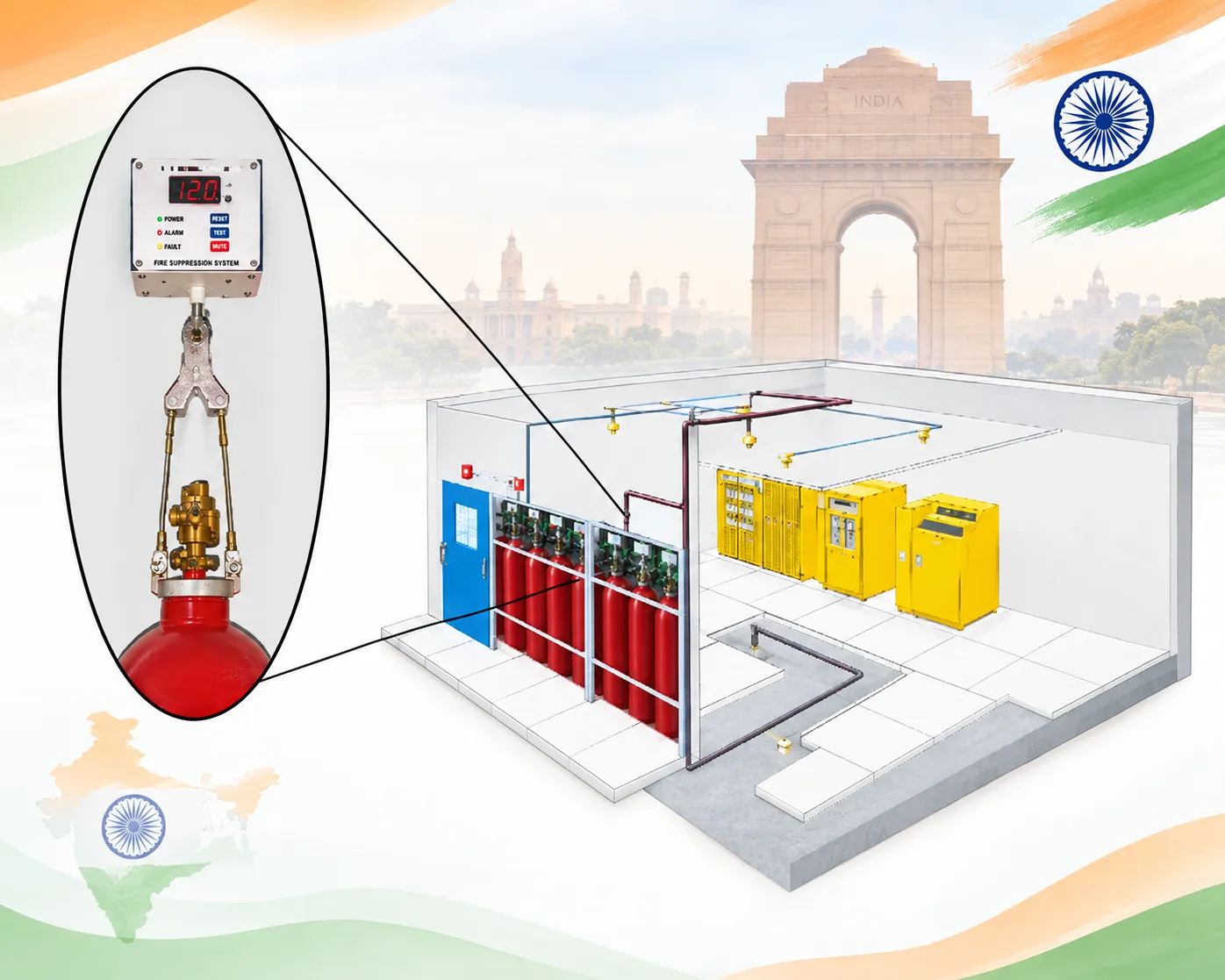
An airport clean agent suppression system is an engineered fire protection system that uses a gaseous or vaporizing extinguishing agent to suppress fire within a protected enclosure.
The system can automatically detect a fire, initiate an alarm sequence and release the calculated quantity of extinguishing agent when the configured release conditions are satisfied.
A typical system can include:
- Clean agent storage cylinders
- Cylinder valves
- Clean extinguishing agent
- Pressure gauges or pressure monitoring
- Fire detection system
- Smoke detectors
- Heat detectors, where appropriate
- Releasing control panel
- Distribution piping
- Engineered discharge nozzles
- Electric actuators
- Manual release station
- Abort switch
- Pressure switch
- Hooter/sounder
- Strobe/visual alarm
- HVAC shutdown interface
- Electrical interlocks
- Fire alarm/BMS interface
- Warning signage
The final configuration is determined by the protected hazard, enclosure, agent, applicable standard, project specification and approval requirements.
LIFEGUARD® – Airport Clean Agent Suppression OEM Manufacturer
As an Indian fire safety manufacturer, LIFEGUARD® combines manufacturing, engineering and project support to develop fire protection solutions for critical applications.
Our clean-agent suppression capabilities can support the complete project lifecycle:
Hazard Assessment → Engineering → System Design → Equipment Selection → Manufacturing/Supply → Installation Support → Testing → Commissioning → Handover → Maintenance
LIFEGUARD®'s published clean-agent portfolio includes engineered solutions using technologies such as FK-5-1-12 and HFC-227ea, subject to project requirements, applicable approvals and environmental/regulatory considerations. (Lifeguard India Updates)
Airport Applications for Clean Agent Fire Suppression
1. Airport Data Centre Fire Suppression
Airport data centres support essential digital infrastructure, including servers, networking, storage, monitoring and operational systems.
A clean agent system can be engineered for suitable enclosed data-centre areas to provide automatic fire detection and suppression while avoiding the type of residue associated with powder extinguishing systems.
Typical protection may cover:
- Server rooms
- Network rooms
- Data halls
- UPS rooms
- Communication rooms
- Control equipment rooms
2. ATC & Air Traffic Control Technical Rooms
Air traffic control infrastructure depends on highly sensitive electronic and communication equipment.
Clean-agent systems can be considered for suitable enclosed areas containing:
- Communication equipment
- Navigation systems
- Electronic control equipment
- Radar-related equipment
- Monitoring systems
- Technical instrumentation
The suppression system can be integrated with fire detection, alarm, HVAC and equipment-control interfaces.
3. Airport NAVAIDS Equipment Rooms
Navigation aids are critical to airport operations and require reliable protection.
The recent AAI clean-agent tender for various NAVAIDS systems at NSCBI Airport, Kolkata demonstrates the relevance of specialized clean-agent protection for airport navigation infrastructure. (BidEasy)
LIFEGUARD® can support project-specific suppression requirements for suitable NAVAIDS and associated technical rooms.
4. Airport Communication Rooms
Airport communication facilities can contain high-value electronic equipment and networking infrastructure.
Potential protection areas include:
- Telecom rooms
- Communication rooms
- Network equipment rooms
- Radio equipment rooms
- Technical control rooms
Clean-agent suppression can be integrated with automatic detection and releasing systems.
5. Airport UPS & Electrical Rooms
UPS and electrical installations can present electrical fire risks.
Depending on the specific hazard, clean-agent technology may be evaluated for:
- UPS rooms
- Electrical control rooms
- Switchgear areas
- Control-panel rooms
- Power equipment rooms
- Critical electrical installations
The appropriate suppression technology must be selected based on the equipment, fire hazard and project engineering requirements.
6. Airport CCTV & Security Control Rooms
Modern airports rely on extensive CCTV, access-control and security infrastructure.
Clean-agent protection can be considered for enclosed rooms containing:
- CCTV servers
- Video management systems
- Network switches
- Security monitoring equipment
- Access-control systems
- Communication equipment
7. Airport Command & Control Centres
Airport command centres coordinate multiple operational systems and may contain computers, communication equipment and electronic controls.
An automatic clean-agent system can combine:
Fire Detection + Alarm + Release Control + Clean Agent Discharge + HVAC Interlock + Monitoring
to create an integrated protection arrangement.
8. Airport Server & Network Rooms
Network infrastructure supports airport communications, passenger services, security and operational systems.
Clean-agent fire suppression can be engineered for suitable enclosed server and network rooms where protecting electronic equipment is a priority.
FK-5-1-12 Clean Agent Suppression System
FK-5-1-12 is a clean-agent technology used in engineered fire suppression applications for suitable enclosed hazards.
LIFEGUARD® can support FK-5-1-12 system requirements for applications such as:
- Airport data centres
- Server rooms
- ATC technical rooms
- Communication rooms
- UPS rooms
- Electrical control rooms
- Network rooms
- Critical electronic equipment rooms
A typical arrangement can comprise:
FK-5-1-12 Cylinder → Cylinder Valve → Piping → Discharge Nozzles → Detection → Releasing Panel → Alarm → Interlocks
Agent quantity and system configuration must be established through appropriate engineering calculations and project requirements. LIFEGUARD®'s technical material identifies protected volume, design concentration, temperature and enclosure characteristics as important factors in system design. (Lifeguard India Updates)
HFC-227ea Clean Agent Suppression
HFC-227ea is another clean-agent technology that can be used for suitable total-flooding applications where specified and permitted.
Potential applications include:
- Server rooms
- Data centres
- Electrical rooms
- Control rooms
- Telecom rooms
- Critical electronic installations
Selection of an extinguishing agent should consider the project specification, environmental requirements, applicable approvals and the characteristics of the protected hazard.
How an Airport Clean Agent System Works
Stage 1 – Fire Detection
Smoke or other approved detection devices identify a developing fire condition.
Stage 2 – Alarm
The releasing control panel receives the detection signal and initiates the programmed alarm sequence.
Stage 3 – Pre-Discharge Warning
Audible and visual alarms notify personnel before discharge according to the system design.
Stage 4 – Interlocks
The system can initiate programmed HVAC shutdown and other equipment interfaces.
Stage 5 – Agent Release
The releasing mechanism activates the clean-agent cylinder system.
Stage 6 – Agent Discharge
The extinguishing agent travels through the engineered piping network and discharges through the designated nozzles.
Stage 7 – Fire Suppression
The designed agent concentration is established within the protected enclosure to suppress the fire.
Stage 8 – Monitoring
System status and alarm conditions can be interfaced with fire alarm, BMS or other monitoring systems where required.
Airport Clean Agent System Components
Clean Agent Cylinder
Stores the required extinguishing agent at the specified system pressure.
Cylinder Valve
Controls agent release from the cylinder.
Releasing Control Panel
Controls detection, alarm and suppression release functions.
Smoke Detection
Provides early detection of smoke or fire conditions.
Distribution Piping
Transfers agent from the storage cylinder to the protected enclosure.
Discharge Nozzles
Distribute the extinguishing agent within the protected area according to the engineered design.
Manual Release
Provides authorized personnel with a manual system-release facility where specified.
Abort Switch
Can provide an authorized means of interrupting or delaying automatic release according to the approved cause-and-effect sequence.
Alarm Devices
Hooters, sounders, strobes and other notification equipment provide warnings.
Pressure Monitoring
Provides cylinder/system status monitoring where specified.
Clean Agent System Design for Airports
Airport suppression systems should be engineered rather than treated as standard off-the-shelf installations.
Important design parameters can include:
Protected Volume
The room volume is fundamental to determining the required quantity of agent.
Hazard Characteristics
The type of equipment and combustible materials influence the suppression strategy.
Design Concentration
The required concentration depends on the selected agent and protected hazard.
Operating Temperature
Temperature conditions are considered during agent quantity and system calculations.
Cylinder Capacity
Cylinder size, number and configuration are selected according to the engineered requirement.
Pipe Network
Pipe sizes, lengths, fittings and configuration affect system discharge performance.
Nozzle Arrangement
Nozzle location and discharge characteristics are engineered to provide appropriate agent distribution.
Enclosure Integrity
Total-flooding systems require consideration of room leakage and agent retention.
HVAC Interlocking
Ventilation systems may need to be interfaced with the suppression sequence.
Pressure Relief
Pressure-management provisions may be required depending on the system and enclosure.
Airport Clean Agent Room Integrity
A clean-agent total-flooding system depends on maintaining the required agent concentration inside the protected enclosure for the specified design period.
Therefore, airport projects should consider:
- Door sealing
- Cable penetrations
- Wall penetrations
- HVAC openings
- Dampers
- Pressure relief
- Room leakage
- Enclosure integrity
AAI's data-centre specification provides an example of airport project requirements addressing enclosure integrity testing and clean-agent concentration retention. (AAI)
Airport Clean Agent Suppression OEM Solutions
LIFEGUARD® can support different project models, including:
OEM Supply
Supply of clean-agent suppression equipment and engineered system packages to OEM/project partners.
EPC Projects
Technical and equipment support for engineering, procurement and construction projects.
MEP Contractors
Fire suppression solutions for airport electrical, mechanical and technical infrastructure.
System Integrators
Integration of detection, releasing, suppression and facility interfaces.
Consultants
Technical documentation, product information and application support.
Airport Operators
Fire protection solutions for new installations, upgrades, replacements and maintenance requirements.
Airport Clean Agent Suppression System Testing & Commissioning
Testing and commissioning are critical stages of a clean-agent installation.
Depending on the project, commissioning can include verification of:
- Detector operation
- Fire alarm signals
- Releasing panel operation
- Manual release
- Abort function
- Alarm sequence
- Cylinder pressure monitoring
- Actuation circuit
- HVAC shutdown
- Electrical interlocks
- BMS interface
- Discharge circuit
- System cause-and-effect
- Warning signage
- Enclosure integrity
Airport maintenance specifications can also require regular preventive checks and replacement of defective suppression components such as actuators, pressure switches, release/abort stations, nozzles and clean-agent supplies. (AAI)
Airport Clean Agent Suppression Maintenance
Fire suppression systems must remain operational throughout the life of the facility.
LIFEGUARD® can support maintenance requirements involving:
- System inspection
- Cylinder inspection
- Pressure monitoring
- Detection-system testing
- Control-panel testing
- Alarm testing
- Release-circuit testing
- Nozzle inspection
- Piping inspection
- Actuator inspection
- Pressure-switch verification
- Agent refilling where applicable
- Replacement of defective components
- Preventive maintenance
- Emergency service support
AAI specifications for airport installations illustrate the importance of periodic maintenance and keeping gas suppression systems in working condition. (AAI)
Standards & Approval Considerations
Airport fire protection projects can involve multiple technical, regulatory and client-specific requirements.
Depending on the application, the project may specify:
- NFPA requirements
- BIS/Indian Standards
- National Building Code provisions
- Airport operator specifications
- DGCA requirements
- ICAO guidance
- UL/FM/VdS or other third-party approvals
- Local fire authority requirements
- Project-specific technical specifications
AAI states that airport rescue and firefighting services operate according to applicable DGCA and ICAO norms and guidelines, while airport fire services also address fire prevention and protection of terminal buildings and other vital installations. (AAI)
AAI project specifications can additionally require system-level approvals and OEM documentation; one AAI data-centre specification, for example, calls for UL/FM/VdS-approved system performance and OEM supply. (AAI)
LIFEGUARD® recommends confirming the exact approval, listing, certification and compliance requirements for the particular agent, component, system configuration and airport project before quotation or procurement.
Why Choose LIFEGUARD® as an Airport Clean Agent OEM?
Indian Manufacturing Expertise
LIFEGUARD® operates through United Fire Equipments Pvt. Ltd., an Indian manufacturer of ISI-certified fire safety equipment.
Fire Safety Experience
LIFEGUARD® has been engaged in fire safety equipment manufacturing since 1991, supporting a wide range of fire protection applications.
Application-Based Engineering
Each clean-agent system can be evaluated according to the actual protected hazard rather than using a generic configuration.
Critical Infrastructure Focus
Our clean-agent solutions can support sensitive environments including data centres, electrical rooms, communication facilities and control infrastructure.
OEM & Project Support
We work with:
- EPC companies
- MEP contractors
- Consultants
- Fire contractors
- System integrators
- OEM customers
- Infrastructure companies
- Facility operators
Complete System Approach
Our solutions can bring together:
Detection + Releasing + Cylinders + Piping + Nozzles + Alarm + Interlocks + Monitoring
Airport Clean Agent Suppression OEM Manufacturer India
LIFEGUARD® provides Airport Clean Agent Suppression OEM Manufacturer solutions in India for critical airport infrastructure and suitable enclosed electronic and electrical hazards.
From airport data centres and ATC technical rooms to NAVAIDS, communication facilities, UPS rooms, security control rooms and network infrastructure, our engineered fire suppression solutions can be developed according to the specific application and project requirements.
With an integrated approach covering engineering, equipment, manufacturing/supply, installation support, testing, commissioning and maintenance, LIFEGUARD® aims to provide dependable fire protection solutions for India's growing aviation infrastructure.
For airport clean agent suppression OEM requirements, contact LIFEGUARD® for technical consultation, system engineering, equipment supply and project support.
Frequently Asked Questions
Who is an Airport Clean Agent Suppression OEM Manufacturer in India?
LIFEGUARD® – United Fire Equipments Pvt. Ltd. is an Indian fire safety equipment manufacturer providing engineered clean-agent suppression solutions for suitable airport and critical-infrastructure applications.
Where can airport clean agent suppression systems be installed?
Potential applications include airport data centres, server rooms, ATC technical rooms, NAVAIDS rooms, communication rooms, UPS rooms, electrical control rooms, CCTV rooms, security rooms and other suitable enclosed technical areas.
Which clean agent is suitable for airport applications?
The appropriate agent depends on the hazard, enclosure, equipment, design requirements, environmental considerations and project specifications. FK-5-1-12 and HFC-227ea are examples of clean-agent technologies used for suitable applications.
Can LIFEGUARD® manufacture OEM clean-agent systems?
LIFEGUARD® supports OEM and project requirements through fire protection engineering, equipment manufacturing/supply and system integration, subject to the specific product and project scope.
Can airport clean agent systems be integrated with fire alarms?
Yes. A clean-agent suppression system can be integrated with fire detection, releasing panels, alarm systems, HVAC shutdown, electrical interlocks, BMS and other project-specific interfaces.
Does an airport clean-agent system require room integrity?
For total-flooding applications, enclosure integrity is an important part of system performance because the protected enclosure needs to retain the designed agent concentration for the required period.
Contact LIFEGUARD®
United Fire Equipments Pvt. Ltd.
Manufacturer of ISI Certified Fire Safety Equipment
📞 8048034226
📧 ufe126@gmail.com | info@lifeguardindia.in
LIFEGUARD® – Airport Clean Agent Suppression OEM Manufacturer India | Airport Fire Protection | Clean Agent Fire Suppression | ATC Fire Protection | NAVAIDS Fire Suppression | Airport Data Centre Fire Protection
SEO Metadata
SEO Title: Airport Clean Agent Suppression OEM Manufacturer India | LIFEGUARD®
Meta Description: LIFEGUARD® is an Airport Clean Agent Suppression OEM Manufacturer in India, offering engineered FK-5-1-12 and other clean-agent fire suppression solutions for airport data centres, ATC, NAVAIDS, server rooms, UPS and critical infrastructure.
Primary Keyword:
Airport Clean Agent Suppression OEM Manufacturer India
Secondary Keywords:
- airport clean agent suppression manufacturer India
- airport clean agent OEM India
- airport fire suppression OEM manufacturer
- airport clean agent fire suppression system
- airport clean agent system manufacturer
- ATC clean agent suppression system
- NAVAIDS fire suppression system
- airport data centre fire suppression
- airport server room fire suppression
- FK-5-1-12 airport suppression system
- clean agent suppression system manufacturer India
- airport fire protection manufacturer India
- airport automatic fire suppression OEM
- aviation fire protection solutions India
Suggested URL Slug:
/airport-clean-agent-suppression-oem-manufacturer-india
Keywords






