
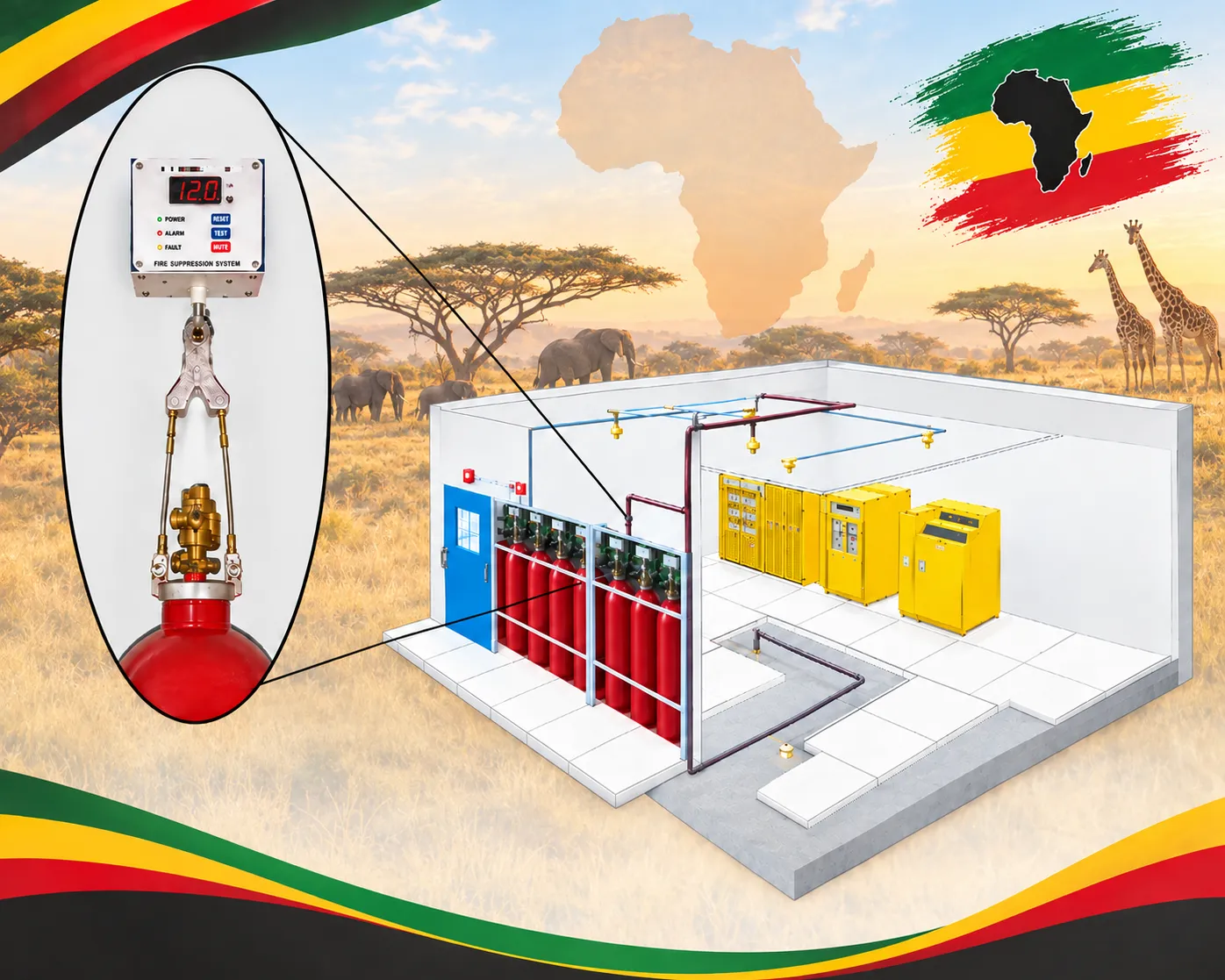
Airport Clean Agent Suppression Solutions Africa
LIFEGUARD® provides engineered airport clean agent suppression solutions for critical airport infrastructure across Africa, including airport data centres, server rooms, communication rooms, control rooms, electrical rooms, UPS rooms, security facilities, IT rooms, telecom rooms and other sensitive enclosed areas.
Modern airports are complex, technology-driven environments where fire protection must safeguard people, electronic equipment, operational infrastructure and business continuity. Airport terminals and supporting facilities contain extensive electrical, communication, IT, security and control equipment that may require specialized fire suppression solutions.
LIFEGUARD® offers airport clean agent suppression solutions in Africa designed for suitable enclosed hazards where rapid automatic fire detection and clean-agent extinguishing can provide effective protection with minimal residue.
Our approach combines fire detection, suppression control, clean-agent storage, engineered piping and nozzle distribution, alarm interfaces, HVAC interlocking and system commissioning into a coordinated fire protection solution.
Advanced Airport Fire Suppression Solutions for Africa
Airport fire protection cannot be treated as a one-size-fits-all application.
An airport contains multiple types of fire hazards, and each area may require a different protection strategy. Aircraft rescue and firefighting, terminal fire protection, fuel-related hazards, baggage facilities and technical rooms have different requirements.
For enclosed technical areas containing sensitive electrical and electronic equipment, clean-agent suppression can be an important component of the overall airport fire protection strategy.
LIFEGUARD® can provide engineered solutions for:
- Airport data centres
- Airport server rooms
- IT rooms
- Communication rooms
- Telecom rooms
- Airport control rooms
- Security control rooms
- CCTV rooms
- Electrical rooms
- Switchgear rooms
- UPS rooms
- Network rooms
- Equipment rooms
- Baggage control rooms
- Airport command centres
- Critical infrastructure rooms
- Aviation communication facilities
The appropriate suppression technology should always be determined through a project-specific hazard assessment and applicable regulatory requirements.
Why Clean Agent Suppression Is Important for Airports
Airports depend heavily on uninterrupted operation of electronic and electrical infrastructure.
A fire in a server room, communication facility or control room can potentially affect multiple airport functions simultaneously. Protection therefore needs to provide rapid response while considering the sensitivity of the equipment inside the protected enclosure.
Clean agents are generally selected for suitable applications because they are electrically non-conductive and designed to leave little or no residue after discharge, characteristics that can be valuable when protecting sensitive electronic equipment.
NFPA 2001 defines a clean agent as an electrically nonconducting, volatile or gaseous extinguishant that does not leave residue upon evaporation.
LIFEGUARD® develops clean-agent solutions around the actual hazard rather than simply specifying a generic extinguishing system.
LIFEGUARD® Airport Clean Agent Suppression Solutions
Our airport suppression solutions can incorporate:
- Automatic fire detection
- Addressable fire alarm interface
- Clean-agent releasing panel
- Clean-agent cylinders
- Cylinder valves
- Automatic actuation
- Manual release station
- Abort switch
- Audible alarms
- Visual warning indicators
- Discharge piping
- Engineered discharge nozzles
- Pressure monitoring
- HVAC shutdown interface
- Damper control
- Electrical equipment shutdown
- BMS interface
- Room pressure management
- System supervision
- Testing and commissioning
The final equipment configuration depends on the protected hazard, agent, room geometry, design requirements, applicable standards and project specifications.
Airport Clean Agent System Applications
Airport Data Centre Fire Suppression
Airport data centres are among the most critical technical facilities within modern aviation infrastructure.
They may contain:
- Servers
- Network switches
- Storage systems
- Routers
- Communication equipment
- Monitoring systems
- IT infrastructure
- Backup systems
A clean-agent suppression system can be engineered to detect and suppress a developing fire while avoiding the residue associated with powder-based extinguishing agents.
LIFEGUARD® can develop suppression solutions for dedicated airport data halls, server rooms and supporting IT infrastructure.
Airport Server Room Suppression
Server rooms frequently operate continuously and contain high-value electronic equipment.
A properly engineered system can combine:
Early Detection + Alarm + Releasing Control + Clean Agent + HVAC Interlock + BMS Interface
This integrated approach allows fire detection and suppression to operate as part of a coordinated airport safety system.
Airport Communication Room Protection
Airport communications infrastructure supports operational coordination and information exchange.
Communication rooms may contain switches, servers, radio-related equipment and other sensitive electronic systems.
Clean-agent suppression can be considered for suitable enclosed communication areas where protection requirements call for a gaseous extinguishing system.
Airport Control Room Fire Suppression
Airport control and monitoring rooms can contain critical electronic equipment and personnel.
LIFEGUARD® suppression systems can be engineered around the room's occupancy, equipment arrangement, detection philosophy and emergency operating procedures.
Airport Security Room Protection
Security facilities may contain:
- CCTV servers
- Monitoring equipment
- Access-control systems
- Security communication equipment
- Video storage systems
- Network infrastructure
A clean-agent system can provide dedicated protection for appropriately designed enclosed security and surveillance rooms.
Airport Electrical Room Suppression
Electrical rooms contain energized equipment where the selection of extinguishing media is particularly important.
For suitable enclosed electrical hazards, clean-agent suppression can provide a residue-minimizing alternative to certain conventional extinguishing approaches.
System selection should be based on electrical hazard characteristics, room configuration, equipment type and applicable regulations.
Airport UPS Room Fire Protection
UPS rooms support critical airport electrical infrastructure.
The appropriate fire protection system depends on the specific UPS and battery technology, room ventilation, equipment arrangement and applicable requirements.
LIFEGUARD® can support project-specific evaluation of suitable suppression arrangements.
Baggage Handling Control Room Protection
Modern baggage systems use extensive electronic controls and automation.
Dedicated control rooms associated with baggage handling may require specialized fire detection and suppression to protect control equipment and support operational continuity.
How Airport Clean Agent Suppression Works
A typical automatic clean-agent system operates through a coordinated sequence.
1. Fire Detection
Smoke, heat or other approved detection devices identify the presence of a potential fire.
2. Alarm Initiation
The releasing control panel receives the detector signal and initiates the programmed alarm sequence.
3. Fire Alarm Notification
Audible and visual warning devices alert personnel within or around the protected area.
4. Pre-Discharge Sequence
The system provides the programmed warning and time delay required by the approved design.
5. HVAC and Equipment Interlocks
Where required, the system can initiate:
- HVAC shutdown
- Damper closure
- Equipment shutdown
- Ventilation control
- BMS signal
- Fire alarm signal
6. Clean Agent Release
After the programmed release conditions are satisfied, the suppression system activates the agent storage and discharge mechanism.
7. Agent Distribution
The clean agent travels through the engineered pipe network and is discharged through strategically positioned nozzles.
8. Fire Suppression
The agent reaches the required design concentration within the protected enclosure to suppress the fire according to the applicable system design.
9. Post-Discharge Monitoring
The system provides appropriate indications to support emergency response, inspection, ventilation and system restoration.
Engineered Clean Agent Suppression for African Airports
LIFEGUARD® approaches airport suppression as an engineered fire protection system, not simply as a collection of cylinders and nozzles.
NFPA 2001 describes engineered systems as systems requiring individual calculation and design for factors such as flow rates, nozzle pressures, pipe sizes, protected volume and nozzle arrangement.
The engineering process can consider:
Protected Volume
Room dimensions, ceiling height, raised floor and false ceiling arrangements affect system design.
Fire Hazard
The type of equipment and potential fire scenario determine the appropriate suppression approach.
Agent Quantity
Agent quantity is calculated according to the selected system, hazard, design concentration and applicable design methodology.
Piping Network
Pipe diameters, lengths, fittings, branches and discharge characteristics are coordinated during system design.
Nozzle Distribution
Nozzle locations are selected to achieve appropriate distribution throughout the protected enclosure.
Room Integrity
Total-flooding systems require suitable enclosure conditions so that the design concentration can be achieved and maintained for the required period.
Cause-and-Effect Logic
Detection, alarm, pre-discharge, release and equipment interfaces are coordinated through an approved cause-and-effect sequence.
Airport Fire Protection and ICAO Requirements
Airport fire safety encompasses several distinct protection functions.
ICAO's airport safety framework addresses rescue and firefighting services at aerodromes, while airport buildings and technical infrastructure can have additional fire protection requirements. ICAO's Airport Services Manual Part I covers airport rescue and firefighting considerations including extinguishing agents, equipment and operational aspects.
Therefore, a clean-agent system protecting an airport server room should not be presented as a substitute for the airport's overall aircraft rescue and firefighting capability.
Instead, it should be considered as one component of a comprehensive airport fire protection strategy.
Clean Agent vs Conventional Fire Suppression
Different airport areas require different technologies.
Airport AreaPotential Protection ApproachServer RoomClean-agent / gaseous suppressionData CentreClean-agent / gaseous suppressionCommunication RoomClean-agent / gaseous suppressionElectrical RoomEngineered clean-agent or other suitable systemUPS RoomHazard-specific suppressionKitchenDedicated kitchen suppressionWarehouseWater-based or other engineered systemAircraft HangarSpecialized aviation/hangar protectionFuel FacilityFuel-hazard-specific protectionAircraft RescueDedicated airport rescue and firefighting systems
This distinction is important because there is no single suppression technology suitable for every airport hazard.
Airport Clean Agent Solutions Across Africa
Africa has a wide and diverse aviation infrastructure network ranging from major international hubs to regional airports and specialized aviation facilities.
LIFEGUARD® can target project requirements across:
North Africa
- Egypt
- Morocco
- Algeria
- Tunisia
- Libya
East Africa
- Kenya
- Ethiopia
- Tanzania
- Uganda
- Rwanda
- Mauritius
West Africa
- Nigeria
- Ghana
- Senegal
- Côte d'Ivoire
- Liberia
Southern Africa
- South Africa
- Zambia
- Zimbabwe
- Botswana
- Namibia
- Mozambique
Central Africa
- Angola
- Cameroon
- Gabon
- Democratic Republic of Congo
- Republic of Congo
International supply remains subject to country-specific regulations, approvals, customs requirements, project specifications and local installation/service arrangements.
Africa's Changing Airport Firefighting Environment
Environmental considerations are increasingly relevant to airport fire protection projects in Africa.
In August 2025, UNEP and ICAO announced the $82.5 million Fortifying Infrastructure for Responsible Extinguishment (FIRE) project, aimed at supporting the transition away from PFAS-containing firefighting foams at major airports in Egypt, Ethiopia, Kenya, Nigeria and South Africa.
The initiative demonstrates the growing importance of evaluating firefighting technologies from both fire-safety and environmental perspectives.
In June 2026, UNEP highlighted Jomo Kenyatta International Airport's use of fluorine-free foam as part of Kenya's transition toward safer aviation firefighting practices.
It is important, however, to distinguish this development from clean-agent protection of enclosed technical rooms. Aircraft rescue firefighting and gaseous suppression for IT/electrical rooms address different hazards and should be engineered separately.
Airport Clean Agent Solutions for Critical Infrastructure
LIFEGUARD® can develop solutions for airport facilities where equipment protection and continuity are priorities.
Critical IT Infrastructure
Protecting servers and networking infrastructure can help reduce the potential impact of fire on airport digital services.
Communication Infrastructure
Dedicated suppression can protect enclosed communications equipment rooms.
Electrical Infrastructure
Clean-agent systems may be considered for suitable electrical and control rooms.
Security Infrastructure
Surveillance and security control facilities can be protected with appropriately engineered suppression.
Airport Command Infrastructure
Command and monitoring facilities can require specialized fire protection because of their operational importance.
Key Benefits of LIFEGUARD® Clean Agent Solutions
Rapid Automatic Response
Fire detection and suppression systems can be engineered to respond quickly to developing fires.
Minimal Residue
Clean agents are designed for applications where avoiding residue is an important consideration.
Protection of Sensitive Equipment
The technology can be suitable for appropriately designed electrical and electronic environments.
Integrated System Operation
Detection, releasing, alarms, HVAC and BMS interfaces can be coordinated into a single suppression strategy.
Application-Specific Engineering
The system can be designed according to room volume, hazard, equipment arrangement and project requirements.
Reduced Post-Fire Cleanup
Clean-agent systems can minimize the cleanup associated with powder or water-based discharge in suitable applications.
Airport Clean Agent System Components
A typical LIFEGUARD® solution may include:
Fire Detection System
Provides early identification of fire conditions.
Releasing Control Panel
Controls detection, alarm, time delay, release and system supervision.
Clean Agent Cylinder
Stores the required extinguishing agent.
Cylinder Valve & Actuation
Controls agent release.
Discharge Piping
Transports the agent from the cylinder to the protected area.
Discharge Nozzles
Distribute the agent throughout the enclosure.
Manual Release
Provides authorized manual activation where specified.
Abort Switch
Provides the specified release interruption/delay functionality during the pre-discharge period.
Audible & Visual Alarms
Warn occupants and personnel.
HVAC Interface
Coordinates air-conditioning and ventilation shutdown where required.
BMS Interface
Allows suitable monitoring and control signals to be exchanged with the building management system.
LIFEGUARD® as an Airport Fire Protection Partner
LIFEGUARD® combines fire safety manufacturing experience with system-oriented engineering capabilities.
Our airport project support can include:
- Technical consultation
- Hazard assessment support
- System concept development
- Agent selection support
- Agent quantity calculation
- Piping design
- Nozzle layout
- Detection design coordination
- Releasing logic
- Cause-and-effect matrix
- Technical submittals
- Product documentation
- Installation support
- Testing
- Commissioning
- Training
- Handover documentation
The exact scope is determined according to the project contract and local requirements.
Airport Clean Agent System Integration
Modern airport fire protection systems rarely operate independently.
A suppression system may need to communicate with:
- Fire alarm systems
- HVAC systems
- BMS
- Electrical panels
- Security systems
- Access-control systems
- Emergency shutdown systems
- Building monitoring systems
LIFEGUARD® can support integration of these interfaces according to the approved system cause-and-effect philosophy.
Airport Clean Agent Solutions for EPC Contractors
Airport EPC projects require close coordination between multiple engineering disciplines.
LIFEGUARD® can support EPC and MEP contractors with technical information required during:
Design → Technical Submittal → Approval → Procurement → Installation → Testing → Commissioning → Handover
This can help contractors coordinate the suppression system with architectural, electrical, HVAC, IT and BMS requirements.
Airport Clean Agent Solutions for Consultants
Fire consultants and MEP consultants can coordinate with LIFEGUARD® during project design to establish:
- Protected zones
- Agent selection
- Cylinder arrangement
- Detection philosophy
- Nozzle arrangement
- Piping configuration
- Room integrity requirements
- HVAC interlocks
- Release logic
- Cause-and-effect requirements
- Testing and commissioning procedures
Airport Clean Agent Solutions for System Integrators
LIFEGUARD® can also support African fire protection system integrators and distributors seeking project-specific clean-agent solutions.
Potential cooperation models include:
- Project-based supply
- OEM supply
- System integration
- Distributor partnerships
- Technical support
- Engineering support
- Installation assistance
- Testing and commissioning coordination
Local licensing, certification, installation and approval requirements should be verified for each African country and airport authority.
Standards and Compliance
Depending on the airport, country, hazard and project specification, clean-agent system design may need to consider:
- NFPA 2001 – Standard on Clean Agent Fire Extinguishing Systems
- NFPA 72 – National Fire Alarm and Signaling Code
- ISO 14520
- Applicable national fire codes
- Civil aviation authority requirements
- Airport-specific standards
- Local authority requirements
- Project consultant specifications
For South African projects, for example, SANS 14520 is used for gaseous fire suppression applications; current South African industry guidance describes it as the national adoption of ISO 14520.
Final compliance should always be confirmed against the specific African country, airport authority, protected hazard and project specification.
Testing and Commissioning
A clean-agent system is only useful when it operates correctly during an emergency.
LIFEGUARD® project support can include functional verification of:
- Detection devices
- Alarm sequence
- Releasing panel
- Manual release
- Abort switch
- Time delay
- Cylinder actuation
- Pressure monitoring
- HVAC interlock
- Damper interface
- Equipment shutdown
- BMS interface
- Audible/visual alarms
- Cause-and-effect operation
Where applicable, enclosure integrity testing should also be addressed as part of the system commissioning strategy.
Maintenance of Airport Clean Agent Systems
Airport fire suppression systems require periodic inspection and maintenance.
Maintenance programs may include:
- Visual inspection
- Cylinder inspection
- Pressure monitoring
- Valve inspection
- Pipe and nozzle inspection
- Detector testing
- Releasing panel testing
- Alarm testing
- Manual release testing
- Abort switch testing
- Interlock verification
- Battery inspection
- BMS interface testing
- Documentation and service records
The required maintenance frequency and procedures should follow the applicable standards, manufacturer requirements, authority requirements and airport maintenance program.
Airport operators in Africa already procure dedicated fire suppression maintenance services for critical airport infrastructure. For example, Airports Company South Africa documentation has included fire detection and suppression systems serving terminal buildings, cargo facilities and IT infrastructure, including interfaces with HVAC and IT rooms.
Why Choose LIFEGUARD®?
Indian Fire Safety Manufacturing Experience
LIFEGUARD® is associated with fire safety equipment manufacturing and engineered fire protection solutions in India.
Complete System Approach
We focus on the complete suppression system rather than supplying only an extinguishing agent or cylinder.
Project-Specific Engineering
Every airport room has different dimensions, equipment and hazards. Our solutions can be developed around individual project requirements.
International Project Support
LIFEGUARD® can support African projects through export-oriented supply, technical documentation and project coordination.
Critical Infrastructure Focus
Our solutions can be applied to sensitive technical areas such as data centres, server rooms, communication rooms, electrical rooms and control facilities.
Technical Documentation
Depending on the project scope, documentation can include technical datasheets, drawings, calculations, specifications, cause-and-effect information, installation documents and commissioning documentation.
Airport Clean Agent Suppression Solutions Africa – Complete Project Lifecycle
LIFEGUARD® can support the project through a structured workflow:
01 — Requirement Analysis
Understand the airport facility, hazard and project specification.
02 — Engineering Review
Review room dimensions, equipment, ventilation and interfaces.
03 — System Design
Develop detection, agent, cylinder, piping and nozzle requirements.
04 — Technical Submittal
Prepare documentation for consultant and client review.
05 — Manufacturing & Supply
Supply the approved equipment and system components.
06 — Installation Support
Provide relevant technical guidance and documentation.
07 — Testing & Commissioning
Verify detection, alarm, interlocks and suppression functions.
08 — Training & Handover
Provide operating, maintenance and system documentation.
Frequently Asked Questions
What are airport clean agent suppression solutions?
Airport clean agent suppression solutions are engineered fire suppression systems designed primarily for suitable enclosed airport areas containing sensitive electrical, electronic and high-value equipment.
Where can clean-agent systems be used in airports?
Typical applications include airport data centres, server rooms, communication rooms, IT rooms, control rooms, security rooms, electrical rooms, UPS rooms, telecom rooms and other suitable technical spaces.
Can clean-agent suppression protect airport servers?
Yes. Clean-agent systems are commonly considered for appropriately designed server and data rooms because the extinguishing medium is intended to minimize residue and is electrically non-conductive.
Is clean agent suitable for aircraft firefighting?
No single suppression technology should be assumed to cover every airport hazard. Aircraft rescue and firefighting is a specialized airport function with its own requirements. Clean-agent systems discussed here primarily address suitable enclosed airport infrastructure.
Does LIFEGUARD® provide solutions in Africa?
LIFEGUARD® can support African airport projects through project-based supply and technical coordination, subject to country-specific regulations, approvals, logistics and agreed project scope.
Can LIFEGUARD® supply systems for African data centres located within airports?
Yes. Airport data centres and other mission-critical IT spaces can be evaluated for engineered clean-agent suppression according to the hazard and project requirements.
Which clean agent is suitable for an airport?
There is no universal agent that is automatically the best choice for every airport application. Agent selection depends on hazard type, enclosure, occupancy, design concentration, environmental considerations, applicable standards, equipment and project specifications.
Does a clean-agent system require a fire alarm panel?
An automatic system normally requires appropriate detection and releasing control equipment to identify the fire condition and execute the approved suppression sequence.
Does the room need to be sealed?
Total-flooding systems require appropriate enclosure integrity so the required concentration can be established and maintained. Door, wall, ceiling, ventilation and pressure-relief conditions should therefore be evaluated during design.
Can the suppression system connect to BMS?
Yes. Suitable BMS interfaces can be incorporated where required by the project cause-and-effect philosophy.
Choose LIFEGUARD® for Airport Clean Agent Suppression Solutions in Africa
Airport infrastructure requires specialized fire protection that considers life safety, asset protection, operational continuity, electronic equipment and environmental requirements.
LIFEGUARD® provides engineered clean-agent suppression solutions for suitable airport technical and critical infrastructure applications, supporting airport authorities, EPC contractors, MEP consultants, fire protection contractors, system integrators and distributors.
From airport data centres and server rooms to communication facilities, electrical rooms, UPS rooms, security rooms and control centres, LIFEGUARD® can support the development of application-specific fire suppression solutions.
LIFEGUARD® – Engineered Fire Safety Solutions for Airports and Critical Aviation Infrastructure
Request an Airport Fire Suppression Proposal
For airport clean-agent suppression projects in Africa, share the protected-room dimensions, application, equipment details, project country and applicable specification with our technical team.
United Fire Equipments Pvt. Ltd.
LIFEGUARD® – Manufacturer of ISI Certified Fire Safety Equipment
📞 8048034226
Keywords






