
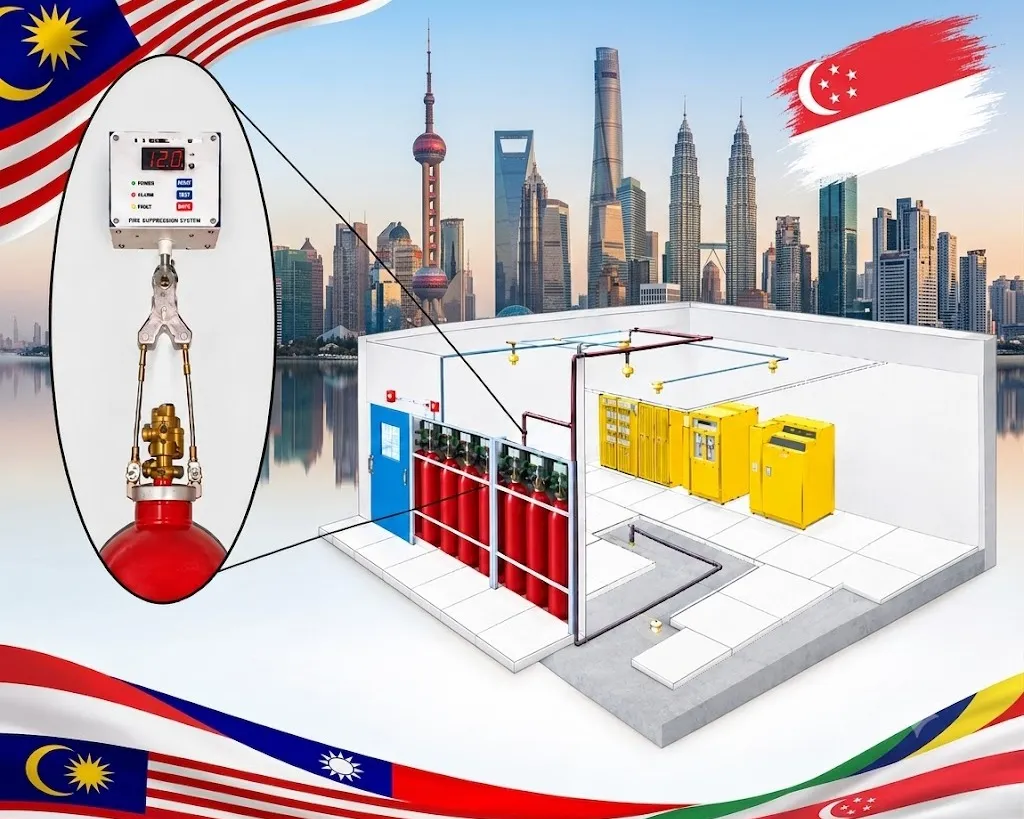
Airport Clean Agent Suppression Solutions Asia
Advanced Fire Protection Solutions for Airports, Critical Infrastructure & Aviation Facilities
Airports are among the most technologically advanced and operationally sensitive infrastructure facilities. From passenger terminals and baggage-handling systems to airport data centres, communication rooms, security centres, electrical rooms and command facilities, modern airports depend on continuously operating electronic and electrical systems.
A fire in one of these critical areas can affect equipment, communications, airport operations and business continuity. LIFEGUARD® provides engineered Airport Clean Agent Suppression Solutions in Asia for suitably enclosed, high-value and sensitive technical environments where conventional water, foam or dry-chemical suppression may not be the preferred approach.
Clean-agent systems are particularly relevant to enclosed electrical, electronic and telecommunications hazards because they use extinguishing media designed for applications where an electrically non-conductive medium and limited post-discharge cleanup are important considerations. (2025 NFPA)
LIFEGUARD® Airport Clean Agent Suppression Solutions
LIFEGUARD®, manufactured and supplied by United Fire Equipments Pvt. Ltd., provides fire protection solutions for critical infrastructure and specialized applications.
Our airport clean-agent suppression solutions can be engineered for:
- Airport data centres
- Server rooms
- Network rooms
- Telecom rooms
- Airport control rooms
- Security and surveillance rooms
- Communication rooms
- UPS rooms
- Electrical rooms
- Switchgear rooms
- MCC rooms
- BMS/control rooms
- Baggage-handling control rooms
- Airport operation centres
- Equipment rooms
- Technical service rooms
- Critical electronic infrastructure
The system configuration is selected according to the hazard, enclosure, occupancy, equipment, agent, applicable standards and project specifications.
Why Airports Require Clean Agent Fire Suppression
Airport infrastructure contains a large amount of high-value electronic equipment. Conventional fire suppression can sometimes create secondary damage that may be significant in an electronics-intensive environment.
A properly engineered clean-agent system is intended to suppress a fire within the protected enclosure while minimizing the introduction of water or solid extinguishing residues.
Important advantages can include:
Rapid Fire Suppression
Automatic detection and releasing systems can initiate a programmed suppression sequence when a fire is detected.
Minimal Post-Discharge Residue
Clean gaseous agents can evaporate or disperse without leaving the powder residue associated with dry-chemical systems.
Electrical Equipment Compatibility
Appropriately selected clean agents are used for applications where an electrically non-conductive extinguishing medium is desirable. (2025 NFPA)
Protection of Critical Assets
Clean-agent technology can be considered for appropriately enclosed high-value electronic and electrical equipment.
Business Continuity Considerations
Where the application is suitable, avoiding water contamination can simplify equipment recovery following an incident.
Airport Clean Agent Suppression System Applications
1. Airport Data Centre Fire Suppression
Data centres are essential components of modern airport infrastructure.
They may contain:
- Servers
- Network switches
- Storage systems
- Communication equipment
- Monitoring systems
- UPS equipment
- IT infrastructure
LIFEGUARD® clean-agent suppression systems can be engineered for suitably enclosed airport data-centre environments.
The system can integrate:
Fire Detection → Releasing Panel → Pre-Discharge Alarm → HVAC Interlock → Agent Discharge → Fire Suppression
2. Airport Server Room Suppression
Airport server rooms contain sensitive electronic equipment that can be affected by smoke, heat and conventional extinguishing media.
A clean-agent system can provide total-flooding protection for a suitably sealed server-room enclosure.
Important design considerations include:
- Room volume
- Design concentration
- Agent quantity
- Temperature
- Ventilation
- Enclosure integrity
- Raised-floor areas
- False-ceiling spaces
- Pipe network
- Nozzle distribution
- Pressure relief
The agent quantity should be established through engineering calculations rather than a simple floor-area estimate.
3. Airport Control Room Fire Suppression
Airport control and monitoring rooms contain critical electronic systems, communication equipment and operational controls.
LIFEGUARD® can provide clean-agent suppression solutions for suitable enclosed control-room applications.
A typical cause-and-effect sequence may include:
First Detection
↓
Fire Alarm
↓
Second Detection / Confirmation
↓
Pre-Discharge Warning
↓
HVAC & Equipment Interlock
↓
Clean Agent Release
The exact sequence must be determined by the approved project fire strategy and authority requirements.
4. Airport Electrical Room Suppression
Electrical rooms can contain:
- Switchgear
- Distribution panels
- MCCs
- UPS systems
- Electrical controls
- Automation equipment
- Control panels
For suitable enclosed hazards, clean-agent suppression can be evaluated where water discharge is undesirable.
The design should consider electrical equipment, fire load, room construction, ventilation, cable penetrations, equipment shutdown and enclosure integrity.
5. Airport UPS Room Fire Suppression
UPS systems support critical airport infrastructure and may operate continuously.
UPS rooms can contain:
- UPS units
- Battery systems
- Power electronics
- Distribution equipment
- Control systems
A clean-agent system can be considered for suitable enclosed UPS environments following an application-specific fire-risk assessment.
Where battery technologies such as lithium-ion are involved, the fire strategy requires particular consideration because clean-agent suppression is not automatically suitable for every battery failure or thermal-runaway scenario.
6. Airport Telecom Room Fire Protection
Communication systems are fundamental to airport operations.
Telecom rooms may contain:
- Network equipment
- Routers
- Switches
- Fibre-optic infrastructure
- Communication equipment
- Power supplies
- Monitoring equipment
Clean-agent suppression provides an option for suitably enclosed telecom and communication facilities where protection of sensitive equipment is a priority.
7. Airport Baggage Handling System Protection
Modern baggage-handling infrastructure incorporates extensive electrical controls, motors, sensors and automated systems.
Clean-agent systems can be considered for enclosed baggage-control rooms and associated technical rooms.
Open conveyor areas may require different fire-protection technologies. The appropriate solution should therefore be established through a hazard assessment rather than assuming that a gaseous total-flooding system is appropriate for the entire baggage system.
8. Airport Security & Surveillance Room Protection
Security infrastructure can include:
- CCTV servers
- Video storage
- Access-control systems
- Network equipment
- Monitoring consoles
- Communication systems
These facilities may be suitable candidates for clean-agent protection where the room can be appropriately enclosed and engineered.
Clean Agent Technologies for Airport Applications
Depending on the project requirements, applicable regulations and system approvals, different clean-agent technologies may be evaluated.
FK-5-1-12
FK-5-1-12 is used in engineered fire suppression systems for suitable electronic and electrical environments.
Potential applications include:
- Data centres
- Server rooms
- Telecom rooms
- Control rooms
- Electrical rooms
- UPS rooms
- Network infrastructure
The suitability of a particular agent must be confirmed based on the specific hazard and project requirements.
HFC-227ea
HFC-227ea has historically been used in engineered total-flooding fire suppression applications. Its use should be evaluated against current environmental regulations, project specifications and applicable national requirements.
Inert Gas Systems
Inert gases such as nitrogen, argon and approved gas blends can also be considered for suitable enclosed hazards.
The system design, cylinder quantity, pressure, enclosure and personnel safety requirements differ from those of chemical clean-agent systems.
Airport Clean Agent Suppression System Components
A complete system can incorporate:
Clean Agent Cylinders
Storage vessels containing the calculated quantity of extinguishing agent.
Cylinder Valves
Valves designed for controlled release of the stored agent.
Releasing Control Panel
The central control unit responsible for monitoring detection devices and initiating the programmed release sequence.
Fire Detection
Depending on the hazard:
- Smoke detection
- Heat detection
- Multi-sensor detection
- Aspirating smoke detection
may be considered.
Manual Release
Provides an authorized manual means of initiating system discharge where required.
Abort Switch
Can be incorporated where the approved release philosophy requires an abort function.
Audible & Visual Alarms
Pre-discharge alarms warn personnel before agent release.
Distribution Piping
Engineered pipe networks transport the agent from cylinders to discharge nozzles.
Discharge Nozzles
Nozzles are positioned and sized according to the system design.
HVAC Interlock
The releasing system may interface with HVAC equipment and dampers.
Electrical Interlock
Where required, electrical equipment may be interfaced with the fire suppression sequence.
Pressure Relief
Pressure-relief provisions should be evaluated because gaseous-agent discharge can cause pressure changes within the enclosure.
How LIFEGUARD® Airport Clean Agent Suppression Works
A typical automatic system can operate through the following stages:
Stage 1 – Fire Detection
The detection system identifies smoke or another indication of fire.
Stage 2 – Alarm
The releasing panel activates the required fire alarm sequence.
Stage 3 – Confirmation
Depending on the design, cross-zoned or multiple-detector confirmation may be used.
Stage 4 – Pre-Discharge Warning
Audible and visual alarms notify occupants before discharge.
Stage 5 – Equipment Interlocking
The system may initiate programmed actions such as:
- HVAC shutdown
- Damper closure
- Equipment shutdown
- Fire-alarm interface
- BMS signal
Stage 6 – Agent Release
The cylinder valve is activated according to the approved release logic.
Stage 7 – Agent Distribution
The agent travels through the engineered piping network and is discharged through strategically positioned nozzles.
Stage 8 – Fire Suppression
The required extinguishing concentration is established within the protected enclosure according to the system design.
Personnel safety is a fundamental part of clean-agent system engineering. NFPA 2001 includes provisions addressing evacuation, discharge alarms, warning signs, training and other safeguards. (NFPA Data)
Airport Clean Agent System Engineering
LIFEGUARD® approaches clean-agent protection as an engineered fire suppression system, rather than simply supplying cylinders and nozzles.
Hazard Assessment
The application is reviewed to understand:
- Fire hazards
- Fuel sources
- Electrical equipment
- Occupancy
- Room construction
- Ventilation
- Equipment density
- Potential ignition sources
Enclosure Assessment
A total-flooding clean-agent system relies on the enclosure to retain the agent. Therefore, doors, dampers, cable penetrations, ventilation openings, raised floors and ceiling voids need to be considered.
Agent Quantity Calculation
Agent quantity is calculated according to the selected agent, design parameters, protected volume, temperature and applicable design criteria.
Pipe Network Design
The piping arrangement is engineered to distribute the agent appropriately throughout the protected enclosure.
Nozzle Design
Nozzle location, quantity and discharge characteristics are determined according to the system design.
Detection & Cause-and-Effect
The detection and releasing sequence is developed according to the project's approved cause-and-effect matrix.
Standards-Based Airport Fire Protection
Airport fire protection has to be considered within the wider aviation emergency and fire-safety framework.
ICAO documentation addresses aerodrome rescue and firefighting arrangements and the use of appropriate extinguishing agents and equipment. (ICAO)
This is important because clean-agent suppression for airport technical rooms is not the same as aircraft rescue and firefighting (ARFF/RFF).
A clean-agent system may protect an airport server room, control room or electrical facility, while airport rescue and firefighting services address aircraft-related emergencies and broader aerodrome response requirements.
For Asian airport projects, applicable requirements can include:
- ICAO provisions
- National civil aviation regulations
- Airport operator specifications
- Local fire authority requirements
- Building regulations
- Electrical codes
- Applicable clean-agent suppression standards
- Project-specific consultant specifications
The applicable requirements should be established for each individual airport project.
ISO 14520, NFPA 2001 & EN-Based Engineering
Depending on the project jurisdiction and specification, clean-agent systems may be engineered with reference to recognized standards such as:
- ISO 14520
- NFPA 2001
- EN 15004
- Applicable national standards
- Local authority requirements
- Manufacturer's listed/approved design criteria
NFPA 2001 describes clean-agent systems as useful for applications including electrical and electronic hazards, telecommunications facilities and other high-value assets where an electrically non-conductive medium or reduced cleanup is desirable. (2025 NFPA)
The actual standard applicable to an Asian airport project should always be confirmed with the project consultant, airport authority and authority having jurisdiction.
Airport Clean Agent Suppression Solutions Across Asia
LIFEGUARD® can support clean-agent fire protection requirements for airport and aviation infrastructure projects throughout Asian markets, including:
- India
- Bangladesh
- Nepal
- Sri Lanka
- Maldives
- Singapore
- Malaysia
- Indonesia
- Thailand
- Vietnam
- Philippines
- Cambodia
- Brunei
- Japan
- South Korea
- Taiwan
- Hong Kong
- UAE
- Saudi Arabia
- Qatar
- Oman
- Kuwait
- Bahrain
- Other Asian markets
International aviation fire-protection organizations maintain resources covering airports and aviation fire-safety organizations throughout Asia-Pacific, illustrating the region's broad airport fire-protection ecosystem. (IAFPA)
Airport Clean Agent Suppression Solutions from India
LIFEGUARD® can support international airport projects from its Indian manufacturing and project-support base.
International project support can include:
- Technical consultation
- System selection
- Engineering assistance
- BOQ preparation
- Technical quotations
- Product datasheets
- System drawings
- Agent calculations
- Technical submittals
- Export packing
- Shipping documentation
- Installation guidance
- Testing support
- Commissioning assistance
- Operation and maintenance documentation
Export documentation and product approvals can vary according to the destination country and project specification.
Applications Beyond Airport Terminals
Airport clean-agent suppression solutions may also be considered for selected facilities associated with aviation infrastructure:
Airport Data Centres
Protection of servers, network infrastructure and IT systems.
Airport Operation Centres
Protection of enclosed monitoring and operational systems.
Airside Technical Facilities
Protection of suitable enclosed technical equipment.
Aviation Communication Centres
Protection of communication and network equipment.
Airport Security Centres
Protection of CCTV, access-control and security infrastructure.
Airport Electrical Infrastructure
Protection of suitable electrical and control rooms.
Airport Maintenance Facilities
Protection of selected enclosed technical areas and equipment.
Why Choose LIFEGUARD® for Airport Clean Agent Solutions?
Experienced Fire Safety Manufacturer
LIFEGUARD® has been associated with fire safety equipment manufacturing since 1991.
Engineered Fire Protection
Solutions are developed according to the actual hazard and protected enclosure.
Critical Infrastructure Focus
The portfolio includes solutions for sensitive electronic and electrical environments.
Integrated System Approach
A complete solution can combine:
Detection + Releasing Panel + Cylinders + Valves + Piping + Nozzles + Alarms + Interlocks
International Project Support
LIFEGUARD® can support consultants, EPC contractors, airport operators, fire-protection contractors, distributors and system integrators.
Documentation Support
Technical documentation can be provided according to project requirements.
Airport Clean Agent Suppression Project Process
Step 1 – Project Enquiry
The customer provides information about the airport facility and intended application.
Step 2 – Hazard Assessment
Room dimensions, equipment, occupancy, ventilation and fire risk are reviewed.
Step 3 – System Selection
The appropriate suppression technology is evaluated.
Step 4 – Engineering
Agent quantity, cylinders, piping and nozzles are determined.
Step 5 – Technical Submission
Technical documentation, drawings and calculations are prepared as applicable.
Step 6 – Supply
The approved system components are manufactured/procured and supplied.
Step 7 – Installation
The system is installed according to approved drawings and project requirements.
Step 8 – Testing
Detection, alarm, releasing logic and interlocks are functionally tested.
Step 9 – Commissioning
The completed installation is commissioned according to the approved procedure.
Step 10 – Handover
Relevant documentation, test records and operating instructions are provided as applicable.
Airport Clean Agent Suppression Solutions Asia – LIFEGUARD®
LIFEGUARD® provides engineered Airport Clean Agent Suppression Solutions in Asia for airports and aviation-related facilities requiring protection of critical electronic, electrical and communication infrastructure.
From airport data centres and server rooms to control rooms, telecom rooms, UPS rooms, electrical rooms and security facilities, LIFEGUARD® develops fire protection solutions around the actual hazard, enclosure and project requirements.
Our approach combines fire detection, suppression engineering, system integration, equipment supply, testing and commissioning support to help airport infrastructure owners and contractors develop coordinated fire-protection systems.
LIFEGUARD® – Engineered Fire Protection for Critical Airport Infrastructure Across Asia.
SEO Keyword Strategy
Primary Keyword
Airport Clean Agent Suppression Solutions Asia
Secondary Keywords
- Airport clean agent fire suppression Asia
- Airport fire suppression solutions Asia
- Airport fire protection system Asia
- Airport clean agent system supplier Asia
- Airport clean agent suppression company
- Airport clean agent fire suppression system
- Airport data centre fire suppression
- Airport server room fire suppression
- Airport control room fire suppression
- Airport electrical room fire suppression
- Airport UPS room fire suppression
- Airport telecom room fire suppression
- Airport security room fire suppression
- Airport automatic fire suppression system
- FK-5-1-12 airport fire suppression
- Inert gas airport fire suppression
- Airport gaseous fire suppression system
- Airport clean agent OEM
- Aviation fire protection solutions Asia
- Airport fire safety equipment supplier Asia
- Clean agent suppression manufacturer India
- Airport fire suppression system exporter Asia
Suggested SEO Meta Title
Airport Clean Agent Suppression Solutions Asia | LIFEGUARD®
Suggested Meta Description
LIFEGUARD® provides engineered airport clean agent suppression solutions across Asia for data centres, server rooms, control rooms, UPS, telecom, electrical and critical airport infrastructure.
Suggested H1
Airport Clean Agent Suppression Solutions Asia
Suggested URL Slug
/airport-clean-agent-suppression-solutions-asia
Suggested SEO-Friendly Page Structure
H1: Airport Clean Agent Suppression Solutions Asia
H2: LIFEGUARD® Airport Clean Agent Suppression Solutions
H2: Why Airports Need Clean Agent Fire Suppression
H2: Airport Clean Agent Suppression Applications
H2: Airport Data Centre Fire Suppression
H2: Airport Server Room Suppression
H2: Airport Control Room Fire Suppression
H2: Airport Electrical Room Suppression
H2: Airport UPS Room Fire Suppression
H2: Airport Telecom Room Fire Protection
H2: Airport Baggage Handling Fire Protection
H2: Clean Agent Technologies for Airport Applications
H2: Airport Clean Agent System Components
H2: How Airport Clean Agent Suppression Works
H2: Airport Clean Agent System Engineering
H2: Standards-Based Airport Fire Protection
H2: Airport Clean Agent Solutions Across Asia
H2: Airport Clean Agent Suppression Solutions from India
H2: Why Choose LIFEGUARD®
H2: Frequently Asked Questions
H2: Airport Clean Agent Suppression Solutions Asia – LIFEGUARD®**
Keywords






