
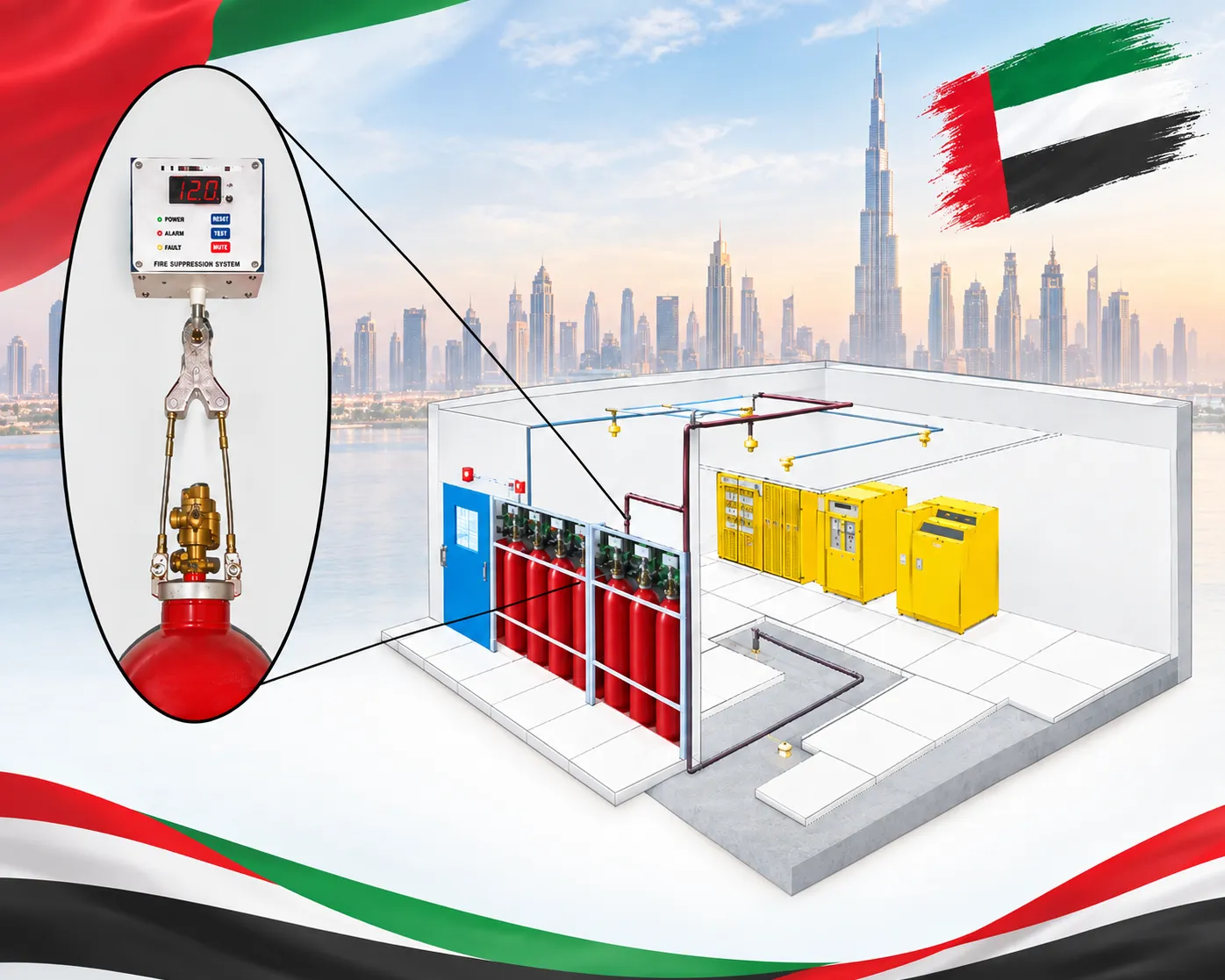
Airport Clean Agent Suppression Solutions UAE
LIFEGUARD® – Engineered Clean Agent Fire Suppression Solutions for Airports in the UAE
Airports are complex, continuously operating environments containing critical electrical, electronic, communication, security and operational infrastructure. Protecting these facilities requires carefully engineered fire protection systems capable of responding rapidly to fire while protecting sensitive equipment and supporting operational continuity.
LIFEGUARD® provides engineered airport clean agent suppression solutions for UAE projects, supporting applications such as airport data centres, server rooms, communication rooms, electrical rooms, control rooms, UPS rooms, security infrastructure and other suitable enclosed technical areas.
Dubai Airports' published requirements state that fire protection systems and fire-extinguishing equipment must be maintained in accordance with the UAE Fire and Life Safety Code of Practice and applicable NFPA codes and standards, with scheduled inspection and servicing.
LIFEGUARD® approaches airport fire protection as an integrated system comprising detection, releasing controls, clean agent storage, distribution pipework, discharge nozzles, alarms, interlocks and testing, rather than simply supplying extinguishing cylinders.
What Are Airport Clean Agent Suppression Solutions?
An airport clean agent suppression system is an engineered fire suppression solution designed for appropriate enclosed hazards where a gaseous extinguishing agent is specified.
The system normally combines:
- Automatic fire detection
- Releasing control panel
- Clean agent cylinders
- Agent discharge piping
- Discharge nozzles
- Manual release station
- Abort switch
- Audible and visual alarms
- Pressure monitoring
- HVAC shutdown interface
- Damper interface
- Fire alarm integration
- BMS interface
- Cause-and-effect programming
- Enclosure integrity provisions
- Testing and commissioning
When a fire is detected, the system follows the approved detection and release sequence and, where the system is designed for automatic discharge, releases the extinguishing agent into the protected enclosure.
The exact sequence, agent quantity, discharge time and equipment configuration must be established through the approved system design.
Why Airports Need Specialised Fire Suppression
Airport infrastructure contains numerous areas where conventional water-based suppression may not be the preferred protection method for sensitive equipment.
A modern airport may contain:
- Data centres
- IT infrastructure
- Server rooms
- Network equipment
- Communication systems
- Airport operations control facilities
- Electrical switchgear
- UPS systems
- Security and surveillance equipment
- Baggage handling controls
- Aviation communication equipment
- Technical control rooms
A fire in one of these areas can potentially affect equipment that supports airport operations.
Dubai Airports describes dedicated airport fire services and also highlights the importance of safety, security and operational resilience across its airport environment.
This makes engineered protection of critical technical spaces an important component of an airport's overall fire safety strategy.
LIFEGUARD® Airport Clean Agent Suppression Solutions UAE
LIFEGUARD® provides fire safety equipment and engineered fire protection solutions for critical infrastructure applications.
For airport projects in the UAE, our clean-agent suppression solutions can be configured around the specific requirements of the protected hazard.
Our solution can include:
Fire Detection
Early detection through suitable smoke, heat, multi-sensor or aspirating detection technologies, depending on the application.
Releasing Control
A dedicated releasing panel manages the detection, alarm, pre-discharge and agent-release sequence.
Clean Agent Storage
Engineered cylinders store the specified quantity of extinguishing agent at the required pressure.
Pipe Distribution
The agent is distributed through an engineered piping network.
Discharge Nozzles
Nozzles are strategically positioned to achieve the required agent distribution throughout the protected enclosure.
Alarm and Warning Devices
Audible and visual warning devices provide notification before and during system operation according to the approved cause-and-effect sequence.
System Interfaces
The system can be coordinated with HVAC, dampers, fire alarm systems, BMS, access control and other relevant building services.
Airport Data Centre Clean Agent Suppression
Data centres are among the most critical facilities within modern airports.
They may contain:
- Servers
- Network switches
- Storage equipment
- Communication infrastructure
- Monitoring systems
- IT power systems
- Data-processing equipment
Water discharge in a sensitive electronic environment can create significant equipment and operational concerns. Consequently, clean-agent suppression is often considered for appropriate enclosed electronic environments.
LIFEGUARD® can support clean-agent protection concepts for:
- Airport data centres
- Server rooms
- Network rooms
- IT rooms
- Communication rooms
- Technical equipment rooms
The final system should be selected and engineered according to the hazard, project specifications and applicable authority requirements.
Airport Control Room Fire Suppression
Airport control and monitoring facilities contain systems that can be essential to airport operations.
A clean-agent suppression system for a suitable control room may integrate:
Detection → Alarm → Pre-Discharge Warning → Equipment Interlocks → Agent Release
The system can be coordinated with:
- HVAC
- Fire alarm
- BMS
- Access control
- Emergency systems
- Audible alarms
- Visual indicators
The precise sequence should be established through the project's approved cause-and-effect matrix.
Airport Electrical Room Clean Agent Solutions
Electrical rooms can contain:
- LV panels
- Switchgear
- Control panels
- Electrical distribution equipment
- Automation equipment
- UPS equipment
- Critical power systems
For suitable enclosed electrical hazards, clean-agent suppression can be considered as part of the overall fire protection strategy.
The design should consider:
- Electrical equipment
- Room volume
- Ventilation
- Cable penetrations
- Raised floors
- False ceilings
- Occupancy
- Fire load
- Agent concentration
- Discharge characteristics
The UAE Civil Defence guidance available publicly identifies server rooms, control rooms, LV rooms and BMS rooms among spaces that may require clean-agent protection in the referenced building checklist.
Airport UPS and Battery Room Protection
Airport power infrastructure is increasingly dependent on UPS systems and energy-storage technologies.
Fire protection for battery and UPS rooms requires special consideration because the fire behaviour can vary significantly according to the battery technology and installation arrangement.
Important design considerations can include:
- Battery chemistry
- Energy capacity
- Room configuration
- Ventilation
- Detection method
- Thermal behaviour
- Fire propagation risk
- Emergency response
- Applicable codes and standards
LIFEGUARD® can support the evaluation of appropriate fire protection solutions for suitable UPS and battery-related applications.
The final suppression strategy should always be based on a project-specific hazard assessment.
Airport Communication Room Fire Protection
Airports depend on extensive communication infrastructure.
Communication and telecom rooms may contain:
- Network equipment
- Telecom equipment
- Communication servers
- Fibre-optic infrastructure
- Control electronics
- Power supplies
A clean-agent system can be engineered for suitable enclosed communication rooms where gaseous fire suppression is specified.
LIFEGUARD® solutions can integrate detection and releasing functions with the protected room's other building systems.
Airport Baggage Handling Fire Protection
Baggage handling facilities incorporate conveyors, motors, control panels, sensors, automation and electrical equipment.
Different parts of a baggage-handling installation have different fire hazards.
Clean-agent suppression may therefore be appropriate for specific enclosed control and equipment rooms, while other areas may require different fire protection technologies.
A proper hazard assessment is essential before selecting the suppression method.
Clean Agent Technologies for UAE Airport Projects
The appropriate extinguishing agent depends on the hazard, enclosure, occupancy, project specification, environmental requirements and authority requirements.
Potential clean-agent technologies include:
FK-5-1-12
FK-5-1-12 is a clean-agent technology used for suitable enclosed electronic and critical-equipment applications.
It can be considered for areas such as:
- Data centres
- Server rooms
- Communication rooms
- Control rooms
- Electrical equipment rooms
Subject to the project specification and required approvals.
HFC-227ea / FM-200
HFC-227ea-based systems can be used for suitable total-flooding applications where specified and approved for the project.
Inert Gas
Inert-gas systems use gases such as nitrogen, argon or approved mixtures and may be suitable for particular protected spaces.
Agent Selection
The agent should never be selected solely because it is marketed as a 'clean agent.'
Selection should consider:
- Hazard type
- Occupancy
- Room volume
- Agent design concentration
- Environmental requirements
- Applicable regulations
- Authority requirements
- Manufacturer design methodology
- Equipment approvals
- Project specifications
UAE Fire Safety Compliance
Compliance is a critical consideration when designing clean-agent systems for UAE airport projects.
Publicly available Dubai Civil Defence guidance states that clean-agent systems should be designed using DCD-approved manufacturer's design software and comply with the UAE Fire & Life Safety Code of Practice and manufacturer's instructions. It also addresses enclosure integrity and leakage compensation.
For airport environments, additional airport-specific requirements can apply.
Dubai Airports' published conditions require fire protection systems and extinguishing equipment to be maintained in accordance with the UAE Fire and Life Safety Code and applicable NFPA codes and standards.
Therefore, LIFEGUARD® airport solutions should be developed around:
- UAE regulatory requirements
- Applicable Civil Defence requirements
- Airport-specific specifications
- Applicable NFPA requirements
- Approved manufacturer design methodology
- Project authority requirements
- Equipment approval requirements
- Testing and commissioning requirements
Airport Clean Agent System Design Process
A professional airport clean-agent solution begins with engineering rather than equipment selection.
1. Site and Hazard Assessment
The protected enclosure is evaluated for:
- Length
- Width
- Height
- Volume
- Ceiling configuration
- Raised floor
- False ceiling
- Equipment layout
- Occupancy
- HVAC system
- Ventilation
- Cable penetrations
- Door openings
2. Hazard Classification
The type of fire hazard is established.
For example:
- Electronic equipment
- Electrical equipment
- IT equipment
- Communication equipment
- UPS equipment
3. Agent Selection
The appropriate clean-agent technology is selected based on the project requirements.
4. Design Calculation
The system is calculated using the applicable approved manufacturer's design methodology/software.
5. Cylinder Selection
Cylinder quantity and capacity are determined from the calculated system requirement.
6. Pipe Network Design
The pipe network is designed to distribute the required quantity of agent through appropriately positioned nozzles.
7. Detection and Release Philosophy
Detection, alarm, pre-discharge, abort, manual release and automatic discharge sequences are established.
8. System Integration
The suppression system is coordinated with:
- HVAC
- Dampers
- Fire alarm
- BMS
- Access control
- Electrical equipment
- Emergency systems
9. Testing and Commissioning
The completed system is inspected, functionally tested and commissioned according to the approved project requirements.
Clean Agent Suppression System Components
Releasing Control Panel
The control panel receives signals from the detection system and controls the programmed suppression sequence.
Smoke Detectors
Smoke detection can provide early warning of a developing fire.
Heat Detectors
Heat detection can supplement the detection strategy where appropriate.
Manual Release
A manual release station allows authorised personnel to initiate system discharge according to the approved system philosophy.
Abort Switch
An abort switch can be provided where required to interrupt or delay discharge during the pre-discharge sequence.
Clean Agent Cylinders
Cylinders contain the specified extinguishing agent and are selected according to the calculated system requirements.
Discharge Nozzles
Nozzles distribute the agent throughout the protected enclosure.
Piping
The distribution pipe network connects the agent storage system to the discharge nozzles.
Alarm Devices
Horns, sounders, strobes or other approved warning devices provide occupant notification.
Pressure Monitoring
Pressure supervision can monitor system/cylinder status where required.
Room Integrity – A Critical Part of Clean Agent Protection
For a total-flooding system, the protected enclosure must be capable of retaining the extinguishing concentration for the required period.
Potential leakage points include:
- Doors
- Cable penetrations
- HVAC openings
- Dampers
- Raised floors
- False ceilings
- Conduits
- Service penetrations
Dubai Civil Defence guidance specifically states that hazard enclosure integrity should be ensured and additional agent quantity provided where required for leakage compensation.
Therefore, clean-agent protection is not simply a cylinder-and-nozzle installation. The room, detection system, suppression system and building services must work together.
Airport Clean Agent Fire Suppression System Integration
An airport clean-agent system can be integrated with the facility's wider fire safety infrastructure.
Typical interfaces may include:
Fire Alarm System
The suppression system can communicate alarm and fault conditions to the main fire alarm system.
HVAC System
Air-conditioning and ventilation equipment may be shut down as required by the approved design.
Motorised Dampers
Dampers may be controlled to prepare the enclosure for agent discharge.
BMS
System status and selected alarms can be integrated with the Building Management System.
Access Control
Door or access-control interfaces can be incorporated according to the approved system sequence.
Emergency Warning
Pre-discharge alarms warn occupants before automatic release where applicable.
Airport Clean Agent Suppression Solutions for Dubai
Dubai is one of the world's major aviation hubs and operates highly sophisticated airport infrastructure.
For Dubai airport projects, fire protection must be coordinated with the applicable UAE requirements and airport-specific requirements.
Dubai Airports identifies its supplier registration and prequalification process for companies wishing to participate in its procurement opportunities, demonstrating the importance of project-specific procurement and qualification requirements.
LIFEGUARD® can support enquiries involving:
- Airport contractors
- EPC companies
- MEP contractors
- Fire protection contractors
- Consultants
- System integrators
- Equipment distributors
- Facility-management organisations
Airport Clean Agent Suppression Solutions Abu Dhabi
Abu Dhabi's aviation and infrastructure projects also require carefully engineered fire protection systems.
LIFEGUARD® can support project requirements for suitable enclosed technical spaces, including:
- Data centres
- Control rooms
- Electrical rooms
- Communication rooms
- Server rooms
- UPS rooms
- Technical equipment rooms
The final design should be coordinated with the relevant Abu Dhabi authority, airport requirements and project specifications.
Airport Clean Agent Suppression Solutions Across the UAE
LIFEGUARD® can support project enquiries throughout:
- Dubai
- Abu Dhabi
- Sharjah
- Ras Al Khaimah
- Ajman
- Fujairah
- Umm Al Quwain
Applications may include airports, aviation infrastructure, airport technical buildings, airport data facilities, aircraft maintenance support infrastructure and associated critical facilities.
Why Choose LIFEGUARD® for Airport Clean Agent Solutions?
Fire Safety Manufacturing Experience
LIFEGUARD® is associated with the manufacture and supply of fire safety equipment and engineered fire protection solutions.
Integrated Fire Protection Approach
The solution considers detection, releasing, agent storage, distribution, alarms and building-system interfaces.
Critical Infrastructure Applications
Clean-agent technology can be applied to suitable critical technical environments where sensitive equipment requires specialised fire protection.
Project-Specific Engineering
Every protected enclosure has different characteristics. LIFEGUARD® supports project-specific engineering rather than relying on generic equipment selection.
Technical Documentation
Depending on project scope, technical support can include:
- Datasheets
- Equipment schedules
- System drawings
- Technical specifications
- Calculation documentation
- Cause-and-effect information
- Testing documentation
- Commissioning documentation
- Operation and maintenance information
International Project Support
LIFEGUARD® can support customers and project stakeholders outside India with technical and commercial coordination for international fire protection requirements.
LIFEGUARD® – Complete Airport Fire Protection Approach
Airport fire protection may involve multiple technologies.
LIFEGUARD® can support requirements involving:
- Portable fire extinguishers
- Clean-agent suppression
- Gas suppression
- Water-based fire protection
- Special hazard suppression
- Fire detection
- Releasing systems
- Kitchen suppression
- Electrical fire protection
- Lithium-ion and battery fire protection solutions
The appropriate technology should always be selected according to the actual hazard and applicable project requirements.
Airport Clean Agent Suppression Solutions UAE – Applications
LIFEGUARD® clean-agent solutions can be considered for:
Airport Data Centres
Protection of enclosed IT and data-processing infrastructure.
Server Rooms
Fire suppression for sensitive server and network equipment.
Communication Rooms
Protection of telecom and communication infrastructure.
Control Rooms
Fire protection for critical monitoring and operational systems.
Electrical Rooms
Clean-agent protection for suitable enclosed electrical hazards.
UPS Rooms
Fire protection assessment for critical power infrastructure.
Security Rooms
Protection of surveillance, access-control and security equipment.
Baggage Control Rooms
Protection of enclosed electrical and automation control facilities.
Technical Equipment Rooms
Suppression solutions for suitable mission-critical equipment spaces.
Frequently Asked Questions
What are airport clean agent suppression solutions?
Airport clean-agent suppression solutions are engineered gaseous fire suppression systems designed for suitable enclosed airport hazards, particularly technical areas containing sensitive electrical and electronic equipment.
Where can clean-agent suppression be used in airports?
Potential applications include data centres, server rooms, control rooms, communication rooms, electrical rooms, UPS rooms, security rooms and other suitable enclosed technical spaces.
Which clean agent is suitable for an airport?
The appropriate agent depends on the hazard, enclosure, occupancy, environmental requirements, project specification and applicable approvals. Options may include FK-5-1-12, HFC-227ea or inert-gas technologies.
Does an airport clean-agent system require automatic detection?
For an automatic suppression system, detection and releasing controls form an integral part of the engineered system. The detection philosophy depends on the project requirements.
Is room integrity important?
Yes. Total-flooding systems depend on the protected enclosure retaining the extinguishing concentration for the required period. UAE Civil Defence guidance specifically addresses enclosure integrity and leakage compensation.
Can a clean-agent system connect to the airport BMS?
Subject to the approved design, clean-agent systems can be interfaced with BMS, fire alarm, HVAC, dampers, access control and other building systems.
Can LIFEGUARD® support UAE airport projects?
LIFEGUARD® can support airport and aviation-related fire protection enquiries with equipment, technical information and engineered clean-agent solutions, subject to project scope, specifications and applicable UAE approval requirements.
Does LIFEGUARD® provide system design?
LIFEGUARD® supports engineered fire protection requirements, with system design and final configuration determined according to the applicable project specifications, approved design methodology and authority requirements.
Airport Clean Agent Suppression Solutions UAE – LIFEGUARD®
Airports require more than conventional fire protection. They require engineered solutions designed around critical infrastructure, sensitive equipment, operational continuity and regulatory requirements.
LIFEGUARD® provides clean-agent suppression solutions for suitable airport applications, combining:
Fire Detection + Releasing Control + Clean Agent + Cylinders + Piping + Nozzles + Alarm + Interlocking + Testing + Commissioning
From airport data centres and server rooms to control rooms, communication rooms, electrical rooms and UPS facilities, LIFEGUARD® can support project-specific clean-agent fire suppression requirements.
Our objective is to provide a technically coordinated fire protection solution that addresses the hazard, enclosure, equipment, detection, suppression and system interfaces as one integrated system.
For UAE projects, the final system should be designed and approved in accordance with the applicable UAE Fire & Life Safety Code of Practice, Civil Defence requirements, airport-specific requirements, relevant standards and the approved manufacturer's design methodology.
Contact LIFEGUARD®
LIFEGUARD® – Manufacturer of ISI Certified Fire Safety Equipment
United Fire Equipments Pvt. Ltd.
📞 8048034226
📧 ufe126@gmail.com | info@lifeguardindia.in
Airport Clean Agent Suppression Solutions for UAE
Protect Critical Infrastructure. Protect Airport Operations. Choose Engineered Fire Protection.
Keywords






