Airport Clean Agent Suppression Supplier UAE
Advanced Airport Clean Agent Fire Suppression Systems in UAE
Airports are highly sensitive and mission-critical facilities where uninterrupted operation, protection of people, and safeguarding of high-value infrastructure are essential. Modern airports contain data centres, server rooms, communication facilities, electrical rooms, control rooms, security infrastructure, passenger-processing systems and other sensitive electronic equipment.
A conventional water-based fire suppression discharge in certain critical rooms can potentially cause significant secondary damage to sensitive electronic equipment. For such applications, an appropriately engineered clean agent fire suppression system can provide rapid fire suppression while avoiding the residue associated with many conventional extinguishing media.
LIFEGUARD® provides engineered fire-safety solutions for critical infrastructure and specialised applications and can support requirements for airport clean agent suppression systems in UAE, subject to project specifications, applicable UAE authority requirements, system approvals and the characteristics of the protected hazard.
Our solutions can be considered for airport environments such as data centres, IT rooms, communication rooms, control rooms, electrical rooms, UPS rooms and other suitably enclosed critical areas.
Airport Clean Agent Fire Suppression Supplier in UAE
Choosing a suitable airport clean agent suppression supplier in UAE requires more than selecting an extinguishing agent or cylinder. A complete suppression system involves fire detection, releasing controls, agent storage, distribution piping, discharge nozzles, alarms, interlocks, manual controls and appropriate commissioning.
LIFEGUARD® approaches airport fire protection as an integrated system.
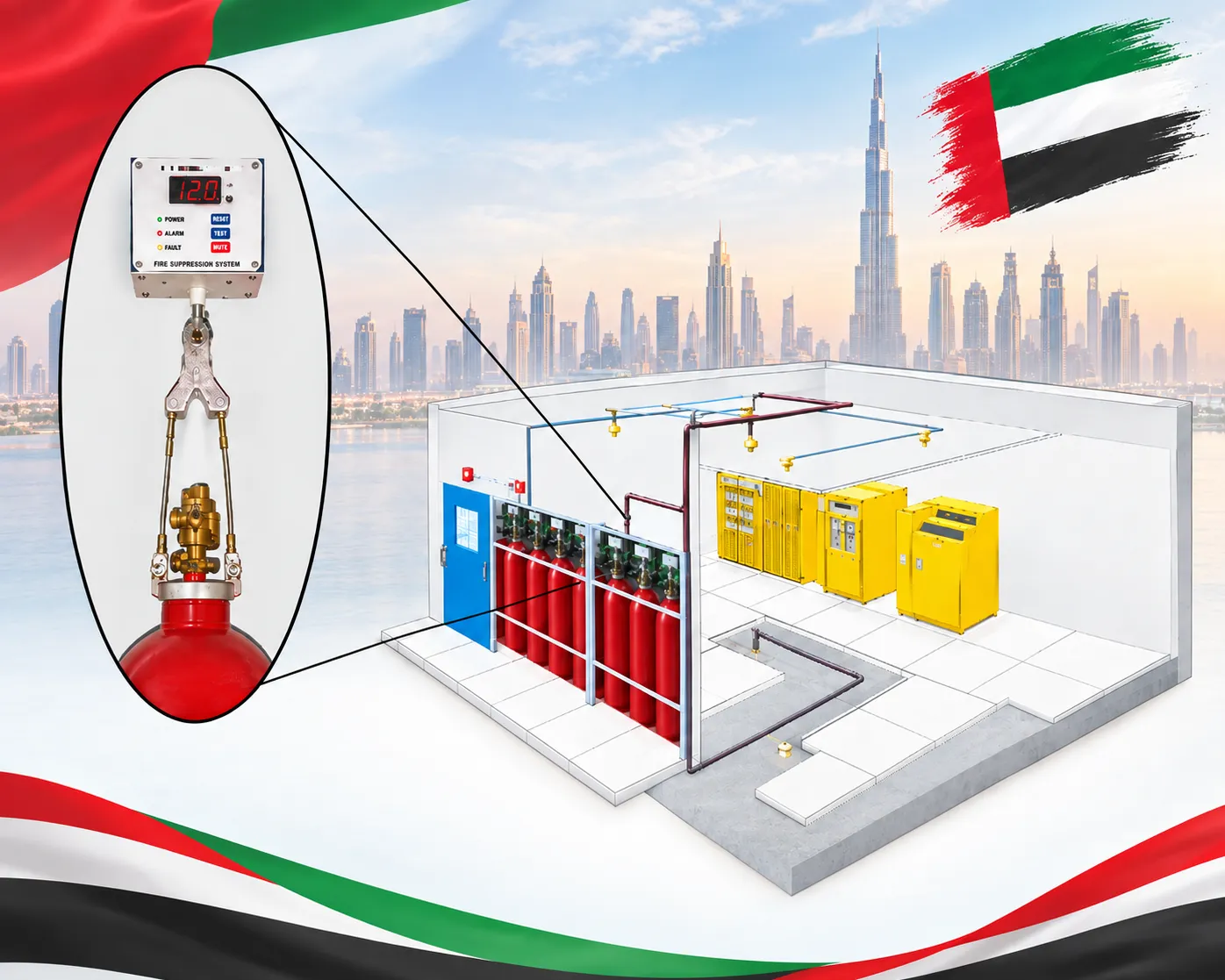
A typical clean-agent suppression arrangement can include:
- Automatic fire detection
- Releasing control panel
- Clean-agent storage cylinders
- Cylinder valves
- Discharge piping
- Engineered discharge nozzles
- Manual release station
- Abort switch
- Audible and visual alarms
- Pressure monitoring
- HVAC shutdown interface
- Damper and door interlocks
- Equipment shutdown interfaces
- Fire alarm system integration
- Building Management System interfaces where required
The exact configuration depends on the protected enclosure, fire hazard, selected agent, equipment, room integrity, design criteria and project requirements.
Why Clean Agent Suppression Is Important for Airports
Airport infrastructure contains numerous areas where fire can threaten both equipment and operational continuity.
Critical electronic systems may include:
- Airport IT infrastructure
- Passenger processing systems
- Baggage-management controls
- CCTV systems
- Communication equipment
- Security systems
- Network infrastructure
- Server equipment
- UPS systems
- Electrical control equipment
- Monitoring systems
- Airport operational technology
For these applications, the fire-protection strategy needs to consider not only suppression performance but also the potential consequences of the extinguishing medium on the protected equipment.
Clean-agent systems are designed for suitable enclosed spaces and use an extinguishing agent that does not leave conventional solid or liquid residue after discharge.
LIFEGUARD® Airport Clean Agent Suppression Solutions
LIFEGUARD® offers fire-safety solutions for critical infrastructure applications, including clean-agent-based fire suppression systems.
Depending on project requirements, clean-agent suppression may use technologies based on:
- FK-5-1-12 clean agents
- Other approved clean-agent technologies
- Engineered gaseous suppression systems
The selected agent must be appropriate for the specific application and comply with the required approvals, listings and project specifications.
LIFEGUARD® also works with Kidde Fenwal gas suppression solutions as an authorised channel partner, supporting projects where specified Kidde clean-agent technology is required.
Airport Data Centre Clean Agent Suppression
Airport data centres are among the most important areas requiring continuous availability.
They may support:
- Airport information systems
- Passenger processing
- Baggage systems
- Security infrastructure
- Communication systems
- Operational databases
- Network infrastructure
- Monitoring systems
- Business-critical applications
A clean-agent suppression system can be designed to detect a fire at an early stage and discharge the extinguishing agent throughout the protected enclosure, subject to the system design and applicable standards.
A typical airport data-centre protection system may include:
Smoke Detection → Alarm → Pre-Discharge Warning → HVAC Shutdown → Clean Agent Release → Fire Suppression → System Monitoring
The actual cause-and-effect sequence should be developed and approved according to the project requirements.
Airport Server Room Fire Suppression System
Server rooms contain sensitive electronic equipment that may be vulnerable to heat, smoke, water and contamination.
A properly engineered clean-agent system can provide:
- Automatic fire detection
- Rapid suppression
- No conventional water discharge
- Minimal post-discharge residue
- Protection for sensitive electronic equipment
- Integration with fire alarm systems
- Manual release capability
- Abort functionality where required
- HVAC and equipment interlocks
Room integrity is an important consideration because gaseous suppression systems depend on maintaining the required agent concentration within the protected enclosure for the specified design period.
Consequently, doors, penetrations, cable openings, dampers, ventilation systems and pressure-relief arrangements should be considered during system design.
Clean Agent Protection for Airport Control Rooms
Airport control and monitoring rooms may contain communication, control and electronic equipment that requires continuous operational availability.
Depending on the hazard assessment, clean-agent suppression can be considered for:
- Airport control rooms
- Security control rooms
- Surveillance rooms
- Communication rooms
- Network rooms
- Equipment rooms
- Monitoring centres
- Operations centres
The system can be integrated with the building's fire alarm infrastructure and designed around the operational requirements of the facility.
Airport Electrical Room Fire Suppression
Electrical and UPS rooms can contain significant electrical fire hazards.
Potential applications include:
- UPS rooms
- Electrical control rooms
- Switchgear rooms
- MCC rooms
- Battery rooms, where the selected technology is suitable
- Power-control rooms
- Electrical equipment enclosures
The selection between clean agent, water mist, sprinkler, gaseous suppression or another technology should be based on the specific hazard and applicable engineering criteria.
LIFEGUARD® can support project teams in identifying an appropriate fire-protection approach for specialised airport infrastructure.
Clean Agent Suppression for Airport Communication Rooms
Communication infrastructure is essential to airport operations.
Communication rooms may contain:
- Network switches
- Routers
- Communication servers
- Fibre-optic equipment
- Radio communication equipment
- Data transmission systems
- Control electronics
A clean-agent system can be considered where protection of sensitive electronic equipment and rapid fire suppression are important design objectives.
Airport Clean Agent Suppression System Components
A complete airport clean-agent system generally consists of multiple coordinated components.
1. Fire Detection System
Detection may incorporate suitable smoke, heat or other approved detection technologies depending on the protected hazard.
For critical IT areas, highly sensitive detection technologies may be considered where appropriate.
2. Releasing Control Panel
The releasing panel receives signals from the detection system and controls the programmed suppression sequence.
Depending on the system design, it may control:
- Detection zones
- Pre-discharge alarm
- Agent release
- Manual release
- Abort functionality
- HVAC shutdown
- Damper operation
- Equipment shutdown
- Alarm interfaces
3. Clean Agent Cylinders
The extinguishing agent is stored in appropriately specified cylinders at the required storage pressure.
Cylinder quantity and agent fill depend on:
- Protected volume
- Design concentration
- Agent type
- Design temperature
- Pipe-network characteristics
- Applicable design methodology
4. Distribution Piping
The agent is distributed through a calculated pipe network.
Pipe diameter, length, fittings and nozzle configuration must be established through the applicable system calculation methodology.
5. Discharge Nozzles
Nozzles are strategically positioned to achieve the required agent distribution throughout the protected enclosure.
6. Manual Release Station
A manual release facility can allow authorised personnel to initiate system discharge when required by the approved system design.
7. Abort Switch
Where applicable, an abort switch can temporarily interrupt or delay the automatic release sequence according to the approved cause-and-effect logic.
8. Audible and Visual Alarms
Pre-discharge warning devices provide occupants with an appropriate warning before agent discharge.
Airport Clean Agent System Working Principle
A typical clean-agent suppression sequence can operate as follows:
Stage 1 – Fire Detection
The detection system identifies smoke or another fire signature.
Stage 2 – Alarm
The releasing panel initiates the programmed alarm sequence.
Stage 3 – Confirmed Fire Condition
For systems using cross-zoned or double-knock logic, the required detector combination can initiate the next stage of the programmed sequence.
Stage 4 – Pre-Discharge Warning
Audible and visual alarms warn occupants to evacuate the protected area.
Stage 5 – Equipment Interlock
HVAC systems, ventilation equipment and other interfaces operate according to the approved cause-and-effect matrix.
Stage 6 – Agent Release
The suppression system activates and discharges the clean agent through the engineered nozzle network.
Stage 7 – Fire Suppression
The agent reaches the design concentration required for suppression of the specified hazard.
Stage 8 – Post-Discharge Monitoring
The system provides appropriate status and alarm feedback for emergency response and subsequent inspection.
The actual sequence varies according to system design, authority requirements and the selected suppression technology.
Airport Clean Agent Suppression Applications in UAE
LIFEGUARD® solutions can be considered for a broad range of airport critical infrastructure, including:
Airport Terminals
- IT rooms
- Server rooms
- Communication rooms
- Electrical rooms
- Security rooms
- Control rooms
Airport Operations
- Operations centres
- Monitoring rooms
- Network rooms
- Technical rooms
- Communication facilities
Airport Support Facilities
- UPS rooms
- Electrical equipment rooms
- Control panels
- Automation rooms
- Specialised equipment spaces
Airport Cargo Infrastructure
- Data and control rooms
- Security systems
- Communication infrastructure
- Specialised technical rooms
Aviation Maintenance Infrastructure
Where appropriate and subject to hazard assessment:
- Technical rooms
- Electronic equipment rooms
- Control systems
- Specialised enclosed equipment spaces
Aircraft hangars and areas involving aviation fuel require separate hazard assessment and may require foam, water spray, deluge or other specialised fire-protection technologies rather than clean-agent suppression alone.
Clean Agent Suppression for UAE Airports
The UAE has a sophisticated regulatory framework for fire and life safety. Airport projects may involve requirements from multiple stakeholders, including the airport operator, consultant, Civil Defence authorities, GCAA requirements and project-specific specifications.
The appropriate system should therefore be designed around the latest applicable:
- UAE Fire & Life Safety Code requirements
- Relevant NFPA standards
- GCAA requirements
- Airport operator specifications
- Civil Defence requirements
- Project consultant specifications
- Manufacturer requirements
- Applicable product approvals/listings
For gaseous fire suppression systems, NFPA 2001 is a key international reference for clean-agent fire-extinguishing systems, while the exact requirements applicable to a UAE project should be confirmed during design approval.
Engineering Design of Airport Clean Agent Systems
A professional clean-agent suppression supplier should evaluate the complete protected enclosure before specifying the system.
Important design parameters include:
Room Volume
The protected volume affects the quantity of extinguishing agent required.
Design Temperature
Agent quantity calculations depend on applicable temperature conditions.
Fire Hazard
The type of fuel and equipment being protected influence the required design criteria.
Occupancy
Personnel safety is an important consideration for gaseous suppression systems.
Room Integrity
The enclosure must be capable of retaining the agent for the required period.
Ventilation
HVAC and ventilation systems must be coordinated with the suppression system.
Pressure Relief
Appropriate pressure-relief provisions may be required because agent discharge can create pressure changes within an enclosed room.
Detection
The detection arrangement should be selected according to the hazard and required response.
Agent Storage
Cylinder quantity, pressure and location should be determined through the approved design.
Airport Clean Agent Suppression Supplier UAE – Complete Project Support
LIFEGUARD® can support airport fire-protection projects through various stages of system implementation.
Design Support
Our technical approach can include:
- Hazard assessment
- System selection
- Protected-volume calculations
- Agent quantity calculations
- Nozzle layout
- Piping design
- Detection-zone planning
- Cause-and-effect development
- Equipment interface planning
Supply
Depending on project requirements, supply can include:
- Clean-agent cylinders
- Agent
- Cylinder valves
- Discharge nozzles
- Pipe and fittings
- Releasing panels
- Detection equipment
- Manual release stations
- Abort switches
- Alarm devices
- Ancillary components
Installation
Installation should be carried out according to approved drawings, manufacturer instructions and applicable project standards.
Testing & Commissioning
System commissioning may include:
- Detector testing
- Alarm testing
- Manual-release testing
- Abort-switch testing
- Interlock testing
- Panel testing
- Cause-and-effect verification
- Supervisory monitoring
- System-status verification
Documentation
Project documentation may include:
- Approved drawings
- System calculations
- Equipment datasheets
- Test reports
- Commissioning records
- Certificates
- Operation and maintenance documentation
- As-built drawings
Why Choose LIFEGUARD® as an Airport Clean Agent Suppression Supplier?
LIFEGUARD® has extensive experience in fire-safety equipment and specialised fire-protection applications.
Our capabilities include:
- Clean-agent fire suppression
- Automatic fire suppression
- Special-hazard fire protection
- Fire detection and releasing systems
- Industrial fire protection
- Critical infrastructure protection
- Fire extinguishing equipment
- Testing and commissioning support
LIFEGUARD® also has experience supporting gas-based suppression applications involving Kidde Fenwal USA technology, including FK-5-1-12-based solutions where specified and applicable.
For airport projects, product approvals, system listings, authority acceptance and certifications should always be matched to the particular project specification rather than assumed universally.
Benefits of Airport Clean Agent Suppression Systems
When appropriately designed and approved for the application, clean-agent systems can offer several benefits:
Fast Fire Response
Automatic detection and releasing systems can respond rapidly to developing fires.
Protection of Sensitive Electronics
Clean-agent systems can be suitable for sensitive electrical and electronic equipment.
No Conventional Water Damage
The system does not depend on conventional water discharge, making it useful for selected equipment rooms.
Minimal Residue
Clean agents are designed to avoid the solid residue associated with dry chemical extinguishing agents.
Space Efficiency
Clean-agent systems can provide engineered protection for enclosed critical rooms.
System Integration
Suppression systems can interface with fire alarms, HVAC systems, access systems and building-management infrastructure.
Protection of Business-Critical Infrastructure
Appropriate fire suppression can help protect equipment essential to airport operations.
Airport Clean Agent Suppression Supplier UAE – LIFEGUARD®
Airports require specialised fire-protection strategies because they combine high occupant density, critical infrastructure, electronic systems, operational technology and aviation-related hazards.
LIFEGUARD® provides engineered fire-safety solutions for airport environments, including clean-agent suppression applications for data centres, server rooms, communication rooms, control rooms, electrical rooms and other suitably enclosed critical facilities.
From fire detection and releasing panels to clean-agent cylinders, piping, nozzles, alarms and system interfaces, LIFEGUARD® can support an integrated approach to airport clean-agent fire protection.
For UAE airport projects, final system selection and approval should always be based on the applicable UAE authority requirements, project specifications, hazard assessment and relevant international standards.
LIFEGUARD® – Engineered Fire Safety Solutions for Airports, Critical Infrastructure and High-Value Facilities.
Frequently Asked Questions
What is an airport clean agent suppression system?
An airport clean-agent suppression system is an engineered gaseous fire-extinguishing system designed to detect and suppress fires in suitable enclosed areas, particularly spaces containing sensitive electronic or electrical equipment.
Where are clean-agent systems used in airports?
Typical applications include airport data centres, server rooms, communication rooms, control rooms, security rooms, electrical rooms, UPS rooms and other critical technical spaces where a clean extinguishing medium is appropriate.
Is clean agent suitable for aircraft hangars?
Not necessarily. Aircraft hangars can present specialised fuel and aviation-related hazards. Their protection may require foam, deluge, water spray or other engineered systems. A hazard assessment should determine the appropriate solution.
What is FK-5-1-12?
FK-5-1-12 is a fluorinated ketone clean-agent extinguishing medium used in certain engineered fire-suppression systems. The suitability of a particular agent depends on the application, system approval/listing, design concentration and project requirements.
Does a clean-agent system require fire detection?
Yes. An automatic clean-agent system normally incorporates a compatible fire-detection and releasing arrangement designed to initiate the approved suppression sequence.
Does a clean-agent system leave residue?
Clean-agent systems are designed to discharge an extinguishing medium without the conventional solid residue associated with dry chemical agents. Post-discharge inspection and appropriate restoration procedures are nevertheless required.
What should be considered when selecting an airport clean-agent supplier in UAE?
Important considerations include technical capability, applicable product approvals/listings, engineering expertise, system design capability, project experience, documentation, installation support, testing and commissioning, maintenance support and compliance with the project's UAE authority and consultant requirements.
SEO Meta Information
SEO Title:
Airport Clean Agent Suppression Supplier UAE | LIFEGUARD®
Meta Description:
LIFEGUARD® is an airport clean agent suppression supplier in UAE offering engineered fire protection solutions for airport data centres, server rooms, control rooms, electrical rooms and critical aviation infrastructure.
Primary SEO Keyword:
Airport Clean Agent Suppression Supplier UAE
Secondary Keywords:
- Airport clean agent suppression UAE
- Airport clean agent fire suppression system UAE
- Airport fire suppression supplier UAE
- Airport fire protection system UAE
- Airport clean agent system Dubai
- Airport gaseous fire suppression UAE
- Airport server room fire suppression UAE
- Airport data centre fire suppression UAE
- Airport fire protection company UAE
- Clean agent fire suppression supplier Dubai
- Aviation fire suppression system UAE
- Airport automatic clean agent suppression system
- FK-5-1-12 fire suppression UAE
- Airport fire safety solutions UAE
Suggested URL:
/airport-clean-agent-suppression-supplier-uae/
Suggested H1:
Airport Clean Agent Suppression Supplier UAE
Suggested Image Alt Tags:
- Airport clean agent suppression system UAE
- Airport server room clean agent fire suppression
- Airport data centre fire suppression UAE
- Clean agent fire suppression system Dubai
- Airport fire protection system UAE
- FK-5-1-12 clean agent suppression system
- LIFEGUARD airport fire suppression solution
Suggested Internal Links:
- Clean Agent Fire Suppression System
- Automatic Fire Suppression System
- FK-5-1-12 Fire Suppression System
- Fire Detection & Releasing System
- Gas Fire Suppression System
- Airport Fire Protection System
- Data Centre Fire Suppression System
- Server Room Fire Suppression System
- Industrial Fire Protection Systems
Keywords