
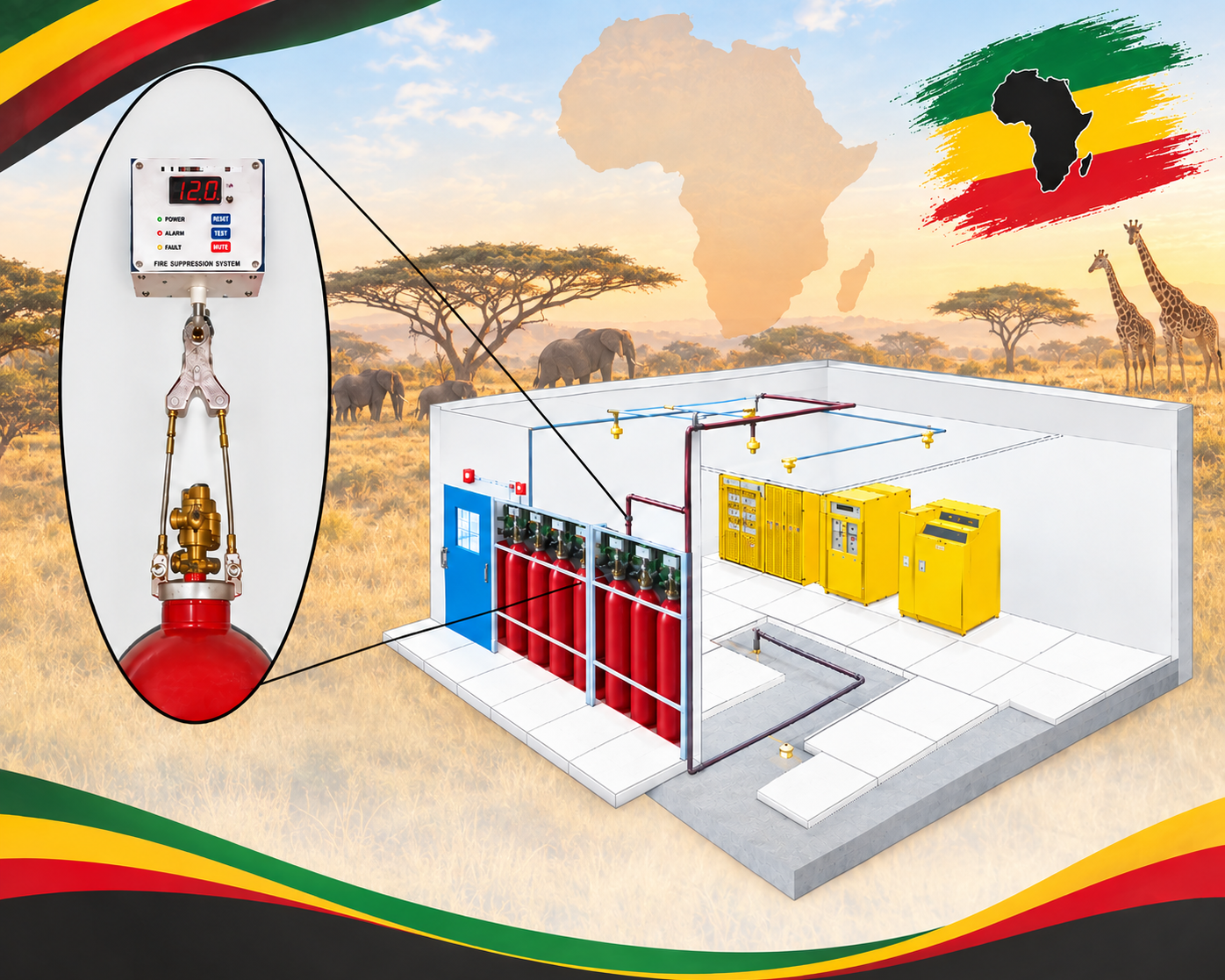
Airport Clean Agent Suppression System Provider Africa
LIFEGUARD® provides engineered airport clean agent suppression systems for critical airport infrastructure across Africa, including data centres, server rooms, communication rooms, control rooms, electrical rooms, UPS rooms, security facilities, IT rooms and other sensitive enclosed areas.
Modern airports depend on sophisticated electrical, electronic, communication, security and information technology infrastructure. Protecting these systems from fire requires carefully engineered suppression solutions that consider equipment sensitivity, occupant safety, operational continuity and the specific characteristics of the protected enclosure.
LIFEGUARD® offers airport clean agent suppression system solutions for Africa, supporting airport authorities, EPC contractors, MEP consultants, fire protection contractors, system integrators and infrastructure developers with project-specific fire suppression requirements.
Our solutions can combine automatic fire detection, releasing control, clean-agent storage, engineered piping, discharge nozzles, alarm systems, HVAC interlocks and building management interfaces into an integrated fire protection system.
Airport Clean Agent Fire Suppression Systems for Africa
An airport is not a single fire hazard. It is a collection of different environments, each requiring an appropriate fire protection strategy.
Passenger terminals, aircraft hangars, baggage systems, kitchens, fuel facilities, electrical rooms, data centres and communication facilities have different fire risks.
Clean-agent suppression is particularly relevant to suitable enclosed technical and electronic spaces where water or residue-producing extinguishing media may create undesirable secondary damage.
LIFEGUARD® can provide engineered clean-agent solutions for:
- Airport data centres
- Server rooms
- IT rooms
- Communication rooms
- Telecom rooms
- Airport control rooms
- Security control rooms
- CCTV rooms
- Electrical rooms
- Switchgear rooms
- UPS rooms
- Network rooms
- Equipment rooms
- Baggage control rooms
- Airport command centres
- Critical infrastructure rooms
- Aviation communication facilities
The final system should always be selected following a project-specific fire risk assessment and applicable airport, aviation, fire and building regulations.
What Is an Airport Clean Agent Suppression System?
An airport clean agent suppression system is an automatic fire detection and gaseous fire extinguishing system designed to protect appropriate enclosed areas.
Unlike conventional water-based systems, a clean-agent system introduces a gaseous extinguishing medium into the protected enclosure at the required design concentration.
Clean agents are particularly considered for applications involving:
- Servers
- Network equipment
- Electronic controls
- Communication equipment
- Electrical equipment
- Data storage equipment
- Security systems
- Control systems
- Other sensitive technical assets
The objective is to detect and suppress a fire rapidly while minimizing damage to valuable equipment and reducing post-discharge cleanup in suitable applications.
NFPA 2001 covers clean-agent fire extinguishing systems and provides requirements relating to system design, installation, approval, testing and maintenance.
Why Airports Need Specialized Clean Agent Fire Protection
Airports operate complex infrastructure around the clock.
A fire in an airport technical room can potentially affect:
- IT operations
- Communication systems
- Security systems
- Baggage operations
- Passenger processing
- Building management
- Airport administration
- Critical electrical systems
Therefore, fire protection for these areas needs to be designed around both fire safety and operational continuity.
A properly engineered clean-agent system can provide automatic detection and suppression while avoiding the water damage that may otherwise affect sensitive electronic equipment.
LIFEGUARD® Airport Clean Agent Suppression Solutions
LIFEGUARD® can provide project-oriented fire suppression solutions incorporating:
Automatic Fire Detection
Smoke, heat or other approved detection technologies can be incorporated according to the fire risk and project design.
Releasing Control Panel
The suppression releasing panel monitors detection devices and controls the programmed alarm and release sequence.
Clean Agent Cylinders
The required quantity of extinguishing agent is stored in appropriately selected cylinders.
Cylinder Valve and Actuation
The cylinder release arrangement initiates agent discharge according to the approved system design.
Discharge Piping
An engineered piping network transfers the extinguishing agent from the cylinder to the protected enclosure.
Discharge Nozzles
Nozzles are selected and positioned to achieve appropriate distribution of the agent throughout the protected space.
Manual Release Station
A manual release facility can be incorporated where required by the project design.
Abort Switch
An abort arrangement can be provided where required to interrupt or delay release during the pre-discharge sequence according to the approved cause-and-effect philosophy.
Audible and Visual Warning
Pre-discharge and discharge warning devices alert personnel in and around the protected area.
HVAC Interlocking
The system can interface with HVAC and ventilation systems where shutdown or control is required.
BMS Integration
Suitable signals can be exchanged with the airport's building management system.
Airport Applications for Clean Agent Suppression
Airport Data Centre Fire Suppression
Data centres are among the most critical facilities supporting modern airports.
They may contain:
- Servers
- Network switches
- Routers
- Storage systems
- Communication equipment
- IT infrastructure
- Monitoring systems
A clean-agent suppression system can be engineered to protect these facilities while minimizing residue and secondary damage.
LIFEGUARD® can support airport data-centre fire suppression requirements with system engineering, equipment supply and project documentation according to the agreed scope.
Airport Server Room Fire Suppression
Server rooms can contain high-value equipment operating continuously.
An automatic clean-agent system can integrate:
Detection → Alarm → Pre-Discharge Warning → HVAC Shutdown → Agent Release → Fire Suppression
This provides a coordinated response to a developing fire.
Airport Communication Room Protection
Communication rooms contain equipment supporting critical airport connectivity.
A dedicated clean-agent system can protect suitable enclosed communication rooms from fire while avoiding conventional water discharge onto sensitive electronic equipment.
Airport Control Room Fire Protection
Control rooms may contain computers, communication equipment, displays and monitoring systems.
Clean-agent suppression can be engineered around the room volume, equipment arrangement, occupancy and operational requirements.
Airport Security and CCTV Room Protection
Security infrastructure is essential to airport operations.
Security rooms can contain:
- CCTV servers
- Video storage
- Access-control systems
- Network equipment
- Monitoring equipment
- Communication systems
Clean-agent suppression can be considered for appropriately designed enclosed security facilities.
Airport Electrical Room Protection
Electrical rooms contain energized equipment and require carefully selected extinguishing systems.
Where appropriate, clean-agent suppression can provide a residue-minimizing alternative to certain conventional extinguishing technologies.
The final suppression method should be selected according to the electrical hazard, equipment, enclosure and applicable requirements.
Airport UPS Room Protection
UPS systems provide backup power to critical airport equipment.
UPS and battery installations require hazard-specific assessment because battery chemistry, electrical equipment, ventilation and room configuration can influence the fire protection strategy.
LIFEGUARD® can support project-specific evaluation and system design for suitable UPS applications.
How an Airport Clean Agent System Works
A typical automatic suppression sequence may operate as follows:
Stage 1 – Detection
A fire detector identifies smoke, heat or another approved indication of fire.
Stage 2 – Alarm
The releasing control panel receives the detection signal and initiates the programmed alarm sequence.
Stage 3 – Pre-Discharge Warning
Audible and visual alarms notify personnel that suppression is about to occur.
Stage 4 – Time Delay
A programmed delay can allow occupants to evacuate the protected enclosure according to the approved system design.
Stage 5 – Equipment Interlock
The system can initiate programmed interfaces such as:
- HVAC shutdown
- Damper closure
- Equipment shutdown
- Ventilation control
- Fire alarm notification
- BMS signal
Stage 6 – Agent Release
The suppression system activates the cylinder release mechanism.
Stage 7 – Agent Discharge
The clean agent flows through the engineered pipe network and is discharged through the system nozzles.
Stage 8 – Fire Suppression
The required design concentration is established within the enclosure to suppress the fire.
Stage 9 – Post-Discharge
The system provides appropriate indications for emergency response, inspection, ventilation and restoration.
Engineered Airport Clean Agent Suppression
A professional airport clean-agent system should be individually engineered for the protected enclosure.
Important design parameters include:
- Room length
- Room width
- Room height
- Protected volume
- Raised-floor volume
- False-ceiling volume
- Equipment arrangement
- Fire hazard
- Occupancy
- Ambient conditions
- HVAC arrangement
- Ventilation openings
- Room integrity
- Agent type
- Design concentration
- Cylinder arrangement
- Pipe network
- Nozzle arrangement
- Discharge characteristics
- Release sequence
The engineering process ensures that the suppression system is not simply selected according to room size but is designed according to the actual fire risk.
Airport Room Integrity
For total-flooding clean-agent systems, enclosure integrity is an important consideration.
The protected room should be capable of achieving and maintaining the required extinguishing concentration for the specified design period.
Potential leakage paths can include:
- Doors
- Cable penetrations
- Pipe penetrations
- HVAC openings
- Raised floors
- False ceilings
- Wall penetrations
- Unsealed construction joints
Room integrity assessment and enclosure testing should be incorporated into the project commissioning strategy where applicable.
Airport Clean Agent Selection
LIFEGUARD® can support the selection of an appropriate clean-agent technology according to project requirements.
Depending on the application, the project may specify technologies such as:
- FK-5-1-12
- HFC-based clean agents
- Other approved gaseous extinguishing technologies
Agent selection should consider:
- Fire hazard
- Protected volume
- Design concentration
- Occupancy
- Equipment sensitivity
- Environmental considerations
- Cylinder storage
- Local regulations
- Applicable standards
- Project specifications
There is no single clean agent that is automatically appropriate for every airport application.
Airport Fire Protection in Africa
African airport infrastructure ranges from major international aviation hubs to regional airports, cargo facilities, aviation maintenance facilities and specialized airport infrastructure.
LIFEGUARD® can support project requirements across markets including:
North Africa
Egypt, Morocco, Algeria, Tunisia and Libya.
West Africa
Nigeria, Ghana, Senegal, Côte d'Ivoire and other regional markets.
East Africa
Kenya, Ethiopia, Tanzania, Uganda, Rwanda and Mauritius.
Southern Africa
South Africa, Zambia, Zimbabwe, Botswana, Namibia and Mozambique.
Central Africa
Angola, Cameroon, Gabon, Democratic Republic of Congo and other regional markets.
Projects remain subject to local regulations, aviation authority requirements, import regulations, technical approvals and agreed local installation/service arrangements.
Airport Clean Agent Solutions and African Aviation Safety
Airport fire protection in Africa operates within an aviation safety environment influenced by ICAO standards and national civil aviation regulations.
ICAO's Airport Services Manual Part I addresses airport rescue and firefighting, including considerations relating to extinguishing agents, equipment and airport protection levels.
It is important to distinguish between:
Aircraft Rescue & Firefighting (ARFF)
and
Clean-Agent Protection of Enclosed Airport Technical Facilities.
A clean-agent system protecting an airport data centre or control room is not a substitute for the airport's dedicated aircraft rescue and firefighting capability.
Instead, clean-agent suppression forms part of a broader, integrated airport fire protection strategy.
Environmental Considerations for African Airports
Environmental requirements are increasingly influencing airport firefighting strategies.
UNEP and ICAO launched the FIRE project to support the transition away from PFAS-containing firefighting foams at major airports in Egypt, Ethiopia, Kenya, Nigeria and South Africa.
This demonstrates the increasing importance of considering environmental impact alongside fire performance when selecting firefighting technologies.
Clean-agent systems for technical rooms are a separate application from aircraft firefighting foam systems, and each airport hazard should be evaluated independently.
Airport Clean Agent Suppression System Provider for Africa
LIFEGUARD® supports African airport projects through an engineering-led approach.
Our potential project support includes:
- Technical consultation
- Fire suppression concept development
- System engineering
- Agent selection support
- Agent quantity calculation
- Piping design
- Nozzle layout
- Detection coordination
- Releasing panel selection
- Cause-and-effect development
- Technical submittals
- Product documentation
- Installation support
- Testing
- Commissioning
- Training
- Handover documentation
The precise scope depends on project requirements and contractual responsibilities.
Airport Fire Suppression Solutions for EPC Contractors
Airport construction projects involve multiple disciplines working simultaneously.
LIFEGUARD® can coordinate clean-agent suppression requirements with:
- Architectural design
- HVAC design
- Electrical design
- Fire alarm systems
- BMS
- IT infrastructure
- Security systems
- Emergency shutdown systems
This integrated approach helps prevent conflicts between fire suppression and other airport building systems.
Airport Clean Agent Solutions for Consultants
Fire and MEP consultants can engage LIFEGUARD® during the design stage for:
- Protected area identification
- Hazard assessment
- Agent selection
- Cylinder sizing
- Piping design
- Nozzle positioning
- Detection philosophy
- Cause-and-effect matrix
- Interlock requirements
- Technical specifications
- Testing and commissioning requirements
Early coordination can help ensure that clean-agent requirements are incorporated into the architectural, electrical and HVAC design.
Airport Clean Agent Solutions for System Integrators
LIFEGUARD® can also support African system integrators and fire protection contractors requiring an experienced Indian fire safety partner.
Potential cooperation models include:
- Project-based supply
- OEM supply
- System integration
- Technical support
- Distributor partnerships
- Engineering assistance
- Installation support
- Testing and commissioning coordination
Local licensing, certification and installation requirements should be confirmed for the relevant African country.
Standards for Airport Clean Agent Systems
Depending on the project and jurisdiction, system design may consider:
- NFPA 2001 – Clean Agent Fire Extinguishing Systems
- NFPA 72 – Fire Alarm and Signaling
- ISO 14520 – Gaseous Fire-Extinguishing Systems
- ICAO requirements and guidance
- National fire safety regulations
- Civil aviation authority requirements
- Airport-specific specifications
- Local authority requirements
The applicable standards should always be confirmed during project design because requirements can vary between African countries and individual airport projects.
Testing and Commissioning
Testing and commissioning are essential parts of a clean-agent suppression project.
LIFEGUARD® project support can include functional verification of:
- Fire detectors
- Releasing panel
- Alarm sequence
- Manual release
- Abort switch
- Time delay
- Cylinder actuation
- Pressure monitoring
- HVAC shutdown
- Damper operation
- Equipment shutdown
- BMS interface
- Audible alarms
- Visual alarms
- Cause-and-effect logic
Where required, enclosure integrity testing should also be completed before final system acceptance.
Maintenance of Airport Clean Agent Systems
Airport fire suppression systems require periodic inspection, testing and maintenance.
A maintenance program can include:
- Cylinder inspection
- Pressure monitoring
- Valve inspection
- Pipe inspection
- Nozzle inspection
- Detector testing
- Releasing panel testing
- Manual release testing
- Abort switch testing
- Alarm testing
- HVAC interlock testing
- BMS interface testing
- Battery inspection
- System documentation
Maintenance requirements should follow the applicable standard, manufacturer recommendations, authority requirements and airport maintenance procedures.
Benefits of LIFEGUARD® Airport Clean Agent Suppression Systems
Protection of Sensitive Equipment
Clean-agent technology is suitable for many electronic and electrical applications where residue and secondary damage are important considerations.
Rapid Automatic Fire Response
Detection and suppression can be integrated into a coordinated automatic sequence.
Minimal Residue
Clean agents are designed for applications where avoiding solid or liquid extinguishing residues is important.
Reduced Cleanup
Appropriately selected gaseous suppression systems can simplify post-discharge cleanup compared with some residue-producing extinguishing media.
System Integration
The system can be integrated with fire alarms, HVAC, BMS and other building interfaces.
Application-Specific Engineering
Each system can be designed according to the protected enclosure and fire hazard.
Critical Infrastructure Protection
Solutions can be applied to airport IT, communication, security and electrical infrastructure.
Why Choose LIFEGUARD®?
Decades of Fire Safety Experience
LIFEGUARD® has been associated with fire safety equipment manufacturing and fire protection solutions in India for decades.
Engineered Fire Protection
We approach clean-agent suppression as an integrated system involving detection, control, agent storage, piping, nozzles and interfaces.
International Project Support
LIFEGUARD® can support African projects through project-based supply, technical documentation and engineering coordination.
Complete Technical Approach
From system concept through testing and handover, project requirements can be addressed through a coordinated technical workflow.
Critical Facility Expertise
Our clean-agent solutions are applicable to sensitive environments such as data centres, server rooms, communication rooms, electrical rooms and control facilities.
LIFEGUARD® Airport Clean Agent Project Workflow
1. Requirement Analysis
Review airport facility, protected room and project specifications.
2. Hazard Assessment
Identify fire risks and equipment requiring protection.
3. System Engineering
Develop agent, cylinder, piping, nozzle and detection requirements.
4. Technical Submittal
Prepare documentation for consultant/client approval.
5. Manufacturing & Supply
Supply approved system components.
6. Installation Support
Provide technical documentation and project support.
7. Testing & Commissioning
Verify system operation and interfaces.
8. Training & Handover
Provide operation and maintenance information.
Frequently Asked Questions
What is an airport clean agent suppression system?
It is an engineered gaseous fire suppression system designed to automatically detect and suppress fires in suitable enclosed airport facilities, especially technical areas containing sensitive electrical and electronic equipment.
Where can airport clean-agent systems be installed?
They can be considered for data centres, server rooms, communication rooms, telecom rooms, control rooms, security rooms, electrical rooms, UPS rooms and other suitable enclosed technical areas.
Is clean agent suitable for airport terminals?
It may be suitable for specific enclosed technical spaces within an airport terminal, but it is not automatically the appropriate suppression technology for every terminal area. The fire hazard and occupancy must be assessed.
Can clean agent protect airport servers?
Yes. Clean-agent systems are commonly considered for suitable server and data rooms because they can provide gaseous suppression without the water discharge associated with conventional sprinkler systems.
Can LIFEGUARD® provide airport clean-agent systems for Africa?
LIFEGUARD® can support African airport projects through project-based engineering, equipment supply and technical coordination, subject to local regulations, approvals, logistics and agreed project scope.
Which clean agent should be used?
The agent should be selected according to the hazard, room volume, occupancy, design concentration, environmental considerations, equipment and applicable standards. There is no universal agent for every airport application.
Does a clean-agent system need room sealing?
Yes. Total-flooding systems require suitable enclosure integrity to achieve and maintain the required concentration.
Can the system be connected to BMS?
Yes. Suitable BMS interfaces can be incorporated according to the project's cause-and-effect requirements.
Does LIFEGUARD® provide installation?
Installation and commissioning scope depends on the project and local arrangements. LIFEGUARD® can provide technical installation and commissioning support according to the agreed scope.
Airport Clean Agent Suppression System Provider Africa – LIFEGUARD®
Airports require fire protection solutions designed around life safety, critical infrastructure, electronic equipment, operational continuity and regulatory requirements.
LIFEGUARD® provides engineered airport clean-agent suppression solutions for suitable enclosed technical facilities across Africa, supporting airport authorities, EPC contractors, MEP consultants, fire protection contractors, system integrators and project developers.
From airport data centres and server rooms to communication rooms, control rooms, electrical rooms, UPS rooms and security facilities, LIFEGUARD® can support the development of application-specific clean-agent fire suppression systems.
LIFEGUARD® – Engineered Fire Safety Solutions for Airports and Critical Aviation Infrastructure
Request an Airport Clean Agent Suppression Proposal
For your African airport project, provide the protected room dimensions, application, equipment details, project country and applicable specification to the LIFEGUARD® technical team.
United Fire Equipments Pvt. Ltd.
LIFEGUARD® – Manufacturer of ISI Certified Fire Safety Equipment
📞 8048034226
Keywords






