
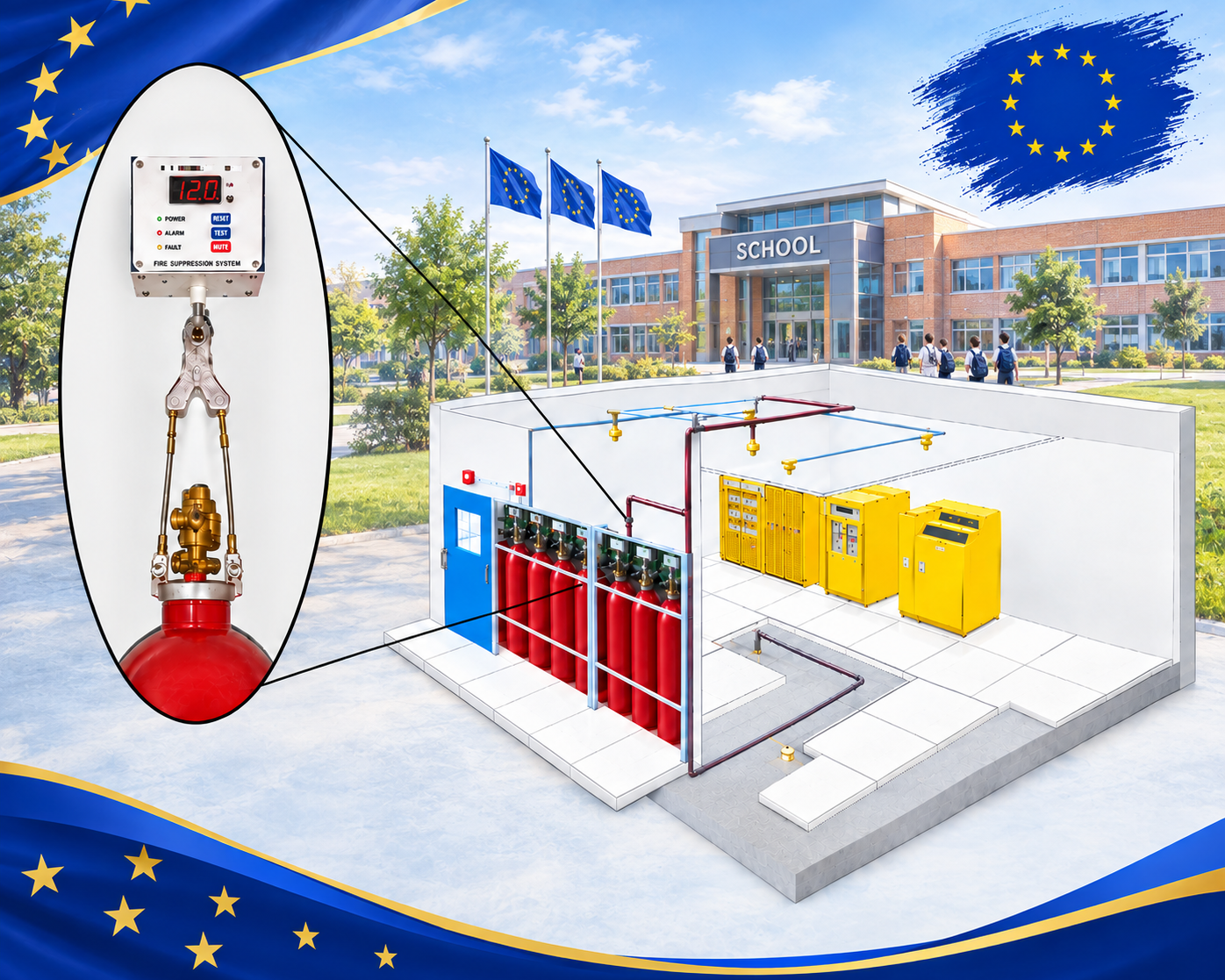
Airport Clean Agent Suppression System Provider Europe
LIFEGUARD® – Engineered Airport Clean Agent Fire Suppression Systems for Europe
Airports are among the most complex and operationally critical infrastructures in the world. From passenger terminals and airport command centres to air traffic control facilities, communication rooms, data centres, UPS rooms and electrical equipment rooms, modern aviation infrastructure depends on sophisticated electronic and electrical systems operating continuously.
A fire in one of these critical areas can result in equipment damage, operational disruption and significant recovery requirements. LIFEGUARD® provides airport clean agent suppression system solutions for Europe, designed for enclosed applications where rapid fire suppression, sensitive equipment protection and minimal post-discharge residue are important considerations.
European projects require careful attention to applicable national regulations, project specifications, environmental requirements and system standards. EN 15004-1:2024 is the current European reference for the design, installation, testing, maintenance and safety of gas extinguishing systems and covers total-flooding systems using electrically non-conductive gaseous extinguishing agents that do not leave residue after discharge.
Airport Clean Agent Suppression System Provider in Europe
LIFEGUARD® supports fire-protection requirements for airport and aviation infrastructure through application-specific clean-agent suppression solutions.
Our solutions can be considered for:
- International airports
- Domestic airports
- Airport terminals
- Air traffic control facilities
- Airport control towers
- Airport command centres
- Airport data centres
- Server rooms
- IT and network rooms
- Communication rooms
- Radio equipment rooms
- Security control rooms
- CCTV rooms
- UPS rooms
- Electrical rooms
- Switchgear rooms
- Control rooms
- Baggage-handling control rooms
- Navigation equipment rooms
- Technical equipment rooms
- Airport operations centres
Each installation should be designed according to the actual fire hazard, enclosure characteristics, occupancy, ventilation conditions, equipment arrangement, selected extinguishing agent and applicable European and national requirements.
Why Choose Clean Agent Fire Suppression for Airports?
Airport technical areas frequently contain sensitive electronic equipment that requires a specialized fire-protection approach.
Clean-agent systems are particularly suited to appropriately designed enclosed hazards because the European EN 15004 framework addresses gaseous extinguishing systems using electrically non-conductive agents that do not leave residue following discharge.
Key advantages include:
Rapid Automatic Fire Suppression
An engineered automatic system can detect a developing fire and initiate a programmed alarm and suppression sequence.
Protection of Sensitive Equipment
Clean-agent systems can be used for appropriately designed rooms containing servers, communication equipment, electronic controls and electrical equipment.
Minimal Residue
Unlike many conventional extinguishing media, clean agents are designed for applications where post-discharge residue can be undesirable.
Reduced Water Exposure
For suitable applications, gaseous suppression provides an alternative to water discharge in sensitive technical rooms.
Integration With Building Systems
Airport suppression systems can be interfaced with:
- Fire alarm systems
- HVAC systems
- Dampers
- Building Management Systems
- Security systems
- Emergency alarms
- Monitoring systems
- Access-control systems
LIFEGUARD® Airport Clean Agent Suppression Solutions
LIFEGUARD® develops clean-agent suppression solutions around the specific characteristics of the protected hazard.
A typical airport clean-agent installation may include:
- Clean-agent storage cylinders
- Cylinder valves
- Actuation mechanisms
- Pressure gauges
- Pressure monitoring
- Releasing control panel
- Smoke detectors
- Heat detectors where appropriate
- Manual release station
- Abort switch
- Pre-discharge alarm
- Audible warning devices
- Visual warning indicators
- Distribution pipework
- Discharge nozzles
- HVAC shutdown interface
- Damper interface
- Fire alarm interface
- Pressure-relief provisions
- System signage
- Remote monitoring interface
The final configuration depends on the selected agent, system design, applicable standard, equipment approvals and airport project specification.
Airport Data Centre Clean Agent Suppression
Airport data centres support many of the digital systems essential to modern aviation operations.
They may contain:
- Servers
- Network switches
- Storage systems
- Communication equipment
- Airport operational technology
- Security infrastructure
- Monitoring systems
- Backup systems
A clean-agent suppression system can provide automatic protection for suitably enclosed data-centre hazards without introducing conventional water discharge onto sensitive electronic equipment.
Data Centre Design Considerations
A professional airport data-centre suppression design should evaluate:
- Room volume
- Raised-floor volume
- False-ceiling volume
- HVAC operation
- Airflow
- Equipment density
- Agent concentration
- Discharge time
- Hold time
- Nozzle arrangement
- Pipe network
- Room leakage
- Pressure relief
- Enclosure integrity
The room should be evaluated as part of the overall suppression system rather than treating the agent cylinders and pipework as independent equipment.
Airport Control Room Fire Suppression System
Airport control rooms and operational command centres contain critical electronic and communication equipment.
LIFEGUARD® clean-agent systems can be engineered with coordinated detection and release functions such as:
Fire Detection → Alarm → Pre-Discharge Warning → HVAC Shutdown → Time Delay → Agent Release → Fire Suppression → Monitoring
Depending on the project, the system can incorporate:
- Addressable smoke detection
- Releasing control panel
- Cross-zone detection
- Manual release
- Abort function
- Pre-discharge warning
- Audible alarm
- Visual indication
- HVAC interlock
- Damper control
- Agent release
- Fire alarm interface
The exact cause-and-effect sequence should be established during system engineering and approved according to the airport's fire-safety philosophy and applicable regulations.
Airport Communication Room Fire Suppression
Communication rooms are essential to airport operations and may contain radio, networking and transmission equipment.
Typical equipment can include:
- Communication servers
- Network switches
- Radio systems
- Transmission equipment
- Fibre-optic infrastructure
- Control electronics
- Communication interfaces
LIFEGUARD® can provide clean-agent suppression solutions for suitably enclosed communication-room hazards, with the system designed around the actual room volume, equipment arrangement, ventilation and fire risk.
Airport Electrical Room Clean Agent Suppression
Airport electrical infrastructure may include:
- Switchgear
- UPS systems
- Electrical panels
- Power distribution equipment
- Control panels
- Automation systems
- Electrical control equipment
For appropriate enclosed hazards, clean-agent fire suppression can provide automatic protection while avoiding conventional water discharge.
The design should consider the type of electrical equipment, potential ignition sources, occupancy, ventilation, room construction and applicable safety requirements.
FK-5-1-12 Clean Agent Airport Applications
FK-5-1-12 is included within the EN 15004 family of standards. EN 15004-2 addresses the physical properties, specification, usage and safety aspects associated with systems using FK-5-1-12 extinguishant.
FK-5-1-12-based systems can be considered for suitable enclosed airport applications such as:
- Data centres
- Server rooms
- Network rooms
- Communication rooms
- Control rooms
- Security equipment rooms
- UPS rooms
- Technical equipment rooms
Agent selection should be based on the fire hazard, occupancy, required concentration, system approvals, environmental considerations and project requirements.
European Standards for Airport Clean Agent Suppression Systems
European airport projects can involve multiple standards and regulatory requirements.
EN 15004
The EN 15004 family is a key European reference for fixed gaseous fire-extinguishing systems.
EN 15004-1 specifies requirements and recommendations concerning:
- System design
- Installation
- Testing
- Maintenance
- Safety
- Extinguishing-agent characteristics
- Suitable fire types
The current European edition is EN 15004-1:2024, with national implementations published by European standards organizations.
ISO 14520
ISO 14520 provides an international framework for gaseous fire-extinguishing systems and forms part of the technical basis referenced by EN 15004-1.
NFPA 2001
Some European projects may additionally specify NFPA 2001. The applicable project specification should determine which standards govern the installation.
Other Requirements
Depending on the country and airport authority, the project may also require compliance with:
- National fire regulations
- National building regulations
- Airport authority requirements
- EN fire-safety standards
- Environmental regulations
- Authority Having Jurisdiction requirements
- Product/system approval requirements
Environmental Considerations for European Airport Projects
Environmental requirements are an increasingly important part of clean-agent selection in Europe.
The European Union's Regulation (EU) 2024/573 on fluorinated greenhouse gases applies to fluorinated greenhouse gases and relevant products and equipment. The regulation has applied since 11 March 2024.
The regulation also contains specific provisions affecting fire-protection equipment containing certain fluorinated greenhouse gases.
Consequently, airport projects in the European market should evaluate:
- Agent type
- Global warming potential
- Applicable environmental legislation
- Product restrictions
- Agent availability
- System approvals
- Maintenance requirements
- Future servicing considerations
- Destination-country requirements
LIFEGUARD® can support project-specific agent selection based on the technical and regulatory requirements applicable to the installation.
Airport Clean Agent Suppression System Engineering
A successful airport suppression system begins with detailed engineering.
Step 1 – Hazard Assessment
The fire risk is assessed according to:
- Equipment
- Fire load
- Ignition sources
- Occupancy
- Electrical installations
- Ventilation
- Room construction
- Access arrangements
Step 2 – Enclosure Assessment
The protected enclosure is evaluated for:
- Room dimensions
- Ceiling height
- Raised floor
- False ceiling
- Doors
- Cable penetrations
- HVAC openings
- Other leakage paths
Step 3 – Agent Selection
The appropriate extinguishing agent is selected according to the hazard, occupancy, environmental considerations and applicable standards.
Step 4 – Agent Quantity Calculation
The required agent quantity is established using the applicable design methodology.
Step 5 – Pipe Network Engineering
The distribution pipework and nozzles are engineered to deliver the required quantity and distribution throughout the protected enclosure.
Step 6 – Detection and Release Design
Detection zones, alarms, pre-discharge warning, time delay, manual release and abort functions are coordinated.
Step 7 – Enclosure Integrity
The enclosure must be suitable for retaining the extinguishing concentration for the required design period.
Step 8 – Testing and Commissioning
The completed installation is tested and commissioned before handover.
Airport Clean Agent System Components
A complete airport clean-agent suppression system may comprise:
System AreaTypical ComponentsDetectionSmoke detectors, heat detectorsControlReleasing control panelAgent StorageClean-agent cylinders, cylinder valvesActuationElectrical/pneumatic actuation componentsDistributionPipework and fittingsDischargeEngineered discharge nozzlesManual ControlsManual release and abort switchWarningAudible and visual alarmsHVAC InterfaceShutdown and damper controlsMonitoringPressure/status monitoringSafetyPressure-relief provisionsIntegrationFire alarm/BMS interfaces
The actual component selection should follow the approved system design.
Airport Clean Agent Suppression Testing & Commissioning
Before the system is handed over, the installation should undergo appropriate inspection, testing and commissioning.
Detection Testing
Verification of detector operation and alarm signals.
Control Panel Testing
Verification of indications, alarms, logic and programmed sequence.
Manual Release Testing
Testing of manual release arrangements.
Abort Function Testing
Verification of the abort circuit according to the approved cause-and-effect sequence.
HVAC Interlock Testing
Verification of ventilation shutdown and related interfaces.
Alarm Testing
Testing of audible and visual warning devices.
Pipe and Nozzle Inspection
Checking pipe routing, supports, fittings and nozzle positions.
Enclosure Integrity Testing
Where required, the enclosure can be tested to assess its ability to retain the extinguishing concentration.
Documentation and Handover
Project handover can include:
- As-built drawings
- System calculations
- Test reports
- Commissioning records
- Operating instructions
- Maintenance documentation
- Cause-and-effect matrix
- Equipment documentation
- Training records
Airport Clean Agent Suppression Provider for European Markets
LIFEGUARD® can support airport and critical-infrastructure projects across European markets, subject to destination-country requirements and project-specific approvals.
Potential markets include:
Germany | France | Italy | Spain | United Kingdom | Netherlands | Belgium | Switzerland | Austria | Poland | Sweden | Norway | Denmark | Finland | Ireland | Portugal | Greece | Romania | Hungary | Czech Republic | Slovakia | Croatia | Serbia | Bulgaria
For each project, the system can be developed around the individual airport's technical specification, protected hazard and regulatory requirements.
Airport Applications Covered by LIFEGUARD®
Airport Passenger Terminals
Protection of suitable technical, electrical and electronic rooms supporting terminal operations.
Air Traffic Control Facilities
Protection of appropriate enclosed technical areas containing critical control and communication equipment.
Airport Data Centres
Clean-agent protection for IT and network infrastructure.
Communication Rooms
Protection of radio, network and communication equipment.
Security Control Centres
Protection of CCTV, access-control and monitoring systems.
Electrical and UPS Rooms
Protection of appropriate enclosed electrical hazards.
Airport Operations Centres
Protection of command-and-control technology.
Baggage System Control Rooms
Protection of electrical and electronic control infrastructure associated with baggage systems.
LIFEGUARD® – Airport Fire Protection Expertise
LIFEGUARD®, from United Fire Equipments Pvt. Ltd., provides fire-protection equipment and engineered fire-suppression solutions for critical infrastructure.
Our capabilities include:
- Clean-agent fire suppression
- Automatic fire detection and suppression
- System engineering
- Application-specific design
- Fire protection equipment manufacturing
- Technical documentation
- Project support
- Installation support
- Testing and commissioning
- System handover
- Maintenance and service support
For European projects, specific certifications, listings and approvals should always be verified against the exact product, system configuration and destination-country requirements.
Why Select LIFEGUARD® as Your Airport Clean Agent Suppression System Provider?
Choosing a clean-agent provider for an airport project requires more than selecting an extinguishing agent. The provider should understand the interaction between fire detection, suppression, room integrity, HVAC, electrical equipment, alarm systems and airport operations.
LIFEGUARD® approaches airport suppression projects as integrated fire-protection systems.
Our approach includes:
Application Assessment
Understanding the protected hazard and operational requirements.
System Engineering
Developing an application-specific suppression arrangement.
Agent Selection
Evaluating suitable clean-agent technology according to the project.
Detection Integration
Coordinating fire detection and releasing logic.
System Configuration
Integrating cylinders, valves, pipework, nozzles and controls.
Testing & Commissioning
Verifying the system before final handover.
Technical Support
Providing project documentation and technical assistance.
Airport Clean Agent Suppression System Provider Europe – Conclusion
European airports require highly coordinated fire-protection systems capable of protecting critical infrastructure while supporting operational continuity.
LIFEGUARD® Airport Clean Agent Suppression System Solutions are designed for appropriately enclosed applications including airport data centres, server rooms, communication rooms, air traffic control facilities, security rooms, control centres, UPS rooms, electrical rooms and other critical technical areas.
By combining hazard assessment, clean-agent selection, detection, releasing controls, engineered pipework, discharge nozzles, HVAC interfaces, enclosure considerations and testing, LIFEGUARD® can support complete airport fire-suppression requirements.
For European projects, system design should be aligned with the applicable edition of EN 15004, relevant national regulations, environmental legislation and project-specific airport requirements.
LIFEGUARD® – Your Airport Clean Agent Suppression System Provider for Europe, delivering engineered fire-protection solutions for critical aviation infrastructure.
SEO Meta Title
Airport Clean Agent Suppression System Provider Europe | LIFEGUARD®
SEO Meta Description
LIFEGUARD® provides airport clean agent suppression systems in Europe for data centres, control rooms, communication rooms, UPS rooms, electrical rooms and critical aviation infrastructure.
Suggested URL
/airport-clean-agent-suppression-system-provider-europe/
Primary SEO Keywords
- airport clean agent suppression system provider Europe
- airport clean agent fire suppression provider Europe
- airport fire suppression system provider Europe
- airport clean agent suppression Europe
- airport fire protection system provider Europe
Secondary SEO Keywords
- airport clean agent system Europe
- airport gas suppression system Europe
- airport data centre fire suppression Europe
- airport control room fire suppression Europe
- airport communication room fire suppression Europe
- airport electrical room fire suppression Europe
- clean agent fire suppression provider Europe
- airport fire safety solutions Europe
- aviation fire suppression system Europe
- airport fire protection company Europe
Long-Tail Keywords
- airport clean agent suppression system provider in Europe
- clean agent fire suppression solutions for European airports
- airport data centre clean agent suppression system provider
- airport control room clean agent fire suppression provider Europe
- airport communication room clean agent suppression system Europe
- airport electrical room clean agent fire suppression Europe
- FK-5-1-12 airport fire suppression system provider Europe
- automatic clean agent fire suppression system for airports Europe
- European airport clean agent fire protection system provider
- airport clean agent suppression system supplier and provider Europe
Keywords






