
Airport Clean Agent Suppression System Provider India
LIFEGUARD® – Airport Clean Agent Fire Suppression System Provider in India
Airports are among the most critical and technologically advanced infrastructures, incorporating passenger terminals, communication networks, navigation systems, data centres, electrical installations, security systems, baggage handling infrastructure and other mission-critical facilities. Fire protection in such environments requires carefully engineered solutions capable of detecting and suppressing fires while protecting sensitive equipment and supporting operational continuity.
LIFEGUARD® is an Indian provider of engineered airport clean agent suppression systems, offering specialised fire protection solutions for airport data centres, server rooms, communication rooms, NAVAIDS facilities, control rooms, electrical rooms, UPS rooms, security rooms and other suitable enclosed technical areas.
Airport fire protection involves requirements beyond conventional building fire safety. Airports Authority of India (AAI) describes its fire services as covering aircraft emergencies as well as fire prevention and protection of terminal buildings and other vital airport installations. (aai.aero)
LIFEGUARD® works with airport authorities, consultants, EPC contractors, MEP contractors, fire protection contractors, system integrators and facility-management teams to develop project-specific clean-agent suppression solutions based on applicable standards and specifications.
What Is an Airport Clean Agent Suppression System?
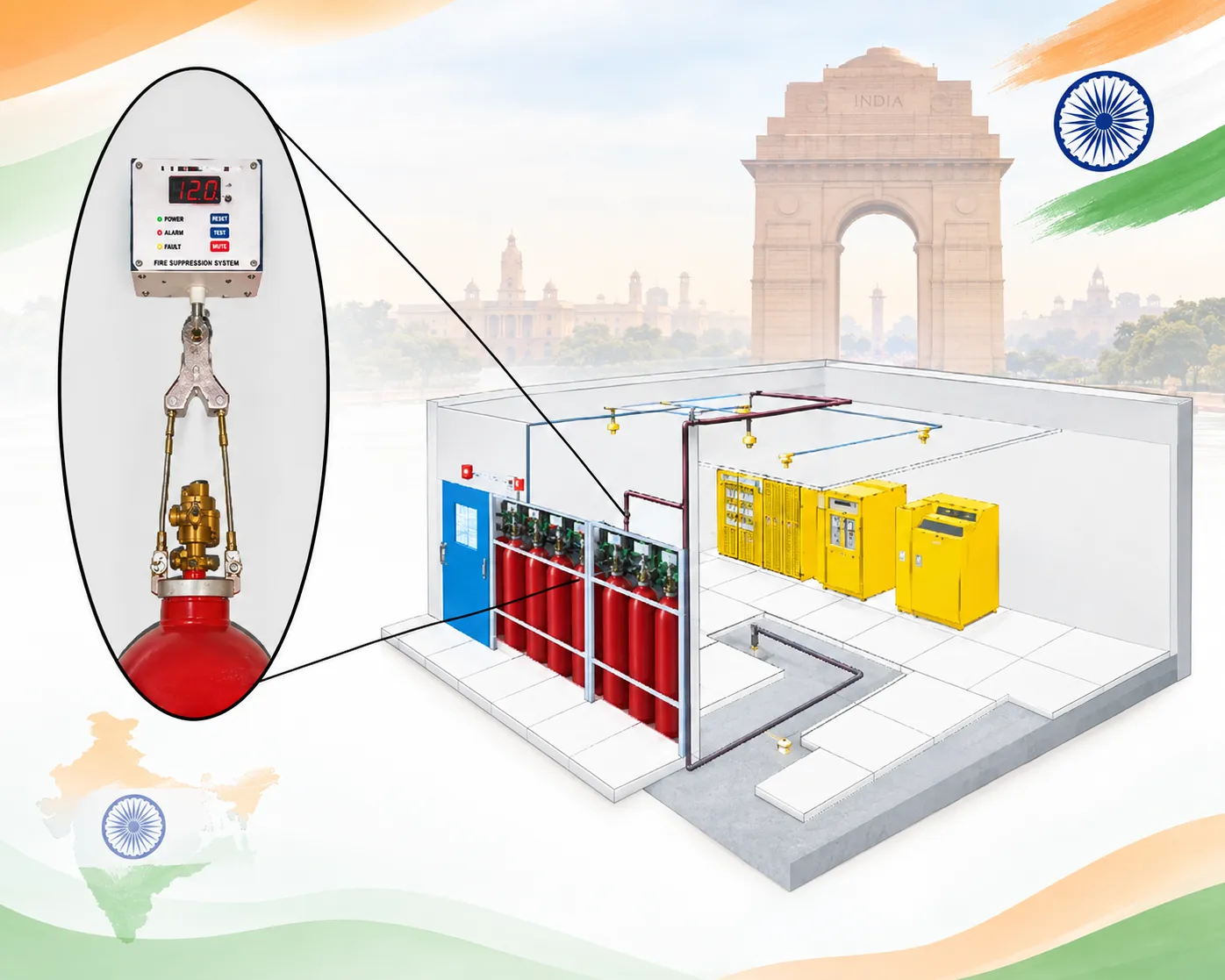
An airport clean agent suppression system is an engineered fire protection system designed to detect and suppress fires in enclosed spaces where sensitive electronic, electrical or mission-critical equipment is installed.
The system typically combines:
Automatic Fire Detection + Suppression Control + Alarm + Pre-Discharge Warning + Equipment Interlocks + Clean Agent Storage + Piping + Discharge Nozzles
Unlike conventional water-based systems, clean-agent suppression is specifically suited to selected enclosed environments where protecting sensitive equipment from secondary damage is an important consideration.
A properly designed system can provide rapid response while leaving little or no conventional extinguishing-media residue, depending on the agent selected.
AAI specifications for critical airport facilities have included clean-agent systems comprising cylinders, extinguishing agent, valves, detection systems and associated suppression equipment, with references to NFPA 2001 and other applicable standards. (aai.aero)
LIFEGUARD® – Airport Fire Suppression System Provider
LIFEGUARD® provides fire protection solutions for critical infrastructure where conventional fire extinguishing methods may not be appropriate.
Our airport clean-agent suppression solutions can be engineered for:
- Airport data centres
- Server rooms
- Network rooms
- Communication rooms
- NAVAIDS facilities
- ATC-support facilities
- Airport operations centres
- Electrical rooms
- UPS rooms
- Control rooms
- Security and surveillance rooms
- Baggage system control rooms
- Telecom rooms
- Technical equipment rooms
- Critical airport infrastructure
The exact system configuration depends upon the fire hazard, protected enclosure, equipment, agent requirements, applicable codes and project specifications.
Airport Clean Agent Suppression Applications
1. Airport Data Centre Fire Suppression
Airport data centres are essential to modern aviation infrastructure. They contain servers, networking equipment, storage systems, communication systems and other electronic infrastructure.
A clean-agent system can be engineered as a total-flooding system for suitable enclosed data-centre environments.
Important design considerations include:
- Room volume
- Raised-floor volume
- Ceiling void
- Equipment arrangement
- Agent quantity
- Cylinder capacity
- Pipe routing
- Nozzle locations
- Detection zones
- HVAC shutdown
- Pressure relief
- Enclosure integrity
AAI technical documentation for data-centre applications has included clean-agent suppression systems with requirements covering agent storage, detection, system approvals and enclosure integrity. (aai.aero)
2. Airport Server Room Suppression System
Server rooms contain high-value electronic equipment that can be affected by water and residue-producing extinguishing agents.
LIFEGUARD® clean-agent systems can be engineered around the room configuration and equipment layout to provide:
- Early fire detection
- Automatic alarm
- Pre-discharge warning
- Controlled agent release
- HVAC interface
- Equipment shutdown interface
- Clean-agent discharge
- Agent retention
The final design should be based on the approved fire protection strategy and applicable standards.
3. NAVAIDS Clean Agent Fire Suppression
Navigation aids are essential to airport operations, making protection of associated electronic equipment an important consideration.
AAI procurement documentation demonstrates the application of clean-agent suppression for Localizer, Glide Path and DVOR NAVAIDS facilities. AAI has also published tender requirements for clean-agent-based fire suppression systems for various NAVAIDS systems at NSCBI Airport, Kolkata. (aai.aero)
LIFEGUARD® can support specialised fire protection requirements for suitable enclosed NAVAIDS and electronic equipment rooms.
4. Airport Communication Room Fire Protection
Communication infrastructure is essential for airport operations.
A clean-agent system can be designed for suitable communication and telecom rooms containing:
- Network equipment
- Communication systems
- Electronic control equipment
- Telecom infrastructure
- Associated power equipment
Detection and suppression can be integrated with the airport's overall fire alarm and building-management infrastructure.
5. Airport Control Room Suppression
Airport control and operations rooms can contain sensitive electronic equipment supporting continuous airport activities.
LIFEGUARD® can provide engineered clean-agent suppression solutions for suitable enclosed control and technical rooms, with system interfaces designed according to the approved cause-and-effect sequence.
6. Airport Electrical Room Fire Suppression
Electrical rooms can contain switchgear, control panels, distribution equipment and other electrical infrastructure.
The appropriate extinguishing technology depends on the specific electrical hazard, equipment configuration and applicable project requirements.
Where appropriate, clean-agent suppression can form part of an integrated airport electrical fire protection strategy.
7. Airport UPS Room Fire Protection
UPS installations provide backup power for critical airport infrastructure.
Where a clean-agent system is appropriate for the particular hazard, LIFEGUARD® can provide an engineered solution incorporating detection, alarm, release logic, agent storage, piping and discharge nozzles.
8. Airport Security & Surveillance Room Protection
Airport security infrastructure includes CCTV, access control, monitoring and security systems.
Clean-agent suppression can be considered for suitable enclosed rooms housing sensitive surveillance and security electronics.
9. Airport Baggage System Control Room
Automated baggage handling systems rely on electrical controls, automation and electronic equipment.
Suitable enclosed control rooms can be evaluated for clean-agent protection as part of the overall airport fire safety design.
How Does an Airport Clean Agent Suppression System Work?
A typical automatic system follows a programmed sequence.
Step 1 – Fire Detection
Smoke or other approved detectors identify a developing fire.
Step 2 – Alarm
The fire suppression/control panel receives the detector signal and activates the programmed alarm sequence.
Step 3 – Detection Confirmation
For selected critical applications, cross-zoned detection or another approved detection philosophy can be used before initiating release.
AAI specifications have included cross-zoned detection arrangements in which activation of one detector generates an alarm and subsequent detector activation initiates the pre-discharge sequence. (aai.aero)
Step 4 – Pre-Discharge Warning
Audible and visual warning devices alert occupants before discharge.
Step 5 – Equipment Interlock
HVAC and other designated equipment can be shut down or controlled through engineered interfaces.
Step 6 – Agent Release
The suppression panel activates the cylinder release mechanism.
Step 7 – Agent Discharge
The clean agent travels through the engineered piping network and is discharged through strategically positioned nozzles.
Step 8 – Fire Suppression
The agent reaches the required design concentration inside the protected enclosure.
Step 9 – Agent Retention
The enclosure must retain the agent for the required period according to the approved design.
Major Components of an Airport Clean Agent System
A complete airport clean-agent suppression system may incorporate:
System ComponentPrimary FunctionClean Agent CylinderStores extinguishing agentCylinder ValveControls agent releaseElectric/Solenoid ActuatorInitiates automatic releaseSuppression Control PanelManages detection and release logicSmoke DetectorDetects fire/smokeManual Release StationProvides authorised manual releaseAbort SwitchProvides approved release-abort functionPressure SwitchProvides system monitoringDischarge HoseConnects cylinder to pipingPipe NetworkCarries extinguishing agentDischarge NozzlesDistributes agentSounderAudible warningStrobe/IndicatorVisual warningHVAC InterfaceCoordinates ventilation shutdownPressure ReliefManages enclosure pressureMonitoring InterfaceProvides remote/system status where specifiedEngineering an Airport Clean Agent Suppression System
An airport clean-agent suppression system should be engineered rather than selected solely on the basis of room size or cylinder capacity.
LIFEGUARD® considers:
Protected Enclosure
The room dimensions, raised floor, ceiling void and other relevant spaces are evaluated.
Fire Hazard
The nature of the combustible materials and equipment is considered.
Agent Selection
Agent selection depends on:
- Fire hazard
- Required design concentration
- Occupancy
- Environmental considerations
- Equipment compatibility
- Applicable standards
- Project specifications
- Required approvals
Cylinder Quantity
Cylinder quantity and capacity are established through the approved system calculation.
Piping Network
Pipe sizes, lengths, fittings, elevation differences and nozzle arrangement affect system performance.
Nozzle Positioning
Nozzle quantity and locations are established through engineering calculations and manufacturer/system requirements.
Detection
Detection coverage and release logic are developed according to the hazard and approved cause-and-effect matrix.
Enclosure Integrity
Doors, penetrations, HVAC openings and other leakage paths need to be considered for total-flooding applications.
AAI documentation for clean-agent installations specifically addresses enclosure-integrity testing and maintaining agent concentration following discharge. (aai.aero)
Airport Clean Agent Suppression Standards
The applicable standards depend on the airport, country, authority and project specification.
Airport projects may reference:
- NFPA 2001 – Clean Agent Fire Extinguishing Systems
- NFPA 72 – National Fire Alarm and Signaling Code
- NFPA 70 – National Electrical Code
- Relevant ISO standards
- National Building Code of India
- Applicable BIS standards
- DGCA requirements
- ICAO requirements
- Airport operator specifications
- Local fire authority requirements
- Project-specific technical specifications
AAI technical specifications have referenced NFPA 2001 and related fire alarm/electrical standards for clean-agent installations. (aai.aero)
The applicable edition and certification requirements should always be confirmed from the specific project documents and authority having jurisdiction.
Environmentally Considered Clean Agent Systems
Environmental characteristics are an increasingly important consideration when selecting a modern clean-agent system.
Certain airport project specifications establish requirements related to ozone depletion and global warming potential. For example, an AAI data-centre specification identifies zero ozone-depleting potential and a specified global-warming-potential criterion as part of its agent-selection requirements. (aai.aero)
LIFEGUARD® can assist consultants and project teams in evaluating suitable technologies based on:
- Environmental characteristics
- Fire suppression performance
- Design concentration
- Occupancy
- Equipment sensitivity
- Cylinder arrangement
- Applicable certifications
- Local regulations
- Project specifications
FK-5-1-12 Clean Agent Suppression Solutions
FK-5-1-12 is one clean-agent technology used for selected electronic and critical-infrastructure applications.
Its suitability should be evaluated based on the hazard, enclosure, design concentration, system listing/approval, environmental requirements and project specification.
AAI documentation for critical infrastructure has specified FK-5-1-12 systems with NFPA 2001-based design requirements and specified approval criteria. (aai.aero)
LIFEGUARD® can support project teams in determining the appropriate system configuration for the intended airport application.
Airport Clean Agent Suppression System Provider – Complete Project Support
LIFEGUARD® can support airport fire protection projects through multiple stages:
Requirement Analysis → Hazard Assessment → System Engineering → Equipment Selection → Design & Calculations → Supply → Installation Support → Testing → Commissioning → Handover
Project documentation may include:
- Technical datasheets
- Product catalogues
- System drawings
- Piping layouts
- Nozzle layouts
- Agent calculations
- Cylinder details
- Cause-and-effect matrix
- Sequence of operation
- Installation manuals
- Testing procedures
- Commissioning reports
- Operation and maintenance manuals
- As-built drawings
AAI tender documentation also identifies drawings, product information, operation manuals, maintenance instructions and as-built documentation among project deliverables for relevant fire protection installations. (aai.aero)
Airport Clean Agent System Integration
Modern airport fire protection systems may need to communicate with multiple building and operational systems.
Depending upon the project, LIFEGUARD® systems can be engineered for interfaces with:
- Fire Alarm System
- Building Management System
- Data Centre Infrastructure Management
- HVAC
- Access Control
- Electrical Systems
- Emergency Shutdown Systems
- Central Monitoring
- Remote Alarm Monitoring
AAI's published data-centre requirements include integration with building fire alarm and data-centre infrastructure-management systems. (aai.aero)
Testing & Commissioning
A clean-agent suppression system must be tested as an integrated system before being placed into service.
Testing may include:
- Smoke detector testing
- Alarm testing
- Suppression-panel testing
- Manual-release testing
- Abort-switch testing
- Cause-and-effect verification
- Actuator/release circuit testing
- Pressure-switch testing
- HVAC interlock testing
- Damper interface testing
- Audible and visual alarm testing
- Monitoring-interface testing
- Enclosure integrity testing where specified
- Documentation verification
Testing procedures should follow the approved project method statement, manufacturer's requirements and applicable standards.
Airport Clean Agent Suppression for New Airport Projects
For new airport developments, clean-agent systems can be considered during the architectural and MEP design stage.
Early coordination helps provide space for:
- Cylinder storage
- Piping routes
- Discharge nozzles
- Detectors
- Suppression panels
- Pressure relief
- HVAC interfaces
- Electrical interfaces
- Maintenance access
Early fire protection planning can also help coordinate the clean-agent system with the overall airport fire alarm and emergency response strategy.
Clean Agent Suppression for Existing Airports
Existing airport facilities may require specialised retrofit solutions.
A retrofit assessment can consider:
- Existing room construction
- Existing fire alarm
- Existing HVAC
- Existing cable penetrations
- Equipment arrangement
- Available cylinder space
- Existing piping
- Existing control interfaces
- Operational restrictions
- Required shutdown windows
LIFEGUARD® can support evaluation of existing installations and development of suitable upgrade or replacement solutions.
Why Choose LIFEGUARD® as Your Airport Clean Agent Suppression System Provider?
Indian Fire Safety Manufacturer
LIFEGUARD® is associated with United Fire Equipments Pvt. Ltd., an Indian manufacturer of fire safety equipment and provider of engineered fire protection solutions.
Application-Focused Engineering
Airport applications require specialised consideration of fire hazards, sensitive equipment, enclosure integrity, system integration and operational requirements.
Critical Infrastructure Capability
LIFEGUARD® solutions are suitable for evaluating protection requirements in data centres, communication rooms, electrical infrastructure and other critical facilities.
Complete System Approach
Fire detection, suppression control, agent storage, piping, nozzles, alarms and interlocks can be considered as one coordinated system.
Technical Documentation
LIFEGUARD® can support consultants, EPC contractors and system integrators with project-specific technical documentation.
Installation & Commissioning Support
System installation, testing and commissioning can be coordinated according to the approved project requirements.
Airport Clean Agent Suppression System Provider India – Applications
LIFEGUARD® solutions can be considered for:
Airport Terminals | Airport Data Centres | Server Rooms | NAVAIDS Facilities | Communication Rooms | Control Rooms | ATC Support Facilities | Electrical Rooms | UPS Rooms | Security Rooms | Baggage Control Rooms | Telecom Rooms | Airport Operations Centres | Technical Buildings | Critical Aviation Infrastructure
Airport Fire Protection Solutions Beyond Clean Agent Suppression
Clean-agent suppression is one component of a comprehensive airport fire safety strategy.
Depending on the facility, an integrated airport fire protection programme may include:
Fire Detection + Fire Alarm + Clean Agent Suppression + Portable Fire Extinguishers + Emergency Response + Fire Hydrant Systems + Sprinkler Systems + Smoke Management + Preventive Maintenance
The appropriate combination depends on the building, hazard, occupancy, airport requirements and applicable regulations.
AAI describes airport fire services as encompassing fire prevention and protection of airport buildings and vital installations in addition to aircraft emergency response. (aai.aero)
Frequently Asked Questions
Who provides airport clean agent suppression systems in India?
LIFEGUARD®, associated with United Fire Equipments Pvt. Ltd., provides fire safety equipment and engineered fire protection solutions for critical infrastructure applications, including suitable airport clean-agent suppression requirements.
What areas of an airport can use clean-agent suppression?
Typical applications include data centres, server rooms, NAVAIDS rooms, communication rooms, control rooms, electrical rooms, UPS rooms, security rooms and other enclosed technical spaces.
Is clean-agent suppression suitable for airport data centres?
Clean-agent systems are widely used for suitable enclosed electronic-equipment environments. AAI project specifications have included clean-agent systems for airport data-centre applications. (aai.aero)
Can clean-agent systems protect NAVAIDS?
Yes, where appropriate to the hazard and project requirements. AAI has published requirements for clean-agent suppression systems serving NAVAIDS facilities, including Localizer, Glide Path and DVOR equipment. (aai.aero)
What standard is generally associated with clean-agent suppression?
NFPA 2001 is a major international standard for clean-agent fire extinguishing systems. Airport projects may additionally require NFPA 72, electrical standards, aviation requirements, local regulations and airport-specific specifications. (aai.aero)
Why is enclosure integrity important?
Total-flooding clean-agent systems depend on achieving and maintaining the required agent concentration. Leakage through doors, cable penetrations, HVAC openings and other gaps can affect agent retention, which is why enclosure-integrity assessment/testing may be required. (aai.aero)
LIFEGUARD® – Your Airport Fire Protection Partner in India
Airport infrastructure demands specialised fire protection that considers life safety, equipment protection, rapid detection, suppression performance, system integration and regulatory compliance.
LIFEGUARD® provides Airport Clean Agent Suppression System Solutions in India for critical enclosed facilities such as data centres, NAVAIDS rooms, communication rooms, control rooms, electrical rooms, UPS rooms and other airport technical infrastructure.
Our approach combines:
Fire Safety Engineering + Detection + Clean Agent Suppression + System Integration + Testing + Commissioning + Technical Support
LIFEGUARD® works with airport authorities, consultants, EPC contractors, MEP contractors, fire protection contractors and system integrators to develop project-specific airport clean-agent fire suppression solutions.
Contact LIFEGUARD®
United Fire Equipments Pvt. Ltd.
LIFEGUARD® – Manufacturer of ISI Certified Fire Safety Equipment
📞 8048034226
📧 ufe126@gmail.com | info@lifeguardindia.in
Airport Clean Agent Suppression System Provider India | Airport Fire Suppression System Provider | Airport Clean Agent Fire Protection | Airport Data Centre Suppression | NAVAIDS Fire Suppression | Aviation Fire Protection Solutions
SEO Meta Title
Airport Clean Agent Suppression System Provider India | LIFEGUARD®
SEO Meta Description
LIFEGUARD® provides airport clean agent suppression systems in India for data centres, NAVAIDS, server rooms, communication rooms, control rooms and critical aviation infrastructure.
Suggested URL
/airport-clean-agent-suppression-system-provider-india/
Primary Keyword
Airport Clean Agent Suppression System Provider India
Secondary Keywords
- Airport clean agent suppression system India
- Airport fire suppression system provider India
- Airport clean agent system provider
- Airport fire protection system provider India
- Airport clean agent supplier India
- Airport data centre fire suppression system
- NAVAIDS fire suppression system India
- Airport server room fire suppression
- Airport automatic fire suppression system
- Aviation fire protection system India
- Clean agent suppression system provider India
- Airport fire safety solutions India
- Airport clean agent fire protection company
- Airport fire suppression equipment supplier
- Airport fire protection solutions provider
Keywords






