Airport Clean Agent Suppression System Provider UAE
LIFEGUARD® – Engineered Airport Clean Agent Fire Suppression Systems for UAE
Airports are among the most technically sophisticated and continuously operating facilities in the world. Behind every passenger terminal, runway operation and baggage-handling facility is a network of data centres, communication rooms, electrical systems, control rooms, security infrastructure, UPS systems and other mission-critical equipment.
Protecting these facilities requires more than conventional firefighting equipment. It requires an engineered fire suppression strategy that considers the specific hazard, sensitive equipment, room enclosure, detection requirements, agent selection, building-system interfaces and applicable regulatory requirements.
LIFEGUARD® provides engineered airport clean agent suppression system solutions for UAE projects, supporting airport owners, consultants, EPC contractors, MEP contractors, fire protection contractors, system integrators and facility-management teams.
Our solutions can be considered for suitable enclosed technical areas including airport data centres, server rooms, communication rooms, control rooms, electrical rooms, UPS rooms, security rooms and other critical infrastructure facilities.
Dubai Airports' published requirements require fire-prevention systems to be maintained and recorded and refer operators and contractors to the UAE Fire and Life Safety Code of Practice and applicable NFPA codes and standards. (Dubai Airports)
What Is an Airport Clean Agent Suppression System?
An airport clean agent suppression system is an engineered automatic fire suppression system designed for suitable enclosed hazards where a gaseous extinguishing agent is specified.
Instead of relying on large quantities of water or extinguishing powder, the system introduces a gaseous extinguishing agent into the protected enclosure at the required design concentration.
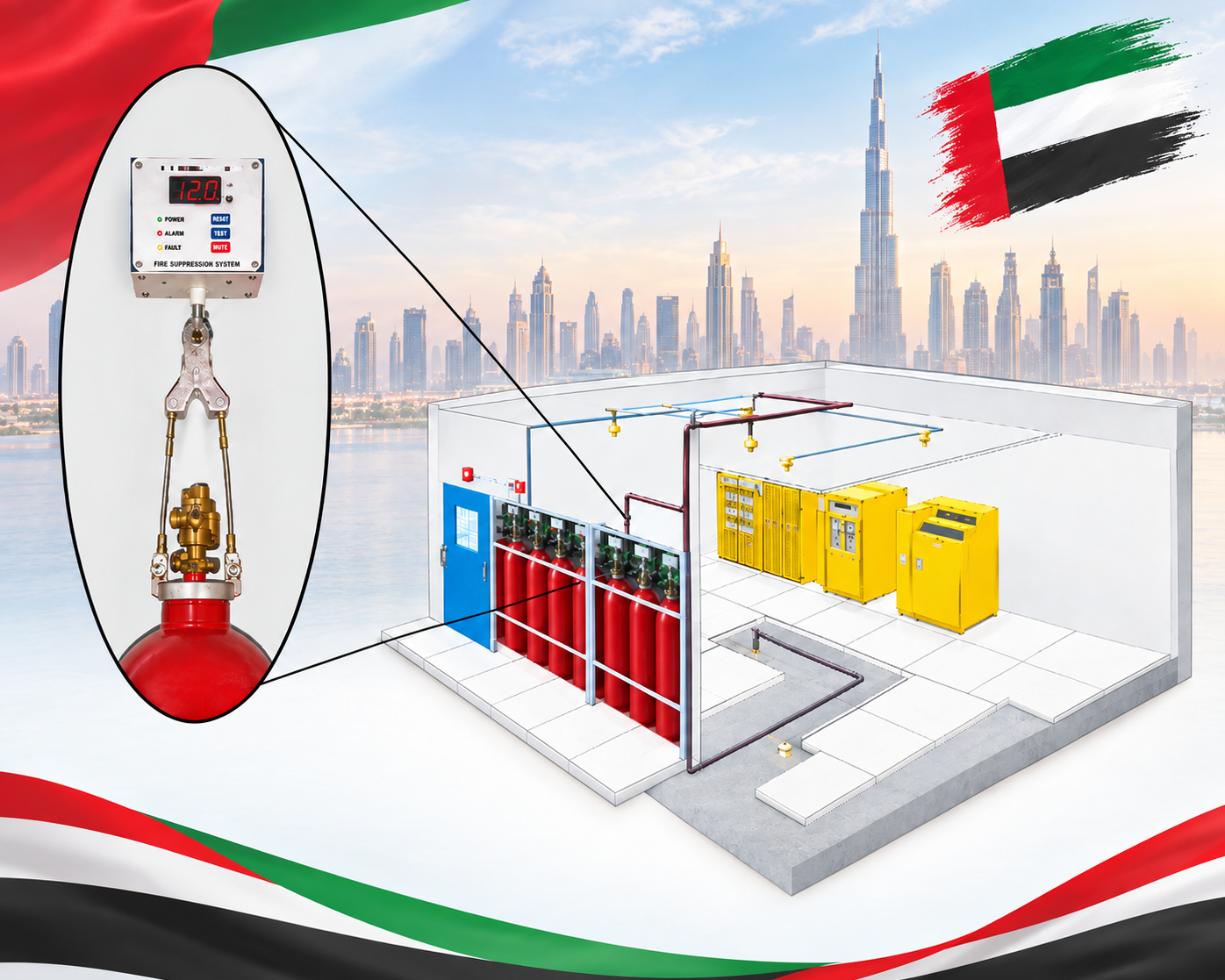
A typical system may incorporate:
- Automatic smoke detection
- Heat or multi-sensor detection where appropriate
- Releasing control panel
- Clean-agent storage cylinders
- Agent distribution pipework
- Discharge nozzles
- Manual release station
- Abort switch
- Audible alarm
- Visual alarm
- Pressure monitoring
- HVAC shutdown interface
- Damper interface
- Fire alarm integration
- BMS interface
- Cause-and-effect programming
- Enclosure integrity provisions
- Testing and commissioning
The exact system configuration depends on the hazard, room characteristics, selected agent, project specification and applicable authority requirements.
LIFEGUARD® – Airport Clean Agent Suppression System Provider UAE
LIFEGUARD® provides fire safety equipment and engineered fire protection solutions for critical infrastructure applications.
Our airport clean-agent solutions are developed around the principle that the complete suppression system must work as one integrated fire protection system.
The solution may combine:
Detection + Alarm + Releasing + Clean Agent + Cylinders + Piping + Nozzles + Interlocking + Testing + Commissioning
This approach helps address the complete fire protection requirement instead of focusing only on the extinguishing agent.
Why Clean Agent Suppression Is Important for Airports
Modern airports depend heavily on electronic infrastructure.
A typical airport may contain:
- Data processing facilities
- Server rooms
- Network infrastructure
- Communication systems
- Electrical distribution equipment
- UPS systems
- Security and surveillance systems
- Baggage automation
- Airport operations control systems
- Technical equipment rooms
- Monitoring systems
Many of these facilities contain high-value electronic equipment in enclosed spaces.
A clean-agent system can be considered for appropriate enclosed hazards where the project requires gaseous fire suppression and minimised residue following discharge.
The objective is to achieve rapid fire suppression while supporting protection of critical equipment and reducing potential disruption to airport operations.
Dubai Airports itself maintains dedicated airport fire services and identifies fire services, airport operations control and technology/infrastructure among its airport functions. (Dubai Airports)
Airport Data Centre Clean Agent Suppression
Protecting Critical Airport IT Infrastructure
Airport data centres form a critical part of modern aviation infrastructure.
They may support:
- Airport information systems
- Networking
- Security systems
- Passenger processing
- Operational databases
- Communication systems
- Monitoring systems
- Building-management systems
A fire in a data centre can affect equipment and potentially interrupt dependent airport services.
For suitable enclosed data-centre hazards, a clean-agent suppression system can be engineered to detect fire, provide warning and release the extinguishing agent according to the approved sequence.
Typical data-centre protection may include:
- Early smoke detection
- Cross-zoned detection
- Releasing panel
- Clean-agent cylinders
- Distribution pipework
- Discharge nozzles
- Pre-discharge alarm
- Abort switch
- HVAC shutdown
- Room integrity provisions
The final configuration must be based on the approved project design.
Airport Server Room Fire Suppression System
Server rooms require carefully selected fire protection because they contain sensitive electronic equipment.
LIFEGUARD® clean-agent suppression solutions can be considered for suitable airport server rooms where the project specification calls for gaseous fire suppression.
The system can be integrated with:
- Fire detection
- Releasing controls
- HVAC
- Fire alarm
- BMS
- Access control
- Emergency warning systems
The result is an integrated protection strategy designed around the specific server-room hazard.
Airport Control Room Clean Agent System
Airport control rooms contain critical monitoring and operational equipment.
A suitable clean-agent suppression system can be designed around:
- Automatic fire detection
- Pre-discharge warning
- Manual release
- Abort function
- Clean-agent discharge
- HVAC shutdown
- Alarm notification
- BMS integration
A properly engineered cause-and-effect sequence determines how these systems interact during a fire event.
Airport Electrical Room Clean Agent Suppression
Electrical rooms can contain switchgear, electrical distribution equipment, control panels, automation systems and other critical infrastructure.
For suitable enclosed electrical hazards, clean-agent suppression may be considered as part of the overall fire protection strategy.
Design considerations include:
- Electrical equipment arrangement
- Room volume
- Ventilation
- Cable penetrations
- Raised floors
- False ceilings
- Occupancy
- Fire load
- Agent concentration
- Discharge requirements
- Equipment interfaces
The UAE Civil Defence checklist available publicly identifies clean-agent applications and includes examples such as server rooms, control rooms, LV rooms and BMS rooms within its referenced building checklist. (Dubai Customs)
Airport Communication Room Suppression
Communication rooms contain infrastructure essential to airport connectivity.
These rooms can include:
- Telecom equipment
- Network switches
- Communication servers
- Fibre infrastructure
- Electronic control equipment
- Power supplies
A clean-agent system can be engineered for suitable enclosed communication hazards.
LIFEGUARD® can support an integrated approach involving detection, releasing, agent storage, pipework, discharge nozzles and building-system interfaces.
Airport UPS Room Fire Suppression
UPS systems provide backup power to critical airport infrastructure.
Suitable UPS rooms may contain:
- UPS equipment
- Electrical distribution systems
- Battery systems
- Control equipment
- Power-conditioning equipment
Fire protection design for these rooms should consider the actual battery technology and hazard.
Important considerations include:
- Battery chemistry
- Energy capacity
- Room configuration
- Ventilation
- Detection
- Thermal behaviour
- Fire propagation
- Emergency procedures
- Applicable standards
A clean-agent system should not be selected automatically for every battery hazard. The appropriate protection strategy should be determined through project-specific hazard assessment and applicable requirements.
Airport Security and Surveillance Room Protection
Modern airports use extensive security infrastructure, including:
- CCTV systems
- Security servers
- Access-control systems
- Monitoring equipment
- Communication systems
- Security control systems
For suitable enclosed security and surveillance rooms, clean-agent fire suppression can provide an engineered solution for protecting sensitive equipment.
Airport Baggage Handling Control Room Suppression
Airport baggage systems contain extensive automation and electrical control infrastructure.
Baggage handling installations can include:
- Conveyor controls
- Motor controls
- PLC systems
- Sensors
- Electrical panels
- Automation equipment
Clean-agent suppression may be suitable for specific enclosed control rooms or technical spaces associated with baggage handling.
The actual conveyor and machinery areas should be assessed separately because different hazards may require different suppression technologies.
Clean Agent Technologies for UAE Airport Projects
The appropriate clean agent depends on the hazard, room characteristics, project requirements, environmental considerations and required approvals.
Potential technologies include:
FK-5-1-12
FK-5-1-12 is a clean-agent technology that can be considered for suitable electronic and critical-equipment applications.
Potential applications include:
- Data centres
- Server rooms
- Communication rooms
- Control rooms
- Electrical equipment rooms
Subject to project requirements and applicable approvals.
HFC-227ea / FM-200
HFC-227ea systems may be specified for suitable total-flooding applications where permitted by the project specification and applicable requirements.
Inert Gas
Inert-gas systems can use gases such as nitrogen, argon or approved mixtures for suitable applications.
Selecting the Right Agent
Agent selection should consider:
- Fire hazard
- Occupancy
- Room volume
- Design concentration
- Environmental requirements
- Equipment sensitivity
- Project specification
- Applicable standards
- Authority requirements
- Manufacturer's approved design methodology
UAE Compliance for Airport Clean Agent Systems
Compliance is a key component of airport fire protection.
The UAE Civil Defence guidance publicly available states that clean-agent systems should be designed using DCD-approved manufacturer's design software and comply with the UAE Fire & Life Safety Code of Practice and manufacturer's instructions. It also requires hazard enclosure integrity and addresses leakage compensation. (Dubai Customs)
Airport-specific requirements may also apply.
Dubai Airports' published conditions refer specifically to the UAE Fire and Life Safety Code of Practice and applicable NFPA Codes & Standards for fire protection and require fire-extinguishing equipment to be inspected and serviced at scheduled intervals. (Dubai Airports)
Therefore, an airport clean-agent project should be developed around:
- UAE Fire & Life Safety requirements
- Civil Defence requirements
- Airport-specific specifications
- Applicable NFPA standards
- Approved manufacturer design methodology
- Product approvals
- Authority requirements
- Testing requirements
- Commissioning requirements
- Maintenance requirements
Clean Agent System Design for Airport Applications
LIFEGUARD® follows an engineering-led approach for suitable clean-agent suppression applications.
Step 1 – Protected Area Assessment
The protected enclosure is evaluated for:
- Length
- Width
- Height
- Volume
- Ceiling height
- Raised floor
- False ceiling
- Equipment layout
- Occupancy
- HVAC
- Ventilation
- Doors
- Cable penetrations
Step 2 – Hazard Assessment
The fire hazard is evaluated according to the equipment and materials within the enclosure.
Step 3 – Agent Selection
An appropriate clean-agent technology is selected according to the project requirements.
Step 4 – Design Calculation
The system is designed using the applicable approved manufacturer methodology/software.
Step 5 – Cylinder Selection
Cylinder quantity and capacity are established from the engineered design.
Step 6 – Pipe Network
Pipe sizes, routes and nozzle locations are determined from the system calculation.
Step 7 – Detection and Release
The detection, alarm, pre-discharge and release sequence is established.
Step 8 – Building Interface
The suppression system is coordinated with:
- HVAC
- Dampers
- Fire alarm
- BMS
- Access control
- Electrical systems
Step 9 – Testing and Commissioning
The completed system is inspected and functionally tested according to the approved project procedures.
Airport Clean Agent System Components
1. Detection System
Smoke, heat, multi-sensor or aspirating detection can be considered depending on the protected hazard.
2. Releasing Control Panel
The releasing panel monitors detection and controls the programmed suppression sequence.
3. Clean Agent Cylinders
Cylinders store the extinguishing agent required by the system design.
4. Discharge Piping
The pipe network transfers the agent from the cylinders to the discharge nozzles.
5. Discharge Nozzles
Nozzles distribute the agent throughout the protected enclosure.
6. Manual Release Station
Manual release provides an authorised means of initiating system discharge according to the approved design.
7. Abort Switch
An abort switch can be incorporated where required by the approved system philosophy.
8. Audible and Visual Alarms
Pre-discharge and discharge warning devices notify occupants.
9. Pressure Monitoring
Pressure monitoring can provide system status supervision where required.
Airport Clean Agent Cause-and-Effect Sequence
A typical engineered sequence may follow:
Stage 1 – First Detector
Fire detection initiates a fire/pre-alarm condition.
Stage 2 – Confirmed Detection
A second detector or approved confirmation logic initiates the confirmed fire condition.
Stage 3 – Pre-Discharge
Audible and visual alarms activate.
Stage 4 – Equipment Interlocking
Specified HVAC, ventilation or other interfaces operate according to the approved cause-and-effect matrix.
Stage 5 – Agent Release
Following the configured time delay and safety conditions, the clean agent is discharged.
Stage 6 – Post-Discharge
System status and alarms are monitored and the incident is managed according to the facility's emergency procedures.
The actual sequence must always follow the approved project cause-and-effect matrix.
Room Integrity for Airport Clean Agent Systems
Room integrity is a critical consideration for total-flooding clean-agent systems.
The protected enclosure should retain the required extinguishing concentration for the specified period.
Potential leakage points include:
- Doors
- Cable penetrations
- HVAC openings
- Dampers
- Raised floors
- False ceilings
- Service penetrations
- Conduits
UAE Civil Defence guidance specifically requires hazard enclosure integrity and provides for additional agent quantity where leakage compensation is necessary. (Dubai Customs)
This means that an effective clean-agent system involves more than installing cylinders and nozzles.
The room, detection, suppression, HVAC and building interfaces must operate as an integrated system.
Airport Clean Agent System Testing and Commissioning
Testing and commissioning are essential before handover.
Depending on the project requirements, commissioning may include:
- Detector testing
- Alarm testing
- Releasing panel testing
- Manual release testing
- Abort switch testing
- Pressure supervision testing
- Solenoid/release circuit testing
- HVAC interlock testing
- Damper interface testing
- Fire alarm interface testing
- BMS interface testing
- Cause-and-effect testing
- Alarm notification testing
Final commissioning procedures should follow the approved project documentation and applicable authority requirements.
Airport Clean Agent Maintenance
A suppression system requires ongoing inspection and maintenance after installation.
Maintenance can include:
- Visual inspection
- Cylinder condition inspection
- Pressure/status checks
- Detection testing
- Alarm testing
- Control panel inspection
- Nozzle inspection
- Pipework inspection
- Interface testing
- Record keeping
- Periodic servicing
Dubai Airports' published requirements explicitly state that fire-extinguishing equipment must be inspected and serviced at regularly scheduled intervals and that inspection status should be documented. (Dubai Airports)
Airport Clean Agent System Provider for Dubai
Dubai is a major international aviation hub, and airport facilities include complex technology and infrastructure.
LIFEGUARD® can support suitable clean-agent suppression requirements for:
- Airport data centres
- Server rooms
- Control rooms
- Communication rooms
- Electrical rooms
- UPS facilities
- Security rooms
- Technical rooms
- Airport support infrastructure
For Dubai airport projects, project-specific authority requirements and airport specifications must be incorporated into the final design.
Dubai Airports also maintains a supplier registration and prequalification process for companies seeking to participate in its tenders and procurement activities. (Dubai Airports)
Airport Clean Agent System Provider Abu Dhabi
LIFEGUARD® can also support suitable aviation and airport-related fire protection requirements in Abu Dhabi.
Potential applications include:
- Data centres
- Communication rooms
- Control rooms
- Electrical rooms
- Server rooms
- UPS rooms
- Security facilities
- Technical equipment rooms
The final design and approval pathway should be coordinated with the relevant UAE authority and project requirements.
Airport Clean Agent System Provider Across UAE
LIFEGUARD® can support enquiries related to airport and aviation infrastructure throughout the UAE, including:
- Dubai
- Abu Dhabi
- Sharjah
- Ras Al Khaimah
- Fujairah
- Ajman
- Umm Al Quwain
Our solutions can support airport operators, consultants, contractors, system integrators and fire protection companies seeking engineered clean-agent suppression systems for suitable applications.
Why Choose LIFEGUARD® as Your Airport Clean Agent System Provider?
Fire Safety Manufacturing Experience
LIFEGUARD® is associated with the manufacture and supply of fire safety equipment and engineered fire protection solutions.
Integrated System Approach
We consider detection, releasing, suppression, alarm and building-system interfaces as part of one coordinated solution.
Critical Infrastructure Focus
Our solutions can be developed for suitable sensitive and mission-critical environments.
Project-Specific Engineering
Clean-agent systems are engineered according to the protected enclosure and actual hazard rather than using a generic configuration.
Technical Documentation
Depending on project scope, technical documentation may include:
- Product datasheets
- Technical specifications
- Equipment schedules
- System drawings
- Calculation documentation
- Cause-and-effect information
- Testing records
- Commissioning documentation
- Operation and maintenance information
International Project Support
LIFEGUARD® can support international customers and project stakeholders with technical and commercial coordination for fire protection requirements.
Airport Clean Agent Suppression Applications
LIFEGUARD® solutions can be considered for:
Airport Data Centres
Protection of critical IT and data-processing infrastructure.
Server Rooms
Gaseous suppression for suitable enclosed server environments.
Communication Rooms
Protection of telecom and communication infrastructure.
Airport Control Rooms
Protection of monitoring and operational equipment.
Electrical Rooms
Clean-agent protection for suitable enclosed electrical hazards.
UPS Rooms
Fire protection assessment for critical power infrastructure.
Security Rooms
Protection of surveillance and security systems.
Baggage Control Rooms
Protection of enclosed baggage automation and control equipment.
Technical Equipment Rooms
Fire suppression for suitable mission-critical technical spaces.
Benefits of an Engineered Airport Clean Agent System
A properly engineered clean-agent system can provide:
Rapid Fire Response
Automatic detection can identify fire conditions and initiate the programmed response.
Equipment Protection
Clean-agent suppression can be appropriate for certain sensitive electronic environments.
Minimal Post-Discharge Residue
Unlike powder-based extinguishing systems, gaseous clean agents do not leave the same type of powder residue on equipment.
Integrated Control
Detection, alarm, release and building interfaces can operate through a coordinated sequence.
Reduced Operational Disruption
Appropriately designed protection can help limit fire damage to critical enclosed equipment areas.
Flexible Application
Clean-agent technology can be considered for a variety of suitable enclosed technical hazards.
These benefits depend on correct system selection, engineering, installation, testing and maintenance.
Frequently Asked Questions
What does an airport clean agent suppression system provider do?
An airport clean-agent suppression system provider supports the engineering, equipment supply, integration, installation coordination, testing and commissioning of clean-agent fire suppression systems for suitable airport applications.
Where can clean-agent suppression be used in an airport?
Potential applications include data centres, server rooms, control rooms, communication rooms, electrical rooms, UPS rooms, security rooms and other suitable enclosed technical spaces.
Which clean agent is best for an airport?
There is no universal agent that is automatically suitable for every airport application. Selection depends on the hazard, enclosure, occupancy, equipment, environmental requirements, project specification and applicable approvals.
Can LIFEGUARD® provide FK-5-1-12 systems?
LIFEGUARD® can support project requirements involving FK-5-1-12 clean-agent technology where specified and where the applicable system/equipment approvals and design methodology meet the project requirements.
Can clean-agent suppression protect airport server rooms?
Yes, clean-agent systems can be engineered for suitable enclosed server-room applications where gaseous suppression is specified.
Does the room need to be sealed?
For total-flooding systems, enclosure integrity is an important design requirement because the protected space must retain the required extinguishing concentration. UAE Civil Defence guidance specifically addresses enclosure integrity and leakage compensation. (Dubai Customs)
Can the suppression system be connected to BMS?
Yes, subject to the approved system design, the clean-agent system can interface with BMS, fire alarm, HVAC, dampers and other building services.
Does an airport clean-agent system require regular maintenance?
Yes. Fire protection equipment requires periodic inspection and servicing according to the applicable requirements. Dubai Airports' published requirements specifically call for scheduled inspection and servicing of fire-extinguishing equipment. (Dubai Airports)
Can LIFEGUARD® support UAE airport contractors?
Yes. LIFEGUARD® can support consultants, EPC contractors, MEP contractors, fire protection contractors, distributors and system integrators with technical information, equipment and engineered fire protection solutions, subject to project scope.
LIFEGUARD® – Airport Clean Agent Suppression System Provider UAE
Airport fire protection requires an integrated approach combining early detection, reliable releasing controls, appropriate clean-agent technology, engineered distribution, room integrity and coordinated building interfaces.
LIFEGUARD® provides engineered clean-agent suppression solutions for suitable airport and aviation applications in the UAE, supporting critical areas such as:
Data Centres | Server Rooms | Control Rooms | Communication Rooms | Electrical Rooms | UPS Rooms | Security Rooms | Technical Equipment Rooms
Our approach combines:
Detection + Releasing + Clean Agent + Cylinders + Piping + Nozzles + Alarm + Interlocking + Testing + Commissioning
For UAE airport projects, every system should be engineered according to the applicable UAE Fire & Life Safety requirements, Civil Defence requirements, airport-specific specifications, relevant standards and the approved manufacturer's design methodology.
Contact LIFEGUARD®
LIFEGUARD® – Manufacturer of ISI Certified Fire Safety Equipment
United Fire Equipments Pvt. Ltd.
📞 8048034226
📧 ufe126@gmail.com | info@lifeguardindia.in
Airport Clean Agent Suppression System Provider UAE
Engineered Fire Protection for Critical Airport Infrastructure.
SEO keyword strategy
Primary keyword:
Airport clean agent suppression system provider UAE
Secondary keywords:
- airport clean agent suppression system UAE
- airport fire suppression system provider UAE
- airport clean agent system provider UAE
- airport fire protection provider UAE
- airport clean agent supplier UAE
- clean agent suppression provider Dubai
- airport fire suppression company UAE
- aviation fire protection system UAE
- airport fire protection solutions UAE
- airport clean agent system Dubai
Long-tail keywords:
- airport clean agent suppression system provider Dubai
- airport clean agent fire suppression provider Abu Dhabi
- airport data centre clean agent suppression UAE
- airport server room fire suppression UAE
- airport electrical room clean agent system UAE
- airport control room fire suppression UAE
- airport communication room fire suppression UAE
- FK-5-1-12 airport suppression system UAE
- FM-200 airport fire suppression UAE
- airport automatic clean agent suppression system provider UAE
Recommended URL:
/airport-clean-agent-suppression-system-provider-uae/
SEO Title:
Airport Clean Agent Suppression System Provider UAE | LIFEGUARD®
Meta Description:
LIFEGUARD® provides engineered airport clean agent suppression systems in UAE for data centres, server rooms, control rooms, electrical rooms, UPS rooms and critical aviation infrastructure.
Recommended H1:
Airport Clean Agent Suppression System Provider UAE
Recommended internal-link topics:
- Clean Agent Fire Suppression System
- FK-5-1-12 Fire Suppression System
- FM-200 Fire Suppression System
- Data Centre Fire Suppression System
- Electrical Room Fire Suppression
- Gas Fire Suppression System
- Automatic Fire Suppression System
- Fire Detection & Releasing System
Keywords