
https://updates.lifeguardindia.in/products/lg-611a-wsm-200-kg-with-collar-cable/13
Clean Agent Suppression Manufacturer in India
LIFEGUARD® – Clean Agent Fire Suppression Systems & Engineered Fire Protection Solutions
Modern buildings contain increasingly valuable electronic, electrical and digital infrastructure. Data centres, server rooms, control rooms, telecom facilities, UPS rooms and critical electrical installations can be highly vulnerable to fire, while conventional water-based firefighting may introduce additional risks to sensitive equipment.
LIFEGUARD® is a clean agent suppression manufacturer in India, providing engineered gaseous fire suppression solutions for critical commercial, industrial, infrastructure and special-hazard applications.
Our clean agent fire suppression solutions are designed to provide rapid fire control while minimizing post-discharge residue and avoiding the water damage associated with conventional water-based suppression in applications where clean-agent technology is appropriate.
LIFEGUARD® can support engineered solutions utilizing technologies such as FK-5-1-12 and HFC-227ea, subject to the application, project specification, applicable environmental requirements and required approvals. LIFEGUARD®'s published project information specifically identifies FK-5-1-12 applications for data centres, server rooms, electrical control rooms, UPS areas and other sensitive electronic environments. (Lifeguard India Updates)
What Is a Clean Agent Fire Suppression System?
A clean agent fire suppression system is an engineered fire protection system that uses a gaseous or vaporizing extinguishing agent to suppress fire without leaving the type of solid or liquid residue associated with many conventional extinguishing media.
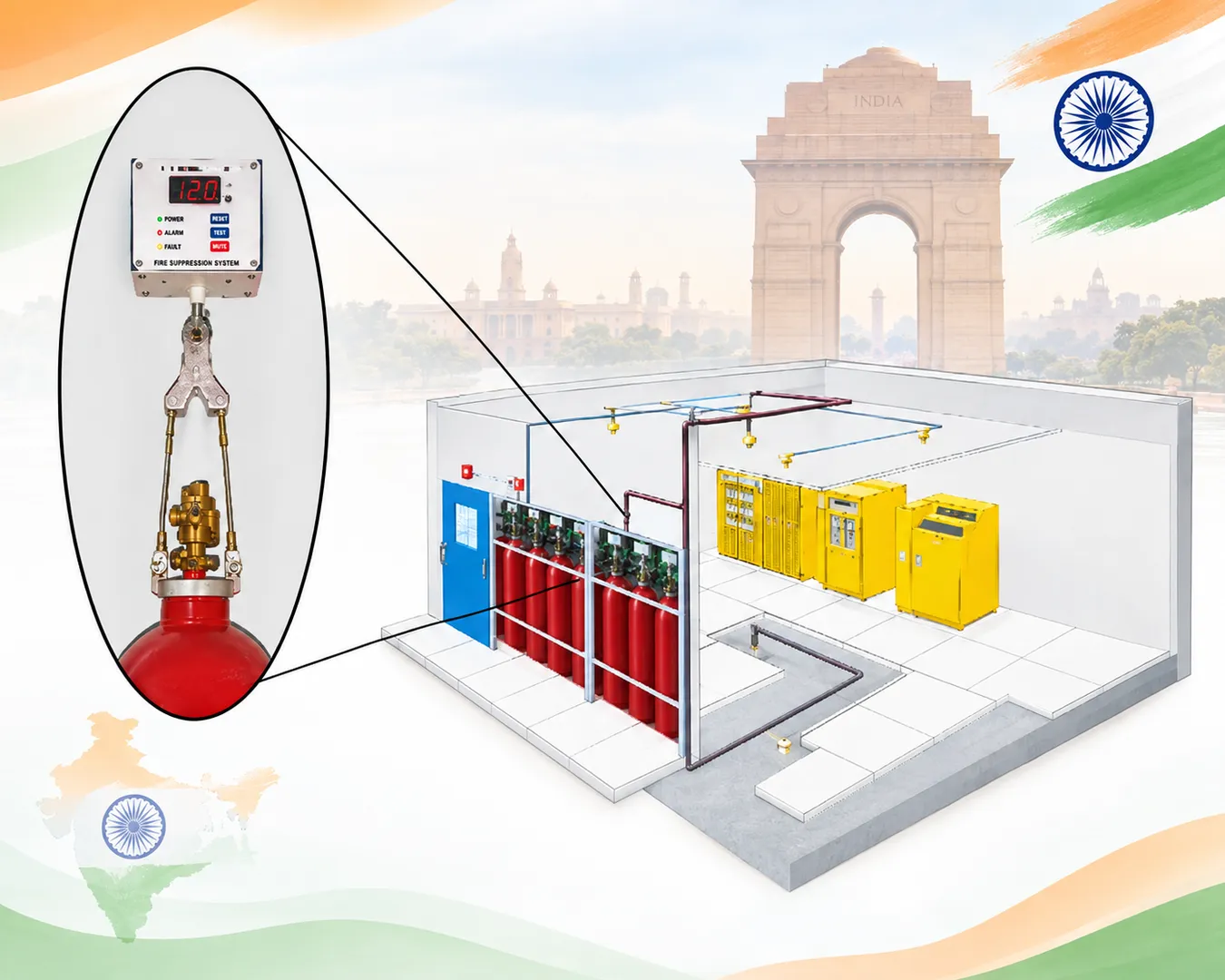
A typical system consists of:
- Clean agent storage cylinder
- Cylinder valve
- Pressure monitoring
- Releasing/control panel
- Smoke or heat detection
- Distribution piping
- Discharge nozzles
- Manual release station
- Abort switch
- Audible alarm
- Visual alarm
- Pressure switch
- HVAC shutdown interface
- Electrical interlock
- Fire alarm/BMS interface
The system detects a fire condition and, according to the approved cause-and-effect sequence, releases the calculated quantity of agent into the protected enclosure.
The required agent quantity is determined through engineering calculations that consider factors such as protected volume, design concentration, temperature, enclosure characteristics and system configuration. (Lifeguard India Updates)
LIFEGUARD® – Clean Agent Suppression OEM Manufacturer India
LIFEGUARD® combines fire safety manufacturing with application-focused engineering to provide clean agent fire suppression solutions for critical environments.
Our capabilities support:
Hazard Assessment → System Engineering → Equipment Selection → Manufacturing/Supply → Installation Support → Testing → Commissioning → Maintenance Support
This makes LIFEGUARD® suitable for customers looking for a clean agent fire suppression OEM manufacturer, system supplier and fire protection solutions partner in India.
We support requirements from:
- EPC contractors
- MEP contractors
- Fire protection contractors
- System integrators
- Consultants
- Data centre operators
- Industrial organizations
- Electrical contractors
- Facility management companies
- Infrastructure developers
- OEM customers
Clean Agent Fire Suppression Applications
Clean agent technology is particularly relevant to enclosed areas containing sensitive or high-value equipment.
LIFEGUARD® clean agent suppression solutions can be considered for:
Data Centres
Protection of servers, networking equipment, UPS systems and critical digital infrastructure.
Server Rooms
Automatic fire suppression for enclosed IT and communication environments.
Electrical Rooms
Protection of electrical and control equipment where water discharge may be undesirable.
UPS Rooms
Fire protection for critical power-support infrastructure.
Control Rooms
Suppression for process-control and automation environments.
Telecom Facilities
Protection of communication and networking equipment.
Archives
Suitable clean-agent technologies can be evaluated for certain storage and archive environments.
Critical Infrastructure
Engineered protection for selected mission-critical facilities.
LIFEGUARD®'s published clean-agent applications include server rooms, data centres, UPS rooms, electrical control rooms, communication facilities and critical electronic equipment rooms. (Lifeguard India Updates)
FK-5-1-12 Clean Agent Fire Suppression System
FK-5-1-12 is a clean-agent technology used in engineered fire suppression systems for suitable applications involving sensitive electronic and electrical equipment.
LIFEGUARD® can provide engineered FK-5-1-12 solutions based on the protected hazard and project requirements.
Potential applications include:
- Data centres
- Server rooms
- UPS rooms
- Electrical rooms
- Control rooms
- Telecom facilities
- Network rooms
- Critical electronic equipment areas
- Industrial control systems
A typical FK-5-1-12 system may incorporate:
Agent Cylinder → Cylinder Valve → Discharge Piping → Nozzles → Detection → Releasing Panel → Manual Release → Abort Switch → Alarm & Interlocks
LIFEGUARD®'s published technical content identifies FK-5-1-12 for sensitive electronic environments and notes that agent quantity is determined through engineering calculations based on factors such as enclosure volume, design concentration and operating temperature. (Lifeguard India Updates)
HFC-227ea Clean Agent Fire Suppression System
LIFEGUARD® can also support projects requiring HFC-227ea clean agent fire suppression systems, subject to project specifications, environmental requirements and regulatory acceptability.
Potential applications include:
- Server rooms
- Data centres
- UPS rooms
- Control rooms
- Electrical rooms
- Telecom facilities
- Critical electronic installations
The system stores the agent in dedicated cylinders and discharges it through engineered piping and nozzles following the appropriate fire detection and release sequence.
LIFEGUARD®'s published technical material identifies HFC-227ea as another clean-agent technology for selected total-flooding applications. (Lifeguard India Updates)
How Does a Clean Agent Suppression System Work?
A properly engineered automatic clean-agent system generally follows a coordinated sequence.
Step 1 – Fire Detection
Smoke, heat or other suitable detectors identify a developing fire.
Step 2 – Alarm
The releasing panel receives the detection signal and initiates the programmed alarm sequence.
Step 3 – Confirmation & Release Logic
Depending on system design, cross-zone or other release logic may be used before automatic agent discharge.
Step 4 – Pre-Discharge Warning
Audible and visual warnings alert occupants before discharge where applicable.
Step 5 – Equipment Interlocks
HVAC systems, ventilation equipment or other associated equipment may be shut down according to the approved cause-and-effect matrix.
Step 6 – Agent Discharge
The clean agent is released from the storage cylinder through the engineered pipe and nozzle network.
Step 7 – Fire Suppression
The agent reaches the required design concentration within the protected enclosure to suppress the fire.
Step 8 – Post-Discharge Monitoring
The system can provide status and supervisory information for response, inspection and restoration.
Clean Agent Fire Suppression for Data Centres
Data centres require special consideration because they combine:
- High electrical loads
- Sensitive electronic equipment
- Continuous operation
- High equipment value
- Critical business functions
- Limited tolerance for downtime
LIFEGUARD® provides clean-agent suppression solutions for:
- Data halls
- Server rooms
- Network rooms
- UPS rooms
- Electrical rooms
- Battery-support areas
- Control rooms
The system can be integrated with fire detection, releasing controls, HVAC shutdown and building management systems.
Clean Agent Suppression for Electrical Rooms
Electrical fires may originate from:
- Short circuits
- Loose connections
- Component failure
- Overheating
- Insulation failure
- Electrical overload
For suitable enclosed electrical hazards, clean-agent suppression can provide an automatic response without introducing conventional water discharge into the protected equipment area.
Potential applications include:
- Switchgear rooms
- Electrical control rooms
- MCC rooms
- PCC rooms
- Control cabinets
- Electrical equipment rooms
- Automation rooms
Clean Agent Fire Suppression for UPS Rooms
UPS systems support critical infrastructure in data centres, telecom facilities, hospitals, commercial buildings and industrial facilities.
LIFEGUARD® clean-agent solutions can be considered for suitable UPS environments, with the system design accounting for:
- Room volume
- Equipment arrangement
- Battery configuration
- Ventilation
- Operating temperature
- Fire hazard
- Detection strategy
- Agent concentration
- Enclosure integrity
Where batteries are present, the battery-specific fire risk should be assessed separately rather than assuming that the same suppression strategy is appropriate for every installation.
Clean Agent Suppression for Telecom Facilities
Telecom and communication facilities contain high-value electronic equipment that may require specialized fire protection.
LIFEGUARD® provides clean-agent solutions for suitable:
- Telecom rooms
- Network rooms
- Communication centres
- Equipment rooms
- Control rooms
- UPS rooms
The system can be integrated with the facility's fire detection and alarm infrastructure.
Clean Agent Fire Suppression for Industrial Applications
Clean-agent technology is not limited to IT environments.
Depending on the fire hazard and enclosure, clean-agent suppression may be considered for:
- Industrial control rooms
- Automation rooms
- Process control systems
- Electrical rooms
- Instrumentation rooms
- Critical machinery enclosures
- Telecom installations
- Specialized equipment rooms
The agent and system configuration must be selected according to the actual hazard and applicable design requirements.
Clean Agent Suppression System Components
A complete engineered system can include:
Clean Agent Cylinders
Store the required quantity of extinguishing agent at the specified system pressure.
Cylinder Valve
Controls agent release from the storage cylinder.
Releasing Control Panel
Processes detection signals and controls the suppression release sequence.
Detection System
Smoke, heat or other appropriate detection technologies identify the fire condition.
Distribution Piping
Transfers the agent from the cylinder to the discharge nozzles.
Discharge Nozzles
Distribute the extinguishing agent throughout the protected enclosure.
Manual Release
Allows authorized personnel to initiate system release according to the system design.
Abort Switch
Provides a means to interrupt or delay automatic release where required by the approved design.
Alarm Devices
Hooters, sounders, strobes and other notification devices warn occupants.
Pressure Monitoring
Provides cylinder/system pressure status where specified.
HVAC & Electrical Interlocks
Interfaces the suppression system with associated equipment according to the approved cause-and-effect sequence.
Total Flooding Clean Agent Suppression
Many clean-agent systems operate on the total-flooding principle, where the calculated concentration of extinguishing agent is distributed throughout an enclosed protected space.
The system design considers:
- Room volume
- Hazard type
- Design concentration
- Minimum/maximum temperature
- Agent quantity
- Cylinder capacity
- Pipe network
- Nozzle arrangement
- Discharge characteristics
- Room integrity
- Ventilation
- Pressure relief
A clean-agent system should therefore not be sized simply by floor area.
The actual enclosure and fire hazard must be evaluated before determining the agent quantity and system configuration. LIFEGUARD®'s own published system information similarly emphasizes enclosure volume and engineering calculations when determining agent quantity. (Lifeguard India Updates)
Clean Agent Fire Suppression Standards
Clean-agent systems should be designed, installed, tested and maintained according to the standards and regulatory requirements applicable to the particular project.
Depending on the system and project specification, relevant references may include recognized standards for gaseous fire-extinguishing systems.
For Indian projects, BIS provides a searchable standards framework through its Know Your Standard portal, which includes standards, amendments, testing information and related certification resources. (Bureau of Indian Standards)
BIS also explains that where product certification applies, manufacturers need to identify the relevant Indian Standard and demonstrate appropriate manufacturing infrastructure, process controls, quality control and testing capabilities. (Bureau of Indian Standards)
For project-specific clean-agent systems, the applicable standard, certification and approval requirements should therefore be verified according to the agent, system components, hazard and project specification.
Engineering & Design of Clean Agent Systems
LIFEGUARD® approaches clean-agent suppression as an engineered fire protection system.
Important design considerations can include:
Protected Volume
The enclosure volume directly affects the quantity of extinguishing agent required.
Hazard Classification
The type of combustible material and fire scenario influence system selection.
Design Concentration
The required concentration depends on the agent and protected hazard.
Operating Temperature
Temperature affects agent quantity calculations and system performance.
Cylinder Configuration
Cylinder capacity and pressure are selected according to the engineered design.
Piping Network
Pipe diameter, length, fittings and configuration influence discharge performance.
Nozzle Arrangement
Nozzle location and discharge characteristics are important for effective distribution.
Room Integrity
Total-flooding systems depend on the protected enclosure retaining the required concentration for the specified design period.
Pressure Relief
Pressure effects associated with agent discharge should be considered during enclosure design.
Clean Agent Suppression vs Water-Based Fire Suppression
Clean-agent systems can be particularly relevant where the protected equipment is sensitive to water or residue.
FeatureClean AgentConventional WaterPrimary mediumGaseous/vaporizing agentWaterResidueMinimal/no solid residue for suitable clean agentsWater dischargeElectronic equipmentOften suitable for appropriate applicationsRequires careful evaluationPost-discharge cleanupGenerally limitedPotentially significantTypical applicationsData centres, server rooms, control roomsBuildings, warehouses, industrial applicationsEnclosure requirementImportant for total floodingDepends on systemEngineeringApplication-specificApplication-specific
This does not mean clean agent is universally preferable. The appropriate suppression technology depends on the fire hazard, occupancy, enclosure, equipment, regulatory requirements and project design.
Why Choose LIFEGUARD® as Your Clean Agent Suppression Manufacturer?
Manufacturing Experience Since 1991
LIFEGUARD® has been engaged in fire safety equipment manufacturing since 1991, providing extensive experience across fire protection applications.
Indian Fire Safety Manufacturer
LIFEGUARD® combines Indian manufacturing capabilities with engineering and project support for domestic and international requirements.
Clean Agent Expertise
Our portfolio includes engineered clean-agent technologies for critical electronic and electrical applications.
FK-5-1-12 Solutions
LIFEGUARD® can support engineered FK-5-1-12 applications for suitable hazards.
HFC-227ea Solutions
HFC-227ea solutions can be evaluated where specified and permitted by project and regulatory requirements.
System Integration
Clean-agent systems can be integrated with:
- Fire detection
- Releasing panels
- HVAC
- Electrical shutdown
- BMS
- Alarm systems
- Access/control interfaces
Technical Support
LIFEGUARD® can support:
- Technical submittals
- Datasheets
- System drawings
- Equipment schedules
- Cause-and-effect documentation
- Installation guidance
- Testing and commissioning
- O&M documentation
Clean Agent Fire Suppression OEM Partner
LIFEGUARD® works with EPC contractors, MEP contractors, fire protection contractors, system integrators, consultants, distributors and facility owners.
For OEM and project requirements, our team can evaluate:
Application → Hazard → Protected Volume → Agent → Cylinder Configuration → Piping → Nozzles → Detection → Release Logic → Interlocks → Testing
This application-driven approach helps customers develop a clean-agent system aligned with their actual project requirements.
Clean Agent Fire Suppression for Critical Infrastructure
LIFEGUARD® solutions can be considered for:
- Data centres
- Telecom facilities
- Financial infrastructure
- Government facilities
- Control centres
- Industrial automation
- Power infrastructure
- Electrical installations
- Server facilities
- Critical communication infrastructure
For mission-critical facilities, the suppression system should be integrated with the overall fire detection, alarm, emergency response and facility-management strategy.
Clean Agent Suppression for Hospitals
Hospitals contain sensitive electronic infrastructure and critical support systems.
Suitable applications may include:
- Hospital server rooms
- Data centres
- UPS rooms
- Communication rooms
- Electrical control rooms
- Medical IT infrastructure
- Critical equipment support rooms
LIFEGUARD®'s published hospital applications identify FK-5-1-12 and HFC-227ea solutions for suitable sensitive electronic areas. (Lifeguard India Updates)
Clean Agent Fire Suppression Manufacturer for India
If you are looking for a clean agent suppression manufacturer in India, LIFEGUARD® provides fire protection technologies for commercial, industrial, electronic and special-hazard applications.
From FK-5-1-12 and HFC-227ea clean-agent systems to detection, releasing controls, piping and discharge nozzles, LIFEGUARD® can support complete engineered suppression requirements according to the project scope.
Our objective is to provide reliable fire protection, technically appropriate system design and professional project support for critical facilities.
Frequently Asked Questions
Who is a clean agent suppression manufacturer in India?
LIFEGUARD® is an Indian fire safety equipment manufacturer offering engineered clean-agent fire suppression solutions for suitable commercial, industrial and critical electronic applications.
What is clean agent fire suppression?
Clean-agent suppression uses a gaseous or vaporizing extinguishing agent to suppress suitable fires without the type of solid residue associated with conventional powder agents.
Where are clean-agent systems used?
Typical applications include data centres, server rooms, UPS rooms, electrical rooms, control rooms, telecom facilities and other sensitive electronic environments.
What clean agents does LIFEGUARD® offer?
Depending on project requirements, LIFEGUARD® can support engineered solutions utilizing FK-5-1-12 and HFC-227ea, subject to applicable specifications, environmental requirements and approvals. (Lifeguard India Updates)
Is clean agent suitable for electrical equipment?
Suitable clean-agent systems can be engineered for many enclosed electrical and electronic hazards. The correct agent and system must be selected according to the equipment, fire risk and applicable design requirements.
Is a clean-agent system automatic?
Yes. An engineered clean-agent system can be connected to an automatic fire detection and releasing system so that agent discharge occurs according to the programmed release sequence.
Does a clean-agent system require room integrity?
For total-flooding applications, enclosure integrity is an important part of system performance because the protected space must retain the required agent concentration.
LIFEGUARD® – Clean Agent Suppression Manufacturer India
Protecting Critical Equipment Through Engineered Fire Suppression
LIFEGUARD® combines fire safety manufacturing, clean-agent technology and application-focused engineering to protect critical electronic, electrical and industrial environments.
Our clean-agent solutions can support:
Data Centres | Server Rooms | UPS Rooms | Electrical Rooms | Control Rooms | Telecom Facilities | Industrial Automation | Critical Infrastructure
With manufacturing experience since 1991, LIFEGUARD® continues to develop and supply fire protection technologies for India's evolving fire safety requirements.
LIFEGUARD® — Clean Agent Fire Suppression Systems & Engineered Fire Protection Solutions from India.
SEO Metadata
SEO Title:
Clean Agent Suppression Manufacturer India | LIFEGUARD®
Meta Description:
LIFEGUARD® is a clean agent suppression manufacturer in India offering FK-5-1-12 and HFC-227ea fire suppression solutions for data centres, server rooms, UPS, electrical and critical facilities.
Suggested URL:
/clean-agent-suppression-manufacturer-india/
Primary Keywords
- clean agent suppression manufacturer India
- clean agent fire suppression manufacturer India
- clean agent suppression system manufacturer
- clean agent fire suppression system India
- clean agent fire suppression company India
Secondary Keywords
- FK-5-1-12 manufacturer India
- FK-5-1-12 fire suppression system
- HFC-227ea fire suppression system
- clean agent gas suppression system
- clean agent fire suppression supplier India
- data centre clean agent suppression
- server room fire suppression system
- UPS room fire suppression
- electrical room clean agent suppression
- clean agent OEM manufacturer India
Long-Tail Keywords
- clean agent suppression system manufacturer in India
- clean agent fire suppression OEM manufacturer India
- FK-5-1-12 clean agent suppression manufacturer India
- clean agent fire suppression system supplier for data centres
- clean agent suppression system for server rooms India
- clean agent fire suppression system for electrical rooms
- clean agent fire suppression OEM supplier India
- industrial clean agent fire suppression manufacturer India
Recommended H1:
Clean Agent Suppression Manufacturer in India
Keywords






