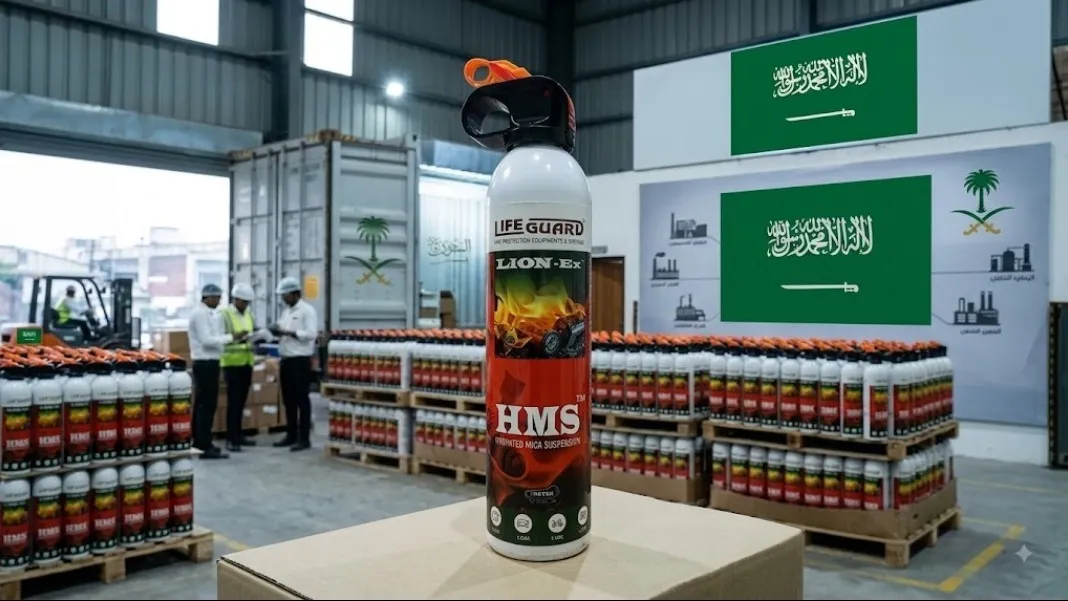
EV Battery Fire Protection System Provider Saudi Arabia
Advanced EV Battery Fire Protection Systems for Electric Mobility in Saudi Arabia
As Saudi Arabia accelerates its transition toward electric mobility, smart transportation, renewable energy and sustainable infrastructure, the requirement for specialized EV battery fire protection systems in Saudi Arabia is becoming increasingly important.
Electric vehicles rely heavily on high-energy-density lithium-ion battery packs. Although these batteries provide excellent performance, range and efficiency, they may present complex fire hazards in the event of overheating, electrical faults, mechanical damage, overcharging or internal cell failure. One of the most significant risks is thermal runaway, which can cause rapid temperature rise, flammable gas generation, fire propagation between cells and possible re-ignition.
LIFEGUARD® – United Fire Equipments Pvt. Ltd. provides engineered fire safety solutions for electric vehicles and lithium-ion battery applications and supports organizations looking for a reliable EV battery fire protection system provider in Saudi Arabia.
Our solutions can be developed for electric cars, electric buses, commercial EVs, battery packs, charging facilities, battery manufacturing plants, battery testing laboratories, battery warehouses and other lithium-ion battery applications.
Leading EV Battery Fire Protection System Provider Saudi Arabia
Lithium-ion battery fires require a different fire protection philosophy compared with many conventional vehicle or equipment fires.
Simply extinguishing visible flames may not be sufficient because heat can remain inside battery cells and potentially cause neighbouring cells to enter thermal runaway.
For this reason, an effective EV battery protection strategy may combine:
Early Detection + Alarm + Automatic Suppression + Cooling + Continuous Monitoring
LIFEGUARD® develops project-specific fire protection concepts based on the battery configuration, vehicle design, identified hazards and operational requirements.
Our EV battery fire protection solutions may incorporate:
- Heat detection
- Linear heat sensing cable
- Smoke detection
- Gas detection
- Temperature monitoring
- Multi-criteria detection
- Automatic fire suppression
- Battery cooling
- Targeted nozzle discharge
- Fire alarm
- Visual warning
- Manual release
- Control-panel integration
- Vehicle control integration
- Battery Management System interface
- System monitoring
Why EV Batteries Require Specialized Fire Protection
A typical EV battery pack contains multiple lithium-ion cells interconnected into modules and packs.
A problem in a single cell can potentially affect adjacent cells if sufficient heat is generated.
Battery incidents may originate from:
- Internal electrical short circuits
- External short circuits
- Overcharging
- Excessive discharge
- Battery overheating
- Manufacturing defects
- Mechanical impact
- Vehicle collision
- Battery crushing or penetration
- Charging equipment malfunction
- Cooling-system failure
- Battery Management System malfunction
- Exposure to external heat
These conditions can potentially initiate thermal runaway.
What Is Thermal Runaway in an EV Battery?
Thermal runaway is a self-sustaining process in which rising temperature inside a lithium-ion battery cell causes chemical reactions that produce additional heat.
As the reaction continues, a battery cell may:
- Heat rapidly
- Release smoke
- Vent gases
- Release flammable vapours
- Ignite
- Rupture
- Transfer heat to neighbouring cells
- Cause cell-to-cell propagation
- Involve multiple battery modules
- Re-ignite after initial fire control
Thermal runaway is therefore one of the main considerations when designing an EV battery fire protection system in Saudi Arabia.
LIFEGUARD® EV Battery Fire Protection Technology
An effective system may use multiple levels of protection depending on the application.
1. Early Heat Detection
Early detection can significantly reduce response time.
Heat detectors or temperature sensors can identify abnormal increases in temperature around battery compartments, electrical systems and high-risk areas.
Early temperature monitoring can allow alarms and predetermined safety actions to begin before conditions escalate.
2. Linear Heat Sensing Cable
Linear heat sensing technology can be installed along battery modules, battery enclosures and high-risk electrical areas.
Benefits may include:
- Continuous monitoring along the protected route
- Fast response to localized overheating
- Flexible installation
- Coverage around battery modules
- Suitability for compact equipment compartments
Linear heat sensing can be particularly valuable where point-type detection alone may not provide suitable localized monitoring.
3. Gas Detection
Lithium-ion batteries may release gases when cells begin to fail.
Depending on the application and battery chemistry, appropriate gas detection can provide another layer of early warning.
Gas monitoring can potentially detect abnormal battery conditions before a major visible fire develops.
4. Smoke Detection
Smoke detection may form part of the protection system where smoke from a developing incident can migrate into an appropriate detection area.
Smoke detectors may also be integrated with other technologies to create a multi-level fire detection strategy.
Automatic EV Battery Fire Suppression System
Once predetermined activation conditions are reached, the system can be configured to activate automatically.
A typical system may consist of:
- Fire suppression cylinder
- Fire suppression or cooling medium
- Cylinder valve assembly
- Pressure gauge
- Pressure switch
- Detection system
- Releasing control panel
- Distribution piping
- Stainless-steel tubing
- Flexible hoses
- Discharge nozzles
- Audible alarm
- Visual alarm
- Manual release arrangement
- Electrical interface
- Monitoring devices
Strategically positioned nozzles deliver the selected suppression medium toward identified battery hazard areas.
Battery Cooling and Thermal Runaway Mitigation
One of the greatest challenges associated with lithium-ion battery incidents is heat removal.
A battery cell may remain at a high temperature even after visible flames have been reduced.
An engineered battery fire protection system may therefore aim to:
- Control flames
- Reduce battery temperature
- Absorb heat
- Cool neighbouring modules
- Protect adjacent equipment
- Delay or limit thermal propagation
- Reduce the likelihood of further cell involvement
- Reduce re-ignition risk
- Support safer post-incident management
The appropriate suppression and cooling strategy depends on battery chemistry, battery construction, enclosure arrangement, detection time and the specific fire scenario.
EV Battery Fire Protection for Saudi Arabian Environmental Conditions
Electric vehicles and battery equipment operating in Saudi Arabia can be exposed to demanding environmental conditions.
Fire protection system design may therefore consider:
- High ambient temperatures
- Dust and sand
- Outdoor exposure
- Vehicle vibration
- Mechanical movement
- Long operating hours
- High-temperature parking conditions
- Battery compartment ventilation
- Equipment mounting requirements
- Maintenance accessibility
System components and installation arrangements should be selected according to the actual operational environment and technical specifications.
EV Battery Fire Protection for Electric Cars Saudi Arabia
Electric passenger vehicles commonly use high-capacity battery packs integrated into the vehicle floor or structural chassis.
A customized system can be developed after evaluating:
- Battery pack dimensions
- Battery chemistry
- Battery capacity
- Number of modules
- Battery enclosure
- Vehicle architecture
- Available mounting space
- Detection locations
- Cylinder location
- Nozzle positions
- Distribution tubing routes
Compact and lightweight solutions can be considered where installation space is limited.
Electric Bus Battery Fire Protection System Saudi Arabia
Electric buses typically use larger battery capacities than passenger cars and may contain several separate battery packs.
Battery installations can be:
- Roof mounted
- Underfloor mounted
- Rear mounted
- Compartment mounted
LIFEGUARD® can develop electric bus battery fire protection systems in Saudi Arabia with automatic detection and targeted suppression.
Protection can also be considered for:
- Battery compartments
- Power electronics
- High-voltage equipment
- Electrical control panels
- Charging equipment
- Auxiliary electrical compartments
- Motor control systems
EV Battery Fire Protection for Electric Trucks
Electric commercial vehicles may operate continuously and carry large battery capacities.
LIFEGUARD® fire protection solutions can be developed for:
- Electric trucks
- Electric delivery vans
- Logistics vehicles
- Municipal electric vehicles
- Utility EVs
- Industrial electric vehicles
- Special-purpose electric vehicles
System configuration can be tailored according to vehicle design and identified battery risk zones.
EV Fleet Fire Protection Solutions Saudi Arabia
Commercial fleet operators may require standardized fire protection arrangements across multiple electric vehicles.
Applications can include:
- Electric taxi fleets
- Electric bus fleets
- Delivery fleets
- Logistics fleets
- Municipal EV fleets
- Airport electric vehicle fleets
- Corporate EV fleets
- Industrial electric fleets
Where multiple vehicles use a common platform, standardized configurations can be evaluated after technical assessment.
EV Charging Station Fire Protection Saudi Arabia
As EV adoption grows, charging infrastructure will become an increasingly important element of electric transportation.
Fire safety solutions can be considered for:
- Public EV charging stations
- DC fast-charging stations
- Commercial charging hubs
- Shopping mall parking
- Underground parking
- Residential charging areas
- Fleet charging depots
- Electric bus depots
- Workplace charging stations
- Highway charging locations
A comprehensive fire safety strategy may include:
- Smoke detection
- Heat detection
- Gas monitoring
- Fire alarm
- Emergency shutdown
- Fire suppression
- Ventilation
- Emergency response procedures
EV Battery Manufacturing Plant Fire Protection
Battery manufacturing and assembly facilities can contain significant concentrations of lithium-ion cells and battery packs.
Potential high-risk locations include:
- Cell manufacturing areas
- Module assembly
- Battery pack assembly
- Charging stations
- Formation and cycling
- Battery testing
- Prototype laboratories
- Quality-control areas
- Battery storage
- Damaged battery isolation areas
Different hazard zones may require different fire detection and suppression approaches.
LIFEGUARD® can support project-specific engineering after reviewing the process and battery risk.
Lithium-Ion Battery Storage Fire Protection Saudi Arabia
Battery storage facilities require careful evaluation because fire behaviour can depend on:
- Battery chemistry
- Battery quantity
- Battery capacity
- State of charge
- Rack configuration
- Battery spacing
- Storage density
- Room volume
- Ventilation
- Fire compartmentation
- Detection response
- Emergency access
LIFEGUARD® can develop lithium-ion battery fire protection solutions in Saudi Arabia for industrial, commercial and infrastructure projects.
EV Battery Testing Laboratory Fire Protection
Battery research and testing laboratories may subject batteries to challenging operating conditions.
Potential applications include:
- Battery test chambers
- Charge/discharge testing
- Battery cycling
- Prototype battery testing
- Thermal testing
- R&D facilities
- Electrical testing
- Abuse testing areas
Specialized detection and suppression solutions can be developed according to the laboratory risk profile.
Main Components of an EV Battery Fire Protection System
Depending on the approved design, an EV battery fire protection system may incorporate:
- Fire suppression cylinder
- Suppression or cooling medium
- Cylinder valve
- Pressure gauge
- Pressure switch
- Linear heat sensing cable
- Temperature detector
- Heat detector
- Gas detector
- Smoke detector
- Multi-criteria detector
- Fire suppression control panel
- Manual release switch
- Audible alarm
- Visual alarm
- Stainless-steel piping
- Distribution tubing
- Flexible hose
- Discharge nozzles
- Electrical wiring
- Monitoring equipment
- Vehicle control interface
- Battery Management System interface
Final component selection should be based on the approved project design and application.
How an EV Battery Fire Protection System Works
A typical sequence can involve the following stages:
Stage 1 – Detection
Heat, smoke, gas or another predetermined indicator of abnormal battery behaviour is detected.
Stage 2 – Alarm
The system provides audible, visual or electronic warning signals.
Stage 3 – Automatic Activation
When the programmed release criteria are satisfied, the suppression system activates.
Stage 4 – Targeted Discharge
The selected suppression or cooling medium is discharged through strategically positioned nozzles.
Stage 5 – Fire Control and Cooling
The system assists in controlling flames and reducing heat around the affected battery area.
Stage 6 – Monitoring
The battery remains under observation because lithium-ion battery incidents may involve delayed thermal reactions or re-ignition.
Customized EV Battery Fire Protection Engineering
Every EV battery application is different.
Battery packs can vary according to:
- Lithium-ion chemistry
- Cell type
- Battery capacity
- Number of cells
- Number of modules
- Operating voltage
- Battery enclosure
- Cooling technology
- Vehicle architecture
- Installation location
- Available installation space
LIFEGUARD® therefore follows an application-specific engineering approach instead of using the same standard configuration for every battery project.
Information Required for Fire Protection System Design
Customers can provide the following information for technical evaluation:
- Vehicle drawings
- Battery pack drawings
- Battery chemistry
- Battery capacity
- Number of modules
- Number of battery packs
- Battery enclosure dimensions
- Battery compartment volume
- Battery installation location
- Operating temperature
- Maximum expected temperature
- Ventilation information
- Electrical drawings
- Available cylinder mounting space
- Detection requirements
- Suppression requirements
- Customer technical specifications
Based on these details, a suitable fire protection concept can be developed.
EV Battery Fire Protection System Provider for OEMs
LIFEGUARD® can support:
- Electric vehicle manufacturers
- Electric bus manufacturers
- Electric truck manufacturers
- Automotive OEMs
- Battery manufacturers
- Battery pack manufacturers
- Battery module manufacturers
- EV conversion companies
- Vehicle body builders
- Engineering consultants
- Fire protection contractors
- System integrators
- Charging infrastructure companies
- Fleet operators
Early involvement during product development can help integrate the fire protection system into the vehicle architecture more effectively.
OEM Integration of EV Battery Fire Protection Systems
During the vehicle design stage, provision can be made for:
- Cylinder mounting
- Detector positioning
- Heat sensing cable routing
- Nozzle positioning
- Distribution tubing
- Wiring
- Alarm connections
- Control interfaces
- Battery Management System integration
- Maintenance access
Integrating fire protection during vehicle development can simplify installation and improve serviceability.
Retrofit EV Battery Fire Protection Systems
Existing electric vehicles may also be evaluated for retrofit fire protection.
Important considerations include:
- Existing battery enclosure
- Battery accessibility
- Available cylinder space
- Detection cable routing
- Nozzle positions
- Distribution tubing
- Electrical power availability
- Vehicle control interfaces
- Maintenance accessibility
A retrofit solution can then be developed according to the existing vehicle configuration.
EV Battery Thermal Runaway Protection Saudi Arabia
Thermal runaway is one of the major hazards associated with lithium-ion batteries.
If sufficient heat transfers from one failing battery cell to neighbouring cells, the event can propagate through the module or battery pack.
An effective protection philosophy may follow:
Detect → Alarm → Activate → Suppress/Cool → Monitor
Early detection and rapid intervention can help reduce the possibility of further escalation.
Benefits of LIFEGUARD® EV Battery Fire Protection Systems
Customers searching for an EV battery fire protection system provider Saudi Arabia can benefit from:
- Application-specific engineering
- Early heat detection
- Linear heat sensing
- Automatic suppression
- Rapid activation
- Targeted nozzle discharge
- Battery cooling solutions
- Thermal runaway mitigation approach
- Compact system configuration
- Flexible piping and tubing
- Alarm integration
- Control-system integration
- Vehicle integration
- OEM technical support
- Project-specific documentation
- Installation guidance
- Testing assistance
- Maintenance support
Applications of EV Battery Fire Protection Systems
LIFEGUARD® solutions can be considered for:
- Electric passenger cars
- Electric buses
- Electric trucks
- Electric vans
- Electric commercial vehicles
- Electric fleet vehicles
- Battery compartments
- Lithium-ion battery packs
- Battery manufacturing plants
- Battery assembly facilities
- Battery test laboratories
- EV charging stations
- Fleet charging depots
- Battery storage rooms
- Battery warehouses
- Battery recycling facilities
- Research facilities
- Energy storage applications
Industries Served in Saudi Arabia
Our battery fire protection solutions can support:
- Automotive
- Electric mobility
- Public transportation
- Battery manufacturing
- Logistics
- Fleet operations
- Industrial manufacturing
- Renewable energy
- Charging infrastructure
- Battery research
- Warehousing
- Engineering
- Testing laboratories
- Energy storage projects
Why Choose LIFEGUARD® as an EV Battery Fire Protection System Provider?
LIFEGUARD® follows an engineering-oriented approach to battery fire protection.
Our project process can include:
- Review of battery specifications
- Study of vehicle or equipment layout
- Identification of high-risk battery locations
- Selection of detection technology
- Development of suppression strategy
- Selection of suitable system components
- Cylinder location planning
- Distribution piping and tubing design
- Nozzle layout optimization
- Alarm and control-system integration
- Technical documentation
- Installation guidance and testing support
This enables LIFEGUARD® to provide customized solutions for customers looking for a professional EV battery fire protection system provider in Saudi Arabia.
EV Battery Fire Suppression System Provider Saudi Arabia
LIFEGUARD® can develop project-specific fire suppression systems for electric vehicles and lithium-ion battery applications.
Depending on the identified hazard, systems can combine detection, automatic activation and targeted suppression or cooling.
This approach helps address battery fire risks while taking vehicle design, battery configuration and installation limitations into account.
EV Battery Fire Protection Solutions for Saudi Arabian Projects
LIFEGUARD® can support battery fire protection requirements associated with:
- Electric mobility projects
- Electric public transportation
- EV fleet development
- Battery manufacturing
- Charging infrastructure
- Industrial applications
- Battery storage
- Battery testing
- Renewable energy
- Energy storage projects
We can work with OEMs, engineering consultants, EPC contractors, system integrators and fleet operators on project-specific requirements.
Frequently Asked Questions
What is an EV battery fire protection system?
An EV battery fire protection system is an engineered combination of detection, alarm, suppression, cooling and monitoring technologies intended to address identified lithium-ion battery fire hazards.
Why do EV batteries require specialized fire protection?
Lithium-ion batteries can experience thermal runaway, intense heat generation, gas release, cell-to-cell propagation and possible re-ignition.
Can EV battery fire protection systems operate automatically?
Yes. Depending on the approved system configuration, detection devices can initiate alarms and automatic fire suppression.
Can the system be customized for electric buses?
Yes. Systems can be engineered according to battery location, battery capacity, bus architecture and available installation space.
Can EV battery fire protection be installed as a retrofit?
Retrofit solutions can be evaluated for existing electric vehicles where suitable mounting locations and access are available.
Can LIFEGUARD® provide solutions for EV charging facilities?
Yes. Project-specific detection and fire suppression arrangements can be evaluated for EV charging facilities, fleet depots and parking applications.
Can lithium-ion battery storage facilities be protected?
Yes. Fire protection concepts can be developed after evaluating battery chemistry, quantity, state of charge, storage configuration and building conditions.
Contact LIFEGUARD®
For electric vehicle manufacturers, battery manufacturers, fleet operators, engineering consultants, EPC contractors and project developers searching for an EV battery fire protection system provider in Saudi Arabia, contact LIFEGUARD® for project-specific technical assistance.
LIFEGUARD®
United Fire Equipments Pvt. Ltd.
Manufacturer of ISI Certified Fire Safety Equipment
📞 8048034226
📧 ufe126@gmail.com | info@lifeguardindia.in
Share your vehicle drawings, battery specifications, battery compartment dimensions and technical requirements with our engineering team for evaluation and a suitable fire protection system proposal.
Recommended SEO Keywords
Primary Keyword:
EV battery fire protection system provider Saudi Arabia
Secondary Keywords:
EV battery fire protection Saudi Arabia, EV battery fire protection provider Saudi Arabia, EV battery fire suppression system Saudi Arabia, EV battery fire suppression system provider Saudi Arabia, lithium-ion battery fire protection Saudi Arabia, electric vehicle battery fire protection Saudi Arabia, electric bus battery fire protection Saudi Arabia, EV battery thermal runaway protection Saudi Arabia, lithium battery fire suppression Saudi Arabia, EV fire protection company Saudi Arabia, EV battery fire safety system Saudi Arabia, battery fire protection solutions Saudi Arabia.
Suggested Meta Title
EV Battery Fire Protection System Provider Saudi Arabia | LIFEGUARD®
Suggested Meta Description
LIFEGUARD® provides engineered EV battery fire protection systems in Saudi Arabia for electric cars, buses, commercial EVs and lithium-ion battery applications, with early detection, automatic suppression, cooling and thermal runaway mitigation solutions.
Suggested URL Slug
/ev-battery-fire-protection-system-provider-saudi-arabia/
Keywords