
https://updates.lifeguardindia.in/products/lg-611a-wsm-200-kg-with-collar-cable/13
University Automatic Suppression Company Africa
Advanced Automatic Fire Suppression Solutions for Universities & Educational Campuses Across Africa
Universities are complex environments where thousands of students, faculty members, researchers, staff and visitors use multiple buildings and facilities every day. Modern university campuses can include academic blocks, laboratories, libraries, research centres, data centres, server rooms, electrical rooms, workshops, commercial kitchens, auditoriums, hostels, administrative offices and specialised infrastructure.
Each facility can present a different fire risk and therefore requires a carefully considered fire protection strategy.
LIFEGUARD® is an Indian fire safety equipment OEM and automatic fire suppression solutions company supporting institutional, commercial, industrial and infrastructure fire protection requirements. LIFEGUARD® provides application-focused fire safety equipment and specialised suppression solutions for universities, colleges, laboratories, research facilities and educational campuses.
For African university projects, LIFEGUARD® can support requirements involving automatic fire suppression systems, clean-agent suppression, water mist, kitchen fire suppression, electrical fire protection, lithium-ion battery fire safety and portable firefighting equipment, subject to project specifications, applicable standards and local authority requirements.
University Automatic Fire Suppression Solutions Africa
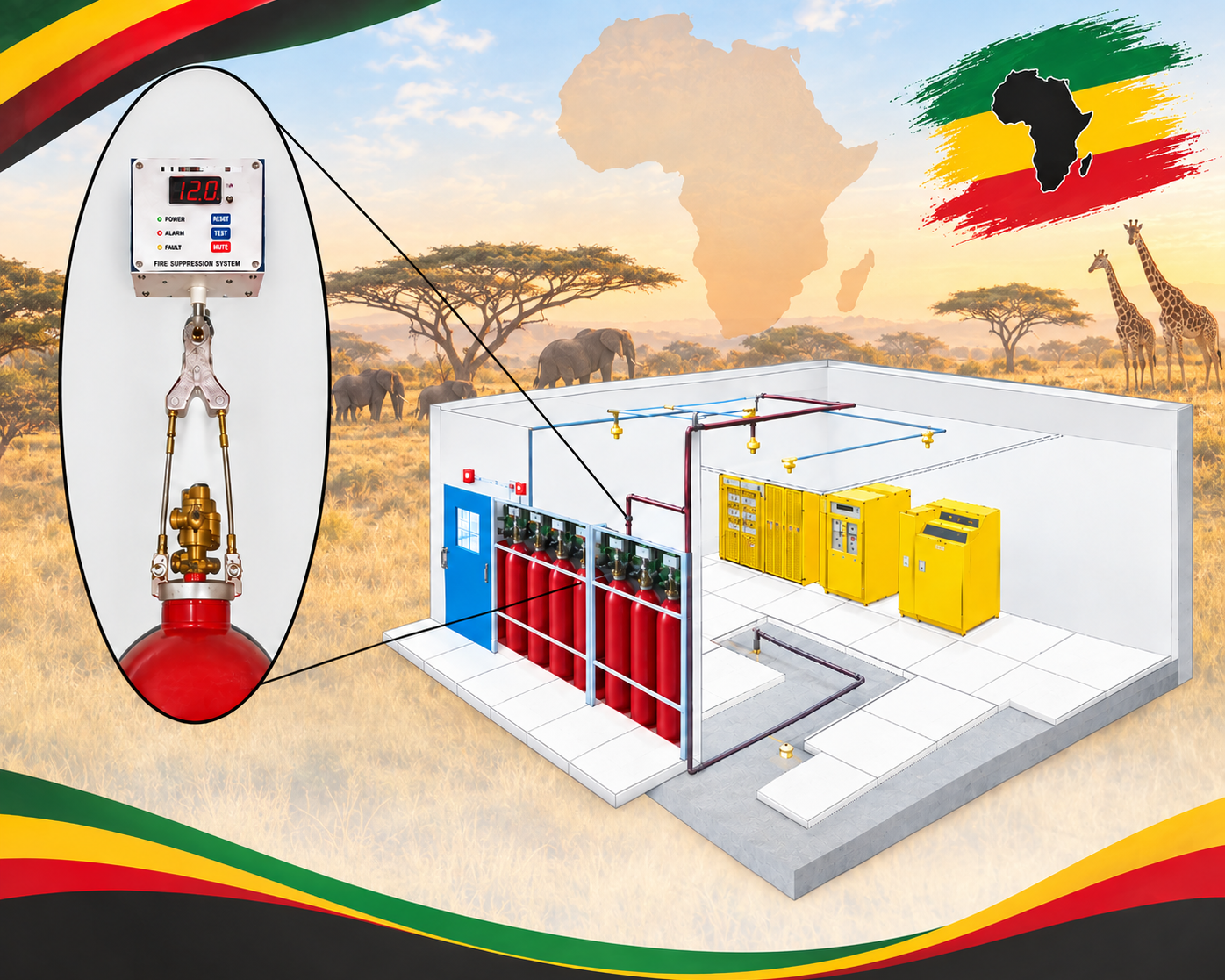
An automatic fire suppression system is designed to respond to a developing fire through automatic detection, activation and discharge of an appropriate extinguishing medium.
Depending on the application, a system may include:
- Automatic smoke or heat detection
- Fire alarm and releasing panel
- Suppression cylinders
- Extinguishing agent
- Distribution piping
- Discharge nozzles
- Manual release station
- Abort switch where applicable
- Audible and visual alarms
- Pre-discharge warning
- HVAC shutdown
- Electrical interlocks
- Equipment shutdown
- Fire alarm integration
- Building management system interfaces
The appropriate system should be selected after evaluating the protected area, occupancy, fire load, equipment, ventilation, enclosure and applicable local requirements.
Why Universities Need Automatic Fire Suppression
A university is not a single fire-risk environment.
A classroom may primarily involve ordinary combustibles, while a chemistry laboratory may contain chemicals and solvents. A data centre contains sensitive electronic equipment, whereas a commercial kitchen presents cooking-oil and high-temperature hazards.
Automatic fire suppression can provide additional protection for critical areas by enabling a rapid response without relying entirely on manual intervention.
A comprehensive university fire protection strategy can combine:
Fire Prevention → Detection → Alarm → Automatic Suppression → Emergency Response → Inspection & Maintenance
Automatic suppression can help:
- Control developing fires
- Protect critical infrastructure
- Reduce potential equipment damage
- Support safe evacuation
- Protect research facilities
- Protect data and communication infrastructure
- Reduce operational interruption
- Provide additional protection in normally unattended areas
Automatic suppression should complement—not replace—appropriate fire detection, alarm, evacuation procedures, portable extinguishers and trained emergency personnel.
University Fire Suppression Company Serving Africa
LIFEGUARD® provides fire safety equipment and specialised suppression solutions for African project requirements.
Our solutions can support:
Educational Campuses
- Universities
- Colleges
- Technical institutes
- Research institutions
- Training centres
- Educational laboratories
Critical Facilities
- Data centres
- Server rooms
- Electrical rooms
- UPS rooms
- Communication rooms
- Control rooms
Specialised Facilities
- Chemistry laboratories
- Engineering workshops
- Battery laboratories
- Research centres
- Commercial kitchens
- Archives and libraries
Clean Agent Fire Suppression for University Data Centres
University data centres and server rooms contain valuable electronic infrastructure that supports academic, administrative and research activities.
Typical equipment includes:
- Servers
- Network switches
- Storage systems
- UPS equipment
- Communication equipment
- Battery systems
- Control equipment
For suitable enclosed environments, clean-agent suppression can provide an alternative to conventional water discharge.
A typical engineered system can operate through:
Detection → Alarm → Pre-Discharge Warning → HVAC Shutdown → Equipment Interlock → Agent Release
LIFEGUARD® supports clean-agent fire suppression applications for critical electronic environments, subject to system design and project requirements.
Potential applications include:
- University data centres
- Server rooms
- Network rooms
- IT rooms
- Communication rooms
- Control rooms
- CCTV rooms
- Digital archive facilities
University Laboratory Automatic Suppression Systems Africa
University laboratories can present specialised fire hazards because they may contain:
- Chemicals
- Flammable liquids
- Compressed gases
- Electrical equipment
- Heating equipment
- Research apparatus
- Batteries
- Laboratory machinery
Different laboratories require different protection strategies.
LIFEGUARD® can support application-specific fire protection for:
Chemistry Laboratories
Protection considerations for chemicals, solvents and laboratory equipment.
Physics Laboratories
Fire protection for electrical and experimental equipment.
Engineering Laboratories
Protection for machinery, electrical systems and technical equipment.
Electronics Laboratories
Protection for sensitive electronic and electrical equipment.
Battery Research Laboratories
Specialised fire safety for lithium-ion and other battery technologies.
Research Centres
Application-specific protection for valuable research infrastructure.
The extinguishing agent must be compatible with the hazard and selected according to appropriate engineering criteria.
Automatic Kitchen Fire Suppression for Universities
University kitchens, cafeterias and dining facilities can contain significant cooking-related hazards.
Potential fire risks include:
- Cooking oils
- Deep-fat fryers
- Griddles
- Gas appliances
- Electrical cooking equipment
- Hot surfaces
- Grease deposits
- Exhaust hoods and ducts
An automatic kitchen suppression system can be designed to protect:
- Cooking appliances
- Fryers
- Griddles
- Hoods
- Filters
- Exhaust ducts
Depending on the system design, activation can also be integrated with:
- Gas shut-off
- Electrical shutdown
- Kitchen exhaust controls
- Fire alarm systems
This creates a coordinated response to a developing kitchen fire.
University Electrical Room Fire Suppression
Electrical infrastructure is essential to university operations.
Potential high-risk areas include:
- Electrical rooms
- Switchgear rooms
- HT/LT rooms
- UPS rooms
- Battery rooms
- Transformer areas
- Control rooms
- Power distribution rooms
- Generator rooms
Fire protection may incorporate:
- Smoke detection
- Heat detection
- Automatic suppression
- Suitable portable extinguishers
- Alarm integration
- Electrical shutdown
- HVAC interlock
The appropriate technology depends on the equipment, enclosure and fire hazard.
Automatic Suppression for University Libraries & Archives
Libraries and archives contain books, paper, documents, furniture and valuable academic records.
Special collections may also include:
- Historical documents
- Manuscripts
- Research records
- Rare books
- Digital archives
- University records
Fire protection may include:
Early Detection + Fire Alarm + Portable Extinguishers + Automatic Suppression + Compartmentation
For sensitive collections, suppression technology should be carefully selected to balance fire control with protection of valuable contents.
University Hostel Fire Safety & Suppression
University hostels and student residences have significant life-safety considerations because buildings can remain occupied around the clock.
Fire protection may include:
- Automatic fire detection
- Fire alarm systems
- Manual call points
- Portable extinguishers
- Hose reels
- Hydrants
- Automatic sprinklers where required
- Emergency lighting
- Fire doors
- Compartmentation
- Emergency evacuation systems
Automatic suppression requirements should be determined based on the building's occupancy, size, height, construction and applicable national/local requirements.
Water Mist Fire Suppression for Universities
Water mist systems produce finely divided water droplets designed to provide effective cooling and fire-control characteristics for appropriate applications.
Water mist can be considered for selected university facilities such as:
- Laboratories
- Electrical areas
- Machinery rooms
- Technical workshops
- Research facilities
- Specialised equipment rooms
The system should be engineered for the specific hazard rather than treating water mist as a universal replacement for sprinkler, clean-agent or other suppression technologies.
Automatic Sprinkler Systems for University Campuses
Water-based fire protection remains an important part of many university fire safety strategies.
Depending on project requirements, systems may include:
- Automatic sprinklers
- Fire hydrants
- Wet risers
- Hose reels
- Fire pumps
- Fire water tanks
- Fire brigade connections
- Water spray systems
In South Africa, SANS 10400-T addresses fire protection and includes provisions concerning automatic sprinkler and other fixed extinguishing systems. The standard also requires competent-person design for certain automatic fire protection systems.
This illustrates why African projects should be designed according to the specific country's regulations and the authority having jurisdiction, rather than applying one generic compliance statement across the continent.
Lithium-Ion Battery Fire Safety for Universities
Universities are increasingly involved in electric mobility, battery research, robotics and energy-storage projects.
Potential applications include:
- EV charging facilities
- Electric campus vehicles
- Battery laboratories
- UPS battery rooms
- Battery energy-storage systems
- Robotics laboratories
- Research and testing facilities
LIFEGUARD® provides specialised fire safety solutions for lithium-ion battery and energy-storage applications.
Battery fire protection should consider:
- Battery chemistry
- Energy capacity
- Installation configuration
- Thermal runaway risk
- Enclosure
- Ventilation
- Detection
- Suppression method
- Applicable testing requirements
Automatic Fire Suppression for University Workshops
Engineering and technical universities may operate workshops containing:
- Welding equipment
- Cutting equipment
- Machinery
- Lubricants
- Fuels
- Electrical tools
- Compressed gases
- Flammable materials
Fire protection can incorporate:
- ABC/DCP extinguishers
- CO₂ extinguishers
- Foam extinguishers
- Water mist
- Automatic suppression
- Fire detection
- Emergency shutdown systems
- Special-hazard protection
The final system should be based on a documented assessment of the workshop's activities and fire hazards.
Electrical Panel & Local Application Suppression
Some university facilities contain individual electrical panels or equipment enclosures that represent localised fire risks.
Automatic local suppression can be considered for selected:
- Electrical panels
- Distribution boards
- Control cabinets
- UPS cabinets
- Generator control panels
- Solar inverter panels
- Battery enclosures
- Equipment cabinets
Compact systems can provide targeted protection where a complete room-level suppression system may not be necessary.
The extinguishing medium and activation method should be selected according to the enclosure, equipment and hazard.
University Fire Detection & Suppression Integration
Automatic suppression should be integrated with fire detection and alarm systems.
A typical sequence can include:
Stage 1 – Detection
A smoke, heat or other appropriate detector identifies a developing fire.
Stage 2 – Alarm
The system provides audible and/or visual warning.
Stage 3 – Pre-Discharge
Where required, occupants receive a warning before suppression discharge.
Stage 4 – Interlock
HVAC, electrical equipment or other services may be shut down according to the approved sequence.
Stage 5 – Suppression
The extinguishing agent is released.
Stage 6 – Monitoring
System status, alarms and faults can be monitored through the appropriate control interface.
This integrated approach helps coordinate fire detection, suppression and building services.
African University Fire Protection Markets
LIFEGUARD® can support enquiries and project requirements across multiple African markets, including:
- South Africa
- Nigeria
- Kenya
- Ghana
- Tanzania
- Uganda
- Ethiopia
- Rwanda
- Zambia
- Zimbabwe
- Botswana
- Namibia
- Mozambique
- Mauritius
- Egypt
- Morocco
- Algeria
- Tunisia
- Senegal
- Côte d'Ivoire
- Cameroon
- Angola
Country-specific fire regulations, product approvals, installation requirements and authority procedures should be confirmed for every project.
Fire Safety Compliance Across Africa
Africa is a diverse market with different national regulations and authority requirements.
A university fire suppression project may need to consider:
- National building regulations
- National fire codes
- Local authority requirements
- Fire brigade requirements
- Applicable NFPA standards
- Applicable EN standards
- National standards
- Product certification
- System listing/approval
- Competent-person design
- Inspection and commissioning
- Maintenance requirements
For example, South African fire-protection requirements under SANS 10400-T cover fire detection, firefighting equipment, hydrants, sprinklers and fixed extinguishing systems.
Nigeria's building-code materials also contain provisions relating to automatic fire detection and approval of detection systems for particular applications.
Therefore, LIFEGUARD® recommends country-specific technical and regulatory review before finalising any university fire suppression design.
University Automatic Suppression Company South Africa
South African universities can involve large campuses containing academic buildings, student accommodation, laboratories, libraries, data centres and research infrastructure.
Fire protection planning may reference applicable SANS standards and local authority requirements.
SANS 10400-T establishes broad fire-protection objectives including occupant protection, limiting fire spread, controlling smoke and providing suitable fire detection and firefighting equipment.
LIFEGUARD® can support South African project enquiries involving:
- Clean-agent suppression
- Automatic suppression
- Water mist
- Fire extinguishers
- Laboratory fire protection
- Data-centre protection
- Kitchen suppression
- Battery fire safety
University Automatic Suppression Company Nigeria
Nigerian university campuses can include extensive academic, residential and research infrastructure.
Potential fire protection applications include:
- Laboratories
- Server rooms
- Libraries
- Electrical rooms
- Hostels
- Kitchens
- Workshops
- Data centres
LIFEGUARD® can support project teams with application-specific automatic suppression and fire safety equipment.
Final system design should be reviewed against applicable Nigerian regulations, project specifications and authority requirements.
University Automatic Suppression Company Kenya
Universities in Kenya can require fire protection for:
- Academic buildings
- Laboratories
- Libraries
- Data centres
- Student accommodation
- Kitchens
- Workshops
- Electrical infrastructure
LIFEGUARD® can support university fire protection requirements through automatic suppression technologies and associated fire safety equipment.
University Automatic Suppression Company Ghana
University facilities in Ghana can include academic buildings, research centres, laboratories, hostels, libraries and administrative infrastructure.
LIFEGUARD® provides application-focused fire protection solutions for such environments, subject to project requirements and applicable Ghanaian regulations.
University Automatic Suppression Company East Africa
For university projects across East Africa, LIFEGUARD® can support requirements involving:
- Kenya
- Tanzania
- Uganda
- Rwanda
- Ethiopia
Potential applications include:
Laboratories | Data Centres | Server Rooms | Kitchens | Libraries | Hostels | Electrical Rooms | Research Centres | Workshops
LIFEGUARD® – OEM Fire Safety Equipment & Suppression Solutions
LIFEGUARD® is an Indian fire safety equipment OEM manufacturer with manufacturing experience dating back to 1991.
The product and solution portfolio includes:
Fire Extinguishing Equipment
- ABC DCP fire extinguishers
- MAP extinguishers
- CO₂ extinguishers
- Water-based extinguishers
- Foam extinguishers
- Water mist extinguishers
- Wheeled fire extinguishers
Specialised Fire Suppression
- Clean-agent suppression
- Kitchen suppression
- Water mist
- Special-hazard suppression
- Lithium-ion battery fire safety
- Electrical equipment suppression
Fire Protection Integration
- Fire detection
- Fire alarm
- Suppression release
- Hydrant integration
- Sprinkler integration
- Equipment interlocks
- Testing and commissioning support
Why Choose LIFEGUARD® for University Fire Protection?
OEM Manufacturing Experience
LIFEGUARD® combines manufacturing capabilities with application-specific fire protection expertise.
Wide Product Portfolio
The portfolio covers portable firefighting equipment and specialised suppression technologies.
Application-Specific Solutions
Different university facilities require different fire protection approaches.
Special Hazard Expertise
Solutions can be considered for:
- Laboratories
- Data centres
- Electrical rooms
- Kitchens
- Battery facilities
- Research facilities
International Project Support
LIFEGUARD® can support project enquiries for African markets through international supply and technical coordination, subject to project scope and local requirements.
Technical Support
Project support can include product selection, technical coordination, documentation, installation guidance, testing and commissioning support depending on the agreed scope.
University Fire Suppression System Application Matrix
University FacilityPotential Fire Protection SolutionClassroomsFire detection, alarm & portable extinguishersLaboratoriesHazard-specific detection & suppressionData CentresEarly detection & clean-agent suppressionServer RoomsClean-agent suppressionElectrical RoomsDetection & suitable suppressionLibrariesDetection & appropriate suppressionArchivesEarly detection & asset-sensitive suppressionKitchensAutomatic kitchen suppressionHostelsDetection, alarm & building fire protectionWorkshopsHazard-specific extinguishing systemsUPS RoomsDetection & specialised suppressionBattery RoomsBattery-specific fire protectionEV Charging AreasEV/battery fire safetyResearch CentresSpecial-hazard protectionAuditoriumsDetection, alarm & building fire protectionEnd-to-End University Fire Suppression Approach
LIFEGUARD® can support university projects through a structured fire protection approach:
1. Risk Assessment
Understand the building, occupancy, equipment and hazards.
2. Hazard Classification
Identify ordinary, electrical, chemical, cooking, battery or special hazards.
3. System Selection
Select the appropriate suppression technology.
4. Engineering
Develop detection, suppression, piping, nozzle and control arrangements.
5. Equipment Supply
Provide the specified fire safety equipment and system components.
6. Installation
Install according to approved drawings and manufacturer requirements.
7. Testing
Verify detection, alarm, release, interlocks and system functionality.
8. Commissioning
Confirm the complete system sequence of operation.
9. Handover
Provide relevant documentation and operating instructions.
10. Maintenance
Implement periodic inspection, testing and maintenance.
Frequently Asked Questions
Who is a university automatic suppression company in Africa?
LIFEGUARD® is an Indian fire safety equipment OEM and automatic fire suppression solutions provider supporting university, educational and institutional fire protection projects for African markets.
Which automatic fire suppression system is suitable for universities?
There is no single system suitable for every university facility. Clean-agent suppression may be appropriate for selected data centres and server rooms, kitchen suppression for commercial kitchens, sprinklers for suitable building applications and specialised systems for laboratories and other hazards.
Can LIFEGUARD® supply automatic fire suppression systems to Africa?
LIFEGUARD® can support international project enquiries and supply requirements for African markets, subject to project scope, logistics, applicable standards and local authority requirements.
Can LIFEGUARD® protect university laboratories?
Yes. Laboratory fire protection can be developed around the chemicals, equipment, processes, occupancy and fire hazards present.
Does LIFEGUARD® provide clean-agent suppression for university data centres?
Yes. LIFEGUARD® supports clean-agent fire suppression applications for suitable electronic and critical infrastructure environments.
Can university kitchens use automatic fire suppression?
Yes. Dedicated kitchen suppression systems can protect cooking appliances, hoods and exhaust arrangements when properly designed for the installation.
Does LIFEGUARD® provide lithium-ion battery fire safety?
Yes. LIFEGUARD® provides specialised fire safety solutions for lithium-ion battery, EV and energy-storage applications.
Is the same fire suppression system suitable for all African countries?
No. Fire safety regulations, standards, authority requirements and approval processes vary by country and project. The system should be reviewed against the applicable local requirements.
Partner with LIFEGUARD® for University Fire Protection in Africa
Universities require fire protection solutions capable of addressing both conventional building hazards and specialised risks associated with laboratories, data centres, electrical infrastructure, kitchens, workshops and battery systems.
LIFEGUARD® combines OEM manufacturing experience, specialised fire suppression technologies and application-focused fire protection capabilities to support university projects across African markets.
From academic buildings and laboratories to data centres, libraries, kitchens and student accommodation, LIFEGUARD® can support the development of a comprehensive fire protection strategy.
LIFEGUARD® – University Automatic Fire Suppression Solutions Africa
Fire Safety Equipment OEM | Automatic Fire Suppression | Specialised Fire Protection | System Integration
For university automatic suppression requirements across Africa:
Email: ufe126@gmail.com | info@lifeguardindia.in
Website: www.lifeguardindia.in
Keywords





