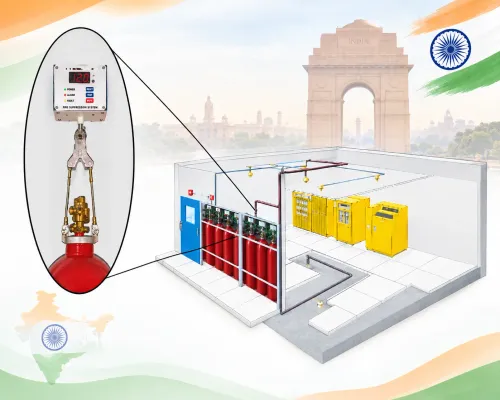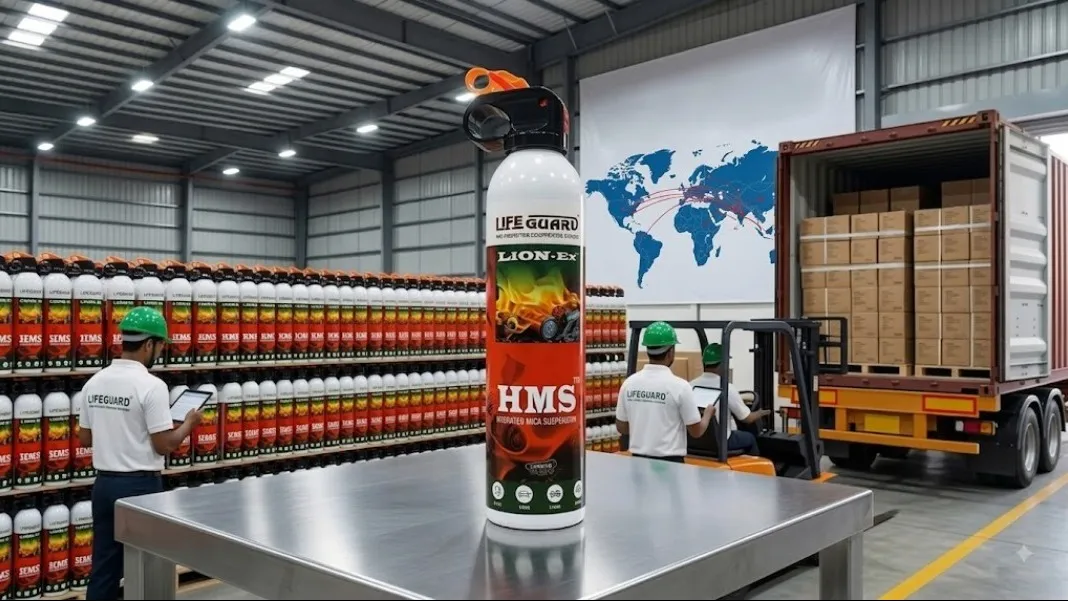
EV Battery Fire Safety Exporter India
Advanced Lithium-Ion Battery Fire Protection Solutions for Global EV & Battery Applications
The rapid global transition toward electric mobility has increased the demand for reliable, application-specific fire safety solutions for lithium-ion batteries. Electric cars, electric buses, commercial EVs, battery storage systems, charging stations, battery swapping facilities and lithium-ion battery manufacturing plants all require specialized protection against the unique risks associated with battery fires and thermal runaway.
LIFEGUARD® – United Fire Equipments Pvt. Ltd. provides engineered EV battery fire protection solutions and serves customers seeking an EV Battery Fire Safety Exporter from India.
Our solutions are designed around early detection, automatic suppression, cooling, alarm generation, emergency isolation and control of thermal runaway propagation. Systems can be customized according to battery chemistry, battery capacity, enclosure design, vehicle configuration and project requirements.
EV Battery Fire Safety Exporter India
Export customers require more than a conventional fire extinguisher supplier. EV battery applications often require an integrated approach combining detection, suppression and engineering.
LIFEGUARD® can provide customized solutions incorporating:
- Early temperature detection
- Linear heat sensing
- Smoke detection
- Gas detection
- Multi-criteria detection
- Thermal runaway monitoring
- Automatic fire suppression
- Battery compartment protection
- Local application suppression
- Cooling arrangements
- Manual emergency activation
- Fire alarm and releasing controls
- Audible and visual alarms
- Emergency electrical isolation
- BMS integration
- Distribution piping and tubing
- Engineered nozzle arrangements
- Customized OEM configurations
The final system is developed according to the risk profile of the protected battery installation.
Why Lithium-Ion Batteries Require Specialized Fire Safety
Lithium-ion batteries are widely used because of their:
- High energy density
- Rechargeability
- Compact dimensions
- Relatively low weight
- High performance
- Suitability for electric mobility
However, battery cells may become hazardous when exposed to electrical, thermal or mechanical abuse.
Potential causes of battery failure include:
- Internal short circuit
- Overcharging
- Excessive temperature
- Mechanical impact
- Vehicle collision
- Manufacturing defects
- Improper charging
- Battery cooling system failure
- Electrical system malfunction
- Physical deformation
- External fire exposure
- Battery Management System failure
A severe battery fault may result in thermal runaway, which can produce intense heat, gases, fire and propagation to neighbouring cells.
Understanding Thermal Runaway in EV Batteries
Thermal runaway occurs when the internal temperature of a battery cell rises uncontrollably and causes further heat-generating chemical reactions.
Once initiated, the process can become self-sustaining.
A thermal runaway event may result in:
- Rapid temperature escalation
- Smoke generation
- Battery venting
- Flammable gas release
- Toxic gas release
- Cell rupture
- Fire
- Cell-to-cell propagation
- Module-to-module propagation
- Re-ignition
- Damage to surrounding equipment
This is why modern EV battery safety strategies should consider more than flame extinguishment.
A comprehensive approach may involve:
Early Detection + Suppression + Cooling + Isolation + Propagation Control
Early Detection for EV Battery Fire Safety
Detecting abnormal battery conditions at an early stage can provide valuable time for alarms, equipment shutdown and fire suppression activation.
Potential warning conditions may include:
- Unusual temperature increase
- Localized overheating
- Smoke
- Off-gas generation
- Electrical abnormalities
- Battery management alarms
Different detection technologies may be considered according to the protected application.
Heat Detection
Heat detectors and temperature sensors can monitor:
- Battery packs
- Battery modules
- Battery enclosures
- Charging cabinets
- Battery racks
- EV compartments
Abnormal temperature rise can be used as an input for alarm or suppression logic.
Linear Heat Sensing
Linear Heat Sensing technology can provide continuous temperature monitoring across extended or difficult-to-access areas.
Applications may include:
- Electric bus battery compartments
- Lithium-ion battery racks
- Battery cabinets
- EV battery enclosures
- Charging facilities
- Battery warehouses
- Industrial battery installations
Smoke Detection
Suitable smoke detectors may be used in enclosed applications such as:
- Battery storage areas
- Charging rooms
- Battery laboratories
- Manufacturing facilities
- Battery rooms
Selection should take environmental conditions into consideration.
Aspirating Smoke Detection
High-sensitivity aspirating smoke detection systems can provide early warning for critical battery installations.
They can be considered for:
- Battery testing laboratories
- High-value facilities
- Battery storage areas
- Industrial battery rooms
- Research facilities
Gas Detection
Lithium-ion battery cells may release gases during certain stages of failure.
Suitable gas monitoring can therefore be incorporated into an early-warning strategy where technically appropriate.
Automatic EV Battery Fire Suppression System
An automatic fire suppression system can provide rapid intervention after a confirmed fire or abnormal condition.
A typical engineered solution may include:
- Detection sensors
- Releasing control unit
- Suppression agent storage
- Cylinder assembly
- Cylinder valve
- Solenoid actuator
- Distribution piping or tubing
- Discharge nozzles
- Manual release
- Pressure monitoring
- Alarm outputs
- Shutdown signals
- Vehicle or BMS interfaces
The design can be configured for a single battery compartment or multiple protection zones.
EV Battery Cooling & Thermal Runaway Control
One of the principal challenges in lithium-ion battery incidents is continued heat generation.
Even after flames are controlled, a damaged battery cell may remain at an elevated temperature.
Cooling can help:
- Reduce battery temperature
- Limit heat transfer
- Slow thermal propagation
- Protect adjacent cells
- Protect surrounding equipment
- Reduce the possibility of re-ignition
For this reason, cooling requirements should form part of the engineering assessment for EV battery fire safety.
EV Battery Compartment Fire Protection
Battery compartments can be difficult to protect because of restricted space, limited accessibility and complex internal geometry.
A suitable protection system should evaluate:
- Battery enclosure dimensions
- Battery module arrangement
- Internal obstructions
- Airflow
- Ventilation openings
- Detector positions
- Nozzle locations
- Piping or tubing routes
- Agent distribution
- Cooling requirements
Customized engineering can help direct fire protection toward the actual battery hazard.
EV Battery Fire Safety for Electric Cars
Modern electric passenger vehicles generally contain high-capacity lithium-ion battery packs located underneath the floor or inside structural enclosures.
Fire safety arrangements may include:
- Temperature monitoring
- Gas detection
- Battery compartment detection
- Automatic suppression
- Localized cooling
- Driver warning
- Manual activation
- Electrical isolation
- Vehicle control system interface
LIFEGUARD® can support EV manufacturers, integrators and developers requiring customized fire safety solutions.
Electric Bus Battery Fire Safety
Electric buses may contain multiple high-capacity battery modules.
Battery packs may be installed:
- On the roof
- Below the floor
- At the rear
- Within dedicated side enclosures
These applications may require separate detection and suppression zones.
Important design parameters include:
- Battery capacity
- Number of battery packs
- Enclosure dimensions
- Vehicle layout
- Ambient conditions
- Vibration
- Dust exposure
- Ventilation
- Equipment mounting locations
LIFEGUARD® can provide customized solutions for electric bus applications.
Electric Truck Battery Fire Safety
Electric trucks and heavy commercial EVs may operate under challenging conditions such as:
- High loads
- Extended operating hours
- High temperatures
- Vibration
- Dust
- Mechanical impact
- Multiple battery compartments
Fire safety arrangements can be engineered according to the individual vehicle and battery configuration.
Electric Two-Wheeler Battery Fire Safety
Electric scooters and motorcycles often contain compact lithium-ion battery packs with limited space available for fire safety equipment.
Battery packs may be positioned:
- Under the seat
- Below the footboard
- Within the frame
- In removable battery compartments
Compact fire detection and suppression arrangements can be developed according to OEM requirements.
Electric Three-Wheeler Battery Fire Safety
Electric three-wheelers are extensively used for passenger transport and commercial applications.
Battery protection measures can include:
- Temperature monitoring
- Battery enclosure protection
- Charging safety
- Fire detection
- Automatic suppression
- Manual activation
- Alarm indication
Customized arrangements can be developed according to battery location and vehicle architecture.
EV Charging Station Fire Safety
EV charging facilities contain both electrical infrastructure and lithium-ion battery risks.
Potential hazards may involve:
- Charging equipment
- Charging cables
- Connectors
- Electrical panels
- Distribution boards
- Power conversion equipment
- Transformers
- Vehicles undergoing charging
A fire safety solution may incorporate:
- Heat detection
- Smoke detection
- Fire alarm systems
- Automatic suppression
- Portable firefighting equipment
- Electrical shutdown
- Charger isolation
LIFEGUARD® can support EV charging infrastructure projects requiring specialized fire safety systems.
Battery Swapping Station Fire Safety
Battery swapping stations may simultaneously contain multiple lithium-ion batteries undergoing:
- Charging
- Storage
- Handling
- Inspection
- Replacement
This results in concentrated battery fire risk.
Suitable protection measures can include:
- Temperature monitoring
- Battery rack detection
- Smoke detection
- Gas monitoring
- Automatic suppression
- Cooling
- Fire alarms
- Electrical isolation
- Manual firefighting equipment
Lithium-Ion Battery Warehouse Fire Safety
Warehouses storing lithium-ion batteries require careful planning to reduce the risk of fire propagation.
Important factors include:
- Battery quantity
- Battery chemistry
- State of charge
- Storage arrangement
- Rack configuration
- Battery spacing
- Fire compartmentation
- Detection sensitivity
- Suppression coverage
- Cooling requirements
- Emergency access
Damaged batteries should also be managed according to appropriate safety procedures.
Battery Manufacturing Plant Fire Safety
Battery manufacturing facilities can contain multiple areas with different hazard profiles.
Fire protection may be required for:
- Cell storage
- Module assembly
- Battery pack assembly
- Charging
- Formation processes
- Battery testing
- Finished product storage
- Research laboratories
- Electrical rooms
- Utility areas
LIFEGUARD® can support integrated fire detection and suppression concepts for these applications.
Battery Testing Laboratory Fire Protection
Battery testing facilities may expose cells and battery packs to demanding conditions such as:
- Charging and discharging
- Electrical loading
- Thermal testing
- Mechanical testing
- Performance testing
Protection measures may include:
- Early heat detection
- Gas detection
- Smoke detection
- Automatic suppression
- Local application systems
- Emergency shutdown
- Audible and visual warnings
Battery Recycling Facility Fire Safety
Lithium-ion battery recycling facilities can receive batteries in varying physical and electrical conditions.
These may include:
- Damaged batteries
- Used battery packs
- Defective cells
- Mechanically compromised batteries
- Partially charged batteries
Fire safety planning may therefore incorporate:
- Battery segregation
- Temperature monitoring
- Fire detection
- Cooling
- Fire suppression
- Emergency response arrangements
EV Fleet Charging Depot Fire Protection
Fleet charging depots may simultaneously accommodate multiple EVs and high-power charging equipment.
Fire safety planning can cover:
- Electric buses
- Electric trucks
- Commercial EVs
- Charging bays
- Electrical rooms
- Transformers
- Battery storage
- Maintenance facilities
Integrated fire protection can address both vehicle and infrastructure hazards.
Integration with Battery Management System
Where technically compatible, the fire protection system may interface with the Battery Management System (BMS) or vehicle control system.
Possible functions include:
- High-temperature alarm
- Fire alarm
- Battery isolation
- Charger shutdown
- Main power isolation
- Ventilation shutdown
- Vehicle controller notification
- Remote alarm
- Central monitoring
Actual interface requirements depend on the customer’s vehicle or facility architecture.
OEM EV Battery Fire Safety Solutions
As an EV Battery Fire Safety Exporter from India, LIFEGUARD® can support OEM and system integration requirements for different battery and vehicle platforms.
OEM support can include:
- Application assessment
- Fire hazard evaluation
- Detection system selection
- Suppression system design
- Cylinder sizing
- Nozzle positioning
- Tubing arrangement
- Piping layout
- Control logic
- Mounting arrangements
- Prototype integration support
- Technical documentation
- Testing assistance
This allows the fire safety system to be developed according to the OEM's installation requirements.
Customized Manufacturing for Export Requirements
International projects may require different configurations based on vehicle dimensions, battery layouts and installation conditions.
Customization can include:
- Cylinder capacities
- Cylinder mounting configurations
- Valve arrangements
- Nozzle quantities
- Nozzle orientation
- Tubing lengths
- Piping layouts
- Detector configurations
- Control arrangements
- Wiring
- Product labeling
- Technical documentation
- Installation drawings
Project-specific requirements should be reviewed before final system selection.
Export-Oriented Documentation Support
Depending on the scope of supply and customer requirements, technical documentation can include:
- Product technical data
- System descriptions
- Equipment schedules
- Component details
- Installation layouts
- System drawings
- Operation guidance
- Maintenance guidance
- Test documentation where applicable
- Commercial documentation for export supply
Documentation requirements may vary according to the destination country, customer specification and applicable regulations.
Applications of LIFEGUARD® EV Battery Fire Safety Solutions
Our systems can be considered for:
- Electric passenger cars
- Electric buses
- Electric trucks
- Electric scooters
- Electric motorcycles
- Electric three-wheelers
- Electric forklifts
- Mining electric vehicles
- Electric construction equipment
- Commercial EV fleets
- EV charging stations
- Battery swapping stations
- Fleet charging depots
- Lithium-ion battery warehouses
- Battery manufacturing units
- Battery assembly facilities
- Battery testing laboratories
- Battery recycling facilities
- Industrial battery cabinets
- Other lithium-ion battery applications
Industries We Support
LIFEGUARD® fire safety solutions can serve:
- Electric vehicle manufacturers
- Automotive OEMs
- Battery manufacturers
- Battery pack assemblers
- EV system integrators
- Electric bus manufacturers
- Electric truck manufacturers
- Two-wheeler OEMs
- Three-wheeler manufacturers
- Charging infrastructure providers
- Fleet operators
- Logistics companies
- Battery swapping companies
- Research institutions
- Industrial organizations
- Renewable energy companies
- Public transport operators
EV Battery Fire Safety Export Solutions from India
LIFEGUARD® can support suitable international project requirements for EV and lithium-ion battery applications.
Export-oriented solutions can be developed for customers, distributors, system integrators and project organizations requiring:
- EV battery fire detection
- Automatic battery fire suppression
- Thermal runaway protection
- Battery cooling solutions
- Electric bus fire protection
- Electric vehicle fire protection
- Battery storage fire safety
- Charging station fire safety
- Battery manufacturing fire protection
Each project should be evaluated according to its destination-market requirements and applicable technical specifications.
EV Battery Fire Safety Exporter to UAE
The UAE continues to invest in electric mobility, charging infrastructure, logistics and advanced energy technologies.
LIFEGUARD® can support suitable project requirements for:
- Electric vehicles
- Commercial EV fleets
- EV charging facilities
- Battery storage
- Battery rooms
- Industrial lithium-ion battery applications
Solutions can be customized according to customer specifications and project requirements.
EV Battery Fire Safety Exporter to Saudi Arabia
Saudi Arabia's development of electric mobility, logistics infrastructure, industrial projects and energy systems is creating demand for specialized battery safety solutions.
LIFEGUARD® can support EV battery fire safety requirements for:
- Electric buses
- Electric commercial fleets
- Charging stations
- Battery facilities
- Warehouses
- Industrial battery applications
EV Battery Fire Safety Exporter to Middle East
LIFEGUARD® can support suitable battery fire safety requirements for international customers across Middle Eastern markets, subject to project specifications, destination-country requirements and applicable approvals.
Solutions can be configured for EV, charging, battery storage and industrial lithium-ion battery applications.
Why Choose LIFEGUARD® as an EV Battery Fire Safety Exporter from India?
Specialized Fire Protection Engineering
Our approach focuses on the specific risks associated with lithium-ion battery applications rather than relying solely on conventional fire protection.
Customized Solutions
Systems can be configured according to:
- Battery chemistry
- Battery capacity
- Enclosure dimensions
- Vehicle architecture
- Environmental conditions
- Detection requirements
- Suppression objectives
Detection & Suppression Integration
An integrated system can combine:
- Detection
- Alarm
- Suppression
- Cooling
- Control
- Nozzles
- Cylinders
- Piping
- Tubing
- Electrical interfaces
OEM Support
EV manufacturers and battery companies can receive support during prototype and production-stage system development.
Technical Documentation
Project-specific engineering support can include technical data, layouts, equipment details and installation documentation.
Export Project Support
LIFEGUARD® can work with international customers, distributors, integrators and project organizations for suitable fire safety requirements.
EV Battery Fire Safety System Development Process
Step 1 – Application Assessment
The vehicle, battery system, charging facility or industrial application is reviewed.
Step 2 – Battery Technical Data Review
Battery chemistry, capacity, voltage, dimensions and module configuration are evaluated.
Step 3 – Hazard Assessment
Potential overheating, fire and thermal runaway propagation scenarios are considered.
Step 4 – Detection Strategy
Suitable heat, smoke, gas or other detection methods are selected according to the application.
Step 5 – Suppression & Cooling Strategy
An appropriate fire control concept is developed.
Step 6 – Engineering Layout
Detector positions, nozzles, cylinders and distribution networks are configured.
Step 7 – System Integration
Required alarm, release and shutdown interfaces are incorporated.
Step 8 – Functional Testing
Detection, alarms, manual release, automatic activation and interface logic are checked according to the agreed system scope.
Frequently Asked Questions
What does an EV battery fire safety exporter provide?
An EV battery fire safety exporter can supply specialized detection, suppression and related fire protection equipment for electric vehicles and lithium-ion battery applications to international customers.
Why do EV batteries require specialized fire safety systems?
Lithium-ion batteries may undergo thermal runaway, producing internal heat and creating risks of propagation and re-ignition. Specialized detection, cooling and suppression strategies can therefore be required.
Can EV battery fire safety systems be customized for overseas OEMs?
Yes. Systems can be configured according to battery dimensions, vehicle architecture, technical specifications and project requirements.
Can LIFEGUARD® provide systems for electric buses?
Yes. Customized fire protection arrangements can be developed for electric bus battery compartments and other high-risk areas.
Can EV charging stations be protected?
Yes. Suitable detection, alarm, suppression and emergency isolation arrangements can be developed according to the charging infrastructure.
Can lithium-ion battery warehouses be protected?
Yes. Fire protection strategies can be developed according to battery quantity, storage configuration and project requirements.
Can the fire safety system integrate with BMS?
Where technically compatible, suitable alarm, monitoring, isolation and shutdown interfaces can be incorporated.
Can systems be supplied for international projects?
Suitable solutions can be developed for international customers subject to project specifications, destination-country regulations, required approvals and agreed scope of supply.
LIFEGUARD® – EV Battery Fire Safety Exporter India
As electric mobility expands worldwide, the need for specialized lithium-ion battery fire protection is increasing across vehicles, charging facilities, battery manufacturing, storage and industrial applications.
LIFEGUARD® – United Fire Equipments Pvt. Ltd. provides engineered EV battery fire safety solutions from India, combining early detection, automatic suppression, cooling, alarm, emergency control and customized system integration.
For OEM manufacturers, distributors, system integrators and project customers seeking an EV Battery Fire Safety Exporter in India, LIFEGUARD® can support application-specific fire protection requirements based on the battery configuration and project objectives.
Contact LIFEGUARD®
United Fire Equipments Pvt. Ltd.
Manufacturer of ISI Certified Fire Safety Equipment
📞 8048034226
📧 ufe126@gmail.com | info@lifeguardindia.in
SEO Meta Title
EV Battery Fire Safety Exporter India | LIFEGUARD®
SEO Meta Description
LIFEGUARD® is an EV Battery Fire Safety Exporter from India offering customized lithium-ion battery fire detection, suppression, cooling and thermal runaway protection solutions for electric vehicles, charging infrastructure and battery applications.
Suggested URL Slug
/ev-battery-fire-safety-exporter-india/
Primary SEO Keyword
EV battery fire safety exporter India
Secondary SEO Keywords
EV battery fire safety exporter, EV fire protection exporter India, lithium battery fire safety exporter India, EV battery fire suppression exporter India, electric vehicle fire safety exporter, lithium-ion battery fire protection exporter, EV battery thermal runaway protection India, electric bus battery fire protection exporter, EV charging station fire safety exporter India, battery fire suppression system exporter India, EV battery safety solutions exporter, lithium battery suppression system supplier India.
Suggested Long-Tail Keywords
EV battery fire safety system exporter from India, lithium-ion battery thermal runaway protection exporter India, automatic EV battery fire suppression exporter India, electric bus battery fire safety exporter India, EV battery compartment fire suppression exporter, battery swapping station fire protection exporter India, EV charging station fire suppression exporter India, customized EV battery fire safety solutions from India.
Keywords