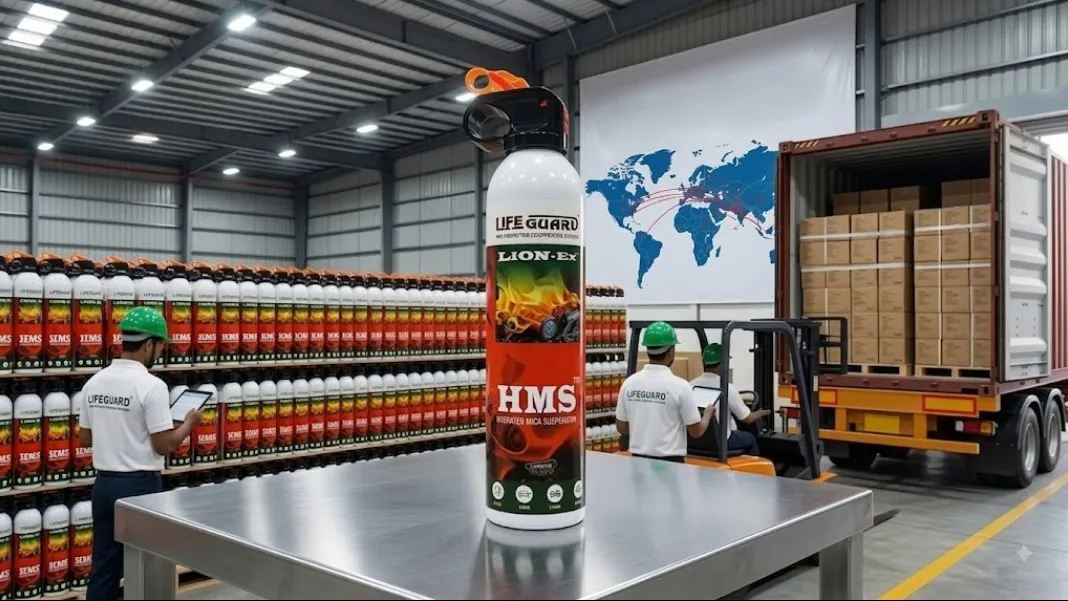
EV Battery Thermal Runaway Suppression Manufacturer India
As electric mobility continues to expand across India, the need for advanced battery fire protection has become increasingly important. Lithium-ion batteries used in electric vehicles can present unique fire risks, particularly when a damaged, overheated, defective, or electrically stressed cell enters thermal runaway. LIFEGUARD®, a brand of United Fire Equipments Pvt. Ltd., provides engineered fire safety solutions for applications requiring early detection, localized suppression, and protection against EV battery fire hazards.
As an EV battery thermal runaway suppression manufacturer in India, LIFEGUARD® focuses on developing application-specific solutions for electric vehicles, battery packs, charging infrastructure, energy storage installations, battery testing facilities, and other lithium-ion battery environments.
What Is EV Battery Thermal Runaway?
Thermal runaway is a condition in which the temperature inside a lithium-ion battery cell rises uncontrollably. Once initiated, the heat generated inside the affected cell may accelerate chemical reactions and potentially transfer heat to neighbouring cells.
The process may involve:
- Rapid increase in battery cell temperature
- Release of flammable gases and vapours
- Smoke generation
- Venting from battery cells
- Internal short circuits
- Flame development
- Heat transfer from one cell to adjacent cells
- Re-ignition risk even after the visible flames have been controlled
Because EV battery fires behave differently from many conventional combustible-material fires, an effective protection strategy should consider early detection, rapid system activation, cooling, fire control and prevention or reduction of thermal propagation.
LIFEGUARD® – EV Battery Thermal Runaway Suppression Manufacturer in India
LIFEGUARD® develops fire protection solutions designed around the actual risk characteristics of the protected battery application.
Instead of adopting a one-size-fits-all approach, the system configuration can be determined after considering factors such as:
- Battery chemistry
- Battery capacity
- Cell and module arrangement
- Battery enclosure dimensions
- Ventilation conditions
- Location of potential ignition points
- Expected heat generation
- Vehicle or equipment configuration
- Detection requirements
- Suppression discharge arrangement
- Nozzle positioning
- Pipe or tubing layout
- Required system response time
This engineering-oriented approach makes LIFEGUARD® a suitable choice for customers searching for an EV battery thermal runaway suppression system manufacturer in India.
Why Thermal Runaway Requires Specialized Fire Protection
Lithium-ion battery incidents can be particularly challenging because fire is often only one part of the hazard. Heat generated within the battery may continue even after visible flames have been extinguished.
An effective EV battery protection system therefore needs to address more than conventional flame suppression.
Early Detection
Early identification of abnormal battery conditions can provide valuable time for system activation and emergency response.
Depending on the application, detection may involve technologies designed to identify:
- Heat
- Smoke
- Rapid temperature rise
- Gas generation
- Flame
- Abnormal conditions inside the battery compartment
Rapid Suppression
Once a hazardous condition is confirmed, automatic activation can help deliver the suppression or cooling medium directly into the protected area.
Cooling of the Battery Environment
Reducing heat is an important consideration in controlling thermal runaway incidents because elevated temperatures can contribute to propagation between neighbouring cells and modules.
Controlling Fire Propagation
The suppression strategy should aim to limit the development of the incident and reduce the possibility of the fire spreading to adjoining battery modules, equipment or vehicle components.
Protection Against Re-Ignition
Lithium-ion batteries may retain substantial internal energy after the initial fire has been controlled. System design should therefore consider the possibility of continued heating or re-ignition.
EV Battery Thermal Runaway Suppression System Components
Depending on the project and risk assessment, a LIFEGUARD® engineered solution may incorporate:
Fire Detection Arrangement
Detection devices can be selected according to the protected environment and response requirements.
Suppression Agent Storage
The required extinguishing or cooling medium can be stored in suitable cylinders, tanks or other engineered containers depending on the selected system technology.
Distribution Piping or Tubing
A properly designed distribution network carries the suppression medium from the storage container to the protected battery area.
Strategically Located Nozzles
Nozzle positioning is important for distributing the extinguishing or cooling medium across critical sections of the battery pack or protected enclosure.
Automatic Activation System
The suppression system can be integrated with suitable detection and control arrangements for rapid automatic activation.
Manual Activation Provision
Where required by the application, manual system activation can also be incorporated.
Alarm and Control Interface
The suppression system may interface with vehicle controls, fire alarm systems, battery monitoring arrangements or other safety systems depending on the project requirements.
Applications of EV Battery Thermal Runaway Suppression Systems
As an EV battery thermal runaway suppression manufacturer India, LIFEGUARD® can support fire protection requirements across a variety of electric mobility and battery applications.
Electric Buses
Large battery packs used in electric buses contain significant stored electrical energy. Fire protection systems can be engineered around battery compartment dimensions, battery arrangement and vehicle operating conditions.
Electric Cars
EV passenger vehicles require compact and rapidly responding protection solutions capable of being integrated within restricted vehicle spaces.
Electric Trucks
Electric commercial vehicles may operate with larger battery capacities and demanding operating cycles, requiring carefully designed protection arrangements.
Electric Two-Wheelers and Three-Wheelers
Battery fire safety solutions may also be developed for electric scooters, motorcycles, e-rickshaws and other light electric mobility applications.
Battery Swapping Stations
Battery swapping facilities may store numerous charged batteries in close proximity. Early detection and localized protection can therefore form an important part of the overall fire safety strategy.
EV Charging Stations
Charging locations can incorporate fire protection measures based on the charging equipment, parking arrangement, battery exposure and overall site risk assessment.
Battery Testing Laboratories
Lithium-ion battery testing may involve overcharge, mechanical damage, temperature exposure and other conditions that increase the possibility of thermal events.
EV Manufacturing Facilities
Battery assembly, vehicle production and battery integration areas can benefit from dedicated detection and suppression arrangements.
Battery Warehouses
Storage areas containing significant quantities of lithium-ion batteries require careful evaluation of fire loading, storage configuration and potential propagation.
Battery Energy Storage Systems
The same engineering principles are relevant to many stationary battery energy storage applications where thermal runaway propagation can create significant fire hazards.
How an EV Battery Thermal Runaway Suppression System Works
A typical engineered protection sequence can involve several stages.
1. Hazard detection: Sensors identify abnormal conditions such as excessive temperature, smoke, gas or flame.
2. Signal transmission: The detection system communicates the hazardous condition to the control or activation arrangement.
3. System activation: Once the specified activation criteria are achieved, the suppression system operates.
4. Agent discharge: The extinguishing or cooling medium is discharged through strategically positioned nozzles.
5. Fire control and cooling: The discharged medium helps control flames, reduce heat and limit development of the incident.
6. Alarm or equipment interface: Where configured, alarms and associated shutdown or safety actions can also be initiated.
The actual sequence depends on the system technology, battery configuration and project-specific design requirements.
Customized EV Battery Fire Suppression System Design
Every battery installation is different. Battery chemistry, enclosure geometry, module arrangement and ventilation can significantly influence fire behaviour.
LIFEGUARD® therefore emphasizes an engineered design approach.
Important design parameters can include:
- Total battery capacity
- Battery chemistry
- Battery module dimensions
- Number of modules
- Compartment volume
- Battery enclosure construction
- Heat generation characteristics
- Ventilation openings
- Potential gas accumulation
- Detection response
- Suppression medium quantity
- Nozzle quantity
- Nozzle discharge pattern
- Distribution network
- Activation mechanism
- Environmental conditions
- Vehicle operating conditions
A properly engineered solution helps ensure that the suppression system is matched to the actual protected hazard.
EV Battery Thermal Runaway Protection for Indian Conditions
Electric vehicles operating in India can experience demanding environmental and operational conditions, including high ambient temperatures, dust, traffic congestion and intensive charging cycles.
Fire protection equipment intended for Indian EV applications should therefore be selected with consideration for:
- High ambient temperature
- Vehicle vibration
- Dust and contamination
- Limited installation space
- Long operating hours
- Frequent charging cycles
- Road shocks
- Maintenance accessibility
- Harsh industrial environments
LIFEGUARD® can develop solutions according to the specific operating environment and project requirements.
Thermal Runaway Detection and Suppression Integration
One of the most important aspects of EV battery fire safety is coordination between detection and suppression.
A well-designed system should detect hazardous conditions sufficiently early while minimizing the possibility of unwanted activation.
Depending on the application, system engineering may consider integration between:
Battery Monitoring → Detection → Control Logic → Alarm → Suppression Activation → Equipment Shutdown
Such integration helps create a more comprehensive approach to battery fire protection than relying on suppression alone.
Importance of Nozzle Placement
Correct nozzle positioning is essential in a localized suppression system.
Nozzles may need to be positioned so that the suppression or cooling medium can reach critical sections of the battery enclosure while avoiding unnecessary obstruction from structural components.
Engineering considerations may include:
- Distance between nozzle and battery
- Nozzle orientation
- Spray or discharge pattern
- Number of nozzles
- Battery module arrangement
- Obstructions
- Enclosure geometry
- Required distribution coverage
The final arrangement should be determined according to the characteristics of the selected suppression technology.
Benefits of LIFEGUARD® EV Battery Thermal Runaway Suppression Solutions
Customers searching for an EV battery thermal runaway suppression manufacturer in India can benefit from an integrated engineering approach that focuses on:
- Early fire and thermal event detection
- Automatic system activation
- Localized suppression
- Cooling support
- Reduction of fire propagation risk
- Customized nozzle positioning
- Compact system configuration
- Vehicle-compatible installation concepts
- Engineering and technical support
- Application-specific system design
- Integration with alarms and control systems
- Solutions for mobile and stationary lithium-ion battery applications
Industries We Serve
LIFEGUARD® EV and lithium battery fire protection solutions can be considered for:
- Electric vehicle manufacturers
- Electric bus manufacturers
- Electric truck manufacturers
- Battery pack manufacturers
- Battery module manufacturers
- Automotive OEMs
- EV fleet operators
- Charging station developers
- Battery swapping companies
- Battery testing laboratories
- Research organizations
- Warehousing facilities
- Logistics companies
- Energy storage companies
- Industrial battery users
- Government and institutional projects
Why Choose LIFEGUARD®?
LIFEGUARD® is backed by United Fire Equipments Pvt. Ltd., an Indian fire safety equipment manufacturer with experience in fire detection, suppression and engineered fire protection systems.
Our approach combines product knowledge with application engineering to help customers develop suitable fire protection concepts for modern battery hazards.
Application-Specific Engineering
System designs are developed around battery and enclosure characteristics rather than relying solely on standard equipment packages.
Technical Support
Our team can assist customers during selection, system configuration and technical evaluation.
Customized System Configuration
Solutions can be developed for compact battery enclosures as well as larger EV and industrial battery installations.
Integrated Fire Safety Approach
Detection, control, suppression and system interfaces can be considered together as part of an overall protection strategy.
Indian Manufacturing Support
Being based in India helps provide better coordination for domestic EV OEMs, system integrators, infrastructure developers and industrial customers.
EV Battery Thermal Runaway Suppression Manufacturer for OEM Projects
EV manufacturers increasingly require fire protection solutions that can be integrated during vehicle or battery-pack development.
LIFEGUARD® can work with OEMs and engineering teams to evaluate:
- Available installation space
- Battery compartment layout
- Cylinder or storage container location
- Nozzle locations
- Detection points
- Distribution piping or tubing
- Electrical interfaces
- Manual activation requirements
- Alarm requirements
- Service accessibility
Early involvement during vehicle development can help simplify installation and improve the effectiveness of the overall fire protection strategy.
Supporting India's Transition to Safer Electric Mobility
The continued expansion of EV technology makes battery fire safety an important engineering consideration for vehicle manufacturers, fleet operators, charging companies and battery manufacturers.
Thermal runaway cannot be addressed effectively through conventional fire protection assumptions alone. Battery chemistry, internal heat generation, propagation and re-ignition must all be considered while selecting an appropriate protection strategy.
LIFEGUARD® aims to support India's growing electric mobility ecosystem with engineered detection and suppression solutions designed for lithium-ion battery risks.
Frequently Asked Questions
What is an EV battery thermal runaway suppression system?
It is a specialized fire protection system designed to detect hazardous battery conditions and activate a suitable suppression or cooling mechanism to help control fire development, heat and thermal propagation.
Can thermal runaway occur without an external fire?
Yes. Thermal runaway can originate within a battery cell because of factors such as internal short circuits, excessive temperature, electrical abuse, mechanical damage or cell failure.
Can a conventional fire extinguisher stop thermal runaway completely?
A conventional extinguisher may control visible flames in some circumstances, but thermal runaway may continue inside damaged battery cells. Battery fire protection therefore requires consideration of cooling, propagation and re-ignition in addition to flame suppression.
Can the system operate automatically?
Yes. An engineered system can incorporate suitable detection and automatic activation arrangements depending on the application.
Can LIFEGUARD® manufacture systems for electric buses?
EV battery suppression solutions can be developed for electric buses based on the battery configuration, compartment dimensions, installation space and project requirements.
Is the system suitable for battery energy storage applications?
Thermal runaway detection and suppression principles are also applicable to stationary battery storage systems, although every installation requires its own hazard assessment and engineered design.
Can a suppression system be customized for an EV OEM?
Yes. System configuration can be developed around battery dimensions, nozzle locations, detection requirements, piping or tubing arrangement, available installation space and vehicle architecture.
Looking for an EV Battery Thermal Runaway Suppression Manufacturer in India?
If your organization manufactures electric vehicles, lithium-ion batteries, EV chargers, battery packs or energy storage systems and requires a customized battery fire protection solution, LIFEGUARD® can assist with application evaluation and engineered system development.
Contact LIFEGUARD®
United Fire Equipments Pvt. Ltd.
Manufacturer of ISI Certified Fire Safety Equipment
📞 8048034226
📧 ufe126@gmail.com | info@lifeguardindia.in
Suggested SEO Meta Title
EV Battery Thermal Runaway Suppression Manufacturer India | LIFEGUARD®
Suggested Meta Description
Looking for an EV battery thermal runaway suppression manufacturer in India? LIFEGUARD® provides engineered lithium-ion battery fire detection, suppression and cooling solutions for EVs, battery packs, charging stations and energy storage applications.
Primary SEO Keyword
EV battery thermal runaway suppression manufacturer India
Related SEO Keywords
EV battery thermal runaway suppression system India, EV battery fire suppression manufacturer India, lithium-ion battery fire suppression system, EV battery fire protection manufacturer India, electric vehicle battery fire suppression, battery thermal runaway protection system, EV fire suppression system India, lithium battery thermal runaway suppression, EV battery cooling and fire suppression, EV battery safety system manufacturer India.
Keywords