
Fire Retardant Coating Specification Powered by Agni-Rodhak®
Technical Fire-Protection Specification for Critical Surfaces, Electrical Infrastructure & Cable Protection
SPECIFY THE PROTECTION. ENGINEER THE PERFORMANCE. PROTECT BEFORE FIRE SPREADS.
A fire-retardant coating is not simply a layer of paint. In a professionally engineered fire-protection system, the substrate, preparation, coating system, application method, thickness, exposure condition and required fire performance all form part of the specification.
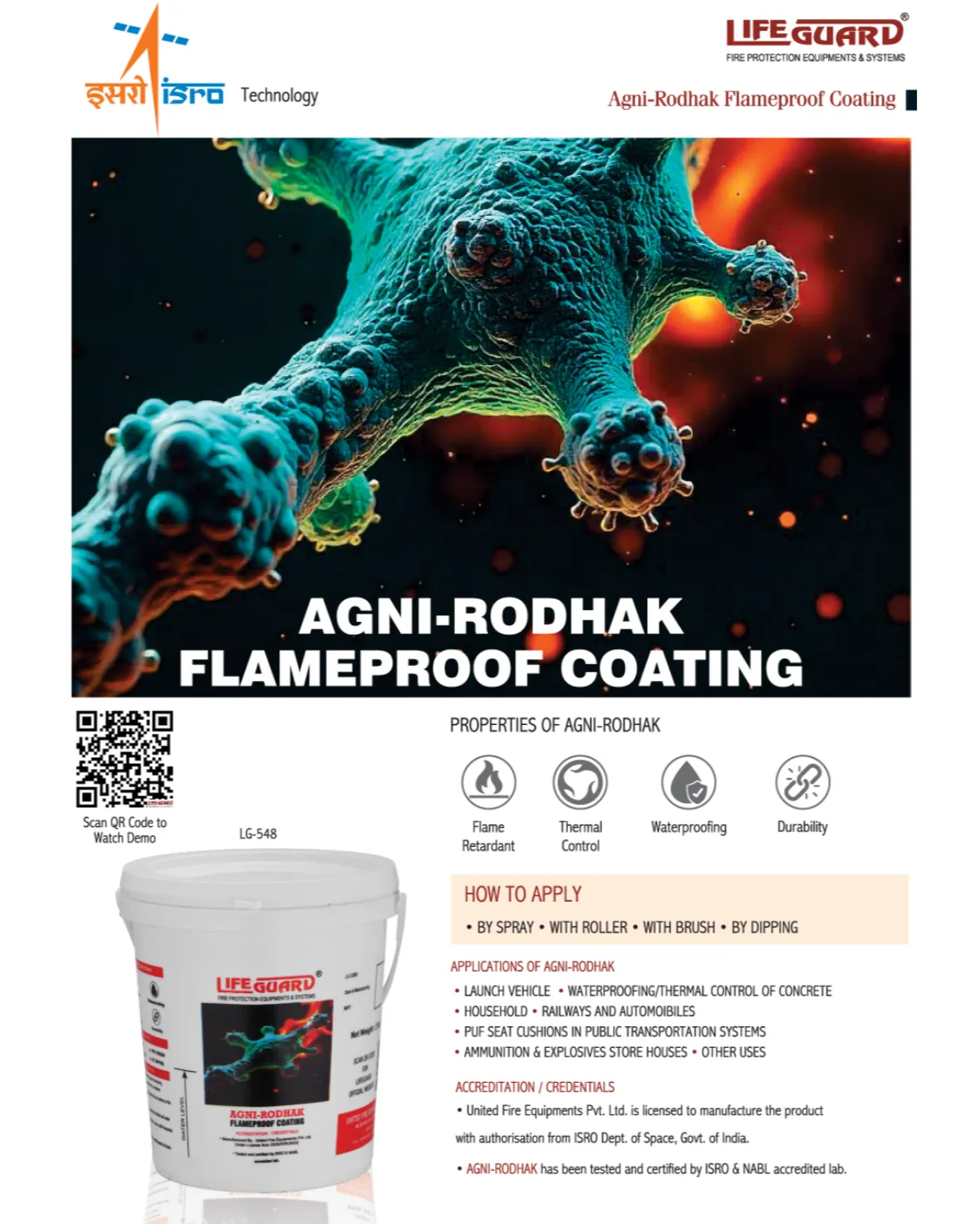
Agni-Rodhak® by LIFEGUARD® is a flame-retardant and fire-protective coating technology developed for suitable applications involving buildings, infrastructure, electrical installations and other critical surfaces. LIFEGUARD describes the product as combining flame retardancy, thermal control/insulation, waterproofing and durability, with spray, roller, brush and dipping application options.
This page provides a practical fire retardant coating specification framework for architects, MEP consultants, electrical consultants, fire consultants, EPC contractors, project owners and procurement teams evaluating Agni-Rodhak®.
What Is a Fire Retardant Coating Specification?
A fire retardant coating specification defines the technical requirements governing the selection, preparation, application, inspection and acceptance of a fire-protective coating system.
A professional specification should answer:
- What is being protected?
- What is the substrate?
- Where will the coating be applied?
- What fire exposure is anticipated?
- What performance is required?
- How will the surface be prepared?
- How will the coating be applied?
- What application thickness is required?
- How will application quality be verified?
- What testing or assessment supports the claimed performance?
- What maintenance is required?
This system-based approach is particularly important for electrical cables, cable trays, cable trenches, electrical panels, critical infrastructure and fire-compartment interfaces.
Agni-Rodhak® Fire Retardant Coating Specification
Agni-Rodhak® can be specified as a passive fire-protection coating system for suitable applications, subject to project-specific engineering and the applicable technical evidence.
Product
AGNI-RODHAK®
Manufacturer
United Fire Equipments Pvt. Ltd. — LIFEGUARD® India
Protection Category
Passive Fire Protection / Flame-Retardant Protective Coating
Intended Functional Characteristics
- Flame retardancy
- Thermal protection/control
- Surface protection
- Waterproofing characteristics
- Protective barrier formation
- Long-term durability, subject to application conditions
LIFEGUARD's published product information identifies Agni-Rodhak® as a flame-retardant, thermal-control, waterproof and durable protective coating.
Suggested Technical Specification — Short Form
For consultants and project specifications, the following format can be adapted to project requirements:
Fire-Retardant Protective Coating: Supply and application of Agni-Rodhak® or approved equivalent, manufactured by United Fire Equipments Pvt. Ltd. (LIFEGUARD®), as a passive fire-protection coating system for the specified substrate/application. The system shall be suitable for the intended substrate and exposure condition and shall be applied in accordance with the manufacturer's approved technical data, surface-preparation requirements, application methodology and specified dry-film/wet-film thickness. Performance requirements shall be established for the complete coating/application system and supported by applicable test reports, assessment documentation or project-specific engineering requirements. Application shall be carried out by suitably trained personnel, followed by inspection and quality-control verification before acceptance.
This wording intentionally avoids assigning a universal fire rating to the coating alone.
Detailed Fire Retardant Coating Specification
1. Scope of Work
The scope shall include:
- Surface inspection
- Surface preparation
- Priming, where specified
- Supply of Agni-Rodhak®
- Mixing/preparation as per manufacturer's instructions
- Application of the coating
- Control of application thickness
- Drying/curing as applicable
- Inspection and quality control
- Rectification of defective areas
- Final acceptance
- Documentation and maintenance recommendations
The coating system shall be installed strictly according to the applicable product technical documentation and project specification.
2. Substrate Identification
Before specifying a fire-retardant coating, the substrate must be clearly identified.
Typical substrates may include:
- Electrical cables
- Cable trays
- Cable ladders
- Cable trenches
- Metal surfaces
- Electrical infrastructure
- Selected building surfaces
- Panels and equipment enclosures
- Other approved substrates
The coating specification should identify the exact substrate and condition.
For example:
“Application of Agni-Rodhak® fire-protective coating to existing electrical cable tray systems within the designated electrical service area.”
is considerably more useful than:
“Apply fireproof paint.”
3. Surface Preparation Specification
Surface preparation is one of the most important elements of coating performance.
Before application:
The surface should be:
- Clean
- Dry
- Free from loose particles
- Free from dust
- Free from oil and grease
- Free from loose rust or contaminants
- Structurally sound
- Compatible with the specified coating system
Any existing coating, corrosion, contamination or damaged substrate should be assessed before application.
For electrical cable applications:
Special attention should be given to:
- Cable sheath condition
- Cable identification
- Existing damage
- Cable joints
- Terminations
- Cable supports
- Cable tray condition
- Accessibility
- Required electrical clearances
- Manufacturer's cable warranty requirements
Fire protection must never compromise electrical safety or the operational integrity of the cable system.
4. Application Method
Agni-Rodhak® is described by LIFEGUARD as suitable for application by:
Spray
Suitable for larger surfaces and complex installations where appropriate.
Roller
Useful for appropriate accessible surfaces.
Brush
Suitable for edges, smaller areas, touch-up and detailed application.
Dipping
Potentially suitable for selected prefabricated components and controlled factory application.
The selected application method should be determined by the substrate, geometry, accessibility, required finish and approved technical procedure.
5. Coating Thickness Specification
One of the most important principles in fire-protective coating specification is:
Do not specify a generic thickness without linking it to the required performance and supporting technical evidence.
The required coating thickness can depend upon:
- Substrate
- Geometry
- Fire exposure
- Required performance
- Test configuration
- Application method
- Environmental conditions
- Complete coating system
Therefore, a project specification should state:
“Required coating thickness shall be as per the manufacturer's approved technical specification and the thickness corresponding to the applicable tested/assessed system and project fire-performance requirement.”
Where required, wet-film thickness (WFT) and dry-film thickness (DFT) should be established as inspection parameters.
6. Wet Film Thickness & Dry Film Thickness
Professional coating projects may use:
WFT — Wet Film Thickness
The thickness immediately after application while the coating remains wet.
DFT — Dry Film Thickness
The thickness after the coating has dried/cured.
For quality control, the project specification should define:
- Measurement method
- Measuring instrument
- Sampling frequency
- Acceptance range
- Corrective procedure
The specified DFT should never be guessed from the fire rating.
It should be established from the approved coating system and applicable technical documentation.
7. Fire Performance Specification
A fire-retardant coating specification should identify the actual performance requirement rather than simply stating “fireproof.”
For example, the project may require evaluation for:
- Flame spread
- Surface burning characteristics
- Fire propagation
- Thermal exposure
- Fire resistance
- Smoke characteristics
- Substrate protection
- Cable-route protection
- Compartmentation performance
The applicable test or assessment should correspond to the actual intended application.
Important:
A test performed on one substrate or configuration should not automatically be interpreted as proof of identical performance on every other substrate or installation.
8. Fire Rating — Specify the Complete System
This is especially important when the specification refers to:
2 Hours
3 Hours
4 Hours
A fire rating is generally a property of the tested/assessed/engineered assembly or system under defined conditions, rather than an automatic universal property of a standalone coating.
Therefore, a responsible specification should read along the lines of:
“Where a defined fire-resistance period is required, the complete Agni-Rodhak® coating/application system shall demonstrate the required performance for the specified substrate and configuration through applicable test, assessment or engineering documentation.”
This protects both the project and the specification from making unsupported universal performance claims.
9. Specification for Electrical Cable Protection
For electrical cable applications, the specification should identify:
Cable Details
- Cable manufacturer
- Cable type
- Voltage class
- Cable diameter
- Insulation/sheath material
- Number of cables
- Cable spacing
- Cable arrangement
Installation Details
- Cable tray
- Cable ladder
- Cable trench
- Cable shaft
- Cable tunnel
- Open or enclosed installation
- Vertical/horizontal orientation
Fire Protection Details
- Required performance
- Fire exposure
- Coating system
- Application method
- Required thickness
- Inspection method
- Repair procedure
This approach is consistent with the broader principle of treating cable-run fire safety as an engineering issue. BIS's current standards information identifies IS 12459:2024, Fire Safety in Cable Runs — Code of Practice, covering cable runs in trenches, vaults, tunnels, shafts, risers, trays and other premises.
10. Specification for HT Cable Fire Protection
For HT cables, the specification should additionally identify:
- Voltage level
- Cable construction
- Insulation type
- Outer sheath
- Cable diameter
- Number of cables
- Installation arrangement
- Cable tray/trench configuration
- Required fire-performance objective
- Electrical safety constraints
Suggested wording:
“Agni-Rodhak® passive fire-protection coating shall be applied to the specified HT cable installation/cable-support system in accordance with the manufacturer's approved application procedure and the project-specific fire-performance requirement. The selected coating system shall be compatible with the cable sheath and installation configuration and shall not adversely affect electrical, thermal or mechanical performance.”
11. Cable Tray Fire Retardant Coating Specification
Cable trays are particularly important because they can support numerous cables simultaneously.
A specification should identify:
- Tray material
- Tray dimensions
- Cable loading
- Cable arrangement
- Existing corrosion
- Access for application
- Required protection area
- Required coating system
- Inspection procedure
Objective:
Protect the pathway carrying multiple critical circuits.
12. Cable Trench Fire Protection Specification
For cable trenches, the specification should identify:
- Trench construction
- Wall/floor material
- Cable arrangement
- Ventilation
- Drainage
- Access
- Cable supports
- Fire compartment boundaries
- Penetrations
- Required fire performance
Agni-Rodhak® may be considered as one component of a passive protection strategy for suitable cable-trench applications.
It should not, however, be treated as a substitute for appropriately designed fire stopping, compartmentation or active fire protection where those measures are required.
13. Electrical Shaft & Penetration Considerations
Cable routes frequently pass through floors and fire-resisting construction.
BIS material on electrical fire safety states that electrical distribution cables/wiring should be laid in a separate shaft and that such shafts should be sealed at every floor with fire-stop materials having the same fire resistance as the floor.
Therefore, a cable coating specification should be coordinated with:
Cable Protection + Fire Stopping + Compartmentation
LIFEGUARD also provides Agni-Rodhak®-powered fire-stop material for suitable service penetrations.
14. Compatibility Specification
Before application, compatibility should be evaluated between Agni-Rodhak® and the substrate.
For cables, consideration should include:
- Cable sheath material
- Existing cable coating
- Surface condition
- Operating temperature
- Flexibility requirements
- Manufacturer's limitations
- Electrical characteristics
- Required mechanical performance
Never assume that every cable sheath requires the same coating system.
A project-specific compatibility evaluation should be performed where necessary.
15. Application Quality Control
A professional fire-retardant coating specification should include inspection checkpoints.
Before Application
☐ Substrate inspected
☐ Surface cleaned
☐ Contamination removed
☐ Existing damage identified
☐ Environmental conditions recorded
☐ Product batch recorded
During Application
☐ Correct application method used
☐ Correct mixing/preparation followed
☐ WFT monitored where applicable
☐ Coverage checked
☐ Defects corrected
After Application
☐ DFT verified where applicable
☐ Surface visually inspected
☐ Cracks/holidays/pinholes checked
☐ Damaged areas repaired
☐ Final inspection completed
☐ Documentation submitted
16. Documentation Requirements
For major projects, the contractor/vendor should provide appropriate documentation such as:
- Product technical data sheet
- Safety Data Sheet, where applicable
- Batch/lot information
- Application instructions
- Surface-preparation procedure
- Approved method statement
- Applicable test reports
- Applicable assessment documentation
- Inspection records
- Thickness records
- Photographic records
- Warranty/maintenance documentation, where offered
A good fire-protection specification creates an auditable trail from product selection to final installation.
17. Fire Retardant Coating Specification for Consultants
Architects, MEP consultants, electrical consultants and fire consultants can structure a project specification under the following headings:
A. Product
Agni-Rodhak® — LIFEGUARD®
B. Function
Passive flame-retardant/fire-protective coating.
C. Application
Specified electrical, building or infrastructure substrate.
D. Surface Preparation
As per approved manufacturer's procedure.
E. Application
Spray/roller/brush/dipping as appropriate.
F. Thickness
As established by approved technical documentation for the intended system.
G. Fire Performance
As required by project specifications and supported by applicable testing/assessment.
H. Quality Control
Visual inspection + thickness/application verification as applicable.
I. Documentation
Technical data, test evidence and installation records.
J. Acceptance
Subject to project requirements and applicable authority/consultant approval.
18. Fire Retardant Coating Specification — BOQ Format
Suggested BOQ Description
Providing and applying Agni-Rodhak® passive fire-protective/flame-retardant coating manufactured by United Fire Equipments Pvt. Ltd. (LIFEGUARD®), on approved and properly prepared [SPECIFY SUBSTRATE], including surface preparation, application by approved method, necessary coats/layers, curing/drying, quality-control inspection and finishing, complete in accordance with manufacturer's technical instructions and project requirements. Required coating system and thickness shall be established according to the specified fire-performance requirement and applicable test/assessment documentation.
Unit
m² / running metre / item, as appropriate to the project measurement methodology.
19. Suggested Consultant Specification Clause
FIRE RETARDANT / PASSIVE FIRE PROTECTION COATING
Supply and application of Agni-Rodhak® passive fire-protective coating or approved equivalent to designated electrical/infrastructure surfaces as indicated in drawings and schedules. The coating system shall be suitable for the specified substrate and application environment and shall provide the required flame-retardant/fire-protection performance established for the complete tested, assessed or engineered system. Surface preparation, application method, coating thickness, curing and inspection shall comply with the approved manufacturer's technical documentation. The contractor shall submit product technical data, applicable fire-performance test/assessment documentation, method statement and quality-control records for approval prior to commencement.
20. Fire Retardant Coating Specification for Critical Infrastructure
Agni-Rodhak® can be evaluated for suitable applications involving:
Electrical Infrastructure
Cables, cable trays, cable trenches and selected electrical surfaces.
Data Centres
Critical cable routes and suitable infrastructure surfaces.
Power Plants
Electrical service routes and selected infrastructure.
Substations
Cable and service infrastructure.
Industrial Plants
Power, control and instrumentation routes.
Rail & Metro
Suitable infrastructure applications.
Hospitals
Selected critical building-service applications.
Renewable Energy
Suitable electrical infrastructure.
Fire Retardant Coating & Building Fire Safety
BIS describes the National Building Code as a comprehensive national instrument covering fire safety, building materials, structural design and building services, including electrical and allied installations.
BIS's electrical-services material similarly describes essential requirements for electrical installations intended to provide safety from fire and shock.
Therefore, fire-retardant coatings should be considered as part of an integrated fire-safety design, rather than as a standalone substitute for code-required systems.
Important specification principle:
“Specified for a project” ≠ “automatically code compliant.”
The final determination depends on the applicable code, project design, installation, supporting evidence and approval by the relevant authority/consultant.
Agni-Rodhak® Fire Protection Specification — Key Advantages
🔥 Passive Protection
The protective layer is present without requiring activation.
🌡 Thermal Protection
Designed to provide thermal-control characteristics.
💧 Waterproofing Characteristics
LIFEGUARD identifies waterproofing among the product characteristics.
🛡 Protective Barrier
Creates a protective layer over suitable substrates.
⚡ Electrical Infrastructure Applications
Can be evaluated for suitable cable and electrical installations.
🏭 Multiple Industrial Applications
Suitable applications span infrastructure, buildings and industrial environments.
🖌 Multiple Application Methods
Spray, roller, brush and dipping methods are identified by LIFEGUARD for appropriate applications.
Fire Retardant Coating Specification — What Should Never Be Assumed?
A professional specification should not automatically assume:
❌ One thickness works for every substrate.
❌ One fire rating applies to every application.
❌ A coating tested on one configuration performs identically on another.
❌ Coating alone makes an entire building code compliant.
❌ Cable coating replaces fire stopping.
❌ Passive coating replaces fire detection.
❌ Passive coating replaces active suppression.
❌ A fire-protective coating eliminates electrical hazards.
Instead:
Specify → Test/Assess → Engineer → Apply → Inspect → Document
Watch the Agni-Rodhak® Demonstration
See the LIFEGUARD® Agni-Rodhak® demonstration:
▶ Watch Agni-Rodhak® Demonstration on YouTube
Buy Agni-Rodhak® Online
🛒 Purchase Agni-Rodhak® Online – LIFEGUARD®
SEO Keyword Strategy
Primary Keyword
Fire Retardant Coating Specification
Secondary Keywords
- Fire retardant coating specification India
- Fire resistant coating specification
- Fire protection coating specification
- Passive fire protection coating specification
- Fireproof coating specification
- Flame retardant coating specification
- Agni-Rodhak specification
- Agni-Rodhak fire retardant coating
- Fire retardant paint specification
- Electrical fire protection coating specification
Electrical Keywords
- Electrical cable fire protection specification
- HT cable fire protection specification
- LT cable fire protection specification
- Cable tray fire protection specification
- Cable trench fire protection specification
- Electrical infrastructure fire protection
- Passive fire protection electrical cables
- Fire resistant cable coating specification
Consultant / Tender Keywords
- Fire retardant coating tender specification
- Fire protection coating BOQ specification
- Fire retardant coating technical specification
- Fire resistant coating consultant specification
- MEP fire protection specification
- Passive fire protection tender specification
- Fire retardant coating project specification
- Fireproof coating technical datasheet
- Fire protection coating method statement
SEO Meta Information
Meta Title:
Fire Retardant Coating Specification | Agni-Rodhak®
Meta Description:
Detailed fire retardant coating specification for electrical cables, cable trays, infrastructure and critical surfaces. Specify Agni-Rodhak® passive fire protection by LIFEGUARD®.
Suggested URL Slug:
/fire-retardant-coating-specification-agni-rodhak
Suggested H1:
Fire Retardant Coating Specification Powered by Agni-Rodhak®
FAQ — Fire Retardant Coating Specification
What is a fire retardant coating specification?
It defines the required product, substrate, surface preparation, application method, thickness, fire-performance criteria, inspection and documentation for a fire-protective coating system.
Can Agni-Rodhak® be specified for electrical cables?
Agni-Rodhak® can be evaluated for suitable cable and electrical-infrastructure applications, subject to cable construction, compatibility, application methodology and project-specific fire-performance requirements.
Is coating thickness the same for every application?
No. Required thickness should be established from the applicable technical documentation and the performance requirement for the complete system.
Does a coating automatically provide a 2-, 3- or 4-hour fire rating?
No. A specified fire-resistance period should be supported by applicable testing, assessment or engineering documentation for the relevant complete assembly/configuration.
Can Agni-Rodhak® replace fire detection or suppression?
No. It is a passive fire-protection layer and should complement, rather than replace, appropriate detection, alarm, suppression, fire stopping and emergency-response systems.
The Specification Philosophy
DON'T JUST SPECIFY A COATING.
SPECIFY THE COMPLETE FIRE-PROTECTION SYSTEM.
Define the substrate.
Define the exposure.
Define the performance.
Define the application.
Define the thickness.
Verify the installation.
Document the protection.
AGNI-RODHAK®
PASSIVE FIRE PROTECTION POWERED BY LIFEGUARD®
SPECIFY WITH PRECISION. APPLY WITH DISCIPLINE. PROTECT WITH PURPOSE.
Keywords






