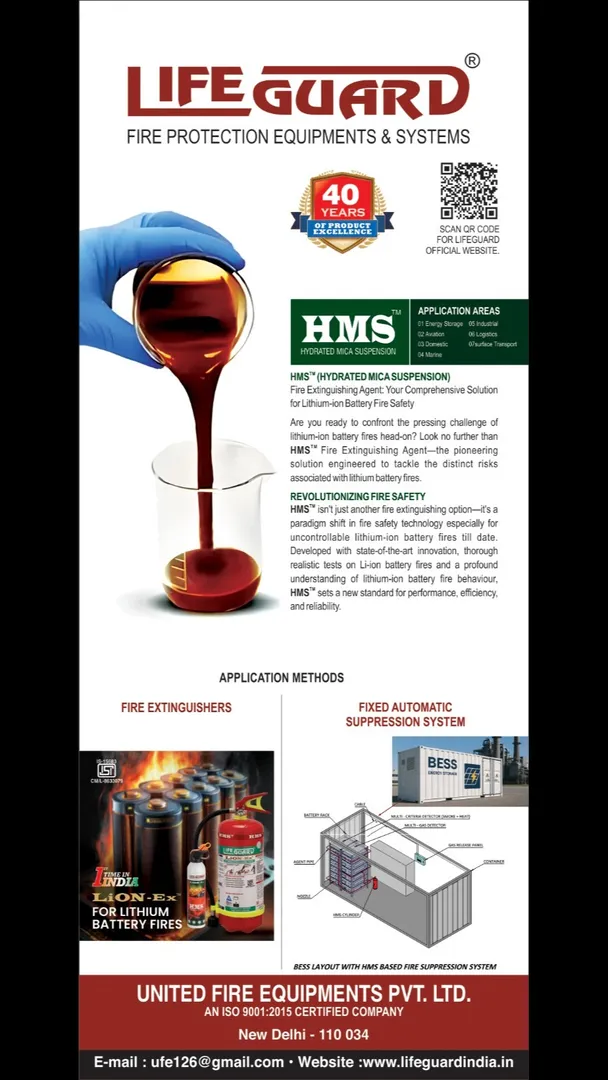
1️⃣ ELECTRIC VEHICLES (EVs)
Fire Risk Profile
- High-energy battery packs in confined enclosures
- Rapid temperature escalation
- Limited response time before propagation
- Vehicle may remain electrically energized
ISO 3941 Performance Focus (EV Context)
- Thermal runaway mitigation at cell/module level
- Heat release reduction in enclosed spaces
- Prevention of post-incident re-ignition
- Safe performance during energized conditions
HMS Performance Alignment
- Rapid heat absorption addresses runaway initiation
- Mica suspension provides thermal buffering within battery enclosures
- Sustained cooling reduces re-ignition risk after vehicle stop
- No dependence on oxygen displacement
EV-Specific Compliance Statement
HMS performance aligns with ISO 3941:2026 evaluation intent for lithium-ion battery fires in electrically energized and spatially constrained EV battery systems.
2️⃣ BESS / ESS YARDS (UTILITY & INDUSTRIAL)
Fire Risk Profile
- Large battery arrays with high propagation potential
- Extended burn duration
- Re-ignition hours or days after suppression
- Asset-scale consequences and site shutdowns
ISO 3941 Performance Focus (BESS Context)
- Limitation of cell-to-cell and rack-to-rack propagation
- Heat release control to protect adjacent systems
- Post-suppression thermal stability
- Support for emergency response timelines
HMS Performance Alignment
- High heat absorption limits thermal escalation
- Mica layer helps interrupt thermal transfer paths
- Extended cooling assists post-suppression monitoring
- Complements detection, isolation, and spacing strategies
BESS-Specific Compliance Statement
HMS supports ISO 3941:2026 performance objectives for thermal runaway control, propagation limitation, and re-ignition prevention in stationary energy storage installations.
3️⃣ ELECTRIC BUSES & MASS TRANSPORT
Fire Risk Profile
- Passenger occupancy during early fire stages
- Battery packs in roof or rear compartments
- High consequence of delayed suppression
- Requirement for first-response usability
ISO 3941 Performance Focus (Bus Context)
- Rapid heat knockdown at first availability
- Prevention of escalation beyond initial battery module
- Safe use in confined and occupied environments
- Reduction of secondary hazards
HMS Performance Alignment
- Immediate cooling-based intervention
- Reduces likelihood of runaway propagation to vehicle structure
- Non-explosive, controlled discharge
- Supports evacuation and emergency protocols
Bus-Specific Compliance Statement
HMS aligns with ISO 3941:2026 lithium-ion fire performance intent while supporting passenger safety and early intervention requirements in electric public transport vehicles.
4️⃣ DATA CENTERS & UPS ROOMS
Fire Risk Profile
- Lithium-ion UPS systems replacing VRLA
- High asset density and uptime sensitivity
- Fire suppression must avoid collateral damage
- Re-ignition presents severe operational risk
ISO 3941 Performance Focus (Data Center Context)
- Thermal runaway control without total system shutdown
- Heat reduction to prevent rack-level escalation
- Post-event thermal stability
- Compatibility with energized infrastructure
HMS Performance Alignment
- Targeted heat suppression without flame spread
- Minimal residue compared to powder agents
- Sustained cooling lowers restart risk
- Suitable for use prior to full electrical isolation
Data Center Compliance Statement
HMS performance characteristics align with ISO 3941:2026 evaluation criteria for lithium-ion battery fire mitigation in mission-critical facilities.
CONSOLIDATED MULTI-SECTOR STATEMENT (VERY POWERFUL)
HMS (Hydrated Mica Suspension) demonstrates performance characteristics aligned with the thermal runaway mitigation, heat control, propagation limitation, energized operation, and re-ignition prevention intents evaluated under ISO 3941:2026, across EVs, BESS installations, electric buses, and data center lithium-ion battery systems.
QUICK PICK – ONE-LINE BY SECTOR
- EVs:
- HMS aligns with ISO 3941 performance intent for energized, confined lithium battery fires.
- BESS:
- HMS supports propagation control and re-ignition prevention evaluated under ISO 3941.
- Electric Buses:
- HMS enables early, cooling-based lithium fire mitigation consistent with ISO 3941.
- Data Centers:
- HMS supports thermal-runaway control without compromising critical infrastructure.
Keywords