
HMS PERFORMANCE → ISO 3941:2026 ALIGNMENT MAP
ISO Context (for cover slide / preface)
ISO 3941:2026 establishes test methods and acceptance criteria to evaluate whether a fire suppression system can effectively mitigate lithium-ion battery thermal runaway events, including re-ignition risk, energized conditions, and heat propagation.
1️⃣ Thermal Runaway Control
ISO 3941:2026 – Requirement Intent
Fire suppression systems shall demonstrate the ability to control or mitigate thermal runaway within lithium-ion battery cells and modules.
HMS Performance Alignment
- HMS provides high specific heat absorption, rapidly extracting energy from overheated cells
- Targets heat source, not just visible flame
- Supports stabilization of runaway reactions
Compliance Mapping Statement (Tender-Ready):
HMS addresses the thermal-runaway-control performance intent of ISO 3941:2026 by focusing on rapid heat absorption at cell level.
2️⃣ Heat Release Rate Reduction
ISO 3941:2026 – Requirement Intent
Suppression systems shall reduce peak heat release to limit escalation and secondary ignition.
HMS Performance Alignment
- Water-based carrier absorbs large quantities of thermal energy
- Hydrated mica particles enhance thermal damping
- Results in lower heat release intensity compared to flame-only knockdown
Mapping Line:
HMS contributes to heat release reduction consistent with ISO 3941:2026 performance evaluation criteria.
3️⃣ Cell-to-Cell Propagation Limitation
ISO 3941:2026 – Requirement Intent
Systems shall demonstrate the ability to limit propagation between adjacent cells or modules.
HMS Performance Alignment
- Mica suspension forms a physical and thermal barrier
- Interrupts conductive and radiative heat transfer
- Reduces likelihood of cascade failure
Mapping Line:
HMS supports propagation-limitation objectives evaluated under ISO 3941:2026 test scenarios.
4️⃣ Re-Ignition Prevention
ISO 3941:2026 – Requirement Intent
Fire suppression shall prevent delayed or repeated re-ignition, a known lithium-ion battery hazard.
HMS Performance Alignment
- Sustained cooling effect beyond initial discharge
- Maintains temperature below runaway threshold
- Addresses one of the core failure modes of conventional extinguishers
Mapping Line:
HMS performance aligns with ISO 3941:2026 re-ignition prevention evaluation requirements.
5️⃣ Performance Under Energized Conditions
ISO 3941:2026 – Requirement Intent
Suppression systems shall be evaluated under energized battery conditions, recognizing delayed isolation realities.
HMS Performance Alignment
- Water-based, non-reactive formulation
- Suitable for electrically energized lithium battery systems when applied as intended
- No reliance on oxygen displacement
Mapping Line:
HMS is suitable for application during energized lithium-ion battery fire scenarios considered in ISO 3941:2026 testing.
6️⃣ Post-Suppression Stability & Monitoring Window
ISO 3941:2026 – Requirement Intent
Systems shall demonstrate post-suppression stability, allowing time for monitoring, isolation, or evacuation.
HMS Performance Alignment
- Extended cooling effect
- Reduces probability of sudden temperature rebound
- Supports operational response timelines
Mapping Line:
HMS supports post-suppression stability objectives evaluated in ISO 3941:2026.
7️⃣ System Safety & Secondary Hazard Control
ISO 3941:2026 – Requirement Intent
Suppression systems shall not introduce additional hazards during deployment.
HMS Performance Alignment
- Non-explosive discharge
- No toxic combustion by-products
- Minimal collateral damage compared to powder agents
Mapping Line:
HMS deployment characteristics are consistent with the system safety intent of ISO 3941:2026.
CONSOLIDATED COMPLIANCE STATEMENT (GOLD STANDARD)
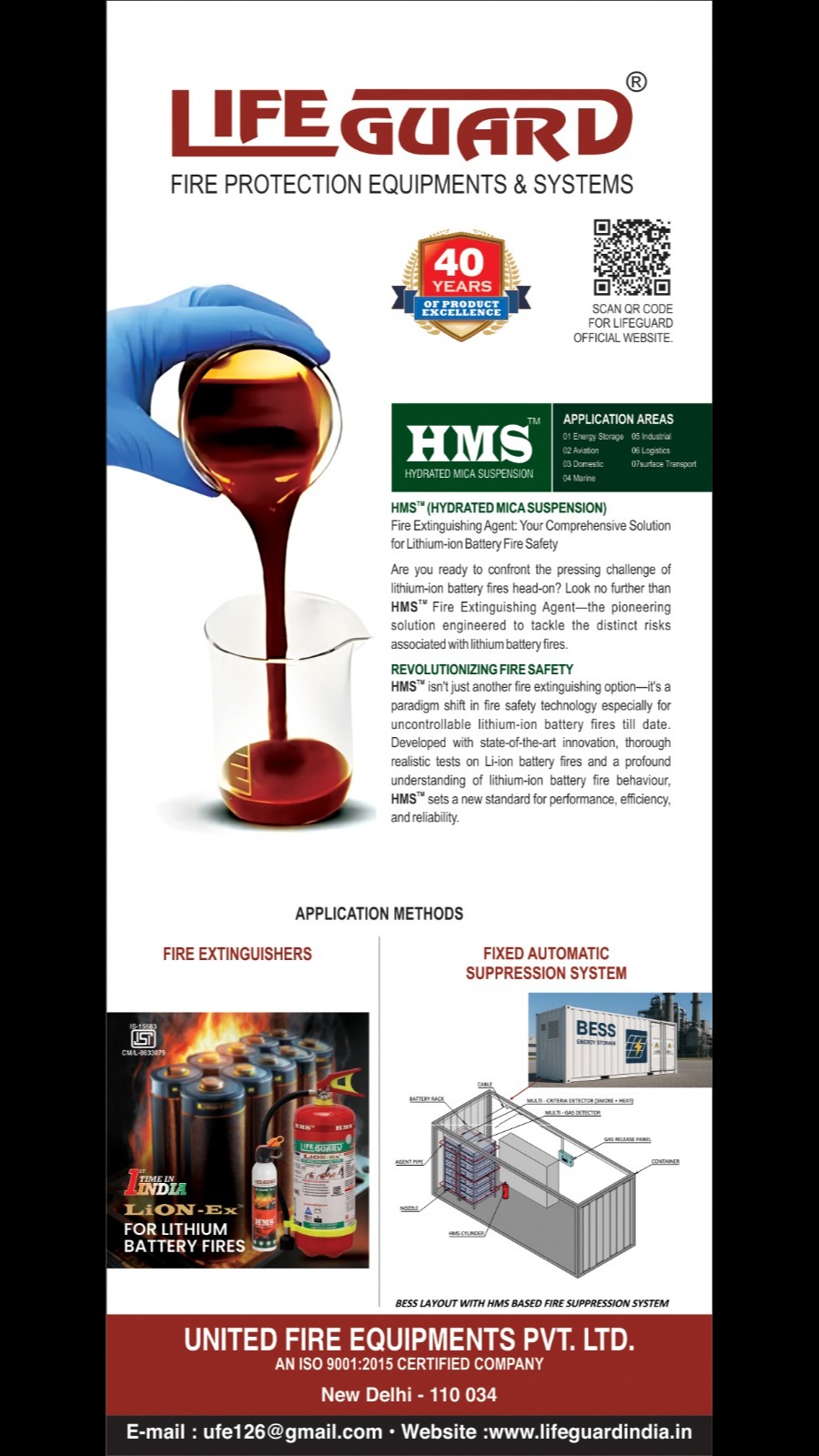
HMS (Hydrated Mica Suspension) demonstrates performance characteristics aligned with the thermal runaway mitigation, heat control, propagation limitation, energized operation, and re-ignition prevention intents evaluated under ISO 3941:2026 for lithium-ion battery fire suppression systems.
TRAINING-FRIENDLY ONE-SLIDE SUMMARY
- ISO 3941: Tests performance, not labels
- Key focus: Thermal runaway, heat, re-ignition
- HMS role: Heat absorption + thermal isolation
- Result: Alignment with global lithium-fire test philosophy
AUTHORITY-SAFE MICRO LINES
- Tender:
- HMS performance aligns with ISO 3941:2026 evaluation criteria for lithium-ion battery fire suppression.
- Training:
- ISO 3941 tests how systems handle thermal runaway—HMS is designed for exactly that.
- Presentation:
- ISO 3941 doesn’t ask “what agent,” it asks “what outcome.” HMS meets the outcome logic.