
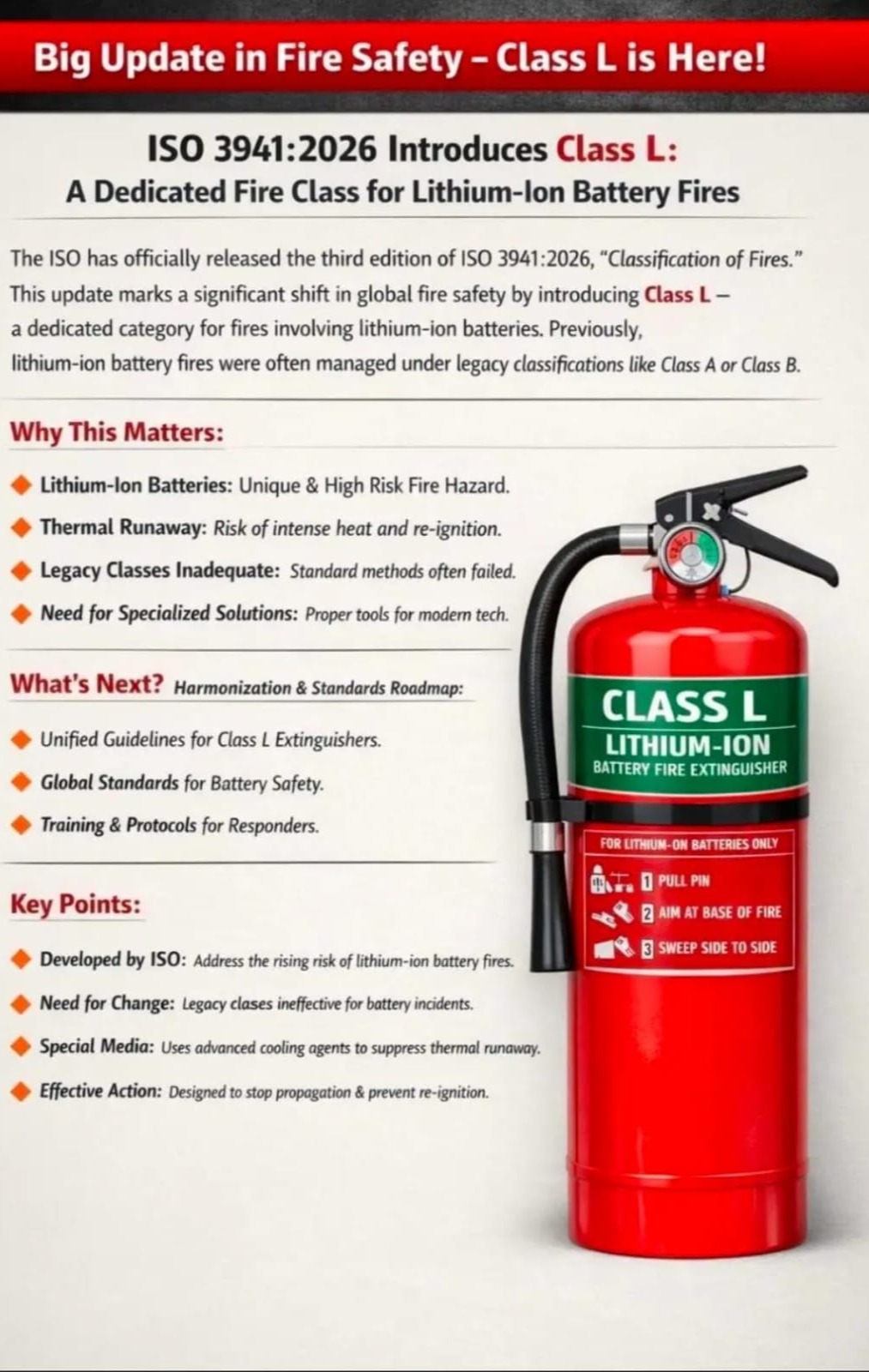
ISO 3941:2026 Introduces Class L – A Dedicated Fire Class for Lithium-Ion Battery Fires
The rapid global adoption of Lithium-ion batteries across industries such as electric vehicles, renewable energy storage, portable electronics, aviation logistics, and robotics has created an entirely new category of fire hazards.
Traditional fire classifications were designed for conventional materials such as solid combustibles, flammable liquids, gases, metals, and cooking oils. However, lithium battery fires behave fundamentally differently, often involving complex electrochemical reactions, extremely high temperatures, and persistent thermal runaway events.
Recognizing these emerging risks, ISO 3941:2026 introduces a new fire classification – Class L, specifically dedicated to Lithium-Ion Battery Fires.
This development marks a major milestone in global fire safety standards and reflects the growing importance of specialized fire suppression technologies for lithium battery incidents.
Understanding Lithium-Ion Battery Fire Hazards
Lithium-ion batteries power some of the most critical technologies of the modern world, including:
- Electric vehicles (EVs)
- Battery Energy Storage Systems (BESS)
- Solar battery storage systems
- Consumer electronics such as laptops and power banks
- Drone and robotics batteries
- Aviation cargo battery shipments
- Lithium battery warehouses and logistics infrastructure
Under certain conditions such as internal short circuits, overheating, physical damage, manufacturing defects, or charging failures, lithium batteries can enter a condition known as thermal runaway.
Thermal runaway can lead to:
- Temperatures exceeding 1000°C
- Release of flammable electrolyte vapors
- Jet-like flames from battery cells
- Propagation of fire across adjacent battery modules
- Persistent combustion reactions
- High probability of re-ignition even after suppression
These characteristics make lithium battery fires fundamentally different from conventional fires, requiring specialized classification and suppression strategies.
Why ISO 3941:2026 Introduced Class L
Historically, lithium battery fires were often grouped under Class D (metal fires) or addressed using conventional fire classifications.
However, lithium-ion batteries are not pure metal fires. Instead, they involve complex electrochemical reactions combined with combustible electrolytes, plastics, and metal components.
As lithium battery usage expanded globally, the need for a dedicated fire classification became increasingly evident.
The introduction of Class L under ISO 3941:2026 reflects the recognition that lithium battery fires require:
- Specialized fire suppression agents
- Dedicated testing methodologies
- Updated fire safety standards
- Advanced fire protection engineering
Class L therefore represents a new category of fire hazards associated with lithium battery technologies.
Key Characteristics of Class L Lithium Battery Fires
Class L fires are defined by several unique characteristics:
Thermal Runaway Reactions
Self-sustaining chemical reactions inside battery cells generate extreme heat.
High Heat Release Rates
Lithium battery packs contain high energy density capable of releasing significant thermal energy.
Propagation Across Cells and Modules
Failure of one cell can trigger a cascading failure across the entire battery pack.
Flammable Gas Emissions
Electrolyte decomposition produces combustible gases.
Re-Ignition Risk
Lithium battery fires can restart hours after apparent extinguishment.
Because of these factors, traditional fire extinguishing methods may not effectively stop the internal electrochemical reaction driving the fire.
Fire Protection Strategies for Class L Fires
With the introduction of Class L fire classification, fire safety systems must adapt to address the specific hazards associated with lithium battery technologies.
Effective fire protection strategies typically include:
Early Detection Systems
Identifying thermal events before full thermal runaway occurs.
Advanced Fire Suppression Technologies
Specialized suppression agents capable of controlling lithium battery reactions.
Thermal Runaway Containment
Preventing propagation between battery cells or modules.
Re-Ignition Prevention
Ensuring long-term stability after suppression.
These strategies are increasingly important across industries using large lithium battery installations.
HMS Technology – Advanced Fire Protection for Class L Fires
As lithium battery technologies evolve, specialized suppression solutions are becoming essential.
HMS (Hydrated Mica Suspension) developed by LIFEGUARD – United Fire Equipments Pvt. Ltd. represents an advanced fire suppression approach designed to address the challenges associated with lithium battery fires and thermal runaway incidents.
HMS is a mineral-based fire suppression technology engineered to control lithium battery fires through multiple mechanisms:
Thermal Insulation
HMS forms a heat-resistant mineral barrier that isolates burning battery cells.
Heat Absorption
The suspension absorbs large amounts of heat generated during thermal runaway events.
Flame Suppression
The mineral layer helps limit oxygen access to flames.
Thermal Runaway Containment
HMS helps prevent propagation of thermal runaway across battery modules.
Re-Ignition Reduction
The protective barrier significantly reduces the likelihood of fire recurrence.
These characteristics make HMS a highly relevant technology for modern lithium battery fire safety frameworks aligned with Class L fire risks.

Industries Impacted by Class L Fire Classification
The introduction of Class L will influence fire safety design across multiple industries using lithium battery systems, including:
- Electric Vehicle Manufacturing and Charging Infrastructure
- Battery Energy Storage Systems (BESS)
- Solar Battery Storage Installations
- Lithium Battery Manufacturing Facilities
- Lithium Battery Warehouses and Logistics Centers
- Airline Cargo and Aviation Logistics
- Drone and Robotics Operations
- Consumer Electronics Storage and Distribution
As lithium battery adoption accelerates globally, fire protection technologies must evolve to ensure safe deployment of these critical energy systems.
LIFEGUARD – Advancing Lithium Battery Fire Protection
The introduction of Class L under ISO 3941:2026 represents a major step forward in recognizing the unique fire hazards associated with lithium battery technologies.
As industries transition toward electric mobility, renewable energy, and advanced energy storage systems, specialized fire protection solutions will become increasingly essential.
Through innovation and engineering expertise, LIFEGUARD continues to develop advanced fire suppression technologies such as HMS (Hydrated Mica Suspension) designed to support modern lithium battery fire safety strategies.
By combining scientific research, practical engineering, and industry insight, LIFEGUARD contributes to safer infrastructure for the rapidly expanding global lithium battery ecosystem.
Contact LIFEGUARD – Lithium Battery Fire Protection Experts
United Fire Equipments Pvt. Ltd.
Manufacturer of ISI Certified Fire Safety Equipment
📞 8048034226
📧 ufe126@gmail.com | info@lifeguardindia.in
🌐 www.lifeguardindia.in