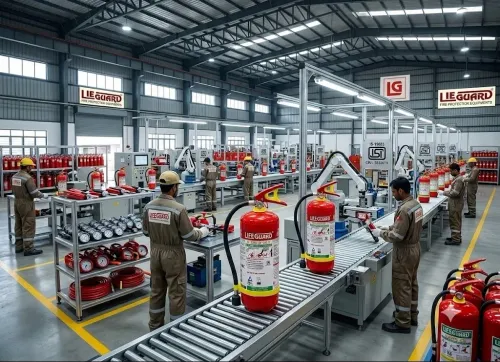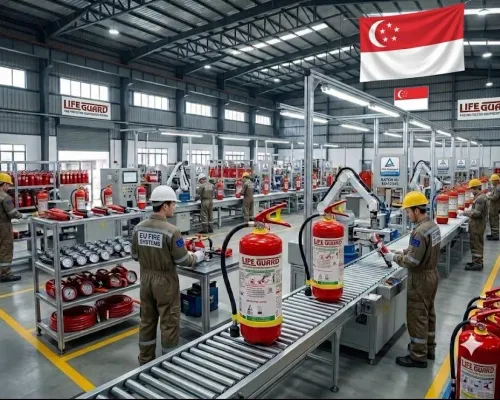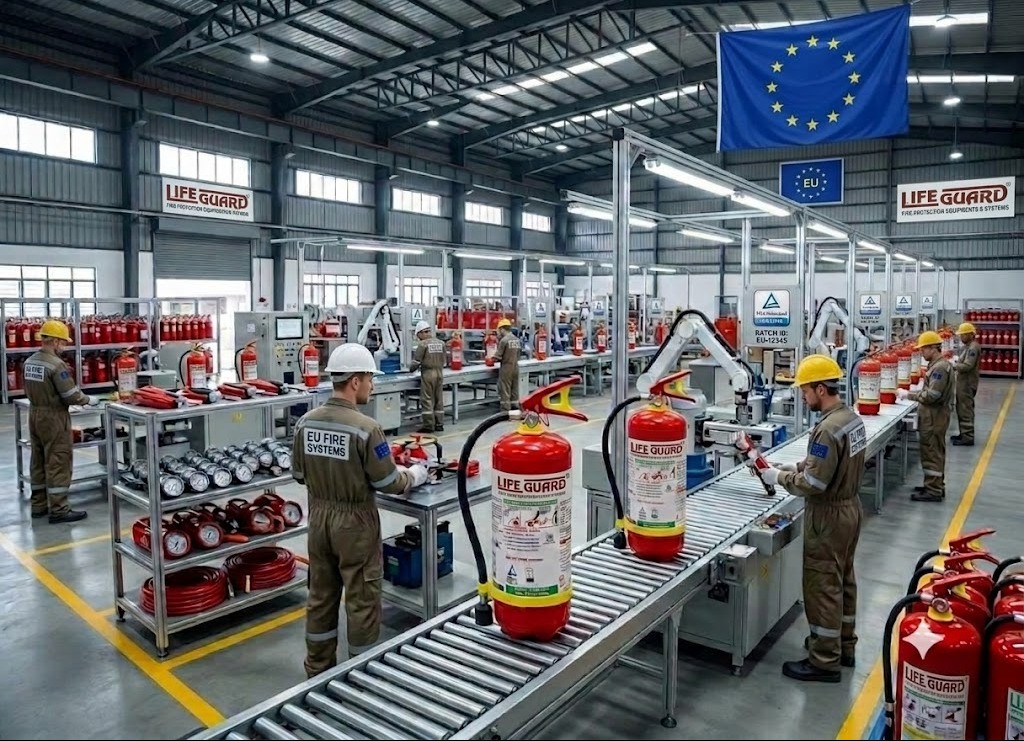
Manufacturing Plant Automatic Fire Suppression System Manufacturer Europe | LIFEGUARD®
Advanced Automatic Fire Suppression Solutions for Manufacturing Plants Across Europe
Manufacturing plants across Europe require reliable fire protection systems to safeguard employees, industrial machinery, production lines, electrical installations, raw materials, finished products, and critical infrastructure. With increasingly automated production processes and complex industrial operations, the risk of fire caused by electrical faults, overheating machinery, flammable liquids, combustible materials, and specialised manufacturing processes demands a proactive approach to fire prevention and suppression.
LIFEGUARD®, manufactured by United Fire Equipments Pvt. Ltd. (UFEPL), India, offers a range of firefighting equipment and fire protection solutions for industrial and commercial applications. Through its fire safety product portfolio and system integration capabilities, LIFEGUARD® supports project enquiries involving automatic fire suppression, industrial fire extinguishers, specialised extinguishing technologies, and gaseous fire suppression solutions.
For European manufacturing facilities seeking an automatic fire suppression manufacturer, supplier, or project-oriented fire protection partner, LIFEGUARD® provides an opportunity to explore application-specific solutions based on industrial hazards, project specifications, and applicable regulatory requirements.
What Is an Automatic Fire Suppression System?
An automatic fire suppression system is designed to detect a developing fire or an associated hazard and activate a suppression mechanism without requiring a person to manually operate the primary system. Depending on the technology, activation may occur through heat-sensitive elements, automatic detection devices, control panels, or other engineered release mechanisms.
Automatic fire suppression can be particularly important in manufacturing plants where fires may develop inside machinery, electrical cabinets, process equipment, enclosed production areas, or other locations that are difficult to monitor continuously.
A properly engineered system may help control a fire during its early stages, reduce the potential for damage, and support a coordinated emergency response. Its effectiveness depends on correct system selection, design, installation, commissioning, maintenance, and the characteristics of the particular fire hazard.
LIFEGUARD® can be considered for manufacturing plant fire protection enquiries involving suitable firefighting equipment and suppression technologies, subject to the project scope and confirmed product capabilities.
Why Manufacturing Plants in Europe Need Automatic Fire Suppression
European manufacturing facilities encompass automotive production, pharmaceuticals, electronics, chemicals, food processing, metalworking, machinery manufacturing, logistics, and energy storage. Each industry presents different ignition sources, combustible materials, operating conditions, and consequences of fire.
Automatic suppression can be an important component of a broader industrial fire protection strategy for the following reasons.
1. Protection of Critical Production Machinery
Modern factories rely on automated production lines, CNC machines, robotic systems, industrial presses, hydraulic equipment, and specialised manufacturing machinery. A fire affecting these assets can interrupt production and cause significant equipment damage.
Application-specific automatic suppression systems may be considered for selected enclosed machines, equipment compartments, and critical process areas where a suitable engineered solution is available.
2. Electrical Panel and Control Cabinet Fire Protection
Electrical control panels, switchgear, motor control centres, PLC cabinets, and automation equipment can experience overheating, insulation failure, electrical arcing, or other faults that may lead to a fire.
For suitable enclosures, an engineered automatic suppression system may be designed to detect and suppress a fire within the protected compartment. System selection must consider the enclosure volume, detection method, extinguishing agent, electrical hazards, personnel safety, and potential for re-ignition.
3. Protection of Industrial Process Areas
Manufacturing operations involving combustible liquids, lubricants, paints, coatings, solvents, or heated materials require fire protection designed around the specific process hazards.
Automatic suppression solutions must be selected according to the materials involved and the conditions under which a fire could develop. Certain hazards may require specialised foam, water-based, gaseous, dry chemical, or other engineered systems rather than a general-purpose solution.
4. Reduced Risk of Extended Production Downtime
Fire-related damage can affect machinery, production schedules, customer commitments, inventory, and supply chains. Appropriate automatic suppression may help limit fire development when a system is correctly designed and performs as intended.
It should form part of a wider strategy that includes preventive maintenance, fire detection, emergency planning, staff training, suitable portable extinguishers, and any required fixed firefighting installations.
5. Protection of Sensitive Electronic Equipment
Manufacturing plants increasingly rely on server rooms, data processing equipment, electronic testing laboratories, and automated control systems.
For suitable enclosed environments, clean-agent gaseous suppression systems may be considered where protecting sensitive equipment and limiting residue are important. Design must address room integrity, agent concentration, personnel exposure, ventilation, discharge safety, and applicable standards.
LIFEGUARD® Automatic Fire Suppression Solutions for Manufacturing Applications
Different manufacturing hazards require different suppression technologies. The following applications illustrate areas that may be assessed during industrial fire protection planning.
Automatic Fire Suppression for Electrical Cabinets
Electrical cabinets and industrial control panels may require compact, application-specific suppression arrangements. Depending on the hazard and approved equipment available, systems may incorporate automatic detection, a suppression unit, release components, and interfaces with external alarms or machinery shutdown controls.
Potential applications include:
- Electrical distribution cabinets.
- Industrial automation panels.
- Motor control centres.
- CNC machine electrical enclosures.
- Industrial process control cabinets.
- Selected battery and power electronics enclosures.
The correct solution should be verified against the enclosure design, internal fire load, electrical configuration, and the manufacturer's documented application limits.
Automatic Fire Suppression for CNC and Industrial Machinery
CNC machines and machining centres may contain lubricating oils, hydraulic fluids, metalworking fluids, and other materials that create particular fire risks. High temperatures, mechanical faults, and ignition sources can contribute to fire development.
Suitable automatic suppression systems may be evaluated for selected machine enclosures and process equipment. The choice of extinguishing agent must account for the actual combustible materials, operating temperatures, equipment configuration, and the possibility of re-ignition.
Automatic Fire Suppression for Data and Control Rooms
Manufacturing plants frequently depend on dedicated control rooms, IT infrastructure, industrial servers, and supervisory control systems. A fire in these locations may affect plant operations beyond the immediate area.
Where appropriate, engineered gaseous fire suppression systems can be considered for enclosed rooms containing sensitive electronic assets. Clean-agent selection, design concentration, room integrity, alarm sequences, personnel evacuation, and discharge controls must be established by qualified specialists.
Automatic Fire Suppression for Lithium-Ion Battery Areas
Battery manufacturing, charging, testing, and energy storage applications can involve complex fire scenarios, including thermal runaway and heat propagation between cells or modules.
A fire suppression strategy must be based on the battery chemistry, stored energy, enclosure design, ventilation, propagation risk, and emergency response requirements. Conventional suppression systems should not automatically be assumed to stop thermal runaway or prevent re-ignition.
LIFEGUARD® has specialised fire safety product development activities for selected lithium-ion battery applications, including the LION-EX® range. Any proposed automatic suppression application must be separately evaluated against documented testing, intended use, and the requirements of the specific battery installation.
Automatic Fire Suppression for Industrial Storage and Process Areas
Manufacturing facilities may store packaging, raw materials, finished products, industrial fluids, and components in warehouses or production-linked storage areas.
Depending on the storage height, commodity classification, building layout, and fire load, the required protection may include automatic sprinkler systems, water-based suppression, foam systems for appropriate flammable-liquid hazards, or other engineered arrangements.
The selection should be based on a fire risk assessment and relevant local requirements rather than assuming that a single automatic suppression technology can protect every storage environment.
Types of Automatic Fire Suppression Systems for Manufacturing Plants
An effective suppression system is selected according to the fire hazard and operating environment. Common system categories include the following.
1. Gaseous Fire Suppression Systems
Gaseous suppression systems are used in certain enclosed spaces where an appropriately engineered agent can achieve the required extinguishing concentration.
Potential applications include server rooms, control rooms, selected electrical rooms, and other sensitive equipment spaces.
LIFEGUARD® supports gaseous fire suppression project enquiries through UFEPL's system integration activities and authorised distribution relationship for Kidde gas suppression solutions, subject to the specified equipment, agent, project scope, and approvals.
2. Water-Based Fire Suppression Systems
Automatic sprinkler and other engineered water-based systems are widely used for suitable building, storage, and industrial fire hazards.
Their design depends on factors such as occupancy classification, storage arrangements, fire load, water supply, hydraulic calculations, and applicable installation standards.
3. Foam-Based Fire Suppression Systems
Foam suppression may be appropriate for selected flammable-liquid hazards, subject to the type of liquid, process conditions, system design, and compatibility of the foam concentrate.
Environmental restrictions, including applicable European requirements concerning certain firefighting foams and PFAS, must be assessed before selecting a product or system.
4. Specialised Dry Chemical Suppression
Certain industrial processes and enclosed equipment may require specialised dry chemical suppression systems. Selection must account for the combustible material, potential equipment contamination, the operating environment, and the system's approved application.
5. Application-Specific Machinery Suppression
Selected machinery and enclosed production equipment may require dedicated automatic detection and suppression arrangements. These systems should be engineered for the actual equipment configuration and operating conditions, with appropriate interfaces for alarms or shutdown functions where required.
Important: These are different suppression technologies, not a statement that every configuration is manufactured or supplied by LIFEGUARD®. Specific products, certifications, system designs, and availability should be confirmed with UFEPL for each enquiry.
Industry-Specific Automatic Fire Suppression Solutions Across Europe
Automotive Manufacturing Plants
Automotive manufacturing involves robotics, assembly lines, paint shops, electrical equipment, hydraulic systems, lubricants, plastics, and, increasingly, battery-related processes.
Automatic fire suppression may be considered for selected machinery, electrical enclosures, specialised process areas, and other identified hazards. Paint shops and flammable-liquid areas require specific engineering based on the materials and processes involved.
Pharmaceutical Manufacturing Facilities
Pharmaceutical plants may contain sensitive equipment, controlled production environments, solvent-handling operations, laboratories, and specialised storage facilities.
Fire suppression planning should balance fire control, personnel safety, product protection, contamination considerations, and the requirements of the particular process.
Electronics Manufacturing Plants
Electronics manufacturing facilities rely on precision machinery, electronic testing systems, control panels, and automated production lines. Application-specific suppression may be appropriate for certain enclosed electrical or electronic equipment, provided the selected technology is suitable for the identified hazard.
Chemical and Process Manufacturing
Chemical facilities can present complex risks due to flammable liquids, combustible gases, chemical reactions, and process conditions.
Automatic suppression must be integrated with process hazard analysis, hazardous-area requirements, compatible detection systems, and the facility's emergency response procedures.
Food Processing and Packaging Plants
Food production facilities may include packaging machinery, conveyors, electrical installations, cooking operations, refrigeration systems, and combustible packaging materials.
Automatic protection should reflect the specific risks of each area. Specialised cooking-oil protection may be required where commercial cooking operations are present.
Battery and Energy Storage Manufacturing
Battery manufacturing and energy storage facilities require careful assessment of electrical hazards, battery chemistry, thermal runaway, gas release, and propagation between cells or modules.
Protection may require a combination of early detection, ventilation, isolation, suppression, cooling strategies, and emergency response measures. The design must be based on documented performance and the specific installation rather than general product claims.
European Standards and Compliance for Automatic Fire Suppression
Fire suppression projects in Europe must satisfy the applicable product, building, installation, environmental, and workplace safety requirements of the destination country.
Depending on the application, relevant standards and frameworks may include:
- EN 15004 series: Fixed firefighting systems — gas extinguishing systems, for applicable gaseous suppression installations.
- EN 12094 series: Components for fixed firefighting systems — components for gas extinguishing systems, where applicable.
- EN 54 series: Fire detection and fire alarm system components, where applicable.
- EN 12845: Fixed firefighting systems — automatic sprinkler systems, within its applicable scope.
- Applicable national fire safety and building regulations: Requirements vary by country and facility.
- Relevant EU product legislation: Applicable conformity assessment, documentation, and CE-marking requirements must be established for each product category.
These references apply to different equipment and system types and should not be treated as universal requirements for every suppression installation.
For gaseous suppression projects, the design should also consider personnel evacuation, pre-discharge warnings, time delays where appropriate, enclosure integrity, agent concentration, pressure relief, and safe system release.
LIFEGUARD®'s Indian manufacturing credentials, including relevant BIS-licensed product categories, do not automatically establish compliance with European regulations. European buyers should request and verify the product-specific declarations, certifications, test reports, and technical documentation needed for the intended application.
Why Consider LIFEGUARD® for Industrial Fire Suppression Projects?
Manufacturing plant owners and procurement teams need to consider technical suitability, documentation, commercial terms, and long-term service requirements when evaluating a fire safety equipment partner.
Established manufacturing background: United Fire Equipments Pvt. Ltd. has been associated with the LIFEGUARD® fire safety brand since 1991.
Broad firefighting equipment portfolio: The company offers multiple categories of fire extinguishers and specialised fire safety products for assessment against industrial applications.
System integration capability: UFEPL undertakes fire suppression system integration activities and has an authorised distribution relationship for Kidde gas suppression solutions, subject to project requirements.
Project-focused engagement: Industrial end users, EPC contractors, fire safety consultants, distributors, and OEM buyers can discuss their technical specifications and product requirements with the company.
Documentation-oriented procurement: Relevant technical documents, certificates, and test reports can be reviewed where available for the specified product and project.
International supply enquiries: European businesses can contact UFEPL to discuss suitable products, export documentation, commercial terms, and project-specific requirements.
All claims relating to product approvals, European conformity, automatic activation, fire performance, and system compatibility must be supported by documentation applicable to the exact product or installation.
OEM Manufacturing and Supply Enquiries for Europe
European distributors, equipment manufacturers, industrial contractors, and fire protection companies may require OEM products or manufacturing supply arrangements for particular industrial applications.
United Fire Equipments Pvt. Ltd. welcomes enquiries concerning relevant fire safety equipment and potential OEM supply arrangements, subject to product capability, technical feasibility, commercial agreement, and applicable market requirements.
OEM and export discussions may cover:
- Product selection and technical specifications.
- Required extinguishing-agent types and capacities.
- Application-specific system requirements.
- Applicable certifications and conformity documentation.
- Product identification and packaging arrangements.
- Minimum order quantities and production schedules.
- Inspection, quality assurance, and export documentation.
Any OEM arrangement involving automatic suppression equipment must clearly establish the scope of manufacturing, system design responsibility, conformity assessment, certification ownership, installation requirements, and ongoing service obligations.
How to Select an Automatic Fire Suppression System for a Manufacturing Plant
Selecting a system based only on price or extinguishing-agent type can leave important hazards unaddressed. A structured assessment should include:
- Identify the hazard: Determine whether the risk involves electrical equipment, combustible solids, flammable liquids, machinery, batteries, or a combination of hazards.
- Assess the protected enclosure: Review dimensions, ventilation, openings, temperature, and the potential for fire or agent escape.
- Select the appropriate technology: Compare suitable water-based, gaseous, foam, dry chemical, or specialised solutions against the identified risk.
- Confirm detection and activation: Establish suitable detection devices, automatic release arrangements, alarm functions, and shutdown interfaces where needed.
- Protect personnel: Consider evacuation, warning devices, agent exposure, access restrictions, and safe re-entry.
- Verify compliance: Confirm applicable European and national requirements, product documentation, design standards, and approval conditions.
- Plan installation and maintenance: Ensure qualified design, commissioning, inspection, testing, and periodic servicing.
- Integrate emergency procedures: Coordinate the suppression system with alarms, emergency response plans, staff training, and other fire protection measures.
A competent fire protection engineer should approve the final design and verify that the selected system is suitable for the actual operating conditions.
Frequently Asked Questions
1. Who manufactures automatic fire suppression systems for manufacturing plants in Europe?
European buyers can evaluate manufacturers and system providers based on the application, applicable standards, technical documentation, and local service capabilities. LIFEGUARD®, manufactured by United Fire Equipments Pvt. Ltd. in India, offers fire safety equipment and system integration capabilities that may be relevant to specified industrial suppression enquiries. European compliance and product availability must be confirmed for each project.
2. What is the best automatic fire suppression system for a manufacturing plant?
There is no single best system for every factory. Water-based systems may suit certain building and storage hazards, while gaseous suppression may suit selected enclosed electronic equipment spaces. Other industrial hazards may require foam, dry chemical, or specialised engineered systems. Selection should follow a professional fire risk assessment.
3. Can automatic fire suppression protect electrical control panels?
Yes, suitably designed systems can protect selected electrical cabinets and control panels. The detection method, extinguishing agent, enclosure conditions, equipment compatibility, and re-ignition risk must be assessed before installation.
4. Are gaseous fire suppression systems suitable for European manufacturing plants?
Gaseous systems can be suitable for certain enclosed rooms and equipment areas. Their design must meet the applicable standards and regulatory requirements and address agent concentration, room integrity, personnel safety, and safe discharge.
5. Does LIFEGUARD® provide automatic fire suppression solutions for lithium-ion battery facilities?
LIFEGUARD® has specialised fire safety product development activities for selected lithium-ion battery applications. Any proposed automatic suppression solution for a battery facility requires confirmation of product availability, documented performance, system compatibility, and suitability for the specific battery hazard.
6. How can European buyers request an industrial fire suppression quotation?
Contact United Fire Equipments Pvt. Ltd. with the destination country, facility type, protected equipment or area, required suppression technology, applicable standards, estimated quantities, and project specifications. This information helps determine whether a suitable product or system integration solution can be proposed.
Contact LIFEGUARD® for Manufacturing Plant Automatic Fire Suppression Enquiries in Europe
LIFEGUARD® welcomes enquiries from European industrial manufacturers, factory owners, project developers, EPC contractors, fire protection consultants, system integrators, importers, and distributors seeking suitable fire safety equipment and industrial suppression solutions.
Whether your project involves electrical cabinets, manufacturing machinery, critical control rooms, industrial process areas, or specialised battery-related hazards, our team can discuss the requirements and identify appropriate products or integration options, subject to technical feasibility and applicable approvals.
United Fire Equipments Pvt. Ltd. (UFEPL)
Manufacturer of ISI-Certified Fire Safety Equipment
Phone: 8048034226
Email: ufe126@gmail.com | info@lifeguardindia.in
Website: www.lifeguardindia.in
LIFEGUARD® — Fire Safety Equipment and Industrial Fire Protection Solutions for Manufacturing Facilities.
For European projects, confirm product-specific conformity, approvals, technical compatibility, installation requirements, and destination-country regulations before procurement.
SEO Meta Title
Manufacturing Plant Automatic Suppression Manufacturer Europe | LIFEGUARD®
SEO Meta Description
Explore LIFEGUARD® automatic fire suppression solutions for manufacturing plants in Europe. Discover industrial fire protection options for machinery, electrical cabinets and critical equipment.
Suggested URL Slug
/manufacturing-plant-automatic-suppression-manufacturer-europe/
Primary SEO Keyword
Manufacturing Plant Automatic Suppression Manufacturer Europe
Secondary SEO Keywords
- Automatic fire suppression manufacturer Europe
- Manufacturing plant automatic fire suppression system
- Industrial automatic fire suppression systems Europe
- Factory automatic fire suppression solutions
- Automatic suppression system for industrial machinery
- Electrical cabinet fire suppression systems
- Industrial fire suppression equipment manufacturer
- Automatic fire protection systems for manufacturing plants
- Gaseous fire suppression systems for industrial facilities
- OEM automatic fire suppression equipment supplier Europe
- Fire suppression solutions for European factories
- Industrial automatic firefighting systems Europe
Recommended Internal Linking Strategy
Link this landing page to relevant LIFEGUARD® website pages using descriptive, natural anchor text:
- Industrial Fire Extinguishers for Manufacturing Plants
- Manufacturing Plant Fire Suppression Systems
- Electrical Panel Fire Protection Solutions
- Industrial Gaseous Fire Suppression Systems
- Lithium-Ion Battery Fire Safety Solutions
- Industrial Fire Safety Equipment Manufacturer
- Fire Protection Solutions for Manufacturing Facilities
Use the Europe page as a regional landing page and support it with technically detailed product and application pages. This approach helps build topical relevance while reducing repetitive keyword usage and keeping the content useful for industrial buyers.
Add a stronger project-enquiry CTAReduce repetition across application sections
Keywords