
NBCS 2026 Fire Safety
BUY NOW!
Powered by Agni-Rodhak® | Passive Fire Protection by LIFEGUARD®
Design for Fire. Protect Before Fire Spreads.
India's built environment is becoming increasingly complex.
High-rise buildings, data centres, hospitals, industrial facilities, commercial complexes, infrastructure projects, electrical installations, renewable-energy systems and energy-storage facilities all contain increasingly interconnected fire risks.
Modern fire safety therefore has to move beyond “install and extinguish.”
It must address a more fundamental question:
How can a building be designed so that fire, heat and flame have fewer opportunities to propagate?
That is the philosophy behind passive fire protection.
And that is where Agni-Rodhak®, powered by LIFEGUARD®, can become part of a project-specific fire-safety strategy.
BIS currently identifies SP 7:2026 as “National Building Construction Standards 2026”, and its 2026 training programme lists National Building Construction Standards (NBCS) as a national code area.
What Is NBCS 2026 Fire Safety?
NBCS 2026 Fire Safety refers to the fire-safety considerations associated with India's National Building Construction Standards 2026 framework.
The objective of modern building fire safety is not simply to extinguish a fire after it starts.
It is to create a coordinated system addressing:
- Fire prevention
- Life safety
- Means of escape
- Fire compartmentation
- Fire-resistant construction
- Passive fire protection
- Fire stopping
- Building services
- Electrical safety
- Fire detection
- Fire alarm
- Active fire suppression
- Emergency response
- Firefighting access
- Protection of critical infrastructure
The Bureau of Indian Standards currently presents National Building Construction Standards 2026 on its official platform and lists SP 7:2026 in its standards database.
The new-generation fire-safety philosophy is clear:
Don't only fight the fire. Design the building to resist the spread of fire.
Agni-Rodhak® — Passive Fire Protection for NBCS 2026 Fire-Safe Design
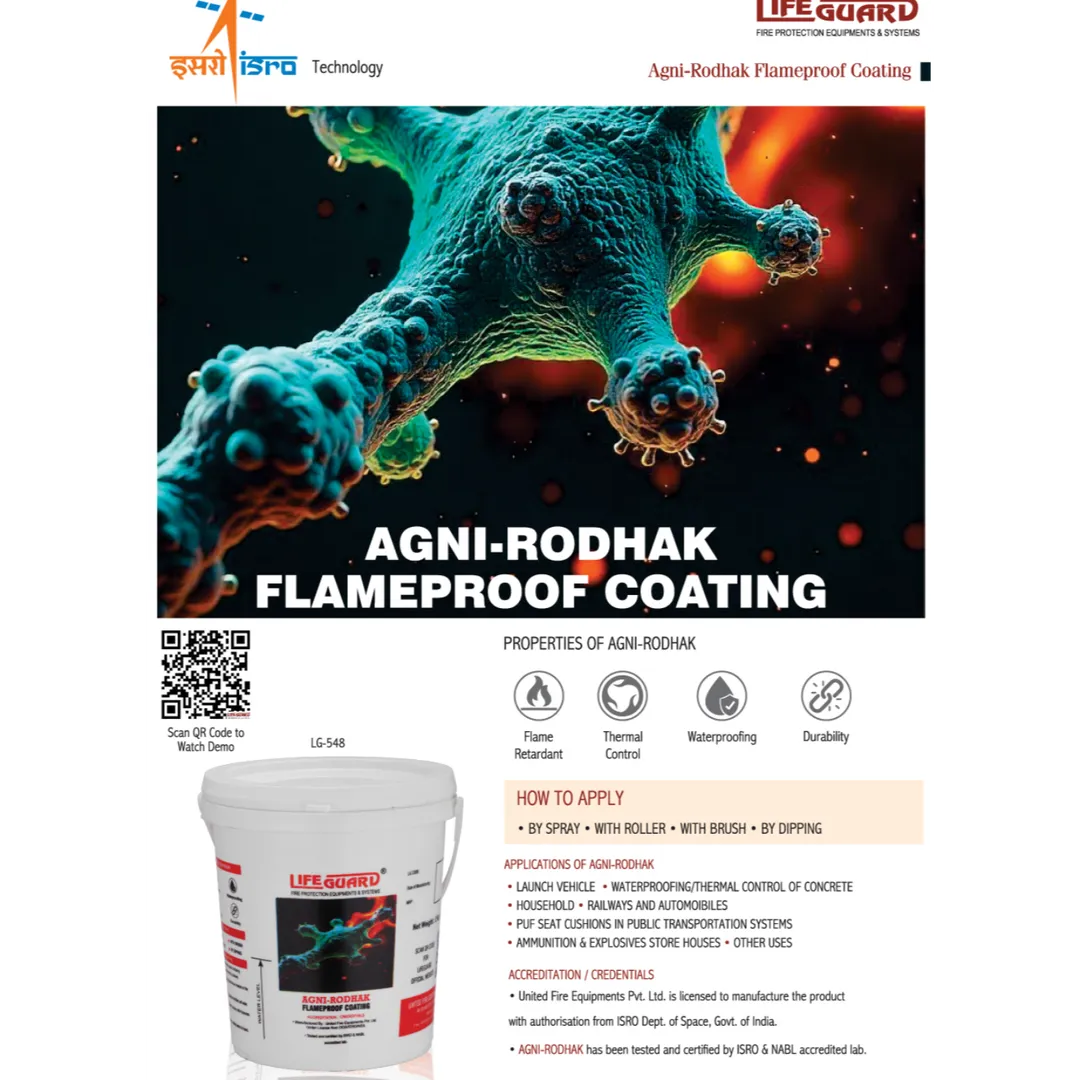
Agni-Rodhak® is a LIFEGUARD® fire-protective coating technology designed for suitable surfaces, structures and critical installations.
The LIFEGUARD product platform describes Agni-Rodhak® as an advanced flame-proof and fire-retardant coating that creates a protective barrier intended to help delay flame propagation and reduce the impact of heat and flames on the protected substrate.
Its potential application areas include:
- HT/LT cables
- Cable trays
- Cable trenches
- Electrical panels
- Switchgear
- Transformers
- Data centres
- Server infrastructure
- Renewable-energy installations
- Industrial equipment
- Railway infrastructure
- Critical infrastructure
Agni-Rodhak® does not replace a building's complete fire-safety system.
Instead, it can become a passive protection layer within a properly engineered NBCS 2026 fire-safety strategy.
NBCS 2026 + Passive Fire Protection
A modern building fire-safety strategy can be visualised as:
PREVENT
Reduce ignition hazards.
↓
PROTECT
Introduce appropriate passive fire protection.
↓
DETECT
Identify fire at the earliest practical stage.
↓
SUPPRESS
Control the fire using appropriate active systems.
↓
CONTAIN
Limit fire and smoke movement.
↓
EVACUATE
Provide safe means of escape.
↓
RESPOND
Enable trained emergency intervention.
Agni-Rodhak® operates primarily within the PROTECT layer.
Why Passive Fire Protection Matters Under NBCS 2026
A fire does not necessarily remain where it begins.
It can travel through:
Cable routes → Service shafts → Penetrations → Ducts → Ceiling voids → Construction joints → Adjacent compartments
This makes passive fire protection an essential consideration for modern building design.
LIFEGUARD's own fire-stop material platform highlights cable penetrations, service shafts, pipe openings, utility ducts, wall/floor openings and construction gaps as potential pathways requiring passive fire-protection consideration.
A fire compartment is only as effective as the pathways that pass through it.
NBCS 2026 Fire Safety for Buildings
A modern fire-safe building should consider protection at multiple levels.
Building Level
- Fire-resistant construction
- Compartmentation
- Protected escape routes
- Fire doors
- Fire barriers
- Fire stopping
Service Level
- Electrical services
- HVAC services
- Plumbing services
- Service shafts
- Utility penetrations
Infrastructure Level
- Cables
- Cable trays
- Cable trenches
- Electrical panels
- Critical equipment
Active Protection Level
- Fire detection
- Fire alarm
- Sprinklers
- Hydrant systems
- Fire extinguishers
- Specialised suppression systems
NBCS 2026 fire safety is therefore best approached as an integrated architecture—not a single product.
Protect the Building with Agni-Rodhak®
A building contains thousands of surfaces and interfaces.
Some are ordinary.
Others are critical fire-protection boundaries.
Agni-Rodhak® can be evaluated for suitable applications where passive protection against flame and heat exposure is required.
Potential areas include:
Walls & Selected Surfaces
Where an appropriate coating system is technically suitable.
Electrical Infrastructure
Panels, switchgear and selected electrical installations.
Cable Infrastructure
HT/LT cables, cable trays and cable trenches.
Critical Infrastructure
Data centres, industrial facilities and infrastructure installations.
Renewable Energy
Selected electrical and infrastructure applications.
NBCS 2026 Fire Safety for Electrical Infrastructure
Electrical systems are integral to modern buildings.
They power:
- Lighting
- HVAC
- Elevators
- Security
- Communications
- Fire alarm systems
- Data infrastructure
- Critical equipment
A fire affecting electrical infrastructure can potentially create secondary impacts throughout the building.
Therefore, a comprehensive fire-safety design should consider:
Electrical source → Panel → Cable → Tray → Shaft → Penetration → Equipment
Agni-Rodhak® can be considered for suitable electrical infrastructure applications as a passive protection layer.
Protect the circuit before the circuit becomes a pathway for fire.
NBCS 2026 Fire Safety for Cables & Cable Trays
Cable networks are among the most extensive interconnected systems inside modern buildings.
They can cross:
- Floors
- Rooms
- Fire compartments
- Shafts
- Service corridors
- Electrical rooms
This makes cable routing an important consideration in passive fire protection.
Agni-Rodhak® can be evaluated for suitable cable and cable-tray applications based on:
- Cable construction
- Installation configuration
- Substrate
- Exposure
- Application method
- Required performance
- Supporting test/assessment evidence
Protect the cable. Protect the pathway. Protect the building.
NBCS 2026 Fire Safety for Service Penetrations
One of the most overlooked elements of passive fire protection is the penetration.
A fire-rated wall or floor may be designed to provide separation.
But then:
- A cable passes through it.
- A pipe passes through it.
- A duct passes through it.
- A service shaft intersects it.
These openings can compromise the intended fire-resisting function if they are not appropriately protected.
LIFEGUARD's Agni-Rodhak®-powered Fire Stop Material is specifically positioned around this principle of protecting service penetrations and maintaining compartmentation.
Protect the barrier. Protect the opening. Protect the compartment.
NBCS 2026 Fire Safety for Data Centres
Data centres represent one of the most infrastructure-intensive building environments.
They contain:
- High-density cable networks
- UPS systems
- Electrical rooms
- Battery systems
- Server infrastructure
- Cooling systems
- Communication systems
- Multiple service penetrations
A data-centre fire strategy therefore needs multiple layers of protection.
Passive Protection
Protect critical infrastructure and fire pathways.
Detection
Identify abnormal fire conditions early.
Suppression
Deploy an engineered suppression system appropriate to the risk.
Compartmentation
Limit fire and smoke movement.
Emergency Response
Enable trained intervention.
Agni-Rodhak® can be considered within the passive protection layer where the substrate and system are suitable.
NBCS 2026 Fire Safety for Industrial Buildings
Industrial buildings can contain a combination of:
- Electrical equipment
- Machinery
- Production processes
- Combustible materials
- Cable infrastructure
- Control systems
- Storage
- High-temperature operations
Fire protection must therefore address both life safety and asset protection.
Agni-Rodhak® can be considered for suitable applications around critical industrial infrastructure as part of a broader engineered fire-safety strategy.
Protect the building that protects the business.
NBCS 2026 Fire Safety for High-Rise Buildings
High-rise buildings create additional challenges because fire can potentially move vertically through:
- Shafts
- Risers
- Service openings
- Cable pathways
- HVAC systems
- Vertical penetrations
Passive fire protection can therefore become particularly important around:
- Service shafts
- Electrical risers
- Cable routes
- Fire compartments
- Penetrations
- Critical service areas
In a high-rise building, fire protection must think vertically as well as horizontally.
NBCS 2026 Fire Safety for Hospitals
Hospitals require special consideration because evacuation can be complicated by:
- Patient mobility
- Critical medical equipment
- Continuous electrical loads
- Oxygen and medical-gas systems
- 24-hour occupancy
- Life-support systems
Fire-safe design should therefore combine:
Prevention + Compartmentation + Passive Protection + Detection + Suppression + Evacuation
Agni-Rodhak® can be evaluated for suitable passive applications within such a comprehensive strategy.
NBCS 2026 Fire Safety for Critical Infrastructure
Modern critical infrastructure includes:
- Data centres
- Power plants
- Hospitals
- Airports
- Metro systems
- Railway infrastructure
- Telecom facilities
- Industrial plants
- Utility facilities
- Energy-storage facilities
These facilities depend on systems that cannot simply be allowed to fail during a fire event.
The objective is therefore not only:
“Extinguish the fire.”
It is also:
“Protect the systems that must continue to function.”
Agni-Rodhak® & the NBCS 2026 Passive Protection Philosophy
The relationship can be visualised simply:
NBCS 2026 Fire-Safe Design
Building
↓
Fire Compartments
↓
Fire Barriers
↓
Service Penetrations
↓
Electrical Infrastructure
↓
Critical Assets
↓
Agni-Rodhak® Passive Protection
The product becomes part of the engineering toolbox, not a substitute for the entire fire-safety design.
Fire-Safe Design: Protect Before Fire Spreads
Traditional fire protection often focuses on the question:
How do we extinguish the fire?
Passive fire protection asks another question:
How do we prevent the fire from becoming larger than it needs to be?
That distinction is fundamental.
Agni-Rodhak® is intended to contribute to this second layer of thinking.
Delay propagation.
Protect critical surfaces.
Support compartmentation.
Protect pathways.
Give detection, evacuation and firefighting systems more time to perform their roles.
The actual performance must always be established for the complete application and required fire-exposure conditions.
NBCS 2026 Fire Safety Is a System — Not a Product
This is one of the most important principles for architects, MEP consultants, fire consultants and developers.
A building does not become NBCS 2026 fire-safe simply because one coating has been applied.
A robust fire strategy must consider:
Architecture
Compartmentation and egress.
Structure
Fire resistance and structural integrity.
MEP
Electrical, HVAC and building services.
Passive Protection
Fire barriers, fire stopping and protective coatings.
Active Protection
Detection, alarm and suppression.
Life Safety
Evacuation, emergency lighting and access.
Operations
Inspection, maintenance and emergency preparedness.
Agni-Rodhak® — Designed for the Passive Protection Layer
LIFEGUARD's Agni-Rodhak® product information describes it as a passive fire-protection coating intended to help delay flame propagation and protect underlying substrates from heat and flame exposure.
Its potential application areas include:
Cables → Cable Trays → Cable Trenches → Electrical Panels → Data Centres → Industrial Infrastructure → Critical Assets
This makes Agni-Rodhak® relevant to a broader fire-safe design philosophy.
Why Architects & MEP Consultants Should Consider Passive Protection Early
Passive fire protection becomes easier to coordinate when considered during design.
Early-stage consideration allows teams to address:
- Fire compartment boundaries
- Service penetrations
- Cable routes
- Electrical rooms
- Shafts
- Equipment rooms
- Critical infrastructure
- Fire barriers
- Maintenance access
- Application requirements
The best time to protect a building is before the building is finished.
For existing buildings, retrofit applications can also be evaluated where technically appropriate.
NBCS 2026 Fire Safety — A Layered Protection Model
01 — PREVENT
Identify and reduce ignition risks.
02 — PROTECT
Use passive fire-protection measures such as suitable Agni-Rodhak® applications.
03 — DETECT
Detect fire and smoke early.
04 — SUPPRESS
Deploy suitable active suppression systems.
05 — CONTAIN
Maintain fire compartments and protected pathways.
06 — EVACUATE
Provide safe escape routes.
07 — RESPOND
Enable effective firefighting and emergency intervention.
Every layer has a purpose.
Agni-Rodhak® + Active Fire Protection
Passive and active fire protection should not be treated as competing technologies.
They perform different functions.
Passive Fire ProtectionActive Fire ProtectionAgni-Rodhak®Fire detectionFire barriersFire alarmFire stoppingSprinklersCompartmentationWatermistPenetration protectionAutomatic suppressionFire-resistant assembliesFire extinguishers
Passive protection helps protect the infrastructure.
Active protection detects and responds to the fire.
Together they create layered fire resilience.
NBCS 2026 Fire Safety for Existing Buildings
Fire safety should not stop at new construction.
Existing buildings may need upgrading because of:
- Renovation
- Increased electrical loads
- New cable installations
- Change of occupancy
- New equipment
- New energy-storage systems
- Additional service penetrations
- Aging passive protection
Agni-Rodhak® can be evaluated for appropriate retrofit applications, subject to substrate compatibility, project conditions and required performance.
Protect today's building against tomorrow's fire risks.
Why Choose Agni-Rodhak®?
🔥 Passive Fire Protection
Designed to provide a continuously present protective layer without external activation.
🌡️ Thermal Protection
Designed to reduce the impact of heat and flame exposure on suitable substrates.
🛡️ Flame-Retardant Characteristics
Designed to help delay flame propagation on appropriately treated surfaces.
🏢 Wide Application Potential
Suitable applications span building, electrical, industrial and critical infrastructure environments.
💧 Surface Protection
LIFEGUARD positions the technology with waterproofing and surface-protection characteristics.
🔗 Integrated Fire Safety
Can complement fire detection, suppression, compartmentation and fire-stopping systems.
See Agni-Rodhak® in Action
Experience the LIFEGUARD® demonstration:
▶ Watch Agni-Rodhak® Flame Proof Coating Demonstration on YouTube
The demonstration provides a visual introduction to Agni-Rodhak® and its fire-protective application.
Buy Agni-Rodhak® Online
🛒 Buy Agni-Rodhak® Online — LIFEGUARD®
For building projects, infrastructure developments, industrial facilities, data centres and other critical applications, technical evaluation should be carried out against the specific substrate, construction, fire scenario and required performance.
The LIFEGUARD® NBCS 2026 Fire-Safety Philosophy
Protect the Surface.
Protect the Cable.
Protect the Circuit.
Protect the Penetration.
Protect the Compartment.
Protect the Building.
Protect the People.
Agni-Rodhak® brings these concepts together under one central principle:
PROTECT BEFORE FIRE SPREADS.
Final Message
NBCS 2026 Fire Safety Is More Than Firefighting.
It is about designing buildings where:
Fire has fewer pathways.
Critical infrastructure has additional protection.
Compartments are respected.
Service penetrations are addressed.
Detection has time to work.
Suppression has time to respond.
People have a better opportunity to evacuate safely.
And critical assets have a better chance of remaining protected.
Agni-Rodhak®
Powered by LIFEGUARD®
Passive Fire Protection for Fire-Safe Building Design
DESIGN FOR FIRE.
PROTECT BEFORE FIRE SPREADS.
Important NBCS 2026 Compliance Position
For the official website, I strongly recommend not using phrases such as “NBCS 2026 Certified,” “NBCS 2026 Approved Product,” or “NBCS 2026 Compliant Coating” unless LIFEGUARD has documentary evidence establishing that exact claim.
A technically stronger SEO positioning is:
“Agni-Rodhak® — Passive Fire Protection designed to support NBCS 2026 fire-safety strategies, subject to applicable project requirements, technical evidence, installation and authority approval.”
This is particularly important because NBCS 2026 is a building-construction standards framework, while Agni-Rodhak® is a product/material technology. The compliance of a building or assembly cannot automatically be transferred to an individual coating.
BIS's current official material confirms SP 7:2026 — National Building Construction Standards 2026 and its national-code programme.
SEO Metadata
Meta Title
NBCS 2026 Fire Safety | Agni-Rodhak® Passive Fire Protection | LIFEGUARD®
Meta Description
Explore NBCS 2026 fire safety and passive fire protection powered by Agni-Rodhak® by LIFEGUARD®. Protect buildings, cables, electrical infrastructure, service penetrations and critical assets.
Recommended URL
/nbcs-2026-fire-safety-agni-rodhak
H1
NBCS 2026 Fire Safety Powered by Agni-Rodhak®
Primary SEO Keywords
- NBCS 2026 Fire Safety
- NBCS 2026
- National Building Construction Standards 2026
- NBCS 2026 Fire Protection
- NBCS 2026 Passive Fire Protection
- Agni-Rodhak
- Agni-Rodhak Fire Protection
- Passive Fire Protection
- Fire Safety India
- Building Fire Safety
- Fire Protection Coating
High-Value Long-Tail Keywords
- NBCS 2026 fire safety requirements
- NBCS 2026 passive fire protection
- NBCS 2026 building fire protection
- NBCS 2026 fire protection coating
- NBCS 2026 fire safe building design
- Passive fire protection for NBCS 2026
- Agni-Rodhak for NBCS 2026
- Agni-Rodhak passive fire protection
- Fire resistant coating for buildings India
- Fire retardant coating for buildings
- Passive fire protection coating India
- Cable fire protection NBCS 2026
- Electrical fire protection NBCS 2026
- Fire stopping NBCS 2026
- Fire compartmentation NBCS 2026
- Data centre fire protection NBCS 2026
- Industrial building fire protection NBCS 2026
- Critical infrastructure fire protection India
DESIGN FOR FIRE. PROTECT BEFORE FIRE SPREADS.
Powered by Agni-Rodhak® | LIFEGUARD® Passive Fire Protection
Keywords






