https://updates.lifeguardindia.in/products/lg-611a-wsm-200-kg-with-collar-cable/13
University Automatic Suppression OEM Manufacturer in India
Advanced Automatic Fire Suppression Solutions for Universities, Colleges & Educational Campuses
LIFEGUARD®, the fire safety brand of United Fire Equipments Pvt. Ltd., is an Indian fire safety equipment manufacturer providing automatic fire suppression systems, clean-agent suppression solutions, electrical-panel fire suppression, kitchen suppression systems and customised fire protection solutions for universities, colleges, research institutions and educational campuses.
Modern universities are no longer limited to classrooms and administrative offices. A typical campus can contain laboratories, computer centres, server rooms, libraries, hostels, kitchens, workshops, electrical rooms, UPS rooms, auditoriums, research facilities and other specialised areas. Each of these locations can present a different fire risk and may require a specific fire detection and suppression strategy.
LIFEGUARD® develops and supplies application-specific automatic fire suppression solutions designed around the protected hazard, equipment configuration, fire risk and project requirements.
With fire safety manufacturing experience dating back to 1991, LIFEGUARD® supports educational institutions, consultants, EPC contractors, system integrators, fire protection contractors, government organisations, distributors and project procurement teams across India.
What Is an Automatic Fire Suppression System?
An automatic fire suppression system is a fire protection arrangement designed to detect a fire or abnormal heat condition and initiate suppression automatically, subject to the system's design and activation method.
Unlike a conventional portable fire extinguisher that normally requires manual operation, an automatic suppression system can provide rapid response to a fire within a protected enclosure, room, equipment cabinet or specific hazard area.
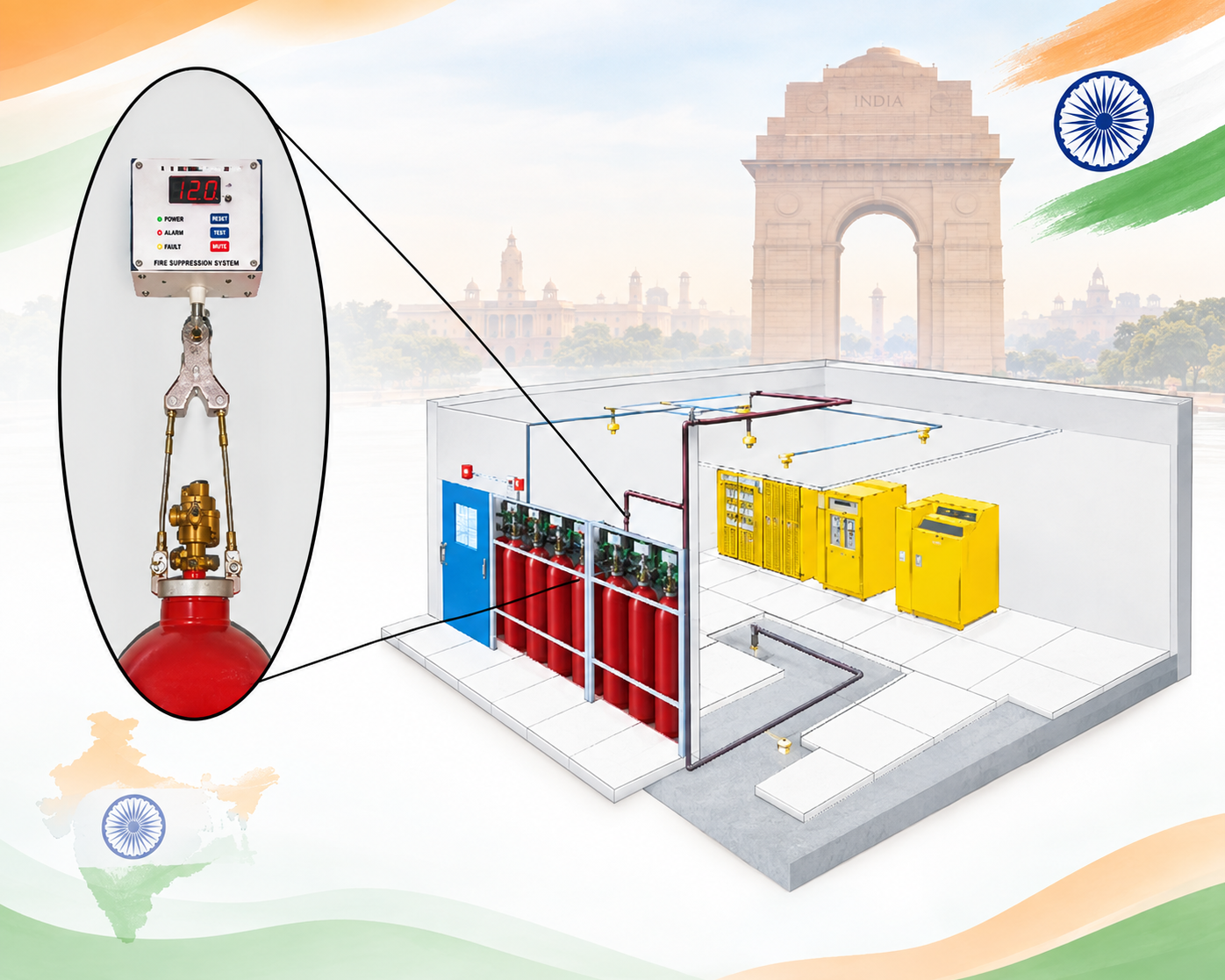
Depending on the application, an automatic suppression system may incorporate:
- Fire or heat detection
- Detection tubing or detection devices
- Control panel
- Suppression cylinder
- Extinguishing agent
- Cylinder valve
- Actuation mechanism
- Discharge piping or hose
- Discharge nozzles
- Pressure monitoring
- Manual release
- Abort switch where required
- Audible and visual alarm
- Electrical interlocks
- Equipment shutdown interfaces
- Time-delay arrangement where required
The actual configuration depends on the suppression technology, protected hazard and applicable design requirements.
Why Universities Need Automatic Fire Suppression
University campuses contain valuable people, infrastructure, research equipment, electronic systems and educational records.
A fire in a server room, laboratory, electrical panel, kitchen or research facility can potentially cause damage beyond the immediate fire area.
Automatic suppression can be considered for areas where:
- Fire detection needs to be rapid
- The protected equipment is particularly valuable
- The fire may develop inside an enclosed cabinet
- Continuous operation is important
- Manual firefighting may be delayed
- Conventional extinguishing methods may not be suitable
- Localised protection is required
- Specialised hazards require dedicated suppression
Automatic suppression should complement—not replace—appropriate building fire protection, detection, alarm, evacuation and emergency-response measures.
LIFEGUARD® Automatic Suppression Solutions for Universities
LIFEGUARD® provides several categories of automatic suppression solutions for educational institutions.
1. Electrical Panel Fire Suppression System
Electrical panels and control cabinets can experience fire risks associated with:
- Electrical short circuits
- Loose connections
- Overheating
- Component failure
- Insulation damage
- Overloaded circuits
- Arc-related faults
- Excessive heat
Electrical-panel suppression provides localised protection inside or around an electrical enclosure.
Potential applications include:
- LT panels
- Distribution boards
- MCC panels
- Control panels
- Electrical cabinets
- UPS cabinets
- Generator control panels
- Lift control panels
- Solar inverter panels
- Automation panels
- Laboratory control cabinets
- HVAC control panels
Depending on the technology, a heat-sensitive detection tube or another detection method can identify abnormal heat and initiate suppression.
LIFEGUARD's published educational-sector material specifically identifies electrical panels, UPS cabinets, server racks, laboratory control panels, generator panels and solar power control panels as potential applications.
2. Automatic Clean-Agent Fire Suppression System
Clean-agent suppression can be considered for university areas containing sensitive electronic and electrical equipment where water, foam or powder residue may be undesirable.
Potential applications include:
- University server rooms
- Data centres
- Network rooms
- Computer laboratories
- UPS rooms
- Control rooms
- CCTV rooms
- Communication rooms
- Electronic equipment rooms
- Research facilities
- Library archives
- Record rooms
- Examination-control rooms
Clean-agent systems can be engineered for total flooding or localised protection, depending on the application and system design.
The design needs to consider factors such as:
- Room dimensions
- Protected volume
- Fire hazard
- Agent concentration
- Ventilation
- Room integrity
- Leakage/openings
- Equipment arrangement
- Discharge nozzle locations
- Pressure relief requirements
- Detection configuration
- Alarm sequence
- System interlocks
LIFEGUARD's published clean-agent material describes engineered protection based on enclosure volume, fire risk and ventilation conditions.
3. Automatic Kitchen Fire Suppression
University kitchens and cafeterias can contain specialised cooking hazards.
Potential hazards include:
- Cooking oil
- Deep fryers
- Gas-fired appliances
- Electrical cooking equipment
- Cooking ranges
- Exhaust hoods
- Grease deposits
- High-temperature surfaces
A dedicated automatic kitchen suppression system can be designed to detect and suppress fires around identified cooking appliances and associated exhaust areas.
A university kitchen fire suppression arrangement may include:
Detection → Alarm → Fuel/Energy Shutdown → Suppression → Manual Intervention
The exact sequence should be established during system engineering and commissioning.
4. Automatic Fire Suppression for Server Rooms
Universities increasingly depend on IT infrastructure for:
- Student databases
- Online learning
- Research systems
- Campus management
- Examination systems
- Communication
- CCTV
- Access control
- Network infrastructure
A fire in a server room can therefore affect critical academic and administrative operations.
A clean-agent suppression system can provide specialised protection for server and network environments where technically appropriate.
The system can incorporate:
- Smoke detection
- Early warning
- Alarm
- Control panel
- Manual release
- Abort function where applicable
- Time delay
- Clean-agent discharge
- HVAC shutdown
- Electrical interlocks
- System monitoring
5. Automatic Suppression for Computer Laboratories
Modern educational institutions can have large computer laboratories containing dozens or hundreds of electronic devices.
Potential fire risks include:
- Electrical faults
- Power supply failure
- Overheating
- Wiring faults
- UPS equipment
- Battery systems
- Distribution boards
A properly designed fire detection and suppression solution can provide additional protection for critical computer infrastructure.
6. Automatic Suppression for University Laboratories
Laboratories require particularly careful fire protection planning because the hazards can vary significantly between disciplines.
Chemistry Laboratories
Potential hazards may involve chemicals, solvents, heating equipment and specialised laboratory apparatus.
Electrical Laboratories
Electrical equipment, control panels and testing equipment may require dedicated protection.
Engineering Laboratories
Machinery, motors, electrical equipment, lubricants and other materials can introduce different fire hazards.
Research Laboratories
Research facilities may contain high-value instruments and unique equipment that require specialised protection.
Automatic suppression should be selected based on the actual laboratory process, materials and fire hazard, rather than using a generic suppression system.
7. Automatic Suppression for University Libraries & Archives
University libraries and archives may contain:
- Books
- Paper records
- Research documents
- Historical records
- Manuscripts
- Academic files
- Digital storage equipment
Fire protection for these areas may combine:
Early Detection + Fire Alarm + Portable Fire Extinguishers + Automatic Suppression + Emergency Response
Where sensitive records or equipment are involved, specialised suppression technologies may be evaluated according to the project requirements.
8. Automatic Suppression for UPS & Electrical Rooms
UPS rooms and electrical infrastructure can contain batteries, electrical equipment, power electronics and associated control systems.
Depending on the equipment and hazard, protection may involve:
- Detection systems
- Clean-agent suppression
- Localised suppression
- Electrical-panel suppression
- Portable extinguishers
- Alarm integration
- Electrical shutdown/interlock arrangements
The correct system should be determined through application-specific engineering.
9. Automatic Suppression for University Workshops
Engineering and technical universities may have:
- Mechanical workshops
- Fabrication shops
- Automotive laboratories
- Electrical workshops
- Machine shops
- Welding areas
- Research workshops
Potential hazards can include electrical equipment, machinery, lubricants, fuels, combustible materials and high-temperature processes.
The suppression technology should be selected according to the individual hazard.
University Automatic Fire Suppression System – Working Principle
A typical automatic suppression sequence may operate as follows:
Step 1 – Fire Detection
A suitable detector or detection mechanism identifies smoke, heat or another defined fire condition.
Step 2 – Signal Transmission
The detection signal is transmitted to the suppression control arrangement where applicable.
Step 3 – Alarm
Audible and/or visual notification alerts occupants and relevant personnel.
Step 4 – Pre-Discharge Sequence
Where required by the system design, a time delay and associated safety sequence can be initiated.
Step 5 – Interlock
Associated equipment such as ventilation or electrical systems may be controlled according to the engineered sequence.
Step 6 – Suppression
The suppression agent is discharged into the protected area or enclosure.
Step 7 – Monitoring
Pressure switches, supervisory signals and control-panel indications can provide information about system status.
The actual operating sequence depends on the selected suppression technology and approved system design.
OEM Automatic Fire Suppression Manufacturer in India
As an OEM manufacturer, LIFEGUARD® can support organisations that require fire suppression equipment for their own projects, product portfolios or distribution networks.
OEM requirements can include:
- Customer-specific configurations
- Private-label manufacturing
- Custom product identification
- Custom model numbers
- Product labels
- Packaging
- Technical documentation
- Cylinder configurations
- Detection arrangements
- Suppression-agent selection
- Nozzle configurations
- System accessories
- Export packaging
- Batch identification
- Serial-number identification
- Project-specific documentation
OEM manufacturing is subject to technical feasibility, applicable standards, certification conditions, minimum quantities and mutually agreed commercial terms. LIFEGUARD's published OEM material describes private-label and customised configurations for eligible customers.
LIFEGUARD® OEM Manufacturing Process
A typical OEM project can follow a structured process:
Requirement Assessment
↓
Application & Hazard Review
↓
Technical Specification
↓
System Configuration
↓
Engineering & Documentation
↓
Manufacturing
↓
Quality Inspection
↓
Testing / Verification
↓
Packing & Identification
↓
Dispatch
↓
Installation & Commissioning Support
This process can be adapted according to the product and project scope.
Custom Automatic Suppression Solutions
Different universities have different architectural layouts, electrical systems, laboratories and operational requirements.
LIFEGUARD® can discuss customised solutions involving:
Detection
- Heat detection
- Smoke detection
- Detection tubing
- Other application-specific detection methods
Suppression
- Clean-agent systems
- Localised suppression
- Enclosure protection
- Electrical-panel suppression
- Kitchen suppression
- Other specialised technologies
Controls
- Fire alarm interfaces
- Manual release
- Abort switch
- Time delay
- Alarm outputs
- Electrical interlocks
- Equipment shutdown
Mechanical Components
- Cylinders
- Valves
- Actuators
- Hoses
- Pipes
- Nozzles
- Pressure-monitoring components
University Automatic Suppression – Application Matrix
University AreaPotential Suppression ApproachServer RoomClean-agent suppressionData CentreEngineered clean-agent systemComputer LabDetection + suitable suppressionElectrical PanelLocalised panel suppressionUPS RoomApplication-specific suppressionLaboratoryHazard-specific suppressionKitchenAutomatic kitchen suppressionLibraryDetection + appropriate suppressionArchiveSpecialised suppression where requiredControl RoomClean-agent suppressionCCTV RoomClean-agent/suitable suppressionGenerator RoomHazard-specific fire protectionWorkshopApplication-specific suppressionAuditorium Control RoomDetection + suitable suppressionResearch FacilityEngineered hazard-specific protection
Important: This matrix is a general application guide. Final system selection, agent quantity, detection arrangement, nozzle configuration and installation requirements must be established through competent fire-protection engineering and the applicable project standards.
OEM Fire Suppression for EPC Contractors & System Integrators
LIFEGUARD® can support:
- EPC contractors
- Fire protection contractors
- MEP contractors
- System integrators
- Electrical contractors
- Building-services companies
- Fire alarm companies
- Facility-management companies
- Distributors
- Importers
- Institutional procurement teams
- Government contractors
For system integrators, OEM supply can help create a coordinated fire protection package for university and institutional projects.
Technical Documentation for University Fire Suppression Projects
University projects frequently require detailed technical documentation before procurement and installation.
Depending on the product and project, documentation can include:
- Technical datasheets
- Product catalogues
- Installation instructions
- Operation manuals
- Maintenance information
- System drawings
- Bill of quantities
- Technical compliance statements
- Test documentation
- Certification documents where applicable
- Inspection documentation
- Product identification information
- Warranty documentation
The specific documents available depend on the product, system configuration and applicable certification.
Standards & Compliance
Automatic fire suppression systems should be designed, manufactured, installed and maintained according to the applicable standards, project specifications, authority requirements and certification conditions.
For example, BIS identifies IS 15105:2021 for the design, installation and maintenance of fixed automatic sprinkler fire-extinguishing systems. BIS material also references standards covering automatic fire detection and alarm systems and portable fire extinguishers.
The applicable standard should always be confirmed for the specific suppression technology and application. A certification applicable to one product or system should not automatically be assumed to apply to another.
University Automatic Suppression OEM Manufacturer for Pan-India Projects
LIFEGUARD® supports fire protection requirements for educational and institutional projects across India.
Potential project locations include:
- Delhi NCR
- Haryana
- Uttar Pradesh
- Rajasthan
- Punjab
- Gujarat
- Maharashtra
- Madhya Pradesh
- Karnataka
- Telangana
- Andhra Pradesh
- Tamil Nadu
- Kerala
- West Bengal
- Odisha
- Bihar
- Jharkhand
- Assam
- Other Indian states and territories
Supply, installation, commissioning and service scope can be defined according to the individual project.
Fire Suppression for New University Projects
For a new university campus, fire protection should ideally be considered during the architectural, electrical and MEP planning stages.
LIFEGUARD® can work with consultants and contractors during:
Design → Specification → Equipment Selection → Procurement → Installation → Testing → Commissioning → Handover
Early coordination can help ensure that suppression equipment is compatible with:
- Electrical systems
- HVAC systems
- Fire alarm systems
- Building management systems
- Emergency shutdown arrangements
- Room construction
- Equipment layouts
- Cable routing
- Access requirements
Fire Suppression Upgrades for Existing Universities
Existing educational campuses may require fire protection upgrades because of:
- Building expansion
- New laboratories
- Additional servers
- Electrical upgrades
- New kitchens
- Installation of EV charging
- Battery storage
- Changes in occupancy
- Ageing fire protection equipment
- New regulatory requirements
- Changes in fire risk
LIFEGUARD® can support evaluation of new suppression requirements and replacement or upgrade projects according to the defined scope.
Automatic Suppression for Modern University Infrastructure
The evolution of educational infrastructure has introduced new fire protection challenges.
Modern universities may contain:
EV Charging Infrastructure
Electric vehicle charging stations can introduce electrical and battery-related considerations requiring appropriate fire risk assessment.
Battery Energy Storage
Battery systems may require specialised detection and suppression strategies depending on chemistry, energy capacity and installation configuration.
Smart Campus Infrastructure
IoT devices, networking systems, control panels and automation equipment increase dependence on electrical infrastructure.
Data Centres
Critical digital infrastructure requires specialised fire detection and suppression considerations.
LIFEGUARD® has also published specialised fire protection solutions for emerging lithium-ion battery and energy-storage applications.
Why Choose LIFEGUARD® as Your University Automatic Suppression OEM?
Experience Since 1991
LIFEGUARD® is backed by United Fire Equipments Pvt. Ltd., with published company experience in fire safety manufacturing dating to 1991.
Indian Manufacturing
LIFEGUARD® provides an Indian manufacturing base for fire safety equipment and project requirements.
OEM Capability
The company supports eligible OEM and private-label requirements involving customised configurations, branding and documentation.
Application-Specific Engineering
Suppression systems are selected according to the identified hazard rather than assuming that a single technology is appropriate for every university area.
Broad Fire Safety Portfolio
LIFEGUARD® offers multiple categories of fire safety equipment, enabling project teams to coordinate different campus fire protection requirements.
Institutional Project Support
The company can support consultants, contractors, universities, government organisations, distributors and system integrators with project-based requirements.
Technical Documentation
Product and system documentation can be provided according to the product, project and applicable requirements.
Information Required for a University Automatic Suppression Quotation
For accurate technical and commercial evaluation, customers can provide:
- University/institution name
- Project location
- BOQ or tender specification
- Protected area
- Room dimensions
- Equipment dimensions
- Fire hazard details
- Photographs of the installation
- Electrical drawings, where relevant
- Architectural drawings
- Required suppression agent
- Required certification/approval
- Quantity
- Installation scope
- Testing and commissioning requirements
- Delivery schedule
- OEM/private-label requirements, if applicable
This information allows the technical team to evaluate the application before recommending a suitable configuration.
LIFEGUARD® – Your University Automatic Fire Suppression OEM Partner
Universities require fire protection solutions that address a wide range of hazards—from electrical panels and server rooms to laboratories, kitchens, libraries, workshops and research facilities.
LIFEGUARD® provides automatic suppression and specialised fire protection solutions designed around individual applications, while supporting OEM customers, system integrators, EPC contractors, consultants and educational institutions.
Whether you require an automatic electrical-panel suppression system, clean-agent system for a university server room, kitchen suppression system, laboratory fire protection, customised OEM suppression equipment or a complete campus fire protection package, LIFEGUARD® can support your project requirements from India.
Contact LIFEGUARD®
United Fire Equipments Pvt. Ltd.
LIFEGUARD® – Manufacturer of ISI-Certified Fire Safety Equipment
Factory: B-38, Mangolpuri Industrial Area, Phase-II, New Delhi – 110034, India
Email: ufe126@gmail.com | info@lifeguardindia.in
Website: www.lifeguardindia.in
Keywords