
https://updates.lifeguardindia.in/products/lg-611a-wsm-200-kg-with-collar-cable/13
University Automatic Suppression Company Europe
Advanced Automatic Fire Suppression Solutions for Universities, Campuses, Laboratories, Data Centres and Educational Facilities
Universities are complex environments where multiple fire hazards can exist within the same campus. Modern European universities may include academic buildings, laboratories, research centres, libraries, data centres, computer rooms, commercial kitchens, student accommodation, workshops, electrical rooms, archives, energy-storage facilities and EV charging infrastructure.
Each application can require a different fire protection approach.
LIFEGUARD®, manufactured by United Fire Equipments Pvt. Ltd., India, provides fire safety equipment and automatic fire suppression solutions for institutional, commercial and infrastructure applications, with capabilities suitable for international project and export requirements.
Our university-focused fire protection solutions can support universities, colleges, research institutions, educational campuses, consultants, MEP contractors, EPC companies, fire-system integrators, distributors and institutional procurement teams across European markets.
The objective is to provide application-oriented automatic suppression solutions that can be evaluated against the project's technical specification, applicable standards and local authority requirements.
Automatic Fire Suppression Solutions for Universities in Europe
A university campus does not have a single fire-risk profile.
A chemistry laboratory, data centre, kitchen, library, electrical room and student residence may require substantially different fire protection measures.
LIFEGUARD® can provide or support solutions for applications including:
- Automatic clean-agent fire suppression
- FK-5-1-12 fire suppression systems
- HFC-227ea suppression systems
- Automatic kitchen fire suppression
- Electrical-panel suppression
- Local application suppression
- Automatic modular suppression
- Water-mist fire protection solutions
- Gas-based suppression systems
- Automatic detection and releasing systems
- Lithium-ion battery fire protection
- EV and battery-related fire safety
- Fire extinguishers and complementary fire protection equipment
The final suppression technology should be selected according to the actual hazard, occupancy, room configuration, equipment, project specification and applicable regulatory requirements.
Why Automatic Fire Suppression is Important for Universities
Universities operate large facilities containing people, valuable equipment, research assets and extensive digital infrastructure.
A fire may originate from:
- Electrical faults
- Overheated equipment
- Laboratory processes
- Flammable liquids
- Cooking equipment
- Server equipment
- UPS systems
- Battery installations
- Machinery
- Generators
- Workshops
- Storage areas
- Research equipment
Automatic suppression provides an additional layer of protection for appropriately selected areas by responding to a developing fire condition without relying solely on manual intervention.
Potential objectives include:
- Rapid fire response
- Limiting fire development
- Protecting critical equipment
- Reducing potential property damage
- Protecting research infrastructure
- Protecting valuable records
- Reducing operational interruption
- Supporting emergency response
Automatic suppression should work together with fire detection, alarm systems, emergency exits, portable extinguishers, compartmentation, evacuation procedures and trained personnel.
LIFEGUARD® University Automatic Suppression Company
LIFEGUARD® approaches university fire protection as an application-specific engineering and equipment requirement, rather than treating automatic suppression as a single standardized product.
Our solutions can be considered for:
Academic Buildings
Fire protection for classrooms, lecture halls, offices and common areas.
Research Centres
Specialized fire protection for research equipment and laboratories.
Computer & IT Facilities
Clean-agent solutions for suitable server and computer environments.
Libraries & Archives
Fire protection for books, records and valuable academic collections.
Commercial Kitchens
Automatic suppression for cooking appliances, hoods and extraction systems.
Electrical Rooms
Localized or engineered suppression for suitable electrical hazards.
Student Accommodation
Fire safety solutions for university hostels and residential buildings.
Workshops
Application-specific protection for engineering and technical facilities.
Battery & EV Facilities
Specialized solutions for lithium-ion batteries, UPS systems and EV-related applications.
1. University Data Centre Automatic Fire Suppression
Data centres have become critical infrastructure within modern universities.
They may host:
- Student information systems
- Learning-management platforms
- Research databases
- Digital libraries
- Campus networks
- Financial systems
- Security systems
- Communication infrastructure
- Examination systems
Fire protection for these areas must consider the sensitivity and value of electronic equipment.
For suitable enclosed rooms, clean-agent fire suppression can provide an alternative to extinguishing technologies that may leave solid or water-based residues.
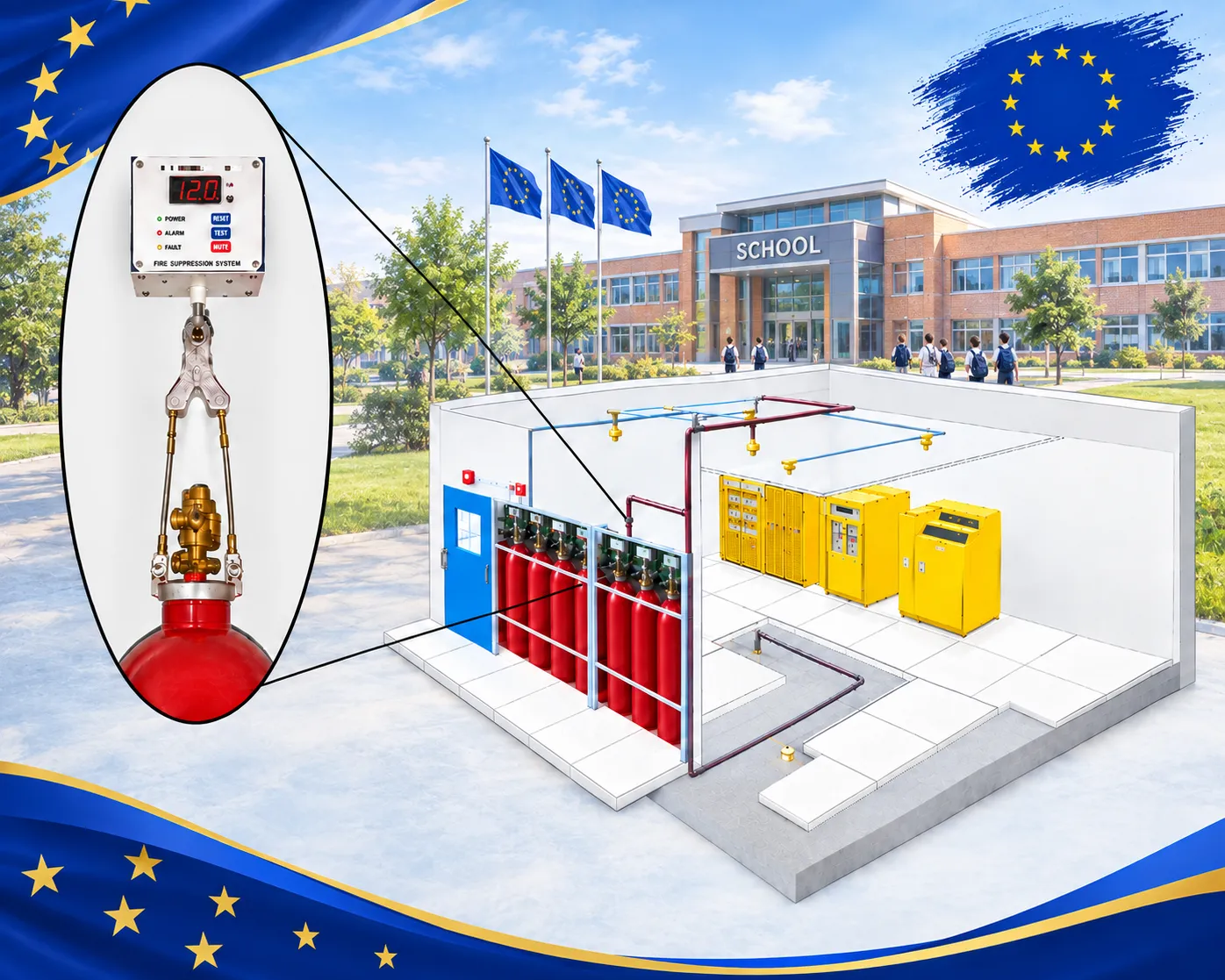
A typical engineered system may include:
- Smoke detectors
- Heat detectors where appropriate
- Releasing control panel
- Agent storage cylinder
- Cylinder valve
- Actuation mechanism
- Distribution pipework
- Discharge nozzles
- Manual release
- Abort switch
- Audible warning
- Visual warning
- HVAC shutdown/interlock
- Pressure monitoring
System design must be based on the protected volume, hazard, agent characteristics and applicable design requirements.
2. Clean-Agent Fire Suppression for University Facilities
Clean-agent systems can be considered for areas where protection of sensitive equipment is particularly important.
Potential applications include:
- Server rooms
- Data centres
- Network rooms
- Computer laboratories
- Communication rooms
- Control rooms
- UPS rooms
- Electrical control rooms
- Digital archives
- Research facilities
Depending on the project, clean-agent technologies may include FK-5-1-12 or HFC-227ea, subject to the selected system, project specification and applicable regulatory requirements.
A clean-agent system should be engineered rather than selected simply according to cylinder size or room area.
Important design considerations include:
- Room volume
- Design concentration
- Agent quantity
- Nozzle arrangement
- Discharge time
- Enclosure integrity
- Ventilation
- Pressure relief
- Detection arrangement
- Occupancy
- Equipment shutdown
- Alarm sequence
3. University Laboratory Fire Suppression
Laboratories can contain diverse fire hazards, including chemicals, solvents, gases, electrical equipment, heating apparatus and research instruments.
LIFEGUARD® solutions can be considered for:
- Chemistry laboratories
- Physics laboratories
- Engineering laboratories
- Electronics laboratories
- Computer laboratories
- Research laboratories
- Biotechnology facilities
- Testing laboratories
- Innovation centres
Before selecting an automatic suppression system, the laboratory should be assessed for:
- Fire load
- Chemical inventory
- Flammable materials
- Electrical equipment
- Gas installations
- Ventilation
- Occupancy
- Research processes
- Storage arrangements
- Emergency shutdown requirements
4. Automatic Kitchen Fire Suppression for Universities
University kitchens and cafeterias contain specialized fire risks involving:
- Cooking oil
- Grease
- Fryers
- Griddles
- Cooking ranges
- Gas appliances
- Electrical appliances
- Extraction hoods
- Filters
- Exhaust ducts
Automatic kitchen suppression systems can be designed for suitable commercial cooking applications.
Potential university applications include:
- Student cafeterias
- Central kitchens
- Hostel kitchens
- Staff dining facilities
- Food courts
- Hospitality training kitchens
- Institutional catering facilities
Where required by the approved design, the suppression system may be coordinated with gas and electrical shutdown/interlock arrangements.
5. Electrical Panel Automatic Suppression
Electrical systems are distributed throughout university campuses.
Potential risks can arise from:
- Short circuits
- Loose connections
- Component failure
- Overheating
- Insulation failure
- Electrical arcing
- Overloaded equipment
Localized automatic suppression can be considered for suitable:
- Electrical distribution boards
- LT panels
- MCC panels
- Control cabinets
- UPS cabinets
- Generator control panels
- Solar inverter cabinets
- Network cabinets
- Laboratory electrical enclosures
Depending on the selected technology, automatic activation may use suitable heat detection, detection tubing or another approved detection method.
6. Automatic Suppression for University Libraries & Archives
Libraries and archives may contain significant quantities of combustible materials.
In addition to books and paper, universities may hold:
- Historical records
- Research documents
- Examination records
- Manuscripts
- Digital storage equipment
- Rare collections
Fire protection may incorporate:
- Early fire detection
- Automatic suppression
- Portable extinguishers
- Alarm systems
- Fire compartmentation
- Smoke management
- Emergency response procedures
Where valuable or sensitive contents are involved, the suppression technology should be selected with consideration for both fire control and potential secondary damage.
7. University Hostel & Student Accommodation Fire Protection
Student accommodation requires particular attention to life safety because buildings may be occupied continuously.
Fire protection strategies can incorporate:
- Automatic fire detection
- Fire alarm systems
- Portable fire extinguishers
- Automatic suppression where required
- Emergency lighting
- Fire doors
- Escape-route signage
- Emergency communication
- Fire drills and training
Automatic suppression should be integrated with the overall building fire-safety strategy and applicable local requirements.
8. Generator & Utility Room Fire Suppression
Universities may operate generators, mechanical rooms, substations and utility installations.
These areas can involve:
- Diesel fuel
- Lubricants
- Electrical equipment
- Hot surfaces
- Mechanical equipment
- Fuel systems
Automatic suppression may be considered after evaluating:
- Fuel type
- Equipment configuration
- Room volume
- Ventilation
- Fire load
- Occupancy
- Shutdown requirements
9. Lithium-Ion Battery & EV Fire Safety
European universities are increasingly incorporating electric vehicles, charging infrastructure, energy storage and battery-powered research equipment.
Potential applications include:
- EV charging areas
- Electric campus vehicles
- UPS battery rooms
- Battery energy storage
- Robotics laboratories
- Battery research laboratories
- E-mobility facilities
LIFEGUARD® offers LION-EX® lithium-ion battery fire protection solutions and other specialized battery fire-safety technologies for appropriately assessed applications.
Battery fire protection should consider:
- Battery chemistry
- Capacity
- Configuration
- Charging conditions
- Enclosure
- Ventilation
- Thermal characteristics
- Potential fire scenarios
10. Automatic Suppression for University Workshops
Engineering and technical universities may operate workshops containing:
- Machinery
- Welding equipment
- Fabrication equipment
- Electrical equipment
- Lubricants
- Fuels
- Compressed gases
- Testing equipment
Application-specific automatic or localized suppression can be evaluated for suitable machinery and enclosed technical areas.
European Fire Safety & Compliance Considerations
European fire protection projects require careful consideration of the applicable regulatory framework.
At EU level, construction-product rules establish harmonized approaches for expressing product performance, while fire safety requirements and implementation can also depend on national regulations and the particular building or project. The European Commission's framework identifies safety in case of fire as one of the basic requirements relevant to construction works.
The EU also maintains harmonized standards for relevant construction products through its published framework.
However, Europe should not be treated as one single fire-code jurisdiction. Requirements can differ between EU Member States and between the EU, UK, EFTA countries and other European markets. The Joint Research Centre's recent work on fire-safety engineering specifically covers the 27 EU Member States together with EFTA countries, the UK and Serbia and notes differences in the implementation of fire-safety engineering approaches.
Therefore, every university project should establish:
- Destination country
- Applicable national fire regulations
- Local authority requirements
- Building classification
- Project specification
- Required product certification
- Required system approvals
- Applicable European/international standards
- Installation requirements
- Inspection and maintenance requirements
European Standards & Technical Documentation
Depending on the project and product, specifications may refer to relevant EN standards, ISO standards, national standards and recognized fire-protection standards.
For fire detection and alarm equipment, European harmonized standards include the EN 54 family; the EU's published harmonized-standard framework, for example, lists EN 54-5 for heat detectors.
For automatic suppression systems, the applicable standard depends on the suppression technology and installation.
LIFEGUARD® can provide relevant technical documentation for the offered product or system, subject to the exact product configuration.
This may include:
- Technical datasheets
- Product catalogues
- System specifications
- Installation instructions
- Operation and maintenance information
- Test documentation
- Manufacturer documentation
- Certificates where applicable
- Product drawings
- Bill of materials
- Warranty information
Certification should always be claimed for the exact product and configuration being offered.
Integrated Automatic Fire Protection
Automatic suppression is only one part of a university's overall fire-safety architecture.
A coordinated system can follow:
Fire Detection
↓
Fire Alarm
↓
Pre-Discharge Warning
↓
Interlock / Equipment Shutdown
↓
Automatic Suppression
↓
Emergency Response
↓
Inspection & Maintenance
This integrated approach can help university operators and project teams address both fire protection and life-safety objectives.
Automatic Suppression System Design for European Universities
A professional system assessment should consider:
- Protected area
- Room dimensions
- Ceiling height
- Fire hazard
- Fire load
- Occupancy
- Equipment installed
- Ventilation
- Room openings
- Enclosure integrity
- Ambient temperature
- Detection method
- Suppression agent
- Agent quantity
- Nozzle arrangement
- Discharge requirements
- HVAC interlock
- Electrical shutdown
- Emergency release
- Local regulatory requirements
The final design should be prepared or reviewed by appropriately qualified fire-protection professionals.
Automatic Suppression for New University Projects
New university developments offer an opportunity to integrate fire protection during the architectural and MEP design stages.
LIFEGUARD® can support project teams with equipment and technical information for:
- Academic buildings
- Laboratories
- Research centres
- Libraries
- Data centres
- Server rooms
- Student accommodation
- Commercial kitchens
- Electrical rooms
- Workshops
- Utility areas
- Battery facilities
Early coordination can help integrate suppression systems with:
- Fire alarm
- HVAC
- Electrical systems
- Building management systems
- Mechanical services
- Architectural layouts
- Emergency systems
Fire Protection Upgrades for Existing Universities
Existing university facilities may require additional protection because of:
- New data centres
- Laboratory modernization
- Campus expansion
- Electrical upgrades
- New kitchens
- EV charging
- Battery installations
- Increased electrical loads
- Changes in room usage
- IT infrastructure expansion
LIFEGUARD® can evaluate suitable equipment and system requirements based on the available project information.
University Automatic Suppression Company for European Markets
LIFEGUARD® can support enquiries from universities, contractors, consultants, distributors and fire-system integrators across European markets.
Potential markets include:
Western Europe
- Germany
- France
- Netherlands
- Belgium
- Luxembourg
- Austria
- Switzerland
- Ireland
- United Kingdom
Southern Europe
- Italy
- Spain
- Portugal
- Greece
- Malta
- Cyprus
Northern Europe
- Sweden
- Norway
- Denmark
- Finland
- Iceland
Central & Eastern Europe
- Poland
- Czechia
- Slovakia
- Hungary
- Romania
- Bulgaria
- Croatia
- Slovenia
- Serbia
Baltic Region
- Estonia
- Latvia
- Lithuania
The final compliance pathway, certification and technical requirements should be confirmed for the specific destination country and project.
Why Choose LIFEGUARD® for University Automatic Suppression?
Established Fire Safety Manufacturer
LIFEGUARD® is manufactured by United Fire Equipments Pvt. Ltd., India, an established fire safety equipment manufacturer.
Application-Based Solutions
Different university facilities require different approaches. LIFEGUARD® can support application-specific selection for laboratories, data centres, kitchens, electrical rooms, hostels and other specialized areas.
Broad Fire Protection Portfolio
Our fire safety portfolio includes:
- Fire extinguishers
- Clean-agent suppression
- Gas-based fire suppression
- Kitchen suppression
- Water-mist solutions
- Electrical-panel suppression
- Lithium-ion battery fire protection
- Detection and releasing components
- Specialized fire safety equipment
International Project Support
LIFEGUARD® can work with:
- Universities
- Consultants
- Architects
- EPC contractors
- MEP contractors
- Fire-system integrators
- Distributors
- Importers
- Facility-management companies
- Institutional procurement teams
Technical Documentation
Project-specific technical support can include appropriate product literature, datasheets, drawings, specifications, test documentation and other available manufacturer documentation.
University Automatic Suppression Solutions for European Distributors
LIFEGUARD® can also work with European fire-protection companies seeking an Indian manufacturing partner for suitable products and projects.
Potential cooperation models include:
- Project supply
- Distributor supply
- Bulk orders
- System integration
- OEM requirements
- Private-label opportunities where technically and commercially feasible
- Institutional procurement
- University project supply
Commercial and technical arrangements can be evaluated according to product, quantity, destination market, certification requirements and project specification.
Request a University Automatic Suppression Proposal
For a university automatic suppression project, the following information can help LIFEGUARD® prepare a technically appropriate proposal:
- University/project name
- Country
- Protected room/application
- BOQ
- Technical specification
- Room dimensions
- Fire hazard
- Required agent
- Quantity
- Applicable standard
- Certification requirement
- Installation scope
- Commissioning requirement
- Delivery location
- Project schedule
This information allows the technical team to evaluate the application before recommending equipment.
Partner With LIFEGUARD® for University Fire Protection in Europe
University fire protection requires a coordinated approach that considers people, buildings, research assets, electronic infrastructure, critical equipment and operational continuity.
LIFEGUARD® provides fire safety equipment and automatic suppression solutions for suitable university applications, supporting project teams with product selection, technical documentation and international project coordination.
From university laboratories and libraries to data centres, commercial kitchens, electrical rooms, student accommodation, workshops and battery facilities, LIFEGUARD® can support application-specific fire protection requirements.
Looking for a University Automatic Suppression Company in Europe?
Contact LIFEGUARD® for:
- Automatic fire suppression solutions
- Clean-agent systems
- University data-centre protection
- Laboratory fire suppression
- Kitchen fire suppression
- Electrical-panel suppression
- Battery and EV fire protection
- Technical documentation
- Project quotations
- Distributor enquiries
- Export enquiries
- Institutional fire safety solutions
LIFEGUARD® – University Fire Protection & Automatic Suppression Solutions
United Fire Equipments Pvt. Ltd.
Delhi, India
Email: ufe126@gmail.com | info@lifeguardindia.in
Website: www.lifeguardindia.in
Key Applications
University Automatic Suppression | University Fire Protection | Automatic Fire Suppression Europe | University Fire Safety | Clean Agent Fire Suppression | Laboratory Fire Protection | Data Centre Fire Suppression | Kitchen Fire Suppression | Electrical Panel Suppression | University Hostel Fire Safety | Battery Fire Protection | EV Fire Safety | Educational Campus Fire Protection
Keywords






