
University Clean Agent Suppression Manufacturer Africa
LIFEGUARD® – University Clean Agent Fire Suppression Manufacturer Serving Africa
LIFEGUARD® is an experienced University Clean Agent Suppression Manufacturer in Africa, providing application-specific clean agent fire suppression solutions for universities, colleges, research institutions, educational campuses, laboratories, data centres and other critical institutional facilities.
Manufactured by United Fire Equipments Pvt. Ltd., LIFEGUARD® provides fire-protection equipment and engineered suppression solutions for applications where conventional water, foam or dry-chemical systems may not be suitable for sensitive equipment and valuable assets.
Modern universities contain extensive electronic infrastructure, research equipment, communication systems, computer laboratories, libraries, archives, electrical installations and data-processing facilities. A fire in any of these areas can result not only in property damage but also in interruption of academic, research and administrative activities.
A properly designed clean agent fire suppression system for universities can provide automatic detection and rapid suppression while avoiding the water damage and powder residue associated with some conventional extinguishing methods.
LIFEGUARD® supports university fire-protection projects with application-specific system configuration, equipment selection, technical documentation, OEM manufacturing support and international supply capabilities.
University Clean Agent Fire Suppression Systems in Africa
Universities require different fire-protection strategies for different areas of a campus.
A lecture hall, laboratory, server room, electrical room, library and commercial kitchen can have completely different fire hazards. Consequently, clean agent suppression should be selected based on the actual protected hazard rather than simply the room name.
LIFEGUARD® clean agent suppression solutions can be considered for:
- University server rooms
- Data centres
- Computer laboratories
- IT rooms
- Network rooms
- Communication rooms
- CCTV control rooms
- Electrical control rooms
- UPS rooms
- Research laboratories
- Instrumentation rooms
- Digital learning facilities
- Audio-visual rooms
- Libraries and archives
- Examination record rooms
- Critical control rooms
- Specialised equipment rooms
The proposed system should be engineered according to room volume, occupancy, fire risk, equipment arrangement, ventilation, enclosure integrity, selected agent and applicable project requirements.
What Is a Clean Agent Fire Suppression System?
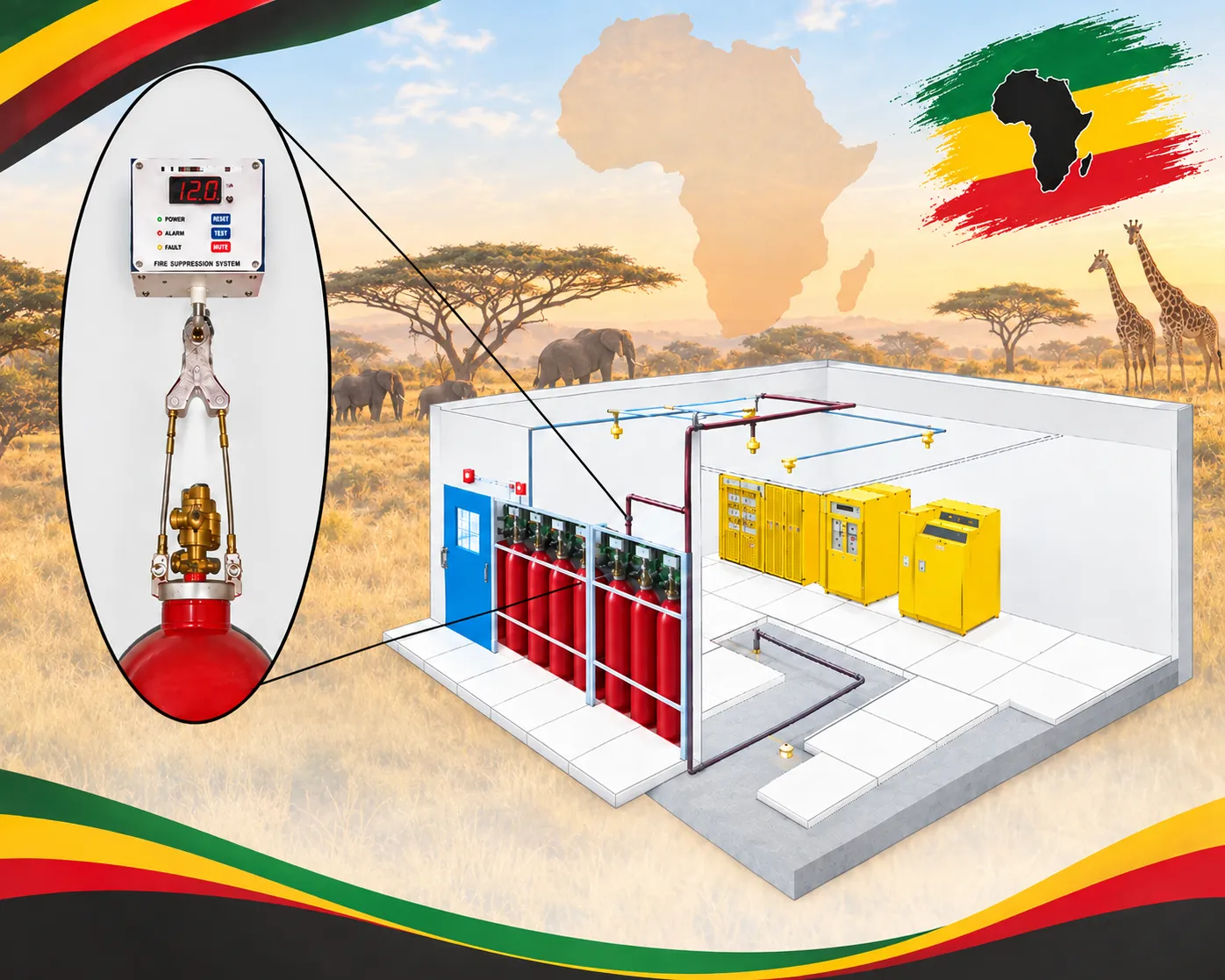
A clean agent fire suppression system is a fixed fire-protection system designed to detect a fire and discharge a gaseous extinguishing agent into a suitably protected enclosure.
Unlike conventional water-based systems, clean-agent systems are intended for applications where water discharge could damage sensitive electronic equipment, documents, electrical installations or other valuable assets.
A typical system can incorporate:
- Clean agent storage cylinders
- Cylinder valves
- Electric or pneumatic actuators
- Pressure monitoring
- Fire detection devices
- Releasing control panel
- Discharge piping
- Engineered discharge nozzles
- Manual release station
- Abort switch
- Audible alarms
- Visual indicators
- HVAC shutdown interfaces
- Electrical interlocks
- Warning signage
- Main and standby cylinder arrangements where required
LIFEGUARD®'s educational-sector clean-agent solutions can be configured using technologies such as FK-5-1-12 and HFC-227ea, depending on the project specification, hazard, design requirements and applicable approvals.
Why Universities in Africa Need Clean Agent Fire Suppression
African universities are increasingly dependent on digital infrastructure, electronic learning systems, research laboratories and computerised administrative systems.
Important assets may include:
- Servers
- Network switches
- Data-storage systems
- Computers
- Laboratory instruments
- Electronic control equipment
- Communication systems
- CCTV infrastructure
- Research equipment
- Digital records
- Academic archives
Fire protection for these facilities must consider not only extinguishing the fire but also limiting secondary damage and operational interruption.
For suitable enclosed hazards, clean-agent suppression can provide an alternative to water-based discharge and can help protect sensitive equipment without leaving conventional powder or water residue.
University Server Room Clean Agent Suppression Africa
University server rooms are among the most important applications for clean-agent fire suppression.
Server and network facilities may contain high-value equipment operating continuously. Fire, smoke and heat can affect:
- Servers
- Network switches
- Storage equipment
- Routers
- Communication equipment
- UPS systems
- Data-storage infrastructure
A clean-agent system can integrate automatic detection with a releasing control panel and engineered discharge arrangement.
The design may include:
Smoke Detection → Alarm → Confirmation/Release Logic → Pre-Discharge Warning → HVAC/Equipment Interlock → Agent Discharge
The actual cause-and-effect sequence must be established according to the approved project design.
University Computer Laboratory Fire Suppression
Computer laboratories require protection against electrical and electronic fire hazards while maintaining the usability of the facility.
LIFEGUARD® clean agent suppression solutions can be considered for:
- Computer laboratories
- IT laboratories
- Engineering computer rooms
- Digital classrooms
- Networking laboratories
- Artificial intelligence laboratories
- Simulation rooms
- Electronics laboratories
- Communication laboratories
The system can be coordinated with the university's fire alarm infrastructure and other building services where required.
Clean Agent Suppression for University Research Laboratories
Research laboratories can contain sophisticated instruments and specialised equipment that may be expensive, difficult to replace or sensitive to water and powder contamination.
Potential applications include:
- Scientific research laboratories
- Electronics laboratories
- Instrumentation laboratories
- Engineering laboratories
- Computer research facilities
- Testing laboratories
- Research data rooms
- Specialised equipment enclosures
However, laboratory fire protection must be based on the actual materials and processes involved.
Where flammable liquids, gases, reactive chemicals or unusual hazards are present, a dedicated hazard assessment should be performed before selecting the suppression technology.
University Electrical Room Fire Suppression
Electrical rooms can contain:
- Switchgear
- Control panels
- MCC panels
- Distribution equipment
- Automation systems
- Electrical control systems
- UPS equipment
Electrical faults can result from overheating, insulation failure, loose connections, component failure, short circuits or other electrical abnormalities.
Where technically appropriate, clean-agent suppression can provide automatic protection for enclosed electrical areas.
The system design should consider electrical isolation, detection, ventilation, room integrity, access and emergency operating procedures.
University UPS & Battery Room Fire Protection
Universities increasingly use UPS systems and battery installations to maintain continuity of critical IT and communication infrastructure.
Potentially protected areas include:
- UPS rooms
- Battery rooms
- Critical power rooms
- Battery cabinets
- Electrical backup rooms
- Data-centre power infrastructure
Battery-related fire risks require a hazard-specific approach. Depending on the battery chemistry and installation, protection may require a combination of detection, suppression, cooling, monitoring, isolation and containment measures.
A clean-agent system should not be considered a universal solution for every battery hazard; the protection strategy should be based on the specific battery technology and applicable design requirements.
University Library & Archive Fire Suppression
University libraries and archives may contain:
- Books
- Research papers
- Historical records
- Manuscripts
- Academic documents
- Examination records
- Digital storage equipment
Fire and smoke can cause irreversible damage to valuable academic resources.
For suitable enclosed areas, clean-agent suppression can be considered where minimising extinguishing-media residue is important.
Potential applications include:
- Library archives
- Rare-book rooms
- Digital archives
- Record rooms
- Examination storage rooms
- Research-document storage
Early fire detection combined with automatic suppression can form an important layer of protection for these facilities.
University Data Centre Fire Suppression Africa
University data centres require continuous availability and protection of mission-critical infrastructure.
LIFEGUARD® clean agent systems can be configured for suitable data-centre environments involving:
- Server racks
- Network equipment
- Storage systems
- Communication infrastructure
- UPS systems
- Control equipment
For a total-flooding system, the enclosure should be evaluated carefully. Room volume, raised floors, false ceilings, ventilation openings, doors and other leakage paths can influence system performance.
Room-integrity considerations and, where required, enclosure integrity testing should form part of the commissioning and maintenance strategy.
FK-5-1-12 Clean Agent Suppression for Universities
FK-5-1-12 is a clean-agent technology used in engineered fire suppression applications where protecting sensitive assets and reducing residue is important.
University applications may include:
- Data centres
- Server rooms
- Control rooms
- Communication rooms
- Electrical rooms
- Research facilities
- Archives
The system requires proper engineering of:
- Agent quantity
- Design concentration
- Cylinder capacity
- Discharge time
- Pipe network
- Nozzle arrangement
- Detection system
- Room integrity
- Pressure relief
- Safety interfaces
The suitability of FK-5-1-12 should always be evaluated against the project specification and applicable requirements.
HFC-227ea Clean Agent Fire Suppression for Universities
HFC-227ea is another clean-agent technology used in engineered fire suppression systems.
It can be considered for suitable enclosed applications such as:
- Server rooms
- Electrical rooms
- Control rooms
- Communication rooms
- Computer rooms
- Critical equipment areas
Agent selection should be based on the protected hazard, occupancy, room characteristics, required concentration, applicable design standard and project specifications.
LIFEGUARD® supports project-specific evaluation of clean-agent technologies rather than using one configuration for every university application.
How a University Clean Agent Suppression System Works
A typical automatic clean-agent system operates through a coordinated detection and releasing sequence.
Step 1 – Fire Detection
Smoke, heat or other approved detection devices monitor the protected area.
Step 2 – Alarm
When a fire condition is detected, the releasing control panel activates the appropriate audible and visual warning devices.
Step 3 – Detection Confirmation
Where the design uses cross-zone or other confirmation logic, the required detection conditions are evaluated before release.
Step 4 – Pre-Discharge Warning
The system provides an appropriate warning before agent discharge.
Step 5 – Building Interlocks
Where required, ventilation, air-conditioning, electrical equipment or other interfaces are controlled according to the approved cause-and-effect sequence.
Step 6 – Agent Release
The suppression cylinder is activated and clean agent flows through the engineered piping network.
Step 7 – Agent Distribution
The discharge nozzles distribute the agent throughout the protected enclosure.
Step 8 – Fire Suppression
The required design concentration is established within the protected enclosure to suppress the fire.
The precise sequence varies according to the selected system and approved project design.
Major Components of a University Clean Agent Suppression System
ComponentFunctionClean Agent CylinderStores the extinguishing agentCylinder ValveControls agent releaseActuatorInitiates cylinder dischargePressure Gauge/SwitchMonitors cylinder/system conditionReleasing Control PanelControls detection and discharge logicSmoke DetectorDetects smoke/fire conditionsHeat DetectorDetects abnormal temperatureDischarge PipingTransfers agent to protected areaDischarge NozzleDistributes agentManual ReleaseProvides manual activationAbort SwitchProvides controlled interruption where designedHooter/StrobeProvides warningHVAC InterlockControls ventilation where requiredElectrical InterlockProvides equipment shutdown/interfacePressure Relief ArrangementManages enclosure pressure where required
Component selection depends on the selected agent, system architecture, project specification and engineering calculations.
University Clean Agent Suppression Manufacturer & OEM Support
LIFEGUARD® supports projects that require more than standard equipment supply.
Depending on the project scope, OEM and engineering support may include:
- Application assessment
- System configuration
- Clean-agent selection
- Cylinder selection
- Agent quantity calculations
- Piping configuration
- Nozzle selection
- Detection arrangement
- Releasing-panel configuration
- Cause-and-effect documentation
- Technical datasheets
- System drawings
- Bill of quantities
- Installation instructions
- Testing and commissioning guidance
- Operation and maintenance documentation
- Export packaging
- Product identification
- Project documentation
OEM/private-label requirements are subject to technical feasibility, applicable certification, quantity and commercial conditions.
Clean Agent Suppression Exporter for African University Projects
LIFEGUARD® supports international enquiries from African markets and works with stakeholders such as:
- Universities
- Colleges
- Educational institutions
- Government departments
- EPC contractors
- MEP contractors
- Fire-protection contractors
- Engineering consultants
- System integrators
- Importers
- Distributors
- Facility-management companies
- Institutional procurement agencies
Our international supply approach can include technical evaluation, product selection, documentation, manufacturing, export packing and dispatch according to the agreed project scope.
LIFEGUARD® already positions its clean-agent portfolio for international markets including Africa and supports educational-sector enquiries covering schools, colleges and universities.
University Clean Agent Suppression Solutions Across Africa
LIFEGUARD® can evaluate project enquiries from different African markets, including:
- South Africa
- Nigeria
- Kenya
- Ghana
- Tanzania
- Uganda
- Ethiopia
- Rwanda
- Zambia
- Zimbabwe
- Botswana
- Namibia
- Mozambique
- Mauritius
- Egypt
- Morocco
- Algeria
- Tunisia
- Other African markets
For each country and project, the applicable local regulations, authority requirements, project specifications and certification requirements should be confirmed before equipment selection.
Application-Specific Engineering for African Universities
No two university campuses are identical.
The engineering process should consider:
Protected Volume
Room length, width and height should be established accurately.
False Ceiling & Raised Floor
Additional protected volumes may need to be evaluated depending on the system design.
Fire Hazard
The type of equipment, combustible materials and expected fire scenario should be identified.
Occupancy
Occupied and normally unoccupied areas may require different safety considerations.
Ventilation
Air-conditioning, ventilation and extraction systems can affect clean-agent retention and discharge performance.
Room Integrity
Doors, cable penetrations, ducts, dampers and other openings should be considered.
Equipment Layout
The position of racks, panels, cabinets and other equipment can affect nozzle distribution.
Agent Quantity
The quantity of agent must be determined through appropriate engineering calculations.
Nozzle Arrangement
Nozzles should be positioned according to the approved design and relevant system requirements.
Technical Documentation for University Projects
For consultants, contractors and procurement teams, documentation can be an important part of technical approval.
Depending on the project and supplied system, LIFEGUARD® can support documentation such as:
- Technical datasheets
- Product catalogues
- System specifications
- Equipment schedules
- Bill of materials
- System drawings
- Agent information
- Cylinder information
- Test documentation
- Inspection records
- Installation instructions
- Operation and maintenance manuals
- Warranty documentation
- Packing lists
- Commercial export documents
- Certificates of origin where applicable
- Manufacturer documentation
Certification and approval claims should always be verified against the specific product, model and system configuration, rather than assumed for the complete product range.
Clean Agent Suppression for University EPC & MEP Contractors
University construction projects are frequently delivered through EPC, MEP and specialist fire-protection contractors.
LIFEGUARD® can support contractors during different project stages:
Tender Stage
Technical specifications, product information and preliminary system details.
Design Stage
System configuration, equipment selection and project-specific engineering inputs.
Procurement Stage
Equipment manufacturing and supply planning.
Installation Stage
Installation documentation and technical guidance.
Testing Stage
Testing and commissioning support according to the agreed scope.
Handover Stage
Operating instructions, documentation and maintenance information.
Quality-Focused Clean Agent Fire Suppression Manufacturing
Fire suppression equipment must perform reliably when required.
A quality-focused manufacturing approach should consider:
- Correct component selection
- Cylinder and valve compatibility
- Piping quality
- Nozzle suitability
- Control-panel functionality
- Detection configuration
- Electrical connections
- Pressure monitoring
- System documentation
- Inspection and testing
- Correct product identification
LIFEGUARD® combines fire-safety manufacturing experience with application-specific system engineering and project documentation support.
United Fire Equipments Pvt. Ltd. has been associated with fire-safety equipment under the LIFEGUARD® brand since 1991.
Why Choose LIFEGUARD® for University Clean Agent Suppression?
Fire-Safety Manufacturing Experience
LIFEGUARD® is manufactured by United Fire Equipments Pvt. Ltd., an Indian fire-safety company with experience dating back to 1991.
Application-Based Solutions
Clean-agent systems are configured according to the protected hazard, room characteristics and project requirements.
Educational Sector Applications
Solutions can be evaluated for universities, colleges, laboratories, computer rooms, server rooms, libraries and other specialised educational facilities.
OEM & International Supply
LIFEGUARD® supports OEM, project procurement and international export enquiries.
Technical Documentation
Project-specific technical documents can be provided according to the offered equipment and agreed scope.
System Integration Capability
Clean-agent suppression can be coordinated with fire detection, releasing panels, alarms, HVAC interfaces and other building systems as required by the approved design.
Complete Fire Protection Strategy for African Universities
Clean-agent suppression should form part of a broader university fire-safety strategy rather than being considered as an isolated product.
Depending on the campus, the overall strategy may incorporate:
- Fire detection systems
- Fire alarm systems
- Automatic clean-agent suppression
- Portable fire extinguishers
- Hydrant systems
- Sprinkler systems
- Kitchen suppression
- Electrical-panel protection
- Emergency lighting
- Fire doors
- Evacuation systems
- Fire-rated construction
- Fire safety signage
- Emergency response procedures
- Inspection and maintenance programmes
Different areas require different protection technologies. The objective is to develop a coordinated fire-protection strategy appropriate to each hazard.
Request a University Clean Agent Suppression Quote for Africa
If you are searching for a University Clean Agent Suppression Manufacturer in Africa, LIFEGUARD® can evaluate your requirement and provide an application-specific technical and commercial proposal.
For a project quotation, provide:
- University/project name
- African country and project location
- Protected room name
- Room length
- Room width
- Room height
- False-ceiling details
- Raised-floor details
- Equipment information
- Fire-risk description
- Required clean agent
- BOQ
- Technical specification
- Preferred certification/approval
- Number of protected rooms
- Installation requirement
- Testing and commissioning scope
- Required delivery schedule
Our technical team can evaluate the information and recommend an appropriate clean-agent suppression configuration subject to the applicable project requirements.
United Fire Equipments Pvt. Ltd. – LIFEGUARD®
Manufacturer of Fire Safety Equipment
Delhi, India
Email: ufe126@gmail.com | info@lifeguardindia.in
Phone: 8048034226
Website: LIFEGUARD® official website
Frequently Asked Questions
Who is a university clean agent suppression manufacturer in Africa?
LIFEGUARD®, manufactured by United Fire Equipments Pvt. Ltd., provides clean-agent fire suppression equipment and application-specific solutions for university and educational projects serving African markets.
Where can clean-agent systems be used in universities?
Typical applications include server rooms, data centres, computer laboratories, electrical rooms, UPS rooms, communication rooms, control rooms, research facilities, libraries and archives.
Which clean agents can be considered for university applications?
Depending on the project, agents such as FK-5-1-12 and HFC-227ea can be evaluated for suitable enclosed hazards. The final selection depends on the project specification, fire risk, occupancy and applicable requirements.
Can LIFEGUARD® supply clean-agent systems to Africa?
LIFEGUARD® supports international project and export enquiries for African markets, subject to the destination, project specifications, commercial terms and applicable regulatory requirements.
Can LIFEGUARD® provide OEM clean-agent suppression systems?
OEM and private-label requirements can be evaluated according to technical feasibility, required quantity, product configuration, certification requirements and commercial conditions.
Is clean-agent suppression suitable for university server rooms?
Clean-agent suppression is commonly considered for suitable enclosed electronic environments because the extinguishing medium does not introduce the same water or powder contamination associated with conventional systems. Suitability must be confirmed through project-specific engineering.
What information is needed for clean-agent system design?
Important information includes room dimensions, equipment layout, occupancy, ventilation, false-ceiling and raised-floor details, fire hazard, selected agent, applicable specification and approval requirements.
Does LIFEGUARD® support consultants and EPC contractors?
Yes. Technical support can include product data, system configuration, drawings, calculations where applicable, BOQ preparation, documentation and testing/commissioning guidance according to the agreed project scope.
SEO Metadata
SEO Title:
University Clean Agent Suppression Manufacturer Africa | LIFEGUARD®
Meta Description:
LIFEGUARD® is a University Clean Agent Suppression Manufacturer serving Africa with engineered clean-agent fire suppression solutions for server rooms, laboratories, data centres, electrical rooms and university campuses.
Suggested URL:
/university-clean-agent-suppression-manufacturer-africa/
Primary Keyword:
University Clean Agent Suppression Manufacturer Africa
Secondary Keywords:
- University clean agent fire suppression Africa
- University clean agent suppression system Africa
- University fire suppression manufacturer Africa
- University fire protection company Africa
- University fire suppression system manufacturer Africa
- University clean agent fire protection Africa
- Clean agent suppression manufacturer Africa
- Clean agent fire suppression company Africa
- University FK-5-1-12 suppression Africa
- University HFC-227ea suppression Africa
- University server room fire suppression Africa
- University data centre fire suppression Africa
- University laboratory fire suppression Africa
- University electrical room fire suppression Africa
- University UPS room fire suppression Africa
- University automatic fire suppression Africa
- University gaseous fire suppression Africa
- University fire safety equipment manufacturer Africa
- Educational institution fire suppression Africa
- University fire protection solutions Africa
- Clean agent system supplier Africa
- Clean agent suppression exporter Africa
Suggested H1:
University Clean Agent Suppression Manufacturer Africa
Suggested Image Alt Text:
LIFEGUARD university clean agent fire suppression system manufacturer serving Africa
Suggested CTA:
Request University Clean Agent Suppression Proposal for Africa
Keywords






