
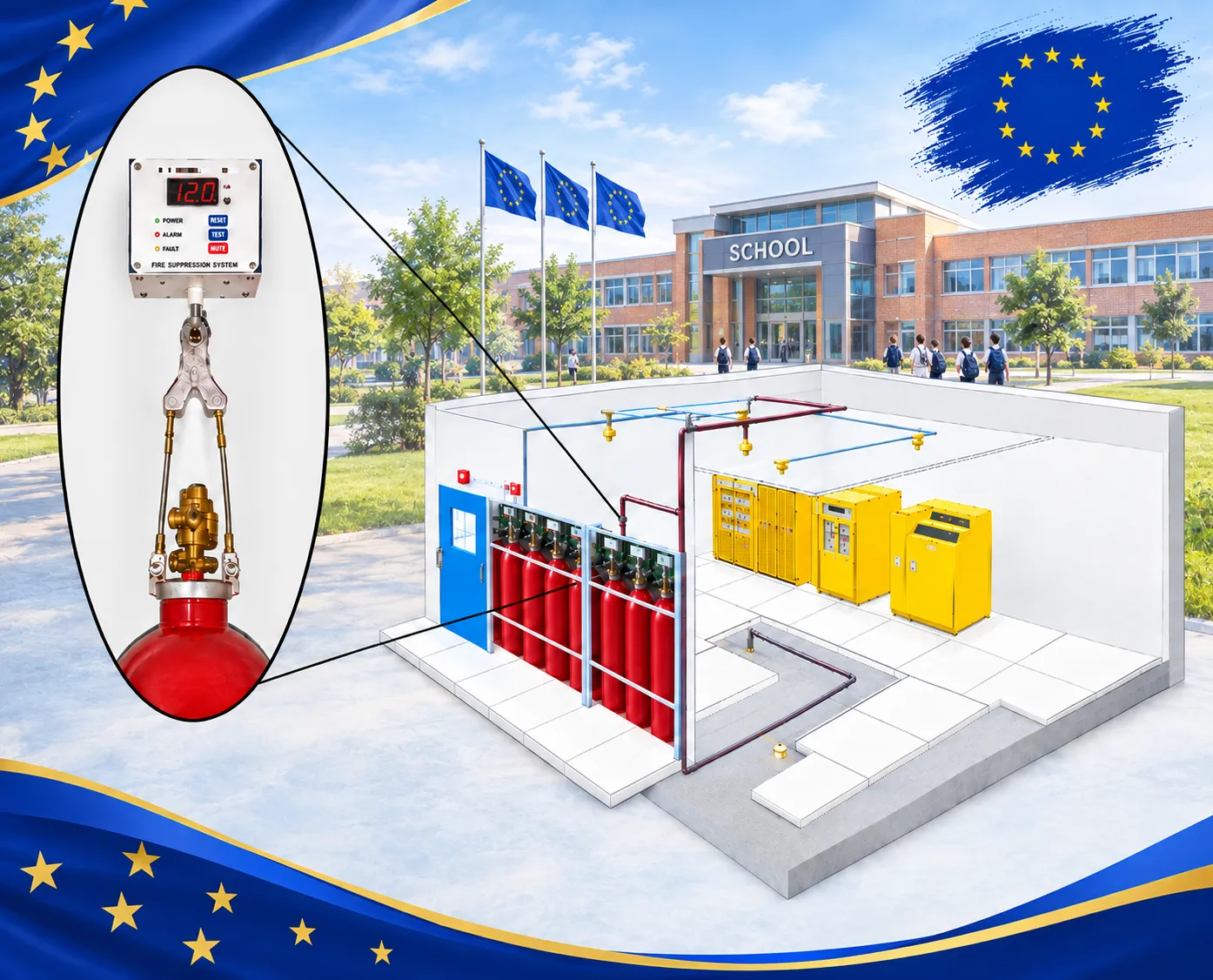
University Clean Agent Suppression Manufacturer Europe
LIFEGUARD® provides engineered fire safety and clean agent suppression solutions for universities, higher-education campuses, research institutions, laboratories, libraries, data centres, electrical rooms, archives and other specialised academic facilities across Europe. As an established Indian fire safety equipment manufacturer and OEM, LIFEGUARD® supports international projects with fire suppression equipment, system engineering inputs, project documentation, supply coordination and technical support.
University campuses contain a diverse combination of fire risks. A single campus can include classrooms, laboratories, server rooms, data centres, electrical substations, libraries, archives, workshops, kitchens, research facilities and student accommodation. Many of these areas contain high-value equipment or sensitive materials where conventional water-based firefighting may not be the preferred first-line protection.
Clean agent fire suppression systems can provide an engineered method of protecting selected enclosed hazards while reducing the potential for water damage to sensitive equipment and valuable contents.
European fire safety projects require careful consideration of applicable national regulations, standards, authority requirements, building characteristics and the specific hazard. CEN/TC 191 is the European technical committee responsible for fixed firefighting systems, while European fire-safety practice also involves national standards and competent authorities.
University Clean Agent Suppression Solutions Europe
LIFEGUARD® develops and supplies fire safety solutions for specialised university applications where clean-agent suppression may be considered, including:
- University data centres
- Server rooms
- IT rooms
- Network and communication rooms
- Research laboratories
- Electrical rooms
- Control rooms
- UPS rooms
- Battery rooms
- Archives and document storage
- Libraries and rare-book collections
- Telecommunications rooms
- Examination and digital learning facilities
- Specialised research equipment rooms
- Electrical and electronic control panels
- Critical infrastructure rooms
The appropriate extinguishing technology should be selected following a detailed hazard assessment, room enclosure evaluation, fire risk assessment and applicable project requirements.
Why Universities Need Clean Agent Fire Suppression
Modern universities are no longer limited to classrooms and lecture halls. Large campuses increasingly operate sophisticated digital, scientific and research infrastructure.
A fire in a server room, laboratory or electrical control room can result in much more than structural damage. It may cause:
- Loss of research data
- Damage to scientific instruments
- Disruption of university IT services
- Loss of academic records
- Business interruption
- Damage to research samples
- Interruption of laboratory operations
- Damage to telecommunications infrastructure
- Loss of irreplaceable archive materials
- Extended campus downtime
Clean agent suppression can be considered for enclosed spaces where rapid fire control is important and where the consequences of water discharge need to be carefully evaluated.
LIFEGUARD® – University Clean Agent Suppression Manufacturer
LIFEGUARD® is a fire safety equipment manufacturing brand of United Fire Equipments Pvt. Ltd. (UFEPL), India, serving industrial, commercial, institutional and infrastructure applications.
Our fire protection portfolio covers portable firefighting equipment as well as specialised suppression technologies.
For university projects, LIFEGUARD® can support requirements involving:
Risk Assessment → System Selection → Engineering → Equipment Manufacturing → Supply → Installation Guidance → Testing & Commissioning Support → Maintenance Guidance
The final system configuration should always be developed according to the project hazard, room volume, enclosure integrity, agent characteristics, detection and releasing philosophy, authority requirements and applicable standards.
Clean Agent Fire Suppression for University Data Centres
University data centres are among the most critical areas requiring specialised fire protection.
They may contain:
- Servers
- Network switches
- Storage systems
- UPS equipment
- Communication equipment
- Fibre-optic infrastructure
- Power distribution equipment
- Monitoring systems
- Digital learning infrastructure
- University databases
A clean agent suppression system can be engineered to detect a fire and discharge an extinguishing agent into a protected enclosure when the applicable release conditions are satisfied.
A typical system can integrate:
Fire Detection
High-performance detection devices identify developing fire conditions and transmit signals to the releasing control panel.
Releasing Control Panel
The releasing panel manages detection inputs, alarm logic, pre-discharge warning, release sequence and associated interfaces according to the approved system design.
Agent Storage
The extinguishing agent is stored in appropriately selected cylinders and associated equipment according to the system design.
Piping Network
The engineered piping network distributes the agent to strategically positioned discharge nozzles.
Discharge Nozzles
Nozzles are selected and positioned according to hydraulic calculations and the approved design.
Alarm and Safety Interfaces
The system can incorporate audible and visual alarms, abort/release functions, HVAC shutdown, equipment shutdown and other project-specific interlocks where required.
University Laboratory Clean Agent Suppression Systems
University laboratories can contain combustible materials, electrical equipment, research instruments, chemicals and specialised machinery.
Different laboratories require different fire-protection approaches.
Examples include:
- Chemistry laboratories
- Physics laboratories
- Electronics laboratories
- Computer laboratories
- Biotechnology laboratories
- Research laboratories
- Medical research facilities
- Instrumentation laboratories
- Engineering laboratories
- Clean rooms
- Specialised testing rooms
A clean agent system may be considered where the protected hazard is compatible with gaseous suppression and where the room can achieve the required enclosure conditions.
For chemical laboratories, the suppression strategy must be determined by a competent fire-protection professional because the chemical inventory, reaction characteristics, ventilation arrangements and fire scenarios can significantly influence system selection.
Clean Agent Suppression for University Server Rooms
Server rooms require continuous availability and protection of sensitive electronic equipment.
Water-based suppression may still form part of an overall building fire strategy, but specialised rooms can require additional engineered protection.
LIFEGUARD® clean-agent solutions can be considered for:
- University server rooms
- Network rooms
- IT infrastructure rooms
- Data processing rooms
- Communication rooms
- Digital examination infrastructure
- Campus network centres
- Research computing facilities
The objective is rapid fire suppression while limiting secondary damage to sensitive electronic equipment.
University Library Fire Suppression
Libraries can contain large quantities of paper, books, manuscripts, documents and archival materials.
Historic libraries and special collections may contain materials that are difficult or impossible to replace.
For selected enclosed library areas, clean-agent protection may be evaluated alongside the overall building fire strategy.
Potential applications include:
- Rare-book rooms
- Manuscript rooms
- Archive rooms
- Digital archive rooms
- Special collections
- Historical document storage
- University records rooms
The suppression system should be designed around the actual storage arrangement, fire load, room enclosure and authority requirements.
University Archive Clean Agent Fire Protection
University archives may contain academic records, historical documents, research records and institutional information.
Clean-agent systems may provide an alternative protection strategy for appropriately designed enclosed spaces where minimising water exposure is an important project consideration.
A complete archive fire-protection strategy can combine:
- Automatic fire detection
- Clean agent suppression
- Manual release
- Alarm notification
- Emergency shutdown interfaces
- Room integrity considerations
- Preventive maintenance
- Portable fire extinguishers
- Building fire alarm integration
Clean Agent Suppression for University Electrical Rooms
Electrical rooms may contain:
- Switchgear
- Control panels
- Distribution boards
- UPS systems
- Transformers
- Electrical control equipment
- Power management systems
Fire protection for electrical rooms requires careful evaluation of energized equipment, ventilation, room configuration and possible fire scenarios.
LIFEGUARD® can support engineered suppression solutions for selected electrical and electronic hazards, subject to project-specific design requirements.
University UPS and Battery Room Fire Protection
University campuses increasingly depend on UPS systems and battery energy storage for critical digital infrastructure.
Battery rooms and energy-storage installations require a hazard-specific fire safety assessment. Lithium-ion battery installations, in particular, may require specialised detection, cooling, containment and suppression strategies rather than simply applying a conventional gaseous suppression approach.
For this reason, the system designer should evaluate:
- Battery chemistry
- Energy capacity
- Cell/module configuration
- Room ventilation
- Thermal runaway characteristics
- Detection requirements
- Fire propagation risk
- Cooling requirements
- Emergency response strategy
LIFEGUARD® also develops specialised lithium-ion battery fire-safety products and technologies for appropriate applications.
University Research Centre Fire Suppression
Research centres often contain expensive equipment and highly specialised infrastructure.
Potential protected areas include:
- Research laboratories
- Instrument rooms
- Experimental facilities
- Computer research centres
- Electronics laboratories
- Testing chambers
- Control rooms
- Specialised equipment rooms
Clean-agent systems can be evaluated where rapid suppression and protection of sensitive equipment are important project objectives.
University Clean Agent System Components
A typical engineered clean-agent suppression installation may include:
1. Fire Detection System
Smoke, heat or other suitable detection technologies are selected according to the hazard.
2. Releasing Panel
The control panel receives detection signals and manages the programmed release sequence.
3. Clean Agent Cylinders
Cylinders are selected according to the agent quantity, pressure, room volume and system design.
4. Cylinder Valves
Appropriate cylinder valves and actuation arrangements provide controlled agent release.
5. Distribution Piping
The piping network is engineered to distribute the extinguishing agent throughout the protected enclosure.
6. Discharge Nozzles
Nozzles are selected and located according to the approved hydraulic design.
7. Manual Release Station
Manual release facilities may be incorporated where required by the approved design.
8. Abort Switch
An abort function may be provided where appropriate to delay or interrupt release during the applicable pre-discharge sequence.
9. Audible and Visual Alarm
Pre-discharge and discharge notification helps alert occupants and relevant personnel.
10. HVAC and Equipment Interlocks
Ventilation, air-conditioning and other equipment may require coordinated shutdown or control.
11. Pressure Relief
Room pressure management should be considered as part of the enclosure and system engineering.
FK-5-1-12 Clean Agent Solutions for Universities
FK-5-1-12-based systems are among the clean-agent technologies considered for applications involving sensitive electronic and critical equipment.
LIFEGUARD® supports clean-agent fire suppression solutions incorporating FK-5-1-12 / FITECH1230, subject to project-specific system design and applicable certification requirements.
Potential university applications include:
- Data centres
- Server rooms
- Control rooms
- Telecommunications rooms
- Electrical rooms
- Research facilities
- Archives
- Specialised equipment rooms
Where a particular certification, listing or approval is specified by the project, the exact equipment and configuration should be verified against the applicable certification documentation before tender submission.
University Clean Agent Fire Suppression Design Europe
European projects should not be treated as a single uniform regulatory market.
Requirements can vary between countries and projects. National authorities, national standards bodies, building regulations, fire authorities, insurers, consultants and project specifications may impose additional requirements.
CEN/TC 191 develops standards for fixed firefighting systems, while CEN/CENELEC also identifies service standards covering design, installation, maintenance and repair of fire and security systems.
Therefore, LIFEGUARD® approaches European university projects with a project-specific methodology.
Typical Engineering Workflow
Step 1 – Site and Hazard Information
Collect room dimensions, ceiling height, equipment details, ventilation information, occupancy and fire-load information.
Step 2 – Hazard Assessment
Identify the potential fire scenarios and determine whether gaseous suppression is suitable.
Step 3 – System Selection
Select the appropriate extinguishing technology based on the project requirements.
Step 4 – Enclosure Evaluation
Assess the protected enclosure, openings, doors, HVAC systems and pressure-relief requirements.
Step 5 – System Engineering
Develop cylinder quantity, piping configuration, nozzle arrangement and detection/releasing philosophy.
Step 6 – Compliance Review
Check the design against the applicable European, national, local and project-specific requirements.
Step 7 – Supply
Manufacture and supply the specified equipment with appropriate technical documentation.
Step 8 – Installation & Commissioning
Installation, testing and commissioning should be undertaken by appropriately qualified personnel in accordance with the approved design.
European Standards and Compliance Considerations
European fire-protection projects frequently involve multiple layers of technical and regulatory requirements.
Depending on the country and application, the project may reference:
- EN standards
- National standards
- Building regulations
- Fire authority requirements
- Insurance requirements
- Project specifications
- International standards where accepted
- Manufacturer installation requirements
CEN/TC 191 is responsible for European standardisation work relating to fixed firefighting systems.
European construction and fire-safety requirements can also be implemented differently at national level. The European Commission's Joint Research Centre notes that national authorities and national standardisation bodies have roles in national implementation of European technical provisions.
Consequently, LIFEGUARD® does not position one generic system as automatically compliant across every European country. The correct approach is to review the individual project's applicable requirements before final system selection.
University Clean Agent Suppression Manufacturer Serving Europe
LIFEGUARD® can support European university projects through an international OEM supply model.
Our support can include:
- Technical product information
- System configuration assistance
- Equipment selection
- Technical datasheets
- Project documentation
- System drawings where applicable
- Installation guidance
- Testing and commissioning guidance
- Operation and maintenance documentation
- Export packing and supply coordination
- Technical communication with consultants and project stakeholders
For larger university projects, LIFEGUARD® can work with local fire-protection contractors, MEP consultants, system integrators and authorised project partners.
University Clean Agent Fire Protection Applications Across Europe
LIFEGUARD® can target university and higher-education projects across European markets, including:
Western Europe
- United Kingdom
- Ireland
- France
- Germany
- Belgium
- Netherlands
- Luxembourg
- Austria
- Switzerland
Southern Europe
- Italy
- Spain
- Portugal
- Greece
- Malta
- Cyprus
Northern Europe
- Sweden
- Norway
- Denmark
- Finland
- Iceland
Central and Eastern Europe
- Poland
- Czech Republic
- Slovakia
- Hungary
- Romania
- Bulgaria
- Croatia
- Slovenia
- Serbia and other European markets
The applicable fire-safety requirements should be confirmed for each country and project rather than assuming that one national requirement applies throughout Europe.
University Data Centre Fire Protection Manufacturer Europe
Universities increasingly operate critical digital infrastructure supporting:
- Student management
- Online learning
- Research computing
- Digital libraries
- Examination systems
- Campus networks
- Cloud connectivity
- Administrative systems
A dedicated clean-agent suppression system can form part of a layered data-centre fire-protection strategy.
The complete protection approach may combine:
Early Detection + Alarm + Clean Agent Suppression + HVAC Control + Electrical Shutdown + Emergency Procedures + Portable Fire Protection + Preventive Maintenance
University Laboratory Fire Protection Manufacturer Europe
Laboratories require specialised fire-protection engineering because fire hazards vary significantly between facilities.
LIFEGUARD® can support fire-protection requirements for:
- Chemical laboratories
- Electronics laboratories
- Engineering laboratories
- Computer laboratories
- Research laboratories
- Biotechnology facilities
- Instrumentation rooms
- University innovation centres
For hazardous chemical environments, additional requirements may apply and should be incorporated into the project fire-safety design.
University Kitchen Fire Suppression
University campuses can operate:
- Student cafeterias
- Commercial kitchens
- Dining halls
- Food laboratories
- Hospitality training kitchens
Kitchen hazards are different from electronic-room hazards. A dedicated kitchen suppression system may therefore be more appropriate for cooking equipment and associated grease/fire risks.
LIFEGUARD® offers specialised fire-protection solutions for commercial kitchen applications, subject to project requirements.
University Workshop Fire Suppression
Engineering universities may operate workshops containing:
- CNC machines
- Electrical equipment
- Machine tools
- Welding equipment
- Hydraulic equipment
- Research machinery
- Testing equipment
Automatic or local application suppression can be evaluated for specific high-risk equipment and enclosed hazards.
The suppression technology should be selected according to the actual fuel, equipment configuration and fire scenario.
University Fire Protection Integration
A modern university fire-safety strategy should not consider suppression equipment in isolation.
LIFEGUARD® can support integration concepts involving:
Fire Detection
↓
Fire Alarm
↓
Releasing Control
↓
Pre-Discharge Warning
↓
HVAC / Equipment Interlocks
↓
Clean Agent Discharge
↓
Post-Discharge Monitoring
This coordinated approach helps create a structured response to a developing fire within the protected enclosure.
Why Choose LIFEGUARD® for University Clean Agent Projects?
LIFEGUARD® combines fire-safety equipment manufacturing capability with experience in specialised suppression applications.
Indian Fire Safety OEM
LIFEGUARD® is an Indian fire safety equipment manufacturing brand with an established presence in the fire-protection sector.
International Project Support
The company can support international customers, consultants, contractors and project partners with technical documentation and equipment supply.
Specialised Fire Protection Portfolio
Solutions extend beyond conventional portable extinguishers to specialised suppression technologies.
Project-Specific Engineering
Clean-agent systems should be engineered around the actual protected hazard rather than using a generic configuration.
Documentation Support
Technical documentation can support consultant review, tender submissions, procurement and installation activities, subject to project requirements.
Partner-Oriented Approach
LIFEGUARD® can work with local contractors, distributors, fire-protection companies and system integrators for international projects.
University Clean Agent Suppression System Selection
Selecting the correct suppression system depends on several factors.
Project ParameterDesign ConsiderationRoom volumeDetermines system quantityFire hazardDetermines suitable suppression technologyEquipmentDetermines sensitivity and protection strategyOccupancyInfluences alarm and safety requirementsVentilationInfluences enclosure performanceRoom integrityImportant for gaseous suppressionDetectionDetermines fire initiation responseElectrical systemsMay require coordinated shutdownHVACMay require interlockingAuthority requirementsDetermines regulatory complianceCountryDetermines applicable national requirementsMaintenanceDetermines long-term system reliabilityComplete University Fire Safety Strategy
Clean-agent suppression should normally form one layer of a broader university fire-safety programme.
A comprehensive university fire-protection strategy can include:
- Fire risk assessment
- Fire detection
- Fire alarm systems
- Automatic sprinkler systems
- Clean-agent suppression
- Water mist systems
- Kitchen suppression
- Electrical-room protection
- Laboratory fire protection
- Portable fire extinguishers
- Emergency lighting
- Fire doors and compartmentation
- Smoke management
- Emergency evacuation procedures
- Inspection and maintenance
- Fire drills and training
The final combination depends on the building, occupancy, hazards, local regulations and project design.
LIFEGUARD® University Clean Agent Suppression Manufacturer Europe – OEM Supply
For universities, educational institutions, research campuses and specialist facilities seeking an experienced fire-safety equipment manufacturer, LIFEGUARD® provides an OEM-oriented approach to clean-agent and specialised fire-protection requirements.
From data centres and laboratories to archives, electrical rooms and research facilities, LIFEGUARD® can support project stakeholders with equipment, technical information and engineered fire-protection solutions.
European projects should be reviewed individually to establish applicable national requirements, standards, authority approvals and certification requirements. This is particularly important because European fire-safety implementation involves national authorities and standards bodies in addition to European standardisation.
LIFEGUARD® — Fire Safety Equipment & Suppression Solutions for Universities, Research Institutions and Critical Facilities.
Frequently Asked Questions
Who is a university clean agent suppression manufacturer serving Europe?
LIFEGUARD® is an Indian fire safety equipment manufacturer and OEM that supports international fire-protection projects, including university, institutional, data-centre, laboratory and specialised clean-agent suppression applications.
What areas of a university can use clean agent suppression?
Potential applications include data centres, server rooms, IT rooms, control rooms, electrical rooms, research laboratories, archives, libraries and specialised equipment rooms, subject to hazard assessment and system suitability.
Is clean agent suppression suitable for university data centres?
Clean-agent suppression can be considered for appropriately designed enclosed data-centre environments where protection of sensitive electronic equipment and rapid fire control are important project objectives.
Does LIFEGUARD® supply FK-5-1-12 systems?
LIFEGUARD® supports clean-agent solutions incorporating FK-5-1-12 / FITECH1230 for suitable applications, subject to system design and applicable certification/project requirements.
Can LIFEGUARD® support university projects in different European countries?
Yes. LIFEGUARD® can support international project enquiries and OEM equipment requirements. However, each project should be reviewed against the applicable country's national regulations, fire authority requirements, standards and project specifications.
Does Europe have one single fire suppression regulation?
No. European projects can involve European standards together with country-specific regulations, national standards, authority requirements and project specifications. CEN/TC 191 is responsible for European standardisation work concerning fixed firefighting systems.
Can clean agent suppression protect university laboratories?
It can be considered for suitable enclosed laboratory hazards. However, laboratory fire protection requires detailed assessment of the materials, equipment, ventilation, occupancy and potential fire scenarios.
Can LIFEGUARD® work with European fire-protection contractors?
LIFEGUARD® can support suitable international contractors, distributors, consultants and system integrators with product information, technical documentation and project coordination.
What information is required for a clean-agent quotation?
Typical information includes:
- Protected room dimensions
- Room volume
- Ceiling height
- Equipment details
- Occupancy
- Fire hazard
- Ventilation arrangement
- HVAC details
- Door/opening information
- Existing fire alarm system
- Required agent
- Applicable standards
- Country/project location
- Consultant/project specification
SEO Optimisation Package
Primary Keyword:
University Clean Agent Suppression Manufacturer Europe
Secondary Keywords:
- University Clean Agent Suppression System Europe
- University Clean Agent Fire Suppression Europe
- University Fire Suppression Manufacturer Europe
- University Fire Suppression Company Europe
- University Fire Protection Manufacturer Europe
- University Clean Agent Manufacturer Europe
- University Data Centre Fire Suppression Europe
- University Laboratory Fire Suppression Europe
- University Server Room Fire Suppression Europe
- University Archive Fire Suppression Europe
- University Electrical Room Fire Suppression Europe
- Clean Agent Fire Suppression Manufacturer Europe
- FK-5-1-12 Fire Suppression Europe
- University Fire Safety Equipment Europe
- University Fire Protection Solutions Europe
- Automatic Fire Suppression Manufacturer Europe
- Educational Institution Fire Suppression Europe
- Research Laboratory Fire Suppression Europe
- Data Centre Clean Agent Suppression Europe
SEO Title:
University Clean Agent Suppression Manufacturer Europe | LIFEGUARD®
Meta Description:
LIFEGUARD® provides university clean agent suppression solutions for data centres, laboratories, server rooms, archives and critical facilities across Europe.
Recommended URL Slug:
/university-clean-agent-suppression-manufacturer-europe
Recommended H1:
University Clean Agent Suppression Manufacturer Europe
Suggested Internal Linking
Link this page to relevant LIFEGUARD® pages such as:
- Automatic Fire Suppression Systems
- Clean Agent Fire Suppression Systems
- FK-5-1-12 Fire Suppression System
- Data Centre Fire Protection
- Laboratory Fire Safety
- Water Mist Fire Suppression
- Kitchen Fire Suppression Systems
- Fire Alarm Systems
- Lithium-Ion Battery Fire Safety
- Fire Extinguishers
- CO₂ Fire Extinguishers
- University Fire Safety Solutions
- Industrial Fire Protection Systems
Recommended SEO Content Strategy
Use this page as the Europe-level pillar page and create supporting country/location pages such as:
- University Clean Agent Suppression Manufacturer Germany
- University Clean Agent Suppression Manufacturer UK
- University Clean Agent Suppression Manufacturer France
- University Clean Agent Suppression Manufacturer Italy
- University Clean Agent Suppression Manufacturer Spain
- University Clean Agent Suppression Manufacturer Netherlands
- University Clean Agent Suppression Manufacturer Poland
- University Clean Agent Suppression Manufacturer Sweden
Each country page should contain genuinely relevant local regulatory, consultant, project and application information rather than simply replacing “Europe” with a country name. European fire-safety implementation can vary by national framework, which makes genuine localisation important for both SEO quality and technical credibility.
Keywords






