
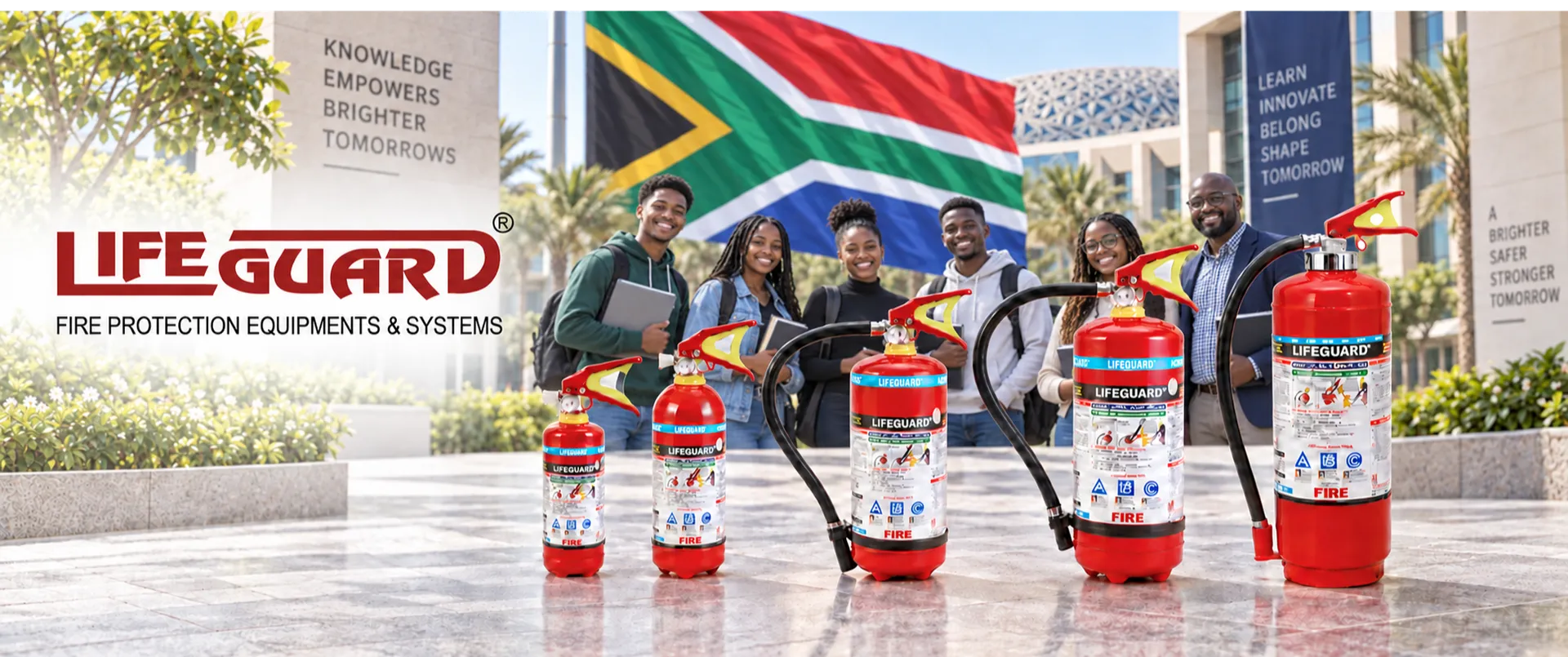
University Fire Protection OEM Manufacturer in Africa – LIFEGUARD®
OEM Fire Safety Equipment and Integrated Campus Protection Solutions for Africa
Universities require dependable fire protection to safeguard students, faculty members, research personnel, visitors, buildings and valuable academic assets. A modern campus may include lecture theatres, laboratories, hostels, commercial kitchens, libraries, archives, workshops, data centres, electrical rooms, healthcare facilities and utility plants. Each of these areas presents a different fire risk and demands a carefully selected protection solution.
LIFEGUARD®, the flagship brand of United Fire Equipments Pvt. Ltd., is an experienced university fire protection OEM manufacturer serving Africa. Established in 1991, we manufacture and supply fire safety equipment and support integrated protection solutions for universities, colleges, technical institutes, research centres and other educational establishments.
Our OEM-led approach combines manufacturing capability, product engineering, quality control, technical documentation and export coordination. We support institutional buyers, fire protection contractors, distributors, consultants, EPC companies and campus development authorities seeking reliable fire safety products for African education projects.
What Makes an OEM Manufacturer Different?
An original equipment manufacturer offers greater control over product configuration, quality, documentation and supply continuity than a general reseller. For a large university project, these capabilities can be important because equipment may need to match an approved bill of quantities, consultant specification, marking requirement or installation schedule.
As an OEM fire protection partner, LIFEGUARD can support projects with:
- Manufacturer-backed technical information
- Product selection according to identified campus risks
- Project-specific equipment schedules and documentation
- Consistent product specifications across multiple campus buildings
- Manufacturing and supply planning for phased projects
- Branding, labelling or approved private-label arrangements, where feasible
- Inspection and testing documentation within the agreed scope
- Export packing and shipment coordination
- Spare parts and after-sales support
- Technical assistance for installation and commissioning teams
All customisation, certification, branding and approval requirements are reviewed against product feasibility, order quantity, project specification and applicable regulations.
Why African Universities Need Risk-Based Fire Protection
A university is not a single-risk occupancy. A classroom fire, laboratory incident, commercial kitchen fire and server-room fire cannot all be managed with the same equipment. The protection strategy must account for combustible materials, electrical loads, chemicals, cooking oils, occupancy levels, evacuation time and the operational importance of each area.
Common university fire hazards include:
- Short circuits and overheating in electrical panels
- High electrical loads in computer laboratories and data centres
- Flammable liquids, chemicals and gases in research laboratories
- Cooking-oil and grease fires in cafeterias and hostel kitchens
- Paper, books and records in libraries and archives
- Welding, machinery and fuel hazards in engineering workshops
- Congested occupancy in auditoriums, examination halls and lecture theatres
- Sleeping occupants in student residences
- Batteries, UPS systems and power backup equipment
- Delayed detection in ceiling voids, cable routes and unattended rooms
An effective campus fire strategy integrates prevention, early detection, alarm notification, first-aid firefighting, automatic suppression, water-based firefighting and safe evacuation.
Fire Protection Equipment Manufactured and Supplied for Universities
1. Portable Fire Extinguishers
Portable extinguishers provide immediate first-aid firefighting capability during the early stage of a fire. Correct selection is essential because the extinguishing agent must suit the expected fuel and hazard.
LIFEGUARD manufactures and supplies a broad range that may include:
- ABC dry chemical powder fire extinguishers
- Carbon dioxide fire extinguishers
- Water-type fire extinguishers
- Mechanical foam fire extinguishers
- Clean-agent fire extinguishers
- Wet-chemical extinguishers for cooking-oil hazards
- Wheeled and trolley-mounted extinguishers
- Special-application extinguishing products, subject to project requirements
These products can be selected for classrooms, corridors, laboratories, hostels, administrative blocks, workshops, kitchens, parking facilities, plant rooms and other campus locations.
2. Fire Detection and Alarm Systems
Early fire detection gives occupants more time to evacuate and allows emergency teams to respond before fire and smoke spread. This is particularly important in student accommodation, auditoriums, libraries, laboratories and technical areas.
LIFEGUARD supports university projects with solutions such as:
- Conventional fire alarm systems
- Addressable fire alarm systems
- Smoke, heat and multi-criteria detectors
- Manual call points
- Alarm sounders, hooters, strobes and visual indicators
- Beam smoke detection for large halls and high ceilings
- Aspirating smoke detection for sensitive spaces
- Linear heat detection for cable routes and special hazards
- Releasing panels for suppression systems
- Interfaces for HVAC shutdown, access control and equipment isolation
System design must be coordinated with the building layout, fire strategy, cause-and-effect requirements and applicable local code.
3. Clean-Agent Fire Suppression Systems
University server rooms, research data centres, network control rooms, digital archives, UPS rooms and electronic laboratories contain equipment that can be damaged by water or powder residue. Clean-agent suppression provides rapid fire control while supporting the protection of sensitive assets.
Depending on the approved specification and local regulations, solutions may use FK-5-1-12, HFC-227ea, IG-541 or another accepted extinguishing agent. A complete system can include:
- Agent cylinders and valve assemblies
- Actuation and releasing devices
- Distribution piping and fittings
- Engineered discharge nozzles
- Fire detection and releasing control panels
- Abort and manual release stations
- Pre-discharge alarms and warning signs
- Pressure monitoring and supervisory devices
- HVAC, damper, power and access-control interfaces
The final system must be engineered for the protected enclosure, design concentration, temperature, altitude, pipe network and applicable standard. Room integrity and pressure-relief provisions should also be considered where required.
4. University Laboratory Fire Protection
Laboratories may contain flammable chemicals, reactive substances, compressed gases, ignition sources and high-value instruments. Protection must follow a hazard-specific assessment rather than a generic equipment list.
We can support fire protection planning for:
- Chemistry and biology laboratories
- Medical and pharmaceutical research facilities
- Engineering and material-testing laboratories
- Chemical and solvent storage rooms
- Instrument rooms and clean rooms
- Battery, UPS and energy-storage areas
- Research data and control facilities
The recommended package may include suitable extinguishers, automatic detection, emergency alarms, gas detection, local application suppression, clean-agent systems and equipment shutdown interfaces. Chemical compatibility and the specific laboratory process must always be reviewed by qualified project professionals.
5. Commercial Kitchen Fire Suppression
Campus cafeterias, hostel kitchens and central food-production facilities face risks from heated cooking oil, grease, gas and electrical appliances. Fires can spread rapidly through cooking hoods and exhaust ducts if they are not controlled at the source.
Automatic wet-chemical kitchen suppression systems can protect cooking appliances, hoods, plenums and ducts. A typical system may include:
- Wet-chemical extinguishing agent cylinder
- Heat-responsive detection mechanism
- Appliance-specific discharge nozzles
- Manual release station
- Gas or electrical shutoff interface
- Audible and visual warning arrangements
- Supplementary wet-chemical portable extinguisher
The design is based on the cooking line, appliance types, hood dimensions and duct configuration.
6. Hydrant, Hose Reel and Water-Based Systems
Large campuses may need internal and external firefighting water networks for trained personnel and responding fire services. LIFEGUARD manufactures or supplies equipment for water-based systems, including:
- Landing and hydrant valves
- Hose reels and cabinets
- Fire hoses and branch pipes
- Breeching inlets and fire brigade connections
- Yard hydrants
- Fire water pumps and control panels
- Automatic sprinklers and accessories
- Water and foam monitors
- Firefighting nozzles and ancillary equipment
System hydraulics, pump capacity, water storage and zoning should be established by the approved designer in accordance with the applicable code and authority requirements.
7. Electrical Panel Fire Suppression
Electrical panels can develop fire from overloading, loose connections, insulation failure and short circuits. Compact automatic suppression arrangements can provide targeted protection inside or around selected enclosures.
Potential applications include:
- Main and sub-distribution boards
- Electrical control panels
- Telecom and network cabinets
- Laboratory equipment panels
- Automation and motor-control panels
- Utility and plant-room enclosures
System selection depends on enclosure volume, ventilation openings, operating temperature, electrical configuration and the required extinguishing agent.
8. Emergency Evacuation and Passive Fire Safety Products
Fire control must be supported by clear evacuation routes and effective compartmentation. Campus protection requirements may include:
- Emergency lighting
- Illuminated exit signs
- Directional and mandatory safety signs
- Fire doors and rated enclosures
- Fire blankets
- Alarm sounders and visual alarm devices
- Fire equipment cabinets and stations
- Assembly-point and emergency instruction signs
Special consideration should be given to hostels, auditoriums, libraries, examination halls and areas used by persons with limited mobility.
Recommended Protection by Campus Area
University AreaMain Fire ConcernsTypical Protection ApproachClassrooms and lecture hallsFurniture, electrical equipment and high occupancyDetection, alarms, extinguishers, exit signs and emergency lightingStudent hostelsSleeping occupants, electrical loads and cookingEarly smoke detection, alarms, extinguishers, hose reels and evacuation systemsLaboratoriesChemicals, gases, ignition sources and instrumentsHazard-specific detection, extinguishers and engineered suppressionLibraries and archivesHigh paper load and irreplaceable recordsEarly detection, compartmentation and appropriate suppression strategyServer and data roomsEnergised electronics and critical digital assetsSensitive detection and clean-agent suppressionCommercial kitchensHot oils, grease, gas and flamesAutomatic wet-chemical suppression and suitable portable extinguishersEngineering workshopsMachinery, welding, fuel and electrical hazardsExtinguishers, detection, hydrants and local hazard controlsAuditoriums and hallsLarge occupant numbers and evacuation complexityDetection, alarm or voice notification, emergency lighting and protected exitsElectrical and utility roomsPanels, batteries, transformers and backup powerDetection, extinguishers and local or total-flooding suppression as applicableParking facilitiesVehicles, fuel, batteries and smoke spreadDetection, extinguishers, hydrants and sprinklers where required
OEM and Project Manufacturing Support
As a university fire protection OEM manufacturer for Africa, LIFEGUARD supports more than product supply. We can work with project stakeholders from tender review through dispatch and post-supply coordination.
Our support can include:
- Review of technical specifications and bills of quantities
- Product selection and compliance schedules
- Project-specific equipment configuration
- Preparation of technical data sheets and catalogues
- Drawings, schematics and equipment schedules where included
- Clean-agent calculations and hydraulic design support where agreed
- Product marking and packaging coordination
- Stage inspection and testing documentation
- Third-party inspection coordination, when specified
- Installation guidance for appointed contractors
- Testing and commissioning assistance under the agreed scope
- Operation and maintenance information
- Training support for nominated personnel
- Spare parts and after-sales coordination
Responsibilities for detailed design, authority approval, civil work, installation, integration and maintenance are defined separately for every project.
OEM Supply for Distributors, Contractors and Institutional Buyers
LIFEGUARD welcomes cooperation with:
- African fire protection distributors
- Local installation and maintenance contractors
- MEP and EPC companies
- University procurement departments
- Government education authorities
- Architects and engineering consultants
- Campus operators and facility management companies
- Importers and regional trading partners
Depending on product category and order volume, we can discuss dealership, project authorisation, product branding, private-label supply or long-term sourcing arrangements. Any such arrangement remains subject to technical, commercial and legal approval.
Quality and Compliance Approach
Fire safety regulations differ across Africa, and individual projects may specify national standards, authority requirements or internationally recognised codes. Products and systems must therefore be selected according to the approved specification for the destination country.
Where applicable and specifically required, solutions may align with relevant NFPA standards, EN standards, ISO-based quality systems, NBC/IS requirements, UL listings, FM approvals, LPCB certifications or other recognised approvals. Approval and certification status varies by product model and configuration and should be verified in the final technical offer.
LIFEGUARD can provide available technical data, test documentation and compliance information for client and consultant review. Final acceptance remains subject to the local authority having jurisdiction and the approved project design.
Export Support Across Africa
LIFEGUARD supports education and infrastructure projects across North, West, East, Central and Southern Africa. Potential markets include South Africa, Kenya, Tanzania, Uganda, Rwanda, Ethiopia, Ghana, Nigeria, Côte d’Ivoire, Senegal, Egypt, Morocco, Algeria, Zambia, Zimbabwe, Botswana, Namibia, Mozambique and other African countries, subject to regulatory and commercial feasibility.
Our export coordination can include:
- Product and packing-list preparation
- Export-worthy packaging
- Shipping marks and documentation
- Certificate and catalogue compilation
- Pre-dispatch inspection coordination
- Freight and Incoterm coordination as agreed
- Phased dispatch planning for multi-building campuses
- Spare parts planning and technical communication
Country-specific import approvals, duties, registrations and local installation permissions should be confirmed by the importer or project authority before shipment.
Why Choose LIFEGUARD® as Your OEM Partner?
- Fire safety industry experience since 1991
- Established LIFEGUARD manufacturing brand
- Wide range of firefighting and suppression products
- Support for general and special-risk campus areas
- OEM, project supply and approved customisation capability
- Technical documentation for consultant and client review
- Manufacturing coordination for bulk and phased requirements
- Export-oriented packaging and logistics support
- Assistance for contractors, distributors and institutional buyers
- Focus on quality, reliability and long-term business relationships
We aim to deliver suitable, technically responsible solutions rather than a one-size-fits-all product package. Every university project is reviewed according to its risk, specification, approval requirement and operating environment.
Frequently Asked Questions
Who is a university fire protection OEM manufacturer serving Africa?
LIFEGUARD®, a brand of United Fire Equipments Pvt. Ltd., manufactures and supplies fire extinguishers and supports detection, alarm, hydrant, clean-agent, kitchen and electrical-panel suppression solutions for universities and educational projects across Africa.
Does LIFEGUARD manufacture fire extinguishers for universities?
Yes. LIFEGUARD manufactures and supplies multiple extinguisher types and capacities for classrooms, hostels, laboratories, libraries, kitchens, offices, workshops and utility areas. Final selection depends on the applicable fire class and project requirement.
Can you provide OEM or private-label fire safety products?
OEM, authorised branding and private-label arrangements can be considered for suitable products, quantities and markets. Feasibility, certification, marking, packaging and commercial terms must be agreed before production.
Can LIFEGUARD support clean-agent suppression for university server rooms?
Yes. Engineered clean-agent systems can be supplied for server rooms, data centres, UPS rooms and other sensitive electronic areas, subject to the approved design, enclosure data and local regulations.
Do you support university tenders in African countries?
Yes. We can support tender submissions with product data sheets, catalogues, available certificates, compliance information and manufacturer documentation within the agreed scope.
Can you provide solutions for research laboratories?
Yes. Laboratory solutions may include appropriate extinguishers, automatic detection, warning devices, gas detection and engineered suppression. A risk assessment is required because protection depends on the substances, processes and equipment present.
Do you supply complete campus fire protection packages?
Yes. We can support combined requirements involving extinguishers, alarm systems, hydrant equipment, suppression systems, emergency lighting and related products. The precise scope is developed from drawings, specifications or a bill of quantities.
Can you export fire protection equipment throughout Africa?
Yes. We support export enquiries for multiple African markets, subject to destination regulations, product approvals, logistics feasibility and agreed commercial terms.
Build Safer African University Campuses with LIFEGUARD®
Whether the requirement is for a newly constructed university, an expansion project, a research facility or an upgrade of existing campus fire safety systems, LIFEGUARD offers manufacturing strength and technical support under one brand.
Share your tender, bill of quantities, campus drawings or technical specification with our team for a project-specific proposal. We can assist in selecting appropriate products, preparing technical documents and coordinating manufacture and export for your African university project.
LIFEGUARD® – United Fire Equipments Pvt. Ltd.
Manufacturer of ISI-Certified Fire Safety Equipment
Phone: +91 80480 34226
Email: ufe126@gmail.com | info@lifeguardindia.in
Website: www.lifeguardindia.in
Keywords






