
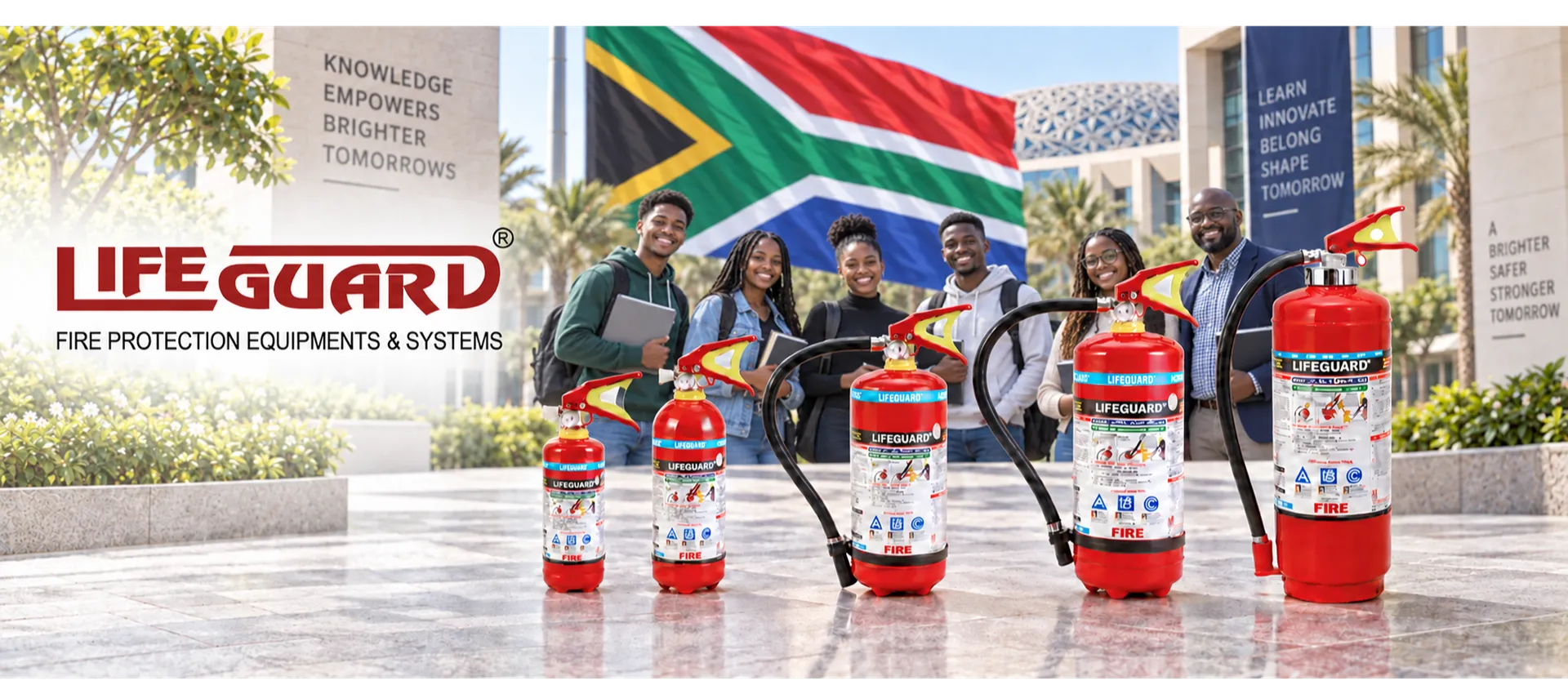
University Fire Protection Solutions in Africa
Complete Campus Fire Safety Solutions from LIFEGUARD®
Modern universities are more than collections of classrooms. A single campus may include laboratories, libraries, hostels, commercial kitchens, auditoriums, hospitals, workshops, data centres, electrical rooms, sports facilities and heritage buildings. Every area has a different combination of ignition sources, combustible materials, occupancy patterns and business-continuity risks. For this reason, university fire safety requires an integrated, risk-based solution rather than a one-product approach.
LIFEGUARD®, the fire safety brand of United Fire Equipments Pvt. Ltd., provides university fire protection solutions for projects across Africa. Established in India in 1991, we support educational institutions, architects, consultants, EPC companies, MEP contractors, distributors and facility-management teams with fire protection equipment, engineered suppression solutions and project documentation.
From portable fire extinguishers and alarm systems to clean-agent suppression, kitchen protection and hydrant equipment, our objective is to help campuses create a coordinated fire safety framework for people, property, research assets and essential operations.
A Risk-Based Approach to University Fire Protection
No two campuses have identical fire risks. The appropriate protection strategy should be based on a detailed assessment of building use, occupancy, stored materials, electrical loads, critical equipment, evacuation arrangements and local regulations.
A comprehensive university fire protection plan may combine:
- Fire-risk identification and hazard-based product selection
- Early fire detection and occupant notification
- Portable first-aid firefighting equipment
- Automatic suppression for critical or high-risk areas
- Hydrant, hose-reel and sprinkler protection
- Passive fire protection and compartmentation
- Emergency lighting, exit signage and evacuation support
- Inspection, testing, training and preventive maintenance
Final system selection, design and installation must comply with the approved project specification and requirements of the relevant local authority.
Our University Fire Protection Solutions
1. Portable Fire Extinguishers
Portable extinguishers are an essential first line of defence against incipient fires. Correct selection is based on the anticipated fire class, operating environment and applicable standard.
LIFEGUARD® solutions may include:
- ABC dry chemical powder extinguishers for general campus risks
- CO₂ extinguishers for suitable electrical and electronic equipment hazards
- Water-type extinguishers for applicable ordinary combustible materials
- Foam extinguishers for suitable Class A and flammable-liquid risks
- Wet chemical extinguishers for cooking-oil and commercial kitchen hazards
- Clean-agent extinguishers for sensitive equipment and residue-critical areas
- Trolley-mounted extinguishers for larger hazards and utility locations
Extinguisher placement should be planned according to hazard type, floor area, travel distance, accessibility and local fire code requirements.
2. Fire Detection and Alarm Systems
Rapid detection and clear notification are critical on university campuses, particularly in hostels, libraries, laboratories and high-occupancy buildings. A properly designed system helps initiate evacuation and can activate or interface with other life-safety systems.
Depending on the application, the solution may comprise:
- Addressable or conventional fire alarm control panels
- Smoke, heat and multi-criteria detectors
- Aspirating smoke detection for selected critical environments
- Beam detection for large or high-ceiling spaces
- Manual call points
- Sounders, bells, hooters and visual alarm devices
- Releasing panels for automatic suppression systems
- Interfaces for HVAC shutdown, access control, lifts and building services
3. Clean-Agent Fire Suppression
University data centres, network rooms, UPS rooms, server rooms, control facilities, laboratories and valuable archives often need fire suppression without water damage or powder residue. Clean-agent systems are designed for rapid fire control while supporting faster recovery and easier post-discharge cleanup.
Subject to the project specification and permitted use in the destination country, solutions may use FK-5-1-12, HFC-227ea or another approved gaseous extinguishing agent. A system can include agent cylinders, valves, actuation equipment, piping, nozzles, detectors, warning devices, abort stations, manual-release points and a releasing control panel.
Engineered gaseous systems require correct hazard classification, room-volume calculations, enclosure assessment, hydraulic flow calculations, nozzle selection and approved installation drawings. Room integrity and pressure-relief requirements should also be evaluated where applicable.
4. Laboratory Fire Protection
Science, engineering, medical and research laboratories can contain flammable liquids, gases, reactive chemicals, energized equipment and high-value instruments. Protection must be tailored to the processes and materials present.
Laboratory protection may involve:
- Suitable portable extinguishers selected for identified hazards
- Automatic detection and alarm
- Local-application or total-flooding suppression where appropriate
- Flammable-material storage controls
- Emergency shutdown and ventilation interfaces
- Fire blankets, safety signage and emergency response equipment
Specialist risks involving chemicals, metals, batteries, gases or biological materials require a dedicated hazard assessment and approved protection strategy.
5. Kitchen and Cafeteria Fire Suppression
University kitchens and food-service areas contain hot cooking oils, grease deposits, gas or electrical appliances and extraction ducts. A fire can spread rapidly from an appliance into the hood and ductwork.
An automatic kitchen suppression system can protect cooking appliances, hoods, plenums and ducts. Depending on the approved configuration, it may provide automatic detection, manual activation, controlled agent discharge, audible warning and fuel or electrical isolation. Routine cleaning, inspection and maintenance remain essential parts of the protection programme.
6. Electrical Panel and Equipment Protection
Electrical panels, switchgear, control cabinets and server racks can develop localized fires that are difficult to detect at an early stage. Compact automatic suppression solutions can be installed inside or around selected enclosures to provide rapid local response.
The appropriate direct- or indirect-release arrangement depends on the enclosure volume, ventilation, equipment layout, hazard level and specified extinguishing agent. Each application should be reviewed individually before system selection.
7. Hydrant, Hose-Reel and Sprinkler Systems
Water-based fire protection is commonly required in large academic buildings, hostels, auditoriums, hospitals, libraries and utility facilities. Depending on the project scope, LIFEGUARD® can support requirements for:
- Fire hydrant valves and landing valves
- Hose reels, hoses, branch pipes and nozzles
- Fire brigade inlet connections
- Sprinklers and associated components
- Hose cabinets and hydrant accessories
- Pumps, valves and selected system equipment
Hydraulic calculations, water-storage capacity, pump selection, zoning and pipe-network design should be completed by qualified professionals in accordance with the applicable code.
8. Passive Fire Protection and Evacuation Support
Active systems control or suppress a fire, while passive protection helps limit its spread and maintain tenable escape routes. A campus fire strategy may therefore include:
- Fire-rated doors and compartmentation products
- Fire and smoke sealing provisions
- Emergency lighting and illuminated exit signage
- Fire equipment location signs
- Assembly-point and evacuation signage
- Fire blankets, sand buckets and emergency accessories
These measures should be coordinated with the building layout, occupant profile and approved evacuation plan.
University Areas We Help Protect
Our solutions can be considered for a wide range of campus environments:
- Classrooms and lecture theatres
- Administrative and faculty buildings
- Student hostels and staff residences
- Libraries, archives and rare-book collections
- Science, engineering and medical laboratories
- Data centres, server rooms and communication hubs
- Electrical rooms, UPS rooms and substations
- Kitchens, cafeterias and food courts
- Auditoriums, conference halls and cultural centres
- Workshops, stores and maintenance buildings
- University hospitals, clinics and pharmacies
- Museums, galleries and research collections
- Parking facilities, generator rooms and utility blocks
Why African Universities Choose Integrated Fire Protection
Protection of Life
Campuses serve large and diverse populations, including students, staff, visitors and residents. Reliable detection, notification and evacuation measures are essential for reducing risk to life.
Safeguarding Research and Academic Assets
Universities invest heavily in scientific instruments, computer infrastructure, libraries, archives and intellectual property. Suitable suppression can help limit physical damage and operational interruption.
Continuity of Education and Operations
A fire incident can close classrooms, laboratories or entire buildings. Coordinated protection, emergency planning and maintenance help strengthen institutional resilience.
Support for Regulatory and Insurance Requirements
Documented fire safety measures can support approval, audit and insurance processes. Exact compliance obligations depend on the country, city, campus and authority having jurisdiction.
Fire Protection Support Across Africa
African university projects operate in varied climates, infrastructure conditions and regulatory frameworks. Equipment selection may be influenced by temperature, humidity, dust, coastal exposure, water availability, maintenance capability and access to spare parts.
LIFEGUARD® welcomes enquiries from universities and project partners in East, West, North, Central and Southern Africa, including South Africa, Kenya, Tanzania, Uganda, Rwanda, Ethiopia, Nigeria, Ghana, Zambia, Zimbabwe, Botswana, Namibia, Mozambique, Mauritius, Egypt, Morocco and other markets, subject to applicable trade requirements and commercial feasibility.
We can work with local distributors, fire contractors and engineering partners to support effective supply, installation coordination and after-sales planning.
LIFEGUARD® Project Support
Technical Review
Share your BOQ, drawings, room data, performance specification and approval requirements. Our team can review the requirement and assist with identifying suitable equipment within the agreed scope.
Product and System Documentation
Depending on the product and order, submissions may include data sheets, catalogues, drawings, test certificates, compliance documents, operation manuals, inspection records and warranty details.
Manufacturing and Supply Coordination
We coordinate product preparation, inspection where included, export packing and dispatch documentation according to the agreed order terms.
Installation and Commissioning Support
Installation guidance, supervision, testing or commissioning assistance may be discussed as part of the project scope. On-site work must be performed by competent personnel and accepted by the relevant local authority.
Maintenance Planning
Fire protection remains reliable only when equipment is inspected, tested and maintained. We encourage campus teams to establish asset registers, inspection schedules, refill or replacement plans, staff training and documented service records.
Standards and Compliance
University fire protection systems should comply with the local building and fire regulations, approved drawings, consultant specifications and requirements of the authority having jurisdiction. Depending on the product category and order, equipment may be offered to relevant IS/BIS or internationally recognized standards and approval frameworks such as NFPA, UL, FM or LPCB.
The applicability and certification status of every product or system must be confirmed against the specific model, project and destination before purchase. References to a standard do not mean that every product carries every approval. Final design approval, installation acceptance and regulatory compliance remain project-specific.
Our Typical Project Process
- Share the requirement: Provide the campus location, BOQ, drawings, specifications, quantities and required certifications.
- Assess the application: We review the protected areas, hazards, operating conditions and requested equipment.
- Develop the supply proposal: Suitable products, accessories, documentation and commercial terms are identified.
- Obtain project approval: Technical submissions are provided as agreed for review by the client, consultant or authority.
- Manufacture and inspect: Equipment is prepared, tested and inspected according to the confirmed scope.
- Pack and dispatch: Products are packed for the agreed transport method and supplied with applicable documents.
- Install and commission: Qualified personnel install and test the systems under the approved project plan.
- Maintain and review: Regular inspection, servicing, training and recordkeeping help sustain performance.
Why Choose LIFEGUARD®?
- Fire safety industry experience since 1991
- Comprehensive portfolio for different campus hazards
- Support for institutional, tender and project requirements
- Technical documentation based on the agreed product scope
- Export-oriented order and packing coordination
- Solutions for both general fire safety and critical-risk areas
- Commitment to responsible product selection and project-specific compliance
Frequently Asked Questions
What fire protection systems are required in a university?
Requirements depend on building use, occupancy, hazards and local regulations. Common provisions include fire alarms, portable extinguishers, hydrants or hose reels, sprinklers, emergency lighting, exit signage and specialized suppression for kitchens, laboratories, data centres and electrical rooms.
Which suppression system is suitable for a university server room?
A clean-agent gaseous system is often considered where protection of electronic equipment and minimal residue are priorities. The correct agent, concentration, cylinder size, pipe network and nozzle arrangement must be established through an engineered design and approved for the project location.
How should university laboratories be protected?
Laboratory protection begins with a chemical and process-specific risk assessment. Detection, extinguishers, ventilation controls, storage practices, shutdown arrangements and specialized suppression may all be required. Generic protection should not replace a detailed assessment of laboratory hazards.
Can one solution cover an entire university campus?
The campus can have one coordinated fire strategy, but different buildings and rooms normally require different technologies. A hostel, kitchen, library, transformer area and data centre should not be protected identically.
Does LIFEGUARD® supply fire protection equipment to African countries?
Yes. We welcome university and campus fire safety enquiries from African markets, subject to the destination, regulatory requirements, product availability, order scope and commercial terms.
What details are needed for a proposal?
Please provide the project location, BOQ, technical specification, floor plans or relevant drawings, room dimensions for suppression areas, hazard details, quantities, required approvals, delivery address and project schedule.
Build a Safer University Campus with LIFEGUARD®
Whether you are developing a new university, upgrading an existing campus or protecting a specialized laboratory or data centre, LIFEGUARD® can support your fire safety procurement with suitable equipment, technical documentation and coordinated project supply.
Send us your BOQ or technical specification to discuss university fire protection solutions for your project in Africa.
Contact Us
LIFEGUARD® – United Fire Equipments Pvt. Ltd.
Manufacturer of ISI Certified Fire Safety Equipment
Phone: +91 8048034226
Email: ufe126@gmail.com | info@lifeguardindia.in
Website: www.lifeguardindia.in
Location: Delhi, India
SEO Metadata
Meta Title: University Fire Protection Solutions Africa | LIFEGUARD®
Meta Description: Explore LIFEGUARD® university fire protection solutions in Africa, including fire alarms, extinguishers, clean-agent, kitchen and panel suppression.
Suggested URL Slug: /university-fire-protection-solutions-africa/
Primary Keyword: university fire protection solutions Africa
Related Keywords:
- university fire safety solutions Africa
- campus fire protection systems Africa
- university fire suppression systems Africa
- fire alarm solutions for universities Africa
- university laboratory fire protection Africa
- campus clean-agent suppression Africa
- university kitchen fire suppression Africa
- university fire extinguisher supplier Africa
- LIFEGUARD fire protection Africa
Keywords






