
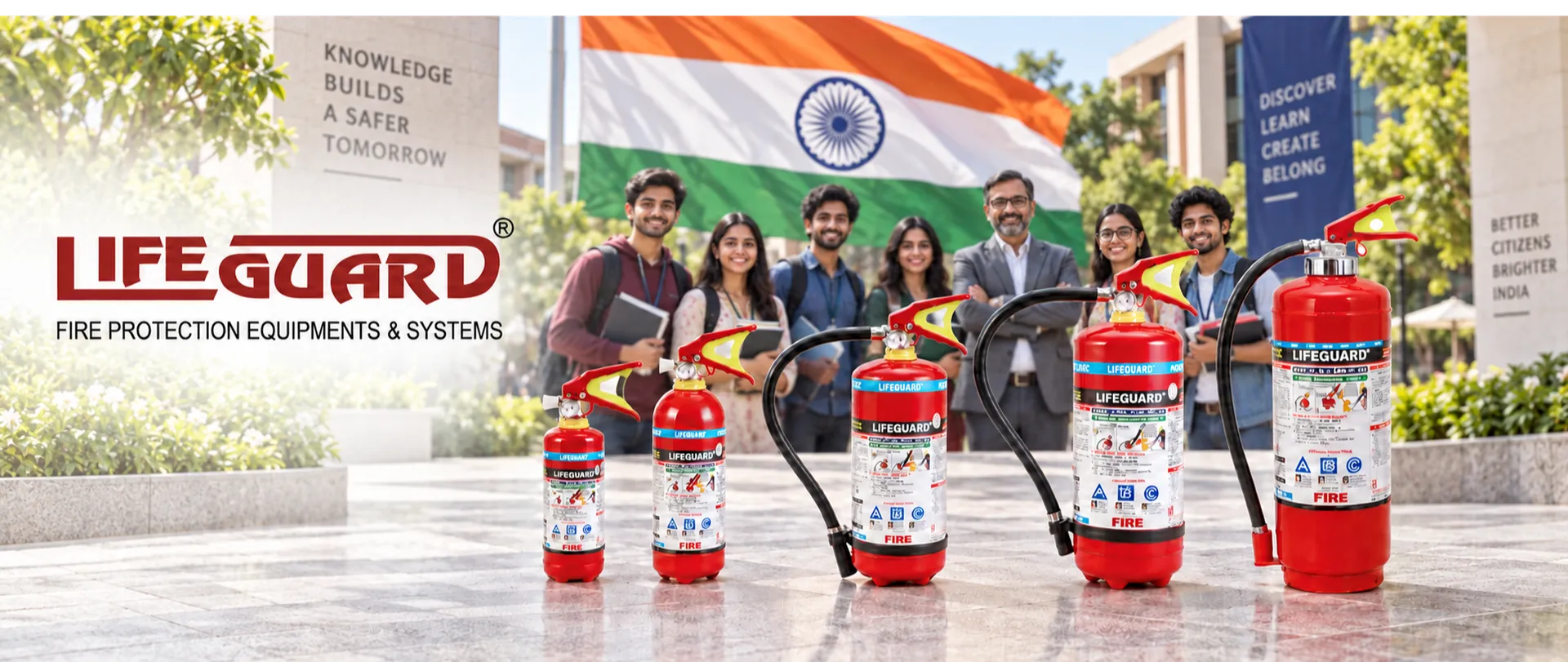
University Fire Safety Equipment Solutions in India
SEO title: University Fire Safety Equipment Solutions in India | LIFEGUARD®
Meta description: Explore LIFEGUARD® fire safety equipment solutions for universities in India, including extinguishers, alarms, hydrants, suppression systems and campus maintenance support.
Suggested URL slug: /university-fire-safety-equipment-solutions-india/
Primary keyword: university fire safety equipment solutions India
Related terms: university fire protection equipment, campus fire safety solutions, fire extinguishers for colleges, university fire alarm systems, hostel fire safety equipment
Fire safety solutions designed for the whole campus
A university is more than a collection of classrooms. Its laboratories, libraries, hostels, kitchens, auditoriums, workshops, server rooms and electrical areas each present different fire risks. A sound campus fire safety plan brings suitable equipment together with detection, warning, evacuation procedures and regular maintenance.
LIFEGUARD®, the fire safety brand of United Fire Equipments Pvt. Ltd., provides university fire safety equipment solutions in India for new campuses, expansions and upgrades. We help institutions select equipment for the hazards in each building, coordinate supply and installation requirements, and plan for inspection, refilling and ongoing service. The final equipment schedule should follow a site assessment, approved drawings and the requirements applicable to the project.
Fire safety equipment for university facilities
Portable and wheeled fire extinguishers
Portable extinguishers give trained occupants a means to tackle a small, early stage fire when it is safe to do so. Depending on the hazard, a university may need ABC dry powder, CO₂, water, foam, clean agent or wet chemical extinguishers. Wheeled units may be considered for larger designated risks. Selection must account for the fuel, nearby electrical equipment, potential residue, access and the site's emergency plan.
An extinguisher schedule can cover classrooms and corridors, administrative areas, libraries, laboratories, workshops, hostels, kitchens, parking facilities and utility buildings. Type, capacity, quantity and placement should be confirmed for each location rather than repeated uniformly across the campus.
Fire detection, alarm and notification
Smoke and heat detectors, manual call points, control panels and audible or visual warning devices help alert occupants and the campus response team. The design should consider occupancy, room use, environmental conditions, building layout and the evacuation strategy. Integration needs may include security rooms, lifts, air handling systems and specialized suppression controls, where specified by the project design.
Hydrant, hose reel and sprinkler equipment
Large academic buildings and campus infrastructure may require hydrant networks, hose reels, landing valves, hoses, nozzles, fire brigade connections and sprinkler equipment under the approved fire protection scheme. Equipment selection must align with the engineered water supply, pressure, coverage and building requirements. LIFEGUARD® lists hydrant, hose reel and sprinkler systems among its integrated fire safety offerings.
Specialized suppression for critical areas
A university's server and UPS rooms, electrical panels, archives, commercial kitchens and other critical spaces may call for application-specific suppression. Options can include clean agent systems, electrical panel protection, kitchen hood suppression and other engineered arrangements where appropriate. Agent choice, room integrity, shutdown interfaces and occupant safety provisions must be reviewed during design. No single suppression method suits every laboratory or every type of stored chemical.
Evacuation and supporting equipment
Exit signage, emergency lighting, fire blankets and protective equipment can support a broader emergency plan. Routes, assembly points and operating instructions should be clear to students, faculty, visitors and maintenance staff, including people in hostels outside teaching hours.
Match the equipment to the campus area
Campus areaTypical considerationsPotential equipment categoriesClassrooms and officesFurniture, paper, electrical equipment and high occupancyAppropriate extinguishers, detection, alarm and evacuation signageLibraries and archivesCombustible collections and valuable recordsDetection, suitable extinguishers and a reviewed suppression strategyComputer, server and UPS roomsSensitive electronics, continuity of service and electrical risksDetection, suitable extinguishers and engineered clean agent or panel protection where justifiedLaboratories and workshopsVaried chemicals, gases, processes and equipmentHazard-specific assessment, detection and appropriately selected extinguishers or systemsHostels and residential blocksSleeping occupants and use outside office hoursDetection, alarms, extinguishers and a practiced evacuation planKitchens and cafeteriasCooking oils, extraction hoods and appliancesSuitable wet chemical extinguishers and kitchen suppression where requiredAuditoriums and sports facilitiesLarge groups and changing event occupancyAlarm and notification, accessible equipment and clear exit routesElectrical and utility areasSwitchgear, generators and other specialized hazardsAppropriate extinguishers, detection and engineered protection where specified
The table is a planning guide. A qualified project assessment and approved design determine the actual system, location and capacity.
A practical process for campus fire protection
- Survey each building. Record occupancy, layout, equipment, stored materials, utility areas and existing fire protection.
- Define the protection schedule. Match risks to equipment types and coordinated detection, alarm, water-based and specialized systems.
- Review drawings and interfaces. Check access, equipment placement, water supply, electrical shutdowns and operating sequences with project stakeholders.
- Supply and install approved equipment. Use the project specifications and applicable certification and documentation requirements for each product.
- Test, commission and hand over. Confirm functions and provide the agreed test records, operating instructions and training.
- Maintain readiness. Schedule inspections, servicing, refilling, replacement and periodic staff orientation.
LIFEGUARD® describes its institutional support as including equipment supply, installation, testing, commissioning, refilling and maintenance. The scope for an individual campus should be confirmed in its proposal and contract.
Why universities work with LIFEGUARD®
United Fire Equipments Pvt. Ltd. manufactures and supplies fire protection equipment under the LIFEGUARD® brand. Its range covers extinguishers and first response equipment alongside detection, hydrant, hose reel and suppression solutions. For a university managing several types of buildings, this breadth helps create a coherent equipment schedule and a clear basis for documentation and service planning. Product approvals and certifications should always be verified against the specific item and project requirement.
Whether the requirement is a new institutional campus, a hostel upgrade, a laboratory refurbishment or replacement of aging extinguishers, our team can review the location schedule and recommend a suitable supply and service scope.
Frequently asked questions
Which fire extinguishers does a university need?
The answer depends on the hazards in each area. General academic spaces, electrical rooms, kitchens and laboratories can require different extinguisher types. A site assessment should establish the type, capacity, quantity and positioning.
Are clean agent systems suitable for university server rooms?
They may be considered where protection of sensitive equipment and continuity of service matter. The design needs to account for room conditions, occupancy, interfaces and the chosen agent's approved application.
Can one fire safety plan cover the whole campus?
A campus-wide plan is useful for consistent documentation and response, but each building and special hazard needs its own assessment. The resulting equipment schedule can then be coordinated across the institution.
What should be included in an enquiry?
Share building plans, room uses and dimensions, existing equipment details, relevant tender or approval specifications, and the desired supply, installation and maintenance scope. These details help the team prepare a more accurate proposal.
Discuss your university fire safety project
Planning a new campus or reviewing existing fire protection equipment? Contact LIFEGUARD® with your building list, drawings and project requirements for an application-specific proposal.
LIFEGUARD® | United Fire Equipments Pvt. Ltd.
Manufacturer of fire safety equipment and provider of fire protection solutions
Phone: 8048034226
Email: ufe126@gmail.com | info@lifeguardindia.in
Website: www.lifeguardindia.in
Keywords






