Warehouse Clean Agent Suppression Manufacturer UAE
Meta Title: Warehouse Clean Agent Suppression Manufacturer UAE | LIFEGUARD®
Meta Description: LIFEGUARD® is an Indian fire safety equipment manufacturer supporting UAE projects with clean agent suppression systems for warehouse electrical rooms, control rooms, server rooms, automation areas and other critical enclosed hazards.
Primary Keyword: Warehouse Clean Agent Suppression Manufacturer UAE
Secondary Keywords: warehouse clean agent fire suppression manufacturer UAE, clean agent suppression system UAE, warehouse gas suppression manufacturer UAE, clean agent fire protection UAE, FK-5-1-12 suppression UAE, automatic clean agent suppression UAE, industrial clean agent system UAE
Warehouse Clean Agent Suppression Manufacturer Serving UAE
Modern warehouses are no longer limited to conventional storage. Today's logistics and distribution facilities can include automated storage and retrieval systems, electrical rooms, communication equipment, server infrastructure, control panels, UPS systems, battery charging areas, automation systems and other critical assets.
While water-based fire protection can be appropriate for many warehouse storage applications, certain enclosed electrical and electronic areas may require a clean-agent fire suppression solution designed specifically for the equipment and enclosure.
LIFEGUARD® provides clean-agent and gas-based fire suppression solutions for UAE projects, supporting warehouses, logistics facilities, distribution centres, industrial buildings, data and communication spaces, electrical rooms, control rooms and other critical enclosed hazards.
As an Indian fire safety equipment manufacturer, LIFEGUARD® can support UAE customers, consultants, contractors, system integrators, EPC companies and project procurement teams with clean-agent suppression equipment and project-specific technical documentation.
For Dubai projects, the fire protection design must take account of the requirements of the applicable authority. Dubai Civil Defence's published guidance states that clean-agent systems should be designed using DCD-approved manufacturer's design software and comply with the applicable UAE Fire & Life Safety Code of Practice and manufacturer's instructions. It also identifies pre-engineered systems from a DCD-approved manufacturer as acceptable in the stated application. (Dubai Culture and Arts Authority)
What Is a Clean Agent Fire Suppression System?
A clean agent fire suppression system is an engineered fire protection system that uses a gaseous extinguishing agent to suppress a fire within a protected enclosure while avoiding the residue normally associated with dry chemical extinguishing agents.
These systems are particularly relevant to areas containing:
- Electrical equipment
- Electronic equipment
- Data processing equipment
- Network systems
- Automation controls
- UPS equipment
- Communication equipment
- Critical industrial controls
- Sensitive machinery
A typical total-flooding clean-agent system uses fire detection to identify an incipient fire, initiates an alarm and pre-discharge sequence and, when the release conditions are satisfied, discharges the extinguishing agent into the protected enclosure.
Clean-agent systems are generally intended for properly enclosed hazards. NFPA 2001 addresses clean-agent fire extinguishing systems and recognises their use for hazards contained within enclosures or equipment enclosures. (NFPA Document Information)
Why Clean Agent Suppression Is Important for Warehouse Critical Areas
Large warehouses can contain rooms and equipment areas where a conventional extinguishing method may create secondary damage or operational disruption.
For example, a logistics centre may contain:
- Main electrical rooms
- MCC rooms
- Automation control rooms
- Server rooms
- Network rooms
- UPS rooms
- Battery-related equipment
- Security control rooms
- PLC panels
- Building management system rooms
These areas may contain expensive electronic equipment that is critical to warehouse operations.
A properly selected clean-agent system can provide fire suppression without introducing large quantities of water or powder into the protected enclosure. However, clean-agent systems should not automatically replace the warehouse's overall fire protection arrangement. General commodity storage may require a different protection strategy, such as an appropriately designed sprinkler system, while clean agents can protect selected enclosed hazards.
LIFEGUARD® – Clean Agent Suppression Manufacturer for UAE Projects
LIFEGUARD® provides fire safety equipment and engineered fire protection technologies for commercial, industrial and infrastructure applications.
Our clean-agent suppression portfolio can support requirements involving:
- Clean-agent fire suppression systems
- Gas-based fire suppression
- Total-flooding systems
- Electrical-room suppression
- Server-room suppression
- Control-room protection
- Automation-room protection
- UPS-room protection
- Critical equipment protection
- Special-hazard applications
Depending on the selected system and project requirements, clean-agent technologies may include chemical agents or inert gases.
DCD's published checklist identifies inert gases such as nitrogen and argon and chemical gases such as FM-200, HFC-based agents, NAFS 125 and Novec as examples within its clean-agent guidance. (Dubai Culture and Arts Authority)
The appropriate agent must be determined from the hazard, enclosure, occupancy, required design concentration, equipment compatibility, environmental conditions and applicable approval requirements.
Clean Agent Systems for UAE Warehouse Electrical Rooms
Electrical rooms are among the important applications for specialised fire suppression.
A warehouse electrical room may contain:
- Switchgear
- MCC panels
- Distribution boards
- Control panels
- Protection relays
- Electrical cabling
- Power management equipment
A fire in such a room can potentially disrupt the warehouse's entire electrical and automation infrastructure.
A clean-agent suppression system can be engineered as a dedicated enclosure-protection system with:
Detection → Alarm → Pre-discharge Sequence → Agent Release → Distribution → Suppression
The design should also consider HVAC shutdown, enclosure integrity, pressure relief and equipment interlocks as required.
DCD's published clean-agent checklist specifically addresses HVAC/air-circulation shutdown, enclosure integrity and pressure-relief provisions as part of clean-agent system design considerations. (Dubai Culture and Arts Authority)
Clean Agent Fire Suppression for Warehouse Server Rooms
Modern warehouses frequently depend on IT infrastructure for:
- Warehouse management systems
- Inventory control
- Order processing
- Barcode and RFID systems
- Network communications
- Security
- Building management
- Automation
A server or network room can therefore be operationally critical even when it occupies a relatively small part of a large warehouse.
Clean-agent suppression can be considered for suitably designed enclosed server and network spaces where protection of electronic equipment is required.
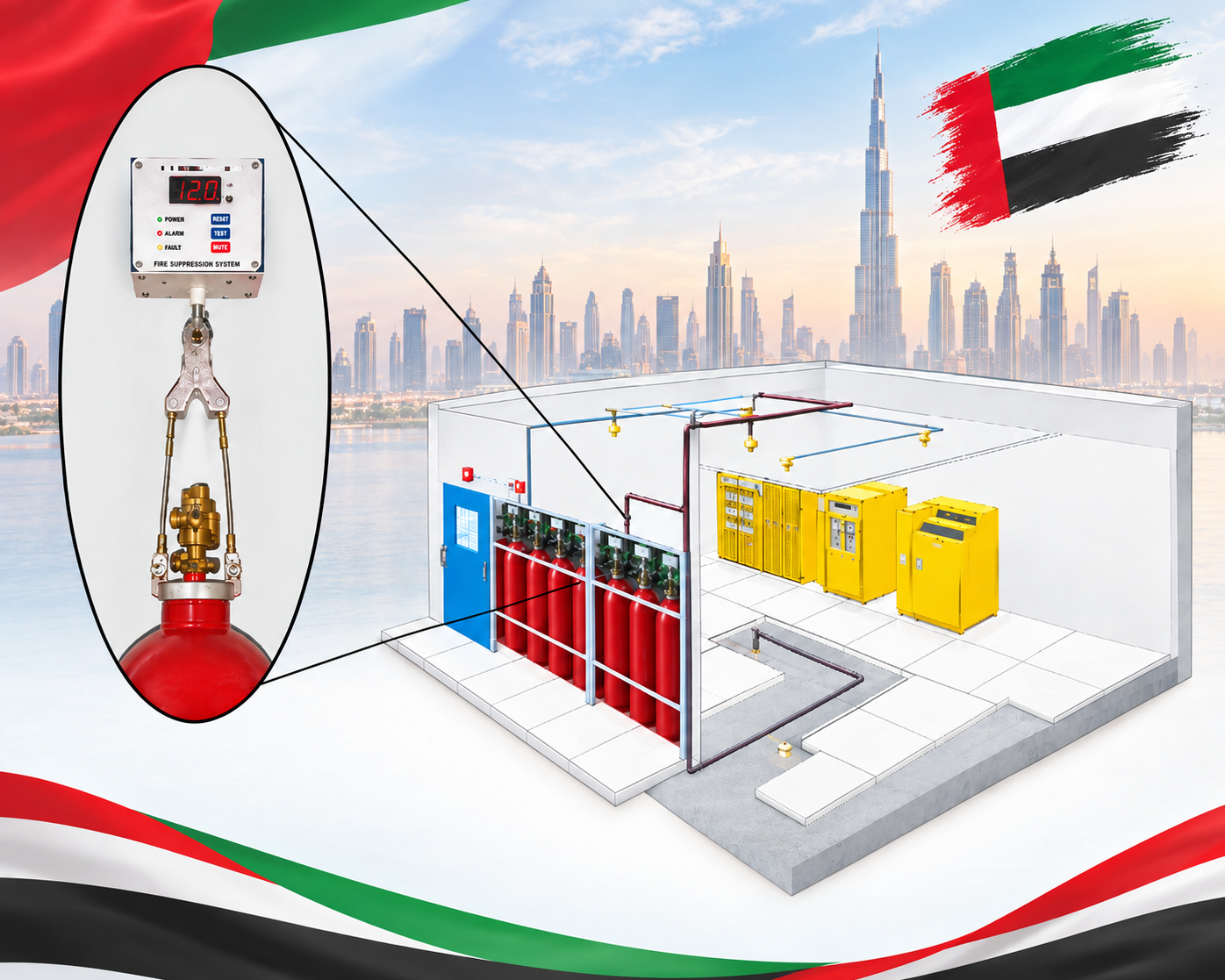
A typical installation may include:
- Smoke detectors
- Fire suppression control panel
- Agent cylinders
- Cylinder valves
- Release mechanism
- Distribution pipework
- Discharge nozzles
- Manual release station
- Abort switch, where applicable
- Audible alarm
- Visual alarm
- HVAC shutdown interface
- Pressure relief arrangement
Clean Agent Suppression for Automated Warehouses
Automation is one of the defining features of many modern logistics facilities.
Automated warehouses can incorporate:
- Automated storage and retrieval systems
- Conveyors
- Sortation systems
- Robotic equipment
- PLC systems
- Motor control centres
- Electrical control panels
- Industrial networking
- Battery-powered machinery
The automation control room may contain sensitive electronic equipment that warrants specialised fire protection.
A clean-agent system can be designed for selected enclosed control and automation rooms, while other areas of the warehouse may require sprinkler, water-based or other appropriate fire protection.
This area-specific protection strategy helps match the extinguishing technology to the hazard rather than treating every part of the warehouse identically.
Warehouse Control Room Clean Agent Suppression
Control rooms are responsible for monitoring and operating critical warehouse systems.
Possible equipment includes:
- PLC controllers
- SCADA systems
- Automation servers
- Industrial computers
- Communication equipment
- Control consoles
- Network switches
- Monitoring systems
A properly engineered clean-agent system can protect these assets by rapidly introducing the extinguishing agent into the protected enclosure after a qualifying fire signal.
Where automatic release is used, the sequence should be designed, tested and commissioned according to the approved system design.
Clean Agent Suppression for UPS Rooms
UPS systems support critical warehouse electrical infrastructure and can contain substantial electrical equipment.
A dedicated fire protection strategy may be appropriate for UPS rooms depending on the equipment configuration, room construction and project requirements.
Clean-agent suppression can be considered where the protected enclosure and hazard are compatible with the selected agent.
The system design can incorporate:
- Early fire detection
- Suppression control
- Agent storage
- Automatic release
- Alarm notification
- HVAC interlock
- Electrical shutdown interface
- Pressure relief
The final design must be based on the specific UPS installation and approved fire protection criteria.
Clean Agent Suppression for Battery & Energy Storage Areas
Battery systems are becoming increasingly important within modern warehouses.
Applications can include:
- Electric forklifts
- Automated guided vehicles
- Charging stations
- Battery rooms
- Energy-storage systems
- Backup power systems
Lithium-ion battery hazards require specialised evaluation. Thermal runaway, heat generation, fire propagation and re-ignition considerations may make a conventional clean-agent approach unsuitable as the only protection strategy for some battery applications.
Consequently, battery protection should be assessed separately from conventional server or electrical-room suppression.
LIFEGUARD® offers specialised fire safety technologies for selected lithium-ion battery, EV and energy-storage applications, with system selection based on the specific technology and hazard.
Clean Agent Suppression System Components
A warehouse clean-agent fire suppression installation normally consists of multiple integrated components.
Fire Detection System
Smoke or other suitable detectors identify developing fire conditions.
Clean Agent Control Panel
The control panel processes detection signals and controls alarm and release sequences.
Agent Storage Cylinders
The extinguishing agent is stored in appropriately sized and pressurised cylinders according to the engineered system.
Cylinder Valve & Actuation
The valve and actuation arrangement controls release of the extinguishing agent.
Distribution Pipework
Pipework transfers the agent from the cylinders to the protected enclosure.
Discharge Nozzles
Nozzles distribute the agent according to the hydraulic and discharge calculations.
Audible & Visual Alarms
Alarms warn occupants and indicate system status.
Manual Release
A manual release arrangement can be provided where required by the approved design.
Abort Switch
Where specified, an abort switch provides a controlled mechanism for interrupting a pre-discharge sequence.
HVAC Interlock
Ventilation and air-circulation systems can be interfaced with suppression controls when required.
Pressure Relief
Enclosure pressure generated during discharge must be addressed through appropriate engineering and pressure-relief provisions.
DCD's published guidance specifically addresses nozzle distribution, enclosure integrity, HVAC shutdown, pressure-relief arrangements and agent-cylinder storage considerations for clean-agent systems. (Dubai Culture and Arts Authority)
Warehouse Clean Agent Suppression System Working Principle
A typical clean-agent system follows a structured sequence.
Step 1 – Fire Detection
The detection system identifies smoke or another configured fire condition.
Step 2 – Alarm Initiation
The control panel activates audible and visual warning signals.
Step 3 – Verification / Release Logic
The system follows the programmed release logic, which may use cross-zoned detection or another approved configuration.
Step 4 – Pre-Discharge Warning
Occupants are warned before agent discharge where required by the system design.
Step 5 – Equipment Interlocks
HVAC, dampers, machinery or other equipment can be shut down or controlled as specified.
Step 6 – Agent Discharge
The clean agent is discharged through the engineered nozzle arrangement.
Step 7 – Fire Suppression
The agent concentration within the enclosure reaches the required design condition for suppression.
Step 8 – System Monitoring
The control panel records or indicates system status for response and subsequent inspection.
Warehouse Clean Agent Suppression System Design
Clean-agent fire suppression is an engineered technology. Correct system design is essential for effective performance.
Hazard Assessment
Determine the type of fire hazard and the equipment requiring protection.
Enclosure Assessment
Establish the dimensions, construction, openings and characteristics of the protected room.
Agent Selection
Select a suitable extinguishing agent based on the hazard and required design conditions.
Agent Quantity Calculation
Determine the quantity required for the protected volume and applicable design concentration.
Pipe Network Design
The distribution network must be designed to achieve the required discharge performance.
Nozzle Layout
Nozzles are positioned to provide appropriate distribution throughout the protected enclosure.
Detection Design
Detection technology and zoning are selected according to the protected environment.
HVAC Coordination
Ventilation systems and air circulation should be coordinated with the clean-agent release sequence where applicable.
Pressure Relief
The enclosure should be assessed for pressure generated during discharge.
Commissioning
Detection, alarms, release sequences, interfaces and discharge-related functions should be tested according to the approved procedure.
NFPA 2001 is specifically dedicated to clean-agent fire extinguishing systems, while relevant UAE projects may also need to comply with local authority requirements and approved design criteria. (NFPA Document Information)
Warehouse Clean Agent Suppression Manufacturer for Dubai
Dubai is an important logistics and warehousing market, with large distribution and industrial facilities incorporating increasingly sophisticated automation and electrical infrastructure.
For Dubai warehouse projects, clean-agent suppression systems may be required for selected:
- Electrical rooms
- Automation rooms
- Server rooms
- Control rooms
- UPS rooms
- Critical equipment areas
Dubai Civil Defence provides dedicated engineering and project-submission requirements, and its published materials identify DCD as the authority having jurisdiction for Dubai projects. (Dubai Culture and Arts Authority)
LIFEGUARD® can support consultants and contractors with relevant product information and technical documentation for project evaluation.
Warehouse Clean Agent Suppression Manufacturer for Abu Dhabi
Abu Dhabi's industrial and logistics landscape includes warehouses, manufacturing support facilities, distribution centres and infrastructure projects.
Clean-agent suppression can be considered for selected critical rooms within these facilities where conventional extinguishing media may not be appropriate.
LIFEGUARD® can support requirements for:
- Clean-agent suppression equipment
- Gas suppression systems
- Electrical-room protection
- Control-room protection
- Server-room protection
- Special-hazard suppression
Final system selection should follow the approved design and applicable local authority requirements.
Clean Agent Fire Suppression for UAE Logistics Centres
Large logistics centres frequently depend on interconnected systems for receiving, storage, sorting, inventory management and dispatch.
A fire affecting a control or electrical room can potentially interrupt multiple warehouse functions.
Clean-agent suppression can provide dedicated protection for critical enclosed infrastructure, while the wider warehouse protection strategy can incorporate:
- Automatic sprinklers
- Fire detection
- Fire alarm systems
- Portable extinguishers
- Wheeled firefighting equipment
- Hydrant systems
- Special-hazard suppression
This layered approach helps match each fire protection technology to the risk it is intended to address.
NFPA identifies NFPA 13 as the industry benchmark for automatic sprinkler design and installation, while NFPA 2001 addresses clean-agent fire extinguishing systems. (NFPA)
Clean Agent Fire Suppression for High-Value Warehouses
Warehouses can contain high-value inventory such as:
- Electronics
- Pharmaceuticals
- Precision equipment
- Spare parts
- Industrial components
- Data hardware
- Automated equipment
Critical rooms associated with these facilities can require specialised suppression to reduce potential damage to sensitive assets.
Clean-agent systems can be considered for appropriate enclosed spaces where the agent, occupancy and enclosure are compatible with the application.
Clean Agent vs Water-Based Suppression
Clean-agent and water-based suppression systems are not simply interchangeable.
Protection TechnologyTypical ApplicationAutomatic sprinklerGeneral warehouse storage and building protection where appropriately designedClean agentSelected enclosed electrical/electronic hazardsGas suppressionSelected enclosed or special hazardsWater mistSelected specialised applicationsPortable extinguisherManual first-response firefightingWheeled extinguisherHigher-capacity mobile firefighting
The correct technology depends on the hazard.
For example, clean agent may be appropriate for a server room while sprinkler protection may be the more appropriate technology for general warehouse commodity storage.
UAE Clean Agent Suppression Compliance
Compliance is an important consideration when specifying fire suppression systems for UAE projects.
Dubai Civil Defence's published materials reference the UAE Fire & Life Safety Code of Practice, DCD requirements and international fire codes as part of the project evaluation framework. (Dubai Culture and Arts Authority)
DCD's published clean-agent guidance also specifies requirements relating to:
- Approved design software
- Manufacturer instructions
- Enclosure integrity
- Agent distribution
- HVAC shutdown
- Cylinder storage
- Nozzle arrangement
- Pressure relief
- Hazard height
- System configuration
The DCD checklist states that where the protected hazard exceeds 5 m in height, intermediate nozzle levels should be considered to achieve even distribution of clean agent. (Dubai Culture and Arts Authority)
Because approval requirements can change and may differ by project or authority, the latest applicable requirements should always be checked during project design and submission.
Important Considerations for UAE Warehouse Clean Agent Systems
Enclosure Integrity
A clean-agent total-flooding system relies on retaining the design concentration within the protected enclosure. Uncontrolled openings can affect system performance.
HVAC Shutdown
Air movement can influence agent concentration. HVAC systems should therefore be coordinated with the suppression sequence as required by the design.
Occupant Safety
Agent selection must take into account the occupancy and applicable life-safety requirements.
Pressure Relief
Discharge of gaseous agent can produce pressure changes in an enclosure, requiring appropriate engineering.
Cylinder Location
The location and environmental conditions around agent cylinders should comply with the selected system's requirements.
Nozzle Arrangement
Nozzles must be positioned and sized according to the approved hydraulic or flow calculations.
Testing & Maintenance
Detection, control and suppression systems need regular inspection, testing and maintenance according to the applicable standard, manufacturer's instructions and project requirements. NFPA's clean-agent materials also address procedures for system impairment when protection is temporarily unavailable. (NFPA Document Information)
Applications of Clean Agent Suppression in UAE Warehouses
LIFEGUARD® clean-agent suppression solutions can be considered for:
Logistics Centres
Protection of critical control, server and electrical rooms.
E-Commerce Warehouses
Protection of automation and network infrastructure.
Pharmaceutical Storage
Protection of sensitive control and electrical areas.
Electronics Warehouses
Protection of server and electronic equipment rooms.
Automotive Warehouses
Protection of electrical and control infrastructure.
Industrial Warehouses
Protection of process-control and electrical rooms.
Automated Distribution Centres
Protection of automation servers, PLC rooms and control rooms.
Cold Storage Facilities
Protection of selected electrical and control spaces subject to environmental requirements.
LIFEGUARD® Clean Agent Fire Suppression Portfolio
LIFEGUARD® supports clean-agent fire protection requirements with systems and components appropriate to the project scope.
The portfolio can include:
- Clean-agent suppression systems
- Gas suppression systems
- Agent storage cylinders
- Suppression control panels
- Detection interfaces
- Release mechanisms
- Distribution piping
- Discharge nozzles
- Manual release stations
- Abort switches
- Audible and visual alarms
- HVAC interfaces
- Electrical shutdown interfaces
- Pressure-relief provisions
Specific agent technology, cylinder configuration, pressure, discharge arrangement and component approvals depend on the selected system and project requirements.
Why Choose LIFEGUARD® for Clean Agent Suppression?
Established Fire Safety Manufacturing
LIFEGUARD® has longstanding experience in fire safety equipment manufacturing and project supply.
Integrated Fire Protection Portfolio
Customers can source clean-agent suppression alongside portable fire extinguishers and other fire safety products.
OEM & Project Procurement Support
LIFEGUARD® can support OEM, distributor, EPC and project-based procurement requirements.
Specialised Applications
Our portfolio supports selected electrical, electronic, industrial, battery and special-hazard applications.
Technical Documentation
Relevant datasheets, product specifications, system documentation and applicable certification information can be supplied according to the product and project.
International Project Support
As an Indian manufacturer, LIFEGUARD® can support customers and project partners sourcing fire safety equipment for UAE applications.
Warehouse Clean Agent Suppression Manufacturer UAE – LIFEGUARD®
A warehouse fire protection system should be designed according to the actual risk within each area of the facility.
General storage, electrical rooms, server rooms, automation rooms and battery areas may each require different protection technologies. Clean-agent suppression is particularly relevant to selected enclosed critical spaces containing sensitive electrical and electronic equipment, while the broader warehouse may require sprinkler and other firefighting systems.
LIFEGUARD® provides warehouse clean agent suppression solutions for UAE projects, supporting logistics centres, automated warehouses, distribution facilities, industrial warehouses, e-commerce facilities, pharmaceutical storage and other commercial and industrial applications.
Our solutions can incorporate clean-agent cylinders, suppression control panels, fire detection interfaces, release mechanisms, pipe networks, discharge nozzles, alarms, manual release arrangements and associated system interfaces, subject to the approved design.
For Dubai projects, the applicable DCD requirements and UAE Fire & Life Safety Code should be incorporated into the project design and submission process. (Dubai Culture and Arts Authority)
Contact LIFEGUARD®
Looking for a warehouse clean agent suppression manufacturer in UAE?
LIFEGUARD® supports UAE projects with clean-agent fire suppression systems, gas suppression solutions and specialised fire safety equipment for critical warehouse areas.
LIFEGUARD® – Manufacturer of Fire Safety Equipment
Phone: 8048034226
Email: ufe126@gmail.com | info@lifeguardindia.in
Website: www.lifeguardindia.in
Contact LIFEGUARD® for clean-agent suppression systems and warehouse fire protection solutions for UAE projects.
Frequently Asked Questions
What is a clean-agent fire suppression system?
A clean-agent fire suppression system uses a gaseous extinguishing agent to suppress suitable fires in a protected enclosure without the residue normally associated with powder-based extinguishing systems.
Where are clean-agent systems used in warehouses?
They are commonly considered for selected enclosed areas such as server rooms, electrical rooms, automation rooms, control rooms, UPS rooms and other sensitive equipment spaces.
Is clean-agent suppression suitable for the entire warehouse?
Not necessarily. General commodity storage and enclosed critical equipment rooms can have very different fire protection requirements. The correct protection technology should be selected for each hazard.
Which clean agents can be used in UAE projects?
Depending on the project, clean-agent technologies can include chemical agents and inert gases. Dubai Civil Defence's published guidance identifies examples including nitrogen, argon, FM-200, HFC-based agents and other listed technologies. (Dubai Culture and Arts Authority)
Can clean-agent suppression protect electrical equipment?
Yes, clean-agent systems can be suitable for selected enclosed electrical and electronic hazards when the system is correctly designed for the equipment and enclosure.
Does a clean-agent system require an enclosed room?
Total-flooding systems generally require an enclosure capable of retaining the required extinguishing concentration. Enclosure integrity is therefore an important design consideration. (NFPA Document Information)
Does the HVAC system need to be considered?
Yes. Air circulation and ventilation can affect agent distribution and retention. DCD's published clean-agent guidance addresses shutdown of ventilation and air-circulation systems except where specific safety functions require otherwise. (Dubai Culture and Arts Authority)
Does a UAE warehouse clean-agent system require Civil Defence consideration?
For projects under Dubai Civil Defence jurisdiction, the applicable DCD requirements and UAE Fire & Life Safety Code should be considered during design and approval. DCD identifies itself as the authority having jurisdiction for Dubai projects. (Dubai Culture and Arts Authority)
Can LIFEGUARD® supply clean-agent suppression equipment for UAE projects?
LIFEGUARD® supports international project and OEM procurement requirements for clean-agent and specialised fire safety equipment. Specific agent, equipment configuration, certification and approval requirements should be confirmed for the individual UAE project.
Can LIFEGUARD® provide clean-agent solutions for automated warehouses?
Yes. Clean-agent suppression can be considered for suitable enclosed automation, control, electrical and server areas within automated warehouse environments, subject to hazard assessment and approved design.
Is clean-agent suppression the same as gas suppression?
Clean-agent systems generally encompass gaseous extinguishing technologies. Depending on the classification and technology, systems can use chemical clean agents or inert gases. The terminology used for a particular project should follow the selected technology and applicable standard.
This page is intentionally positioned as “manufacturer serving UAE projects” rather than falsely implying that LIFEGUARD® has a UAE manufacturing facility. It also creates strong SEO relevance for clean-agent suppression manufacturer UAE, while keeping the technical content focused on where clean agents are actually appropriate within a warehouse.
Keywords