
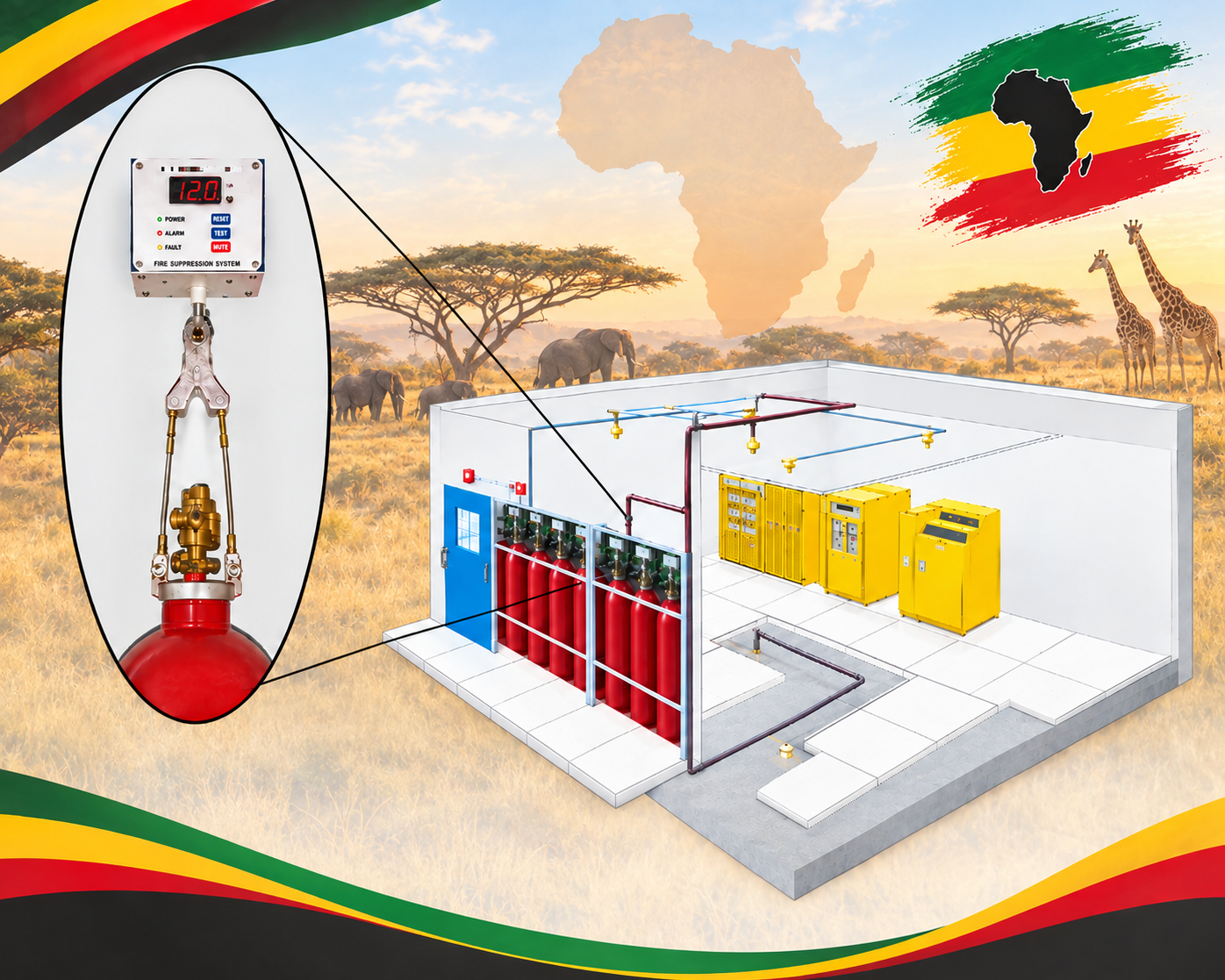
Warehouse Clean Agent Suppression Solutions Africa
Advanced Warehouse Clean Agent Fire Suppression Solutions Across Africa
Modern warehouses and logistics facilities across Africa are becoming increasingly sophisticated, with large-scale storage systems, automated material handling equipment, electrical installations, IT infrastructure, battery charging areas and high-value inventory operating within the same facility.
A fire in such an environment can rapidly affect inventory, infrastructure, business continuity and supply-chain operations. For selected enclosed and equipment-sensitive areas, a properly engineered clean agent fire suppression system can provide rapid fire suppression while minimizing the residue and secondary damage associated with conventional extinguishing media.
LIFEGUARD® provides engineered Warehouse Clean Agent Suppression Solutions in Africa, supporting warehouse owners, EPC contractors, MEP consultants, fire-protection contractors, system integrators, distributors and industrial organizations with application-specific fire suppression solutions.
Our solutions can be considered for logistics centers, distribution facilities, e-commerce warehouses, automated storage areas, electrical rooms, control rooms, server rooms, UPS rooms, telecommunications facilities and other critical enclosed spaces.
Why Warehouses Need Advanced Fire Suppression
Warehouses can contain significant quantities of combustible materials and high-value assets. Depending on the operation, potential hazards may include:
- Packaging materials and cartons
- Plastics and polymer products
- Electrical equipment
- Automation and control systems
- Conveyor systems
- Forklift charging equipment
- Battery systems
- IT and communication equipment
- Machinery and production-related equipment
- High-value electronic products
- Specialized industrial inventory
- Flammable or combustible materials
A warehouse fire can result in:
- Loss of valuable inventory
- Damage to electrical infrastructure
- Extended operational downtime
- Supply-chain disruption
- Equipment replacement costs
- Structural damage
- Business interruption
- Safety risks to employees and emergency responders
A comprehensive warehouse fire strategy should therefore combine appropriate detection, suppression, compartmentation, emergency response and maintenance measures.
What Is a Warehouse Clean Agent Suppression System?
A clean agent fire suppression system is an engineered fire protection system that uses a gaseous or vaporizing extinguishing agent to suppress fire within a suitably protected enclosure.
The system normally integrates:
Fire Detection → Releasing Control → Alarm → Interlocking → Agent Release → Piping → Discharge Nozzles → Fire Suppression
Clean-agent technology is particularly relevant to enclosed areas where water, foam or powder could cause undesirable secondary damage to sensitive equipment.
The appropriate technology must be selected according to the specific hazard, enclosure, occupancy, equipment, agent characteristics, applicable standards and project requirements.
LIFEGUARD® Warehouse Clean Agent Suppression Solutions
LIFEGUARD® provides application-focused clean agent fire suppression solutions that can be engineered according to project requirements.
Depending on the application, the system may incorporate:
- Clean agent storage cylinders
- Clean extinguishing agent
- Cylinder valves
- Actuation arrangements
- Pressure gauges and monitoring devices
- Fire detection system
- Smoke or heat detectors
- Releasing control panel
- Manual release station
- Abort switch
- Audible alarms
- Visual warning indicators
- Discharge warning signage
- Distribution piping
- Engineered discharge nozzles
- Pressure relief arrangements, where required
- HVAC shutdown interfaces
- Electrical interlocks
- Fire alarm/BMS interfaces
- Main and standby cylinder arrangements, where specified
The final configuration is established through application-specific engineering and approved project documentation.
Clean Agent Applications in Warehouses
1. High-Value Inventory Areas
Warehouses containing expensive electronics, precision equipment, machinery or specialized products may require fire protection designed around asset preservation.
For suitable enclosed spaces, clean-agent suppression can help control fire while minimizing post-discharge residue.
2. E-Commerce Fulfilment Centers
E-commerce facilities may combine large inventories with conveyors, automated sorting equipment, control systems and IT infrastructure.
LIFEGUARD® can support clean-agent protection for selected enclosed critical areas within these facilities.
3. Automated Storage and Retrieval Systems
ASRS facilities use automated equipment, robotics, conveyors and electrical control systems.
The fire protection strategy should consider:
- Storage configuration
- Equipment arrangement
- Enclosure characteristics
- Electrical systems
- Detection requirements
- Accessibility
- Fire load
- Applicable standards
Clean-agent suppression can be evaluated for appropriate enclosed equipment rooms and critical areas.
4. Warehouse Electrical Rooms
Electrical rooms may contain switchgear, control panels, MCCs, UPS equipment and other sensitive electrical infrastructure.
Where suitable, clean-agent suppression can provide an alternative to water-based suppression for selected enclosed electrical hazards.
5. Server and Network Rooms
Modern warehouses frequently include server rooms, network rooms and communication infrastructure.
Clean-agent systems are widely considered for enclosed electronic environments where avoiding water discharge is an important design consideration.
6. Control and Automation Rooms
Industrial warehouses increasingly rely on PLCs, automation panels and centralized control systems.
A clean-agent suppression system can be engineered for suitable enclosed control and automation areas.
7. Battery Charging and Energy Storage Areas
Battery and energy-storage hazards require specialized assessment. The appropriate fire protection system depends on battery chemistry, configuration, energy density, enclosure design, ventilation and applicable standards.
LIFEGUARD® can evaluate the application and identify an appropriate fire protection approach rather than applying a generic clean-agent solution to every battery hazard.
Warehouse Clean Agent Suppression Engineering
A reliable clean-agent system requires considerably more than installing cylinders and nozzles.
LIFEGUARD® follows an engineering-oriented approach that considers:
Protected Volume
Accurate room length, width and height are essential for determining the protected volume.
Fire Hazard
The type of equipment, stored material and potential fire scenario must be evaluated.
Design Concentration
The required design concentration depends on the selected agent, hazard classification and applicable design methodology.
Ambient Temperature
Temperature conditions affect agent storage and system design and must be considered during engineering.
Enclosure Integrity
A total-flooding system requires the protected enclosure to retain the agent for the required duration.
Open doors, cable penetrations, ventilation openings and other leakage paths should therefore be evaluated.
Piping Network
The piping arrangement must be engineered according to the selected agent, cylinder configuration, pipe dimensions, lengths, fittings and discharge requirements.
Nozzle Distribution
Nozzle type, quantity and positioning should be determined through appropriate system calculations and engineering.
Pressure Relief
Pressure effects generated during agent discharge should be considered where required by the enclosure and system design.
Typical Warehouse Clean Agent System Operation
A typical automatic system may operate through the following sequence:
Stage 1 – Fire Detection
Automatic detectors monitor the protected area for signs of fire.
Stage 2 – Alarm Signal
A fire condition is transmitted to the releasing control panel.
Stage 3 – Warning
Audible and visual warning devices alert personnel that a suppression sequence is being initiated.
Stage 4 – Equipment Interlocking
Where required, HVAC, ventilation, electrical equipment or other services are controlled according to the approved cause-and-effect sequence.
Stage 5 – Time Delay
An engineered time delay can provide personnel with an opportunity to evacuate before agent discharge.
Stage 6 – Agent Release
The suppression system releases the calculated quantity of clean agent.
Stage 7 – Agent Distribution
The agent travels through the engineered piping network and discharges through the selected nozzles.
Stage 8 – Fire Suppression
The agent reaches the required concentration within the protected enclosure and suppresses the fire according to its extinguishing mechanism.
Clean Agent Technologies for African Warehouse Projects
Clean-agent technologies include several different gaseous suppression approaches.
Depending on the project specification and regulatory requirements, LIFEGUARD® can evaluate technologies such as:
- FK-5-1-12-based clean-agent systems
- HFC-based clean-agent systems
- Inert-gas fire suppression systems
- Other approved gaseous fire suppression technologies
LIFEGUARD®'s published clean-agent portfolio identifies FK-5-1-12 and HFC-227ea for selected engineered suppression applications. (Lifeguard India)
The final agent should not be selected solely on cost. Considerations include:
- Fire performance
- Design concentration
- Occupant safety
- Environmental characteristics
- Room volume
- Operating temperature
- Equipment compatibility
- Enclosure integrity
- Required approvals
- Local regulations
- Client specifications
- Insurance requirements
Warehouse Clean Agent Suppression Solutions for Africa
Africa represents a diverse group of markets rather than one uniform regulatory environment. Fire-protection requirements can differ between countries and projects.
LIFEGUARD® can evaluate project requirements for markets including:
Southern Africa
- South Africa
- Botswana
- Namibia
- Zimbabwe
- Zambia
- Mozambique
- Mauritius
East Africa
- Kenya
- Tanzania
- Uganda
- Rwanda
- Ethiopia
West Africa
- Nigeria
- Ghana
- Senegal
- Côte d'Ivoire
- Other West African markets
North Africa
- Egypt
- Morocco
- Algeria
- Tunisia
The final design, certification, installation and approval requirements should be reviewed according to the specific country, Authority Having Jurisdiction (AHJ), project specification and applicable local regulations.
Fire Safety Standards and Compliance in Africa
There is no single fire-safety regulatory framework that automatically applies to every African country.
Depending on the project, specifications may reference:
- NFPA standards
- ISO standards
- EN standards
- National standards
- Local building regulations
- Fire authority requirements
- Insurance requirements
- Client engineering standards
- Industry-specific requirements
For example, South African projects may reference SANS requirements alongside international standards such as NFPA, depending on the application. SANS 10400-T addresses fire protection under South Africa's National Building Regulations, while gaseous fire-extinguishing projects may also reference relevant SANS standards. (Lifeguard India)
Therefore, LIFEGUARD® recommends that every African project be evaluated individually for applicable compliance requirements.
Warehouse Fire Protection Beyond Clean Agent Suppression
Clean-agent suppression is not necessarily intended to replace the complete warehouse fire protection system.
Depending on the facility, a comprehensive fire protection strategy may include:
- Automatic sprinkler systems
- Hydrant systems
- Fire pumps
- Fire water tanks
- Fire detection and alarm systems
- Beam smoke detection
- Aspirating smoke detection
- Heat detection
- Portable fire extinguishers
- Water mist systems
- Foam systems
- Fire-rated compartmentation
- Fire doors
- Emergency lighting
- Evacuation systems
- Smoke management
- Specialized battery fire protection
LIFEGUARD® can support customers in evaluating the appropriate combination of fire safety technologies for their specific application.
Clean Agent Protection for High-Risk Warehouse Areas
A warehouse does not necessarily require the same suppression technology throughout the entire building.
An application-based strategy can identify individual high-risk areas such as:
Warehouse Floor
May require conventional or specialized warehouse fire protection based on storage configuration and commodity.
Electrical Room
Clean-agent suppression may be evaluated where appropriate.
Server Room
Clean-agent suppression is often considered for sensitive electronic equipment.
UPS Room
An engineered suppression strategy can be developed based on the equipment and hazard.
Control Room
Clean-agent technology may be suitable for enclosed control environments.
Battery Area
Requires dedicated hazard assessment and appropriate fire protection technology.
This approach helps ensure that the fire protection system is matched to the actual hazard rather than applying the same system everywhere.
LIFEGUARD® as a Warehouse Clean Agent Suppression Solutions Partner
LIFEGUARD® combines fire safety manufacturing capabilities with application-oriented engineering and project support.
Our capabilities can support:
- Hazard assessment
- System concept development
- Clean agent selection
- Agent quantity calculations
- Cylinder selection
- Piping and nozzle engineering
- Detection and releasing integration
- Technical submittals
- Product documentation
- Bill of quantities
- Commercial quotations
- Export-oriented packing
- Installation guidance
- Testing and commissioning support
- Training
- Spare parts
- Maintenance support
Our published international-market material also describes support for technical submittals, quotations, export packaging, installation guidance, training and after-sales assistance for African projects. (Lifeguard India)
Why Choose LIFEGUARD®?
Indian Fire Safety Manufacturing Experience
LIFEGUARD® is an established Indian fire safety brand associated with the manufacture and supply of fire safety equipment and engineered fire protection solutions.
Application-Based Engineering
Rather than providing a generic package, LIFEGUARD® evaluates the hazard, protected volume, agent requirements, system configuration and project specification.
OEM and Project Support
LIFEGUARD® can work with:
- EPC contractors
- MEP contractors
- Fire protection contractors
- Consultants
- System integrators
- Distributors
- Industrial companies
- Warehouse operators
- Facility management companies
- OEM customers
Export-Oriented Support
For international projects, documentation, packaging, logistics coordination and technical communication are important parts of project execution.
Complete Suppression System Approach
LIFEGUARD® can support the complete system architecture:
Hazard Assessment → Engineering → Agent Selection → Cylinder Configuration → Piping → Nozzle Design → Detection → Releasing Panel → Interlocks → Testing → Commissioning
Warehouse Clean Agent Suppression System Maintenance
A clean-agent system should remain operational throughout the life of the protected facility.
Periodic inspection should consider:
- Cylinder condition
- Cylinder pressure
- Valve condition
- Detection devices
- Releasing panel
- Manual release station
- Abort switch
- Alarm devices
- Nozzle condition
- Piping condition
- HVAC interlocks
- Electrical interfaces
- Room configuration
- Enclosure integrity
- System impairment
- Maintenance records
Changes to partitions, doors, ventilation, cable penetrations or room volume can affect system performance and should be reviewed by qualified personnel.
Maintenance intervals should follow the applicable standard, manufacturer's requirements and local regulations.
Warehouse Clean Agent Suppression for Logistics & Industrial Infrastructure
The rapid development of logistics infrastructure across Africa is creating new requirements for dependable fire protection.
LIFEGUARD® can support clean-agent requirements for:
- Logistics parks
- Distribution centers
- E-commerce warehouses
- Cold-chain facilities
- Industrial warehouses
- Manufacturing warehouses
- Spare-parts warehouses
- Electronics storage facilities
- Pharmaceutical storage areas
- High-value inventory facilities
- Automated warehouses
- Data-enabled logistics facilities
The protection strategy should always be developed around the specific warehouse operation and fire risk.
Frequently Asked Questions
What are warehouse clean agent suppression solutions?
Warehouse clean-agent suppression solutions are engineered gaseous fire suppression systems designed to protect suitable enclosed warehouse areas, particularly spaces containing sensitive electrical, electronic or high-value equipment.
Is clean agent suppression suitable for a complete warehouse?
Not necessarily. Large storage warehouses can have complex commodity, storage-height and fire-load considerations. The overall warehouse may require sprinklers or other systems, while clean-agent suppression may be better suited to selected enclosed critical areas.
Can LIFEGUARD® supply clean agent systems to Africa?
LIFEGUARD® can evaluate export and project requirements for African markets, subject to project scope, applicable regulations, logistics and required approvals.
Which clean agents can be used for African warehouse projects?
Depending on the project, technologies may include FK-5-1-12, HFC-based agents, inert gases or other approved gaseous suppression technologies. Final selection depends on the application and applicable requirements.
Can clean agent systems protect warehouse server rooms?
Yes. Server and IT rooms are common applications for clean-agent suppression because these enclosed spaces may contain sensitive electronic equipment.
Can clean agent systems protect electrical rooms?
Clean-agent systems can be considered for suitable enclosed electrical and control environments following appropriate hazard assessment and engineering.
Does LIFEGUARD® provide technical documentation?
LIFEGUARD® can support project documentation such as technical submittals, product information, system details, quotations and other project-specific documents according to the scope.
How can I obtain a quotation for a warehouse clean agent system in Africa?
For an accurate technical and commercial proposal, provide the project location, room dimensions, protected volume, hazard description, number of protected rooms, preferred agent if specified, applicable standard, required approvals and installation/commissioning scope.
Partner with LIFEGUARD® for Warehouse Clean Agent Suppression Solutions in Africa
Protecting a modern warehouse requires a fire protection strategy that considers the facility as a complete system.
From high-value inventory and automated storage equipment to electrical rooms, control rooms, server infrastructure and specialized industrial areas, LIFEGUARD® can support customers in developing application-specific clean-agent fire suppression solutions.
With an engineering-led approach, international project support and an established Indian fire-safety manufacturing background, LIFEGUARD® is positioned to support Warehouse Clean Agent Suppression Solutions in Africa for industrial, commercial, logistics and critical infrastructure applications.
Request a Technical & Commercial Proposal
For project evaluation, share:
- Project name
- Country and city
- Warehouse application
- Protected room dimensions
- Room height
- Number of protected areas
- Nature of stored goods/equipment
- Fire hazard
- Preferred clean agent, if specified
- Applicable standard
- Required certification/approval
- Detection requirements
- Installation requirement
- Testing and commissioning scope
- Required delivery schedule
LIFEGUARD® – Manufacturer of ISI Certified Fire Safety Equipment
Phone: 8048034226
Email: ufe126@gmail.com | info@lifeguardindia.in
Website: www.lifeguardindia.in
Recommended SEO metadata
SEO Title: Warehouse Clean Agent Suppression Solutions Africa | LIFEGUARD®
Meta Description: LIFEGUARD® provides engineered warehouse clean agent suppression solutions across Africa for logistics centers, warehouses, server rooms, electrical rooms, control rooms and critical facilities.
Primary Keyword:
Warehouse Clean Agent Suppression Solutions Africa
Secondary Keywords:
- Warehouse Clean Agent Suppression System Africa
- Warehouse Clean Agent Fire Suppression Africa
- Warehouse Clean Agent Suppression Company Africa
- Warehouse Clean Agent Suppression Manufacturer Africa
- Warehouse Clean Agent Suppression Supplier Africa
- Warehouse Fire Suppression Solutions Africa
- Clean Agent Fire Suppression System Africa
- Clean Agent Suppression System Supplier Africa
- FK-5-1-12 Fire Suppression System Africa
- Warehouse Fire Protection Solutions Africa
- Automatic Clean Agent Suppression System Africa
- Industrial Warehouse Fire Suppression Africa
- Clean Agent Fire Protection Company Africa
- Warehouse Fire Safety Solutions Africa
Suggested URL Slug:
/warehouse-clean-agent-suppression-solutions-africa/
Suggested H1:
Warehouse Clean Agent Suppression Solutions Africa
Suggested Image Alt Text:
LIFEGUARD warehouse clean agent fire suppression solutions Africa
The structure also aligns with LIFEGUARD®'s existing warehouse and international-market content, including its positioning around engineered clean-agent systems for selected sensitive warehouse areas. (Lifeguard India)
Keywords






