Warehouse Clean Agent Suppression Supplier Africa
Modern warehouses across Africa are becoming increasingly automated, technology-driven and asset-intensive. High-bay storage, automated storage and retrieval systems (AS/RS), conveyor systems, electrical control panels, server rooms, UPS systems, battery-charging areas, packaging materials and valuable inventory can create complex fire risks that require more than conventional portable fire extinguishers.
LIFEGUARD® provides engineered warehouse clean agent suppression solutions for Africa, supporting project requirements involving clean-agent fire suppression, gaseous fire extinguishing systems, automatic detection and releasing systems, electrical and control-room protection, and other specialised enclosed hazards.
Clean-agent suppression can be particularly relevant for enclosed areas containing sensitive electrical and electronic equipment where the use of water or powder may create secondary damage. The appropriate system, however, must always be selected according to the actual fire hazard, enclosure, occupancy, applicable standards and project specifications.
Clean Agent Fire Suppression for African Warehouses
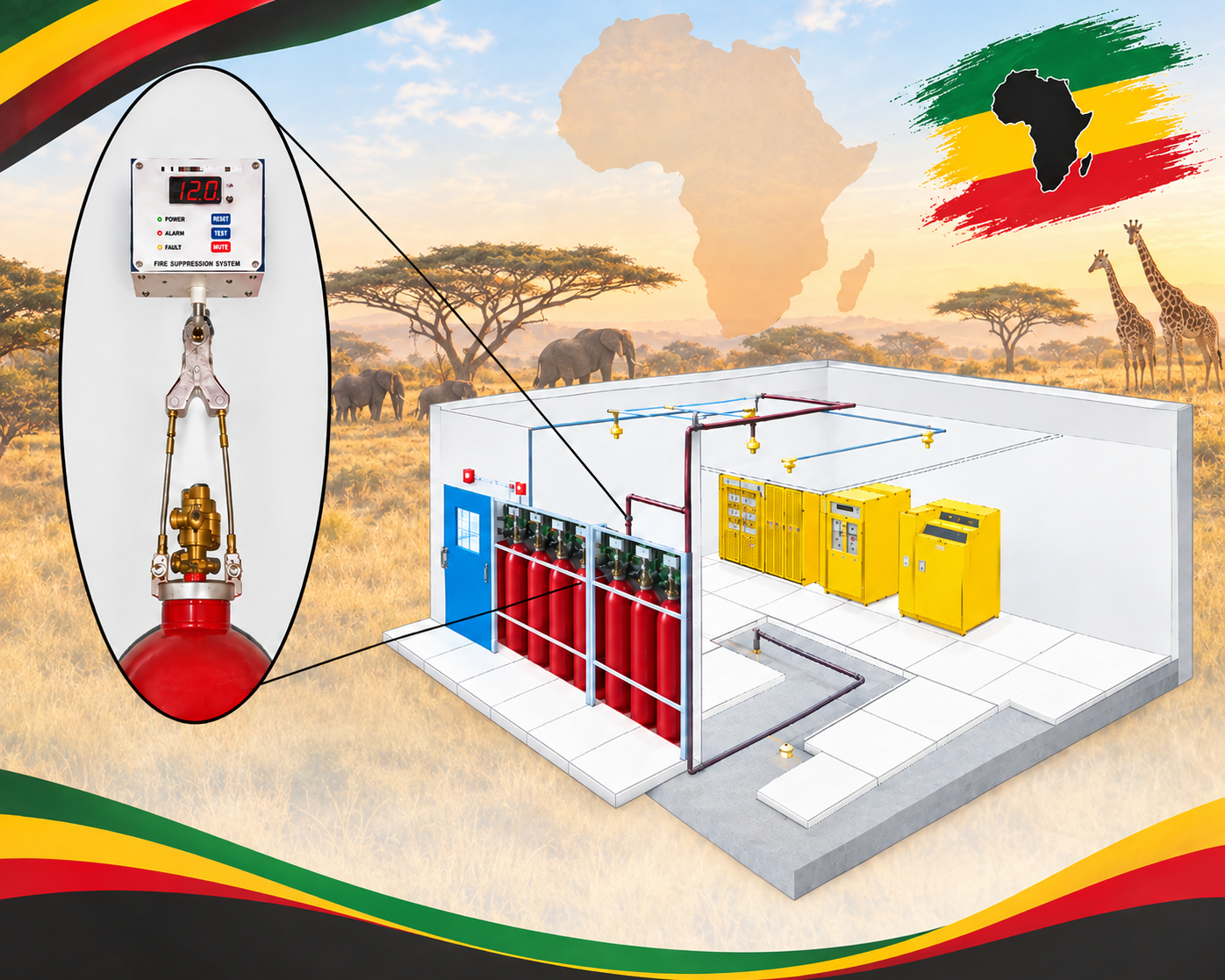
A clean agent fire suppression system is an engineered automatic fire protection system that uses a gaseous extinguishing agent to control or suppress fire within a protected enclosure.
Unlike conventional water-based suppression, clean-agent systems are designed to discharge an extinguishing agent through an engineered piping and nozzle network. When correctly designed and installed, suitable clean agents can suppress fires while leaving little or no solid residue.
This makes clean-agent protection particularly applicable to enclosed warehouse areas such as:
- Electrical rooms
- Control rooms
- Automation rooms
- PLC and MCC rooms
- Server and IT rooms
- UPS rooms
- Network rooms
- Security control rooms
- Battery and specialised equipment rooms
- Telecommunications rooms
- Archive and document storage areas
- High-value equipment enclosures
- Specialised process or control areas
For the main warehouse storage area, the appropriate protection may instead involve sprinklers, water mist, foam, detection, smoke control or other technologies depending on the commodities, storage height, rack configuration and fire scenario.
LIFEGUARD® – Warehouse Clean Agent Suppression Supplier for Africa
LIFEGUARD®, a brand of United Fire Equipments Pvt. Ltd. (UFEPL), provides fire safety equipment and engineered suppression solutions for industrial, commercial and infrastructure applications.
Our approach to warehouse fire protection focuses on integrating:
- Fire detection
- Automatic releasing systems
- Clean-agent suppression
- Alarm and notification
- HVAC shutdown/interlocking
- Manual release
- Abort functions where specified
- Pressure-relief arrangements where required
- Room-integrity considerations
- Appropriate portable firefighting equipment
- Inspection, testing and maintenance requirements
LIFEGUARD® can support African project requirements with technical documentation, system configurations, equipment supply and project coordination, subject to project scope and local regulatory requirements.
Why Warehouses Need Specialised Fire Suppression
Warehouse fire hazards are not limited to stored goods.
Modern facilities can contain multiple ignition sources and combustible materials, including:
- Electrical distribution equipment
- Motors and drives
- Conveyor systems
- Automated storage equipment
- Battery charging equipment
- Packaging materials
- Plastics and polymers
- Cardboard and paper products
- Flammable or combustible products
- Forklift charging areas
- Control cabinets
- UPS systems
- IT infrastructure
- Electrical cables
- Machinery and automation equipment
A warehouse may therefore require different fire protection technologies for different zones.
A properly engineered fire protection strategy can divide the facility into appropriate protection zones rather than attempting to use one suppression technology for every hazard.
Automatic Clean Agent Suppression System for Warehouses
A typical automatic clean-agent suppression system can include:
1. Fire Detection
Smoke detectors, heat detectors or other approved detection devices identify a developing fire condition.
2. Releasing Control Panel
The fire suppression releasing panel processes detector signals and controls the automatic release sequence according to the approved system logic.
3. Alarm and Pre-Discharge Warning
Audible and visual notification devices provide warning before agent discharge where required by the system design.
4. Time Delay
A programmed time delay may provide an evacuation period and allow associated equipment interlocks to operate before agent discharge.
5. HVAC and Equipment Interlocks
Air-conditioning, ventilation and other connected equipment can be interfaced with the suppression system where required.
6. Agent Release
The releasing mechanism activates the clean-agent storage cylinder arrangement.
7. Piping and Nozzles
The agent travels through an engineered pipe network and is distributed through strategically positioned discharge nozzles.
8. Fire Suppression
The agent reaches the required design concentration within the protected enclosure and suppresses the fire according to the engineered system design.
The exact operating sequence must be based on the approved design, equipment configuration and applicable codes.
Major Components of a Warehouse Clean Agent Suppression System
A complete clean-agent installation may include:
- Clean-agent storage cylinders
- Cylinder valves
- Electric or pneumatic actuators
- Pressure gauges
- Manifold arrangements
- Discharge piping
- Engineered discharge nozzles
- Releasing control panel
- Smoke/heat detection
- Manual release station
- Abort switch
- Hooters and sounders
- Visual strobes
- Pre-discharge warning devices
- HVAC shutdown interface
- Fire alarm interface
- Pressure-relief arrangements
- Cylinder brackets
- Pipe supports
- Detection and release wiring
- Warning and safety signage
- Main and standby cylinder arrangements where required
The final bill of materials depends on the protected volume, hazard classification, selected agent, cylinder configuration, piping arrangement and project specification.
Clean Agent Protection for High-Bay Warehouses
High-bay warehouses present different fire protection challenges because of their considerable storage height and densely arranged inventory.
Racking systems can contain:
- Cardboard packaging
- Plastics
- Palletised goods
- Textile products
- Electronic products
- Automotive components
- Consumer goods
- Industrial materials
The high storage density can increase the complexity of fire development and suppression.
For this reason, warehouse fire protection should be based on a detailed fire risk assessment and storage analysis.
Clean-agent systems are generally more suitable for enclosed technical rooms within or supporting a warehouse rather than automatically being treated as the universal solution for open high-bay storage areas.
Clean Agent Suppression for Automated Warehouses
Automated warehouses increasingly depend on:
- AS/RS systems
- Robotic storage systems
- Automated conveyors
- PLC panels
- Motor control centres
- Variable-frequency drives
- Industrial computers
- Sensors
- Network infrastructure
- Automated picking equipment
A fire involving critical automation infrastructure can result in operational downtime even when the physical fire is relatively small.
LIFEGUARD® can support engineered protection concepts for suitable enclosed automation and control areas using automatic detection and clean-agent suppression technology.
Conveyor and Material Handling Fire Protection
Conveyor systems can contain multiple electrical and mechanical components, including motors, bearings, control panels and electrical cabling.
Depending on the hazard assessment, fire protection may involve:
- Automatic detection
- Localised suppression
- Water mist
- Clean-agent protection for enclosed control areas
- Fire alarm integration
- Emergency shutdown
- Conveyor interlocking
- Portable firefighting equipment
The selected technology should be determined by the actual hazard rather than applying clean-agent suppression indiscriminately.
Electrical Room Clean Agent Suppression
Electrical rooms are among the most common applications for gaseous fire suppression.
Typical protected equipment may include:
- Switchgear
- MCC panels
- Control panels
- PLC systems
- Electrical distribution equipment
- UPS equipment
- Drives
- Automation equipment
- Communication equipment
A clean-agent system can be considered where water or powder contamination could result in substantial equipment damage or extended downtime.
UPS and Battery Room Fire Protection
Warehouses increasingly use UPS systems and battery-powered equipment to support automation and operational continuity.
Battery rooms and charging areas require specific hazard assessment because battery technologies can behave differently from conventional electrical fires.
Clean-agent systems should not automatically be considered sufficient for every battery or lithium-ion thermal-runaway scenario. Agent selection and system suitability must be evaluated against the specific battery technology, enclosure, fire scenario and applicable engineering requirements.
For high-risk battery applications, additional detection, thermal monitoring, containment, cooling or specialised suppression measures may be required.
Clean Agent Systems for Warehouse Server and IT Rooms
Modern logistics facilities can depend heavily on:
- Warehouse management systems
- Data servers
- Network switches
- Communication systems
- CCTV infrastructure
- Access control
- Industrial computers
- Automation servers
A fire in a server or network room can affect warehouse operations even when the warehouse storage area remains unaffected.
Clean-agent suppression is often considered for these enclosed technical spaces because suitable agents can suppress fire without leaving conventional powder or water residue.
The enclosure must be appropriately designed and maintained so that the required extinguishing concentration can be retained.
Room Integrity – A Critical Design Consideration
Total-flooding clean-agent systems depend on the protected enclosure retaining the extinguishing concentration for the required design period.
Potential leakage paths include:
- Cable penetrations
- Doors
- Windows
- Raised-floor openings
- False ceilings
- HVAC ducts
- Louvres
- Wall penetrations
- Unsealed service openings
Where required, a room-integrity or door-fan test can be conducted to evaluate enclosure leakage and retention performance. South African public-sector specifications, for example, explicitly reference room-integrity testing under SANS 14520 for clean-gas systems. (Public Works)
Clean Agent Suppression Standards for Africa
Africa does not have one single continent-wide fire protection regulation. Requirements can differ substantially between countries, authorities and individual projects.
Depending on the country and specification, projects may reference:
- NFPA 2001 – Clean Agent Fire Extinguishing Systems
- ISO 14520 – Gaseous fire-extinguishing systems
- SANS 14520 – Gaseous fire-extinguishing systems in South Africa
- Applicable national building regulations
- National fire safety standards
- Electrical safety requirements
- Authority Having Jurisdiction (AHJ) requirements
- Client engineering specifications
- Insurer requirements
South African technical and regulatory sources identify SANS 14520 for gaseous fire suppression, while Egyptian electricity-sector specifications have also referenced NFPA 2001 and ISO 14520 for clean-agent systems. (SAQA)
Therefore, LIFEGUARD® recommends confirming the applicable standard, agent approval, component certification and AHJ requirements before final system selection.
Clean Agent Fire Suppression Solutions Across Africa
LIFEGUARD® can support project enquiries involving warehouses, logistics facilities and industrial installations in markets including:
- South Africa
- Nigeria
- Kenya
- Ghana
- Tanzania
- Uganda
- Rwanda
- Ethiopia
- Zambia
- Zimbabwe
- Botswana
- Namibia
- Mozambique
- Angola
- Egypt
- Morocco
- Algeria
- Tunisia
- Senegal
- Cameroon
- Mauritius
- Other African markets
Each project should be evaluated individually because local regulations, installation practices, certification requirements, environmental conditions and authority approvals can vary.
Industries Served
Warehouse clean-agent suppression requirements can arise across multiple industries.
E-Commerce & Fulfilment Centres
Protection for automated logistics, IT infrastructure, electrical rooms and warehouse control systems.
Logistics & Distribution
Fire protection for distribution centres, conveyor systems, control rooms and technical spaces.
Automotive Warehouses
Protection for automotive components, electrical systems and specialised technical rooms.
Pharmaceutical Warehouses
Fire protection for temperature-controlled storage, technical rooms and valuable pharmaceutical inventory.
Electronics Warehouses
Clean-agent protection can be considered for electrical, electronic and control areas where residue-free suppression is important.
Cold Storage Facilities
Special attention may be required for electrical rooms, refrigeration control systems and enclosed technical spaces.
Manufacturing Warehouses
Integrated protection can combine automatic detection, suppression, fire alarm systems and portable firefighting equipment.
Data-Driven Logistics Facilities
Server, network, UPS and automation rooms can be evaluated for clean-agent suppression where appropriate.
Engineering Approach for Warehouse Clean Agent Suppression
Effective clean-agent suppression depends on engineering rather than simply selecting cylinders and nozzles.
Important design parameters can include:
- Protected room volume
- Hazard classification
- Combustible materials
- Design concentration
- Minimum and maximum temperature
- Agent characteristics
- Cylinder capacity
- Storage pressure
- Piping length
- Pipe diameter
- Number of fittings
- Nozzle quantity
- Nozzle positioning
- Ceiling height
- Raised-floor and ceiling voids
- Ventilation arrangements
- Room leakage
- Pressure-relief requirements
- Required agent-retention period
Hydraulic or flow calculations should be performed according to the selected system and applicable standard to verify the proposed piping and nozzle arrangement.
Design, Supply, Installation and Commissioning Support
For project-based requirements, LIFEGUARD® can support various stages of clean-agent fire suppression procurement, subject to scope:
Technical Consultation
Understanding the warehouse layout, hazards and protection objectives.
System Design
Developing an engineered suppression concept based on project requirements.
Technical Submittals
Providing relevant datasheets, drawings, calculations and technical documentation as applicable.
Equipment Supply
Supplying specified suppression equipment and associated components.
Installation Support
Providing technical guidance for installation and system integration.
Testing & Commissioning
Supporting functional testing, detection/releasing sequences and system commissioning according to the approved design.
Documentation
Project documentation may include:
- Equipment datasheets
- System drawings
- Bill of quantities
- Test documentation
- Operation and maintenance information
- Installation guidelines
- Commissioning documentation
Maintenance Support
Periodic inspection, testing and maintenance are important for maintaining system readiness throughout the service life.
Why Choose LIFEGUARD® as a Warehouse Clean Agent Suppression Supplier?
LIFEGUARD® combines fire safety equipment manufacturing capabilities with engineered fire suppression solutions for commercial, industrial and infrastructure applications.
Key capabilities include:
- Established Indian fire safety brand
- OEM manufacturing capability
- Project-specific technical support
- Clean-agent suppression solutions
- Automatic detection and releasing integration
- Engineered piping and nozzle arrangements
- Technical documentation support
- Export-oriented project coordination
- Support for consultants, EPC contractors and system integrators
- Application-focused fire protection solutions
- Maintenance and technical support subject to project scope
The objective is to provide a technically appropriate fire protection solution rather than applying a single suppression technology to every warehouse application.
Warehouse Clean Agent Suppression Supplier Africa – LIFEGUARD®
For African warehouse projects requiring clean-agent fire suppression, LIFEGUARD® can support enquiries involving:
Warehouse Fire Suppression | Clean Agent Suppression | Gaseous Fire Suppression | Automatic Fire Suppression | Electrical Room Protection | Server Room Protection | Control Room Protection | UPS Room Protection | Automation Room Protection | Industrial Fire Protection
Our technical team can review project requirements and recommend a suppression configuration based on the protected hazard, enclosure, applicable standards and project specifications.
Contact LIFEGUARD®
United Fire Equipments Pvt. Ltd. (UFEPL)
Brand: LIFEGUARD®
Manufacturer of Fire Safety Equipment
Phone: +91 8048034226
Email: ufe126@gmail.com | info@lifeguardindia.in
Website: www.lifeguardindia.in
SEO Keyword Cluster
- warehouse clean agent suppression supplier Africa
- warehouse clean agent fire suppression supplier Africa
- clean agent suppression supplier Africa
- clean agent fire suppression company Africa
- warehouse fire suppression supplier Africa
- warehouse fire protection supplier Africa
- automatic warehouse suppression supplier Africa
- gaseous fire suppression supplier Africa
- warehouse gas suppression system supplier Africa
- clean agent fire suppression system Africa
- warehouse fire suppression systems Africa
- industrial clean agent suppression Africa
- electrical room clean agent suppression Africa
- server room fire suppression Africa
- control room clean agent suppression Africa
- warehouse fire safety equipment supplier Africa
- clean agent suppression OEM Africa
- fire suppression system supplier Africa
- automatic fire suppression system Africa
SEO Title
Warehouse Clean Agent Suppression Supplier Africa | LIFEGUARD®
Meta Description
LIFEGUARD® is a warehouse clean agent suppression supplier for Africa, providing engineered fire suppression solutions for warehouses, logistics centres, electrical rooms, automation and specialised hazards.
Suggested H1
Warehouse Clean Agent Suppression Supplier Africa
Suggested URL
/warehouse-clean-agent-suppression-supplier-africa/
This version deliberately distinguishes clean-agent protection for enclosed technical warehouse areas from protection of the main high-bay commodity-storage area, helping the page remain technically credible while targeting the requested SEO phrase. Current African project specifications also show the relevance of standards such as SANS 14520, NFPA 2001 and ISO 14520, depending on jurisdiction and project requirements. (SAQA)
Keywords