
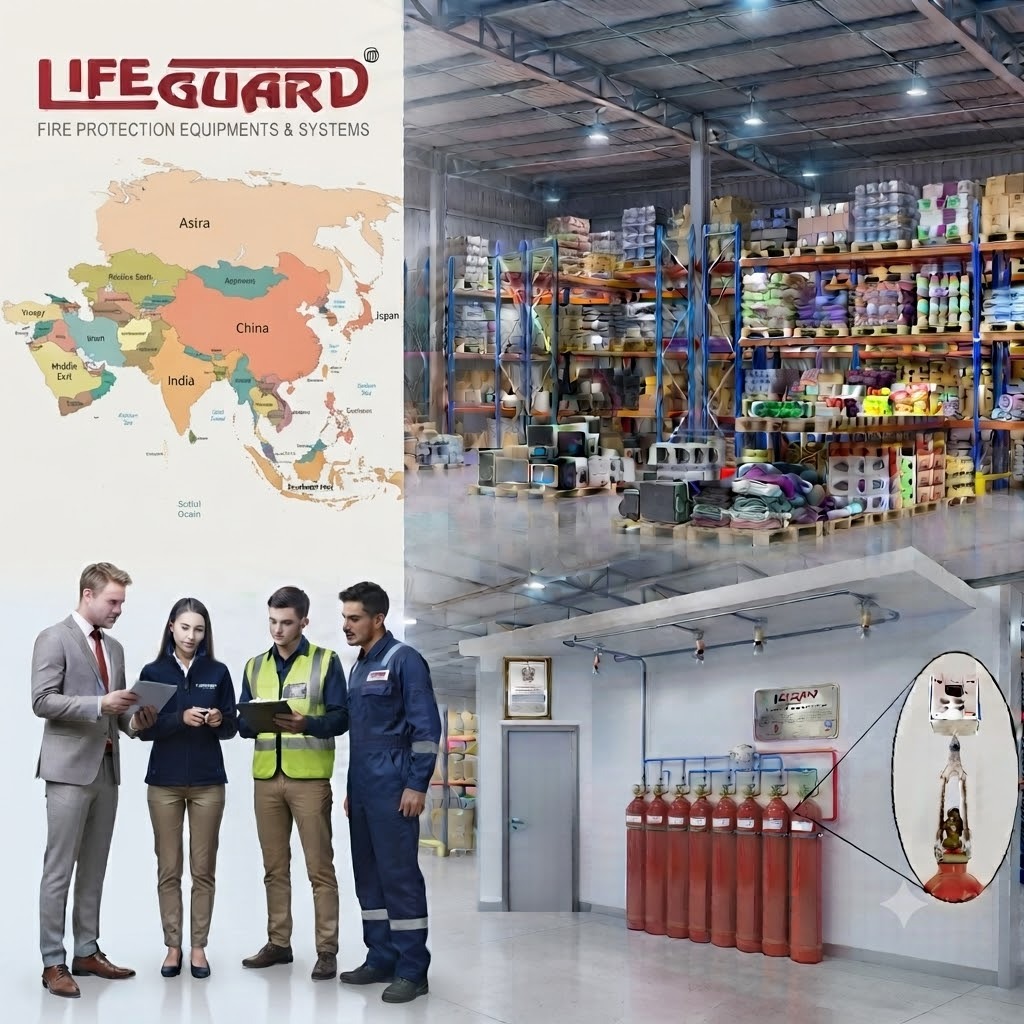
Warehouse Clean Agent Suppression System Provider Asia
LIFEGUARD® – Advanced Warehouse Clean Agent Fire Suppression Systems for Asia
Warehouses across Asia are becoming increasingly sophisticated, housing high-value inventory, automated storage and retrieval systems, electrical infrastructure, packaging materials, lithium-ion batteries, chemicals, electronics and other combustible commodities. A warehouse fire can therefore result in extensive property damage, inventory loss, operational disruption and costly business interruption.
LIFEGUARD® provides engineered warehouse clean agent suppression system solutions across Asia, designed for applications where rapid fire suppression, equipment protection, minimal residue and reduced post-fire cleanup are important considerations. Clean-agent systems are particularly suitable for appropriately enclosed areas containing sensitive equipment or assets where conventional water, foam or dry-chemical discharge may create additional damage or cleanup requirements. (updates.lifeguardindia.in)
Warehouse Clean Agent Suppression System Provider in Asia
As an experienced fire protection company, LIFEGUARD® approaches clean-agent suppression as a complete engineered system rather than simply supplying cylinders and discharge nozzles.
A typical warehouse clean-agent system can integrate:
- Automatic smoke and/or heat detection
- Releasing control panel
- Clean-agent storage cylinders
- Cylinder valves and actuators
- Engineered discharge piping
- Discharge nozzles
- Manual release station
- Abort switch
- Audible and visual pre-discharge alarms
- Pressure monitoring
- HVAC shutdown interface
- Damper control
- Electrical equipment shutdown
- Fire alarm panel integration
- BMS monitoring
- Cause-and-effect programming
- Room pressure-relief arrangements
- Testing and commissioning
- Operation and maintenance documentation
The exact system configuration is determined by the protected hazard, enclosure, agent, design concentration, temperature, equipment arrangement and applicable project requirements.
Why Clean Agent Suppression for Warehouses?
Traditional sprinkler and water-based fire protection remains important for many warehouse applications. However, certain warehouse areas may contain assets or equipment where a clean-agent system provides a useful additional layer of protection.
Clean agents are electrically non-conductive and are designed to suppress fire without leaving conventional water or powder residues. This makes appropriately engineered systems useful for selected enclosed spaces containing sensitive electronic or high-value assets. (Hochiki)
Potential applications include:
- Automated warehouse control rooms
- Server and IT rooms
- Warehouse electrical rooms
- UPS rooms
- Control panels and PLC rooms
- Telecommunications rooms
- Security and surveillance rooms
- Data processing areas
- Battery and energy-storage support rooms, subject to hazard-specific engineering
- High-value inventory rooms
- Archive and document storage areas
- Enclosed automation equipment areas
- Special-purpose storage rooms
For large commodity-storage areas, the clean-agent approach must be evaluated carefully because total-flooding systems depend on appropriate enclosure conditions and maintaining the required extinguishing concentration. (JICA Report)
How a Warehouse Clean Agent Suppression System Works
A properly engineered automatic suppression system generally follows a coordinated sequence:
1. Early Fire Detection
Smoke or other approved detection technologies identify a developing fire condition.
2. Alarm & Verification
The releasing panel processes detector signals according to the approved cause-and-effect philosophy. Multi-detector or cross-zone logic may be incorporated where appropriate to reduce the possibility of unwanted discharge.
3. Pre-Discharge Warning
Audible and visual alarms alert personnel before agent discharge. Where required, the system can provide time for occupants to evacuate the protected enclosure.
4. Equipment Interlocking
The releasing system can initiate programmed actions such as HVAC shutdown, damper closure, equipment shutdown and signals to the building fire alarm or BMS.
5. Clean Agent Release
Following the programmed release sequence, the agent is discharged from the storage cylinder through the engineered pipe network.
6. Uniform Agent Distribution
Discharge nozzles distribute the agent throughout the protected enclosure to achieve the required design concentration.
7. Fire Suppression
The agent suppresses the fire according to the approved system design and application criteria.
This integrated approach combines detection, control, alarm, interlocking and suppression into a coordinated fire protection solution. (updates.lifeguardindia.in)
Clean Agent Options for Warehouse Protection
Depending on the project, hazard classification and applicable regulations, clean-agent technologies can include systems based on agents such as:
FK-5-1-12
FK-5-1-12 is a clean-agent technology used in appropriately engineered total-flooding applications. It is particularly relevant where low-residue fire suppression and protection of sensitive equipment are important.
HFC-Based Clean Agents
HFC-based agents may also be considered for suitable applications, subject to the environmental regulations and restrictions applicable in the country and project.
Inert Gas Systems
For some applications, inert-gas technologies such as IG-541, IG-55 or IG-100 may be evaluated. Agent selection should consider protected volume, fire hazard, occupancy, cylinder-storage requirements, concentration, design temperature and local regulations. (updates.lifeguardindia.in)
LIFEGUARD® recommends selecting the extinguishing agent based on engineering requirements rather than simply choosing an agent by brand or marketing preference.
Warehouse Clean Agent System Design & Engineering
Every warehouse is different. The system therefore needs to be engineered around the actual protected enclosure and fire hazard.
Key design considerations include:
Protected Volume
The volume of the protected room directly influences the required quantity of extinguishing agent.
Fire Hazard
The type of commodity, combustible material and equipment determines the appropriate suppression strategy.
Design Concentration
The required extinguishing concentration is established according to the selected agent, hazard and applicable design criteria.
Operating Temperature
Ambient and minimum/maximum design temperatures can affect agent quantity calculations and cylinder selection.
Room Integrity
Total-flooding clean-agent systems require the protected enclosure to retain the required agent concentration for the specified design period.
Openings and Leakage
Doors, cable penetrations, ducts, ventilation openings and other leakage paths must be evaluated.
Pressure Relief
Discharge of gaseous agents can create pressure changes within the enclosure. Appropriate pressure-relief provisions should therefore be considered during system design.
Pipe Network
Pipe diameter, pipe length, fittings, elevation changes and nozzle configuration influence the discharge performance.
Nozzle Arrangement
Nozzles should be positioned according to the approved hydraulic/flow calculation and system design.
False Ceiling & Raised Floor
Where applicable, concealed spaces and raised floors should be evaluated as part of the fire protection design.
HVAC Interlock
Ventilation systems may need to be shut down or controlled before agent discharge, depending on the approved cause-and-effect sequence.
Standards & Compliance for Asian Warehouse Projects
Asia represents a highly diverse group of markets, and fire safety requirements can differ substantially from one country to another. Therefore, warehouse clean-agent systems should be designed against the standards, regulations and authority requirements applicable to the specific installation.
Depending on the project, relevant references may include:
- NFPA 2001 – Clean Agent Fire Extinguishing Systems
- ISO 14520 – Gaseous Fire-Extinguishing Systems
- Applicable national fire safety standards
- Local building and fire codes
- Authority Having Jurisdiction requirements
- Project consultant specifications
- Manufacturer's approved system design criteria
- Applicable product testing and certification requirements
ISO 14520 covers important aspects of gaseous fire-extinguishing systems including design, installation, testing, maintenance and safety. (updates.lifeguardindia.in)
For Asian projects, LIFEGUARD® recommends evaluating every project through:
Application → Hazard → Agent → Design → Applicable Standard → Testing → Certification → Installation → Commissioning → Local Approval
Warehouse Applications Across Asia
LIFEGUARD® can support clean-agent suppression requirements for warehouse and logistics projects across diverse Asian markets, including:
- India
- Bangladesh
- Nepal
- Sri Lanka
- Singapore
- Malaysia
- Indonesia
- Thailand
- Vietnam
- Philippines
- South Korea
- Japan
- Taiwan
- Hong Kong
- Maldives
- Bhutan
- and other Asian markets
Because regulations, environmental requirements, product approvals and fire authority procedures differ between countries, the final system design should always be reviewed against the requirements applicable at the project location.
Clean Agent Protection for Modern Logistics Warehouses
The rapid expansion of e-commerce and organized logistics has created increasingly automated warehouse environments. Modern facilities may include:
- Automated storage and retrieval systems
- Conveyor systems
- Robotics
- Warehouse management systems
- Automated picking systems
- Barcode and scanning infrastructure
- CCTV and security systems
- PLC control systems
- Electrical distribution equipment
- Server and network infrastructure
- Battery charging areas
- Temperature-controlled storage
Such facilities can require a layered fire protection strategy, combining conventional warehouse fire protection with specialized suppression systems for enclosed critical areas.
LIFEGUARD® can help project teams evaluate where clean-agent suppression is technically appropriate and how it can be integrated with detection, fire alarm, HVAC, electrical and building-management systems.
LIFEGUARD® – Warehouse Clean Agent Suppression System Provider
With extensive experience in fire safety equipment and suppression technologies, LIFEGUARD® provides project-oriented fire protection solutions for industrial, commercial and critical applications.
LIFEGUARD® has been associated with fire safety equipment manufacturing since 1991 and offers an extensive portfolio covering fire extinguishers, clean-agent systems, gas suppression, water-mist technology, kitchen suppression, lithium-ion battery protection and other fire protection solutions. (updates.lifeguardindia.in)
Our project support can include:
- Technical consultation
- Hazard assessment support
- Agent selection
- System design
- Agent quantity calculations
- Cylinder selection
- Pipe network design
- Nozzle selection
- Detection integration
- Releasing-panel configuration
- Cause-and-effect development
- Technical submittals
- GA and installation drawings
- Testing and commissioning support
- O&M documentation
- System maintenance guidance
Why Choose LIFEGUARD®?
Experienced Fire Safety Manufacturer
LIFEGUARD® has more than three decades of experience in the fire safety industry, with manufacturing and project-support capabilities.
Engineered Solutions
We focus on application-specific system engineering instead of treating clean-agent suppression as a standard one-size-fits-all package.
International Project Orientation
Our solutions can be evaluated for projects across Asian markets while taking local standards and authority requirements into consideration.
Comprehensive Fire Protection Portfolio
From portable firefighting equipment to sophisticated suppression technologies, LIFEGUARD® offers solutions for diverse industrial and commercial applications.
Quality Management
LIFEGUARD® operates with ISO 9001:2015 and ISO 45001:2018 management-system certifications.
Technical Documentation
Project support can include technical datasheets, calculations, drawings, specifications, installation information, testing documentation and O&M requirements.
Warehouse Clean Agent Suppression System – SEO Keywords
For search-engine optimization, this page can naturally target keywords such as:
warehouse clean agent suppression system provider Asia, warehouse clean agent fire suppression system Asia, warehouse clean agent suppression company Asia, warehouse clean agent suppression supplier Asia, warehouse fire suppression system provider Asia, clean agent fire suppression manufacturer Asia, clean agent suppression system supplier Asia, warehouse gas suppression system Asia, automatic clean agent suppression system Asia, FK-5-1-12 warehouse suppression system Asia, warehouse fire protection company Asia, industrial clean agent suppression system Asia, warehouse fire suppression solutions Asia, clean agent system integrator Asia, warehouse gaseous fire suppression system provider Asia.
Conclusion
A warehouse fire protection strategy should address the actual commodity, storage configuration, building construction, fire load, equipment and operational requirements. For appropriately enclosed critical areas, a professionally engineered clean-agent system can provide rapid gaseous fire suppression while avoiding the water or powder residue associated with conventional suppression methods.
LIFEGUARD® is a warehouse clean agent suppression system provider serving project requirements across Asia, offering engineering-oriented solutions covering detection, releasing, agent storage, piping, nozzles, alarms, interlocks, testing and commissioning.
For warehouse clean-agent fire suppression requirements, contact LIFEGUARD® for application-specific technical consultation and system design.
LIFEGUARD® – Manufacturer of ISI Certified Fire Safety Equipment
📞 Phone: 8048034226
📧 Email: ufe126@gmail.com | info@lifeguardindia.in
🌐 Website: www.lifeguardindia.in
Final agent selection, system design, certification and installation should be based on the specific warehouse hazard, protected enclosure, applicable standards and requirements of the relevant authority having jurisdiction.
Keywords






