
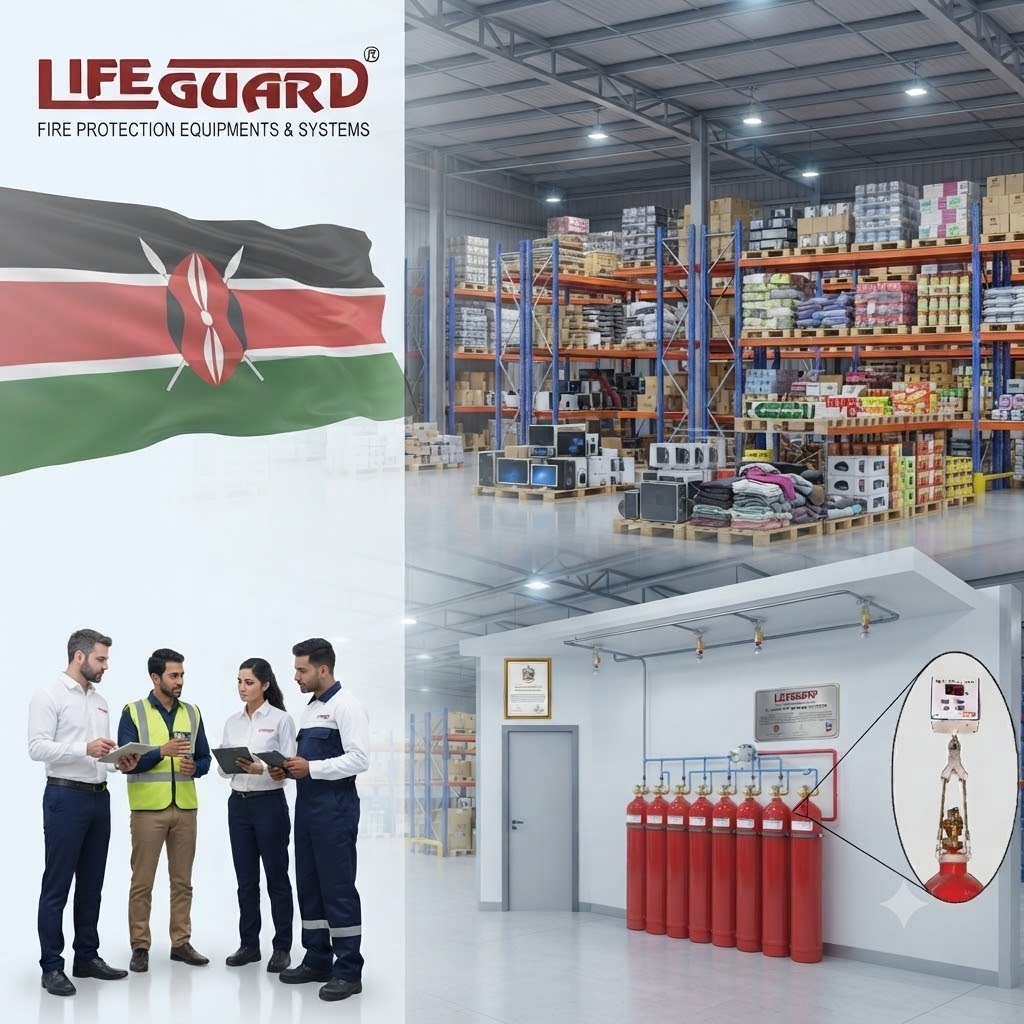
Warehouse Clean Agent Suppression System Provider in Africa
LIFEGUARD® – Advanced Warehouse Clean Agent Fire Suppression Solutions for Africa
Warehouses across Africa are becoming increasingly sophisticated, with large distribution centres, logistics hubs, e-commerce fulfilment facilities, cold-storage warehouses, pharmaceutical stores, manufacturing warehouses, data-intensive inventory operations and high-value commodity storage facilities. These environments can contain significant combustible loads, electrical equipment, packaging materials, automated handling systems and valuable inventory, making a properly engineered fire protection strategy essential.
LIFEGUARD® provides advanced warehouse clean agent suppression systems in Africa, offering engineered fire detection and clean agent fire suppression solutions for applications where rapid fire control, equipment protection and minimal post-fire contamination are important. Our solutions can be designed around the specific hazard, enclosure characteristics, storage arrangement, fire risk and applicable project requirements.
Warehouse fire protection must be evaluated carefully because warehouse layouts, storage configurations, ceiling heights and commodities can significantly influence fire behaviour and suppression requirements. NFPA research specifically identifies warehouses as challenging environments for fire protection because their contents and layouts can promote fire spread and make manual firefighting more difficult. (NFPA)
Why Choose LIFEGUARD® for Warehouse Clean Agent Suppression in Africa?
LIFEGUARD® combines fire detection, clean agent suppression, control panels, releasing systems, notification devices and engineered system design to provide an integrated fire protection approach.
Our warehouse solutions can be considered for:
- Distribution and logistics warehouses
- E-commerce fulfilment centres
- Pharmaceutical and healthcare warehouses
- Electronics and electrical equipment storage
- Automated storage and retrieval systems
- High-value inventory rooms
- Server and IT equipment areas within warehouses
- Control and electrical rooms
- UPS and battery-related rooms
- Generator and equipment rooms
- Archive and document storage areas
- Specialized enclosed storage areas
- Cold-chain and temperature-controlled facilities, subject to application assessment
Advanced Clean Agent Fire Suppression Technology
Clean agent systems are particularly valuable for enclosed areas containing sensitive equipment or assets where conventional water-based extinguishing could create secondary damage. Depending on the hazard assessment and applicable approvals, engineered systems may use suitable halocarbon or inert-gas clean agents.
A properly engineered clean agent system typically detects a developing fire, activates an alarm sequence and, following the designed release logic, discharges the extinguishing agent into the protected enclosure to achieve the required extinguishing concentration.
NFPA 2001 is the principal NFPA standard addressing clean agent fire extinguishing systems and includes requirements relating to system design, installation and safety considerations. (NFPA)
Warehouse Fire Risks in Africa
Warehouse facilities can face multiple ignition and fire hazards, including:
- Electrical distribution equipment
- Lighting systems
- Material-handling equipment
- Battery charging stations
- Forklifts and automated equipment
- Motors and machinery
- Packaging materials
- Cardboard and paper products
- Plastics and polymer-based products
- Flammable or combustible products
- Conveyor systems
- Control panels
- UPS and electrical rooms
- Maintenance activities
- Heating, ventilation and air-conditioning equipment
NFPA's recent warehouse fire research found that operating equipment was the leading heat source in warehouse fires, while electrical distribution and lighting equipment were also significant contributors. (NFPA)
This makes early fire detection combined with an appropriately engineered suppression strategy an important part of warehouse risk management.
Engineered Warehouse Clean Agent Suppression System
LIFEGUARD® approaches warehouse fire suppression as an engineered system rather than simply supplying individual components.
A typical system may include:
- Addressable or conventional fire detection
- Smoke and/or heat detection
- Fire suppression releasing control panel
- Clean agent storage cylinders
- Cylinder valves and actuation arrangements
- Discharge piping network
- Engineered discharge nozzles
- Manual release station
- Abort switch where required
- Pre-discharge audible and visual alarms
- Pressure relief/venting provisions
- Interlocking with HVAC and other relevant equipment
- Fire alarm interface
- Supervisory and fault monitoring
- System status indication
- Commissioning and functional testing
The final configuration depends on the hazard, agent selected, enclosure volume, leakage characteristics, equipment arrangement, applicable codes and the requirements of the approving authority.
Clean Agent Systems for Sensitive Warehouse Areas
Not every part of a warehouse necessarily requires clean agent protection. In many projects, the most appropriate strategy is to identify critical enclosed hazards where clean agent suppression provides particular value.
Examples can include:
Electrical Rooms:
Protecting switchgear, electrical panels, control equipment and associated critical infrastructure.
UPS Rooms:
Providing engineered fire suppression for enclosed electrical power-support areas.
Server/IT Rooms:
Protecting networking, servers and electronic equipment where water discharge could cause significant secondary damage.
Control Rooms:
Protecting automation, warehouse management systems and control electronics.
Security & Monitoring Rooms:
Protecting CCTV, access-control and security infrastructure.
Specialized Storage Enclosures:
Providing suppression where the enclosure, commodity and fire risk are suitable for clean agent protection.
Total Flooding Clean Agent Protection
For suitable enclosed hazards, total flooding clean agent systems discharge the agent throughout a protected enclosure to achieve the design concentration required for extinguishing.
However, clean agent protection is not automatically appropriate for every warehouse or commodity. NFPA material notes that general cargo and dry cargo areas can present limitations for halocarbon clean-agent protection because of deep-seated fire risks and variation in stored commodities. (NFPA DocInfo)
Therefore, LIFEGUARD® recommends a project-specific engineering assessment before selecting a clean agent system for a warehouse.
The assessment can consider:
- Commodity classification
- Storage height
- Rack configuration
- Ceiling height
- Enclosure volume
- Fire load
- Equipment layout
- Ventilation
- Openings and leakage paths
- Occupancy
- Required detection strategy
- Agent selection
- Design concentration
- Discharge duration
- Hold-time requirements
- Pressure-relief requirements
- Applicable local regulations
- Authority Having Jurisdiction (AHJ) requirements
Clean Agent Options for African Warehouse Projects
Depending on the application, LIFEGUARD® can engineer systems around suitable clean-agent technologies, including FK-5-1-12 and inert-gas solutions, subject to system listing/approval, project specifications and hazard suitability.
The selection should not be based solely on the name of the agent. Factors such as enclosure volume, occupancy, design concentration, discharge characteristics, environmental considerations, equipment sensitivity and applicable approvals should be evaluated by qualified fire protection engineers.
For occupied spaces, personnel safety is also an important design consideration. NFPA 2001 includes requirements addressing human exposure and safe egress, reinforcing the importance of engineering the system around both fire performance and occupant safety. (NFPA)
Detection and Suppression Integration
One of the key advantages of an engineered suppression system is the integration of detection, alarm and suppression functions.
A typical sequence may involve:
Fire Detection → Alarm Verification/Logic → Pre-Discharge Warning → HVAC/Equipment Interlock → Time Delay → Clean Agent Release → Discharge Confirmation → System Monitoring
Cross-zoned detection logic may be used where appropriate to reduce the possibility of unwanted discharge. Manual release and abort functions can also be incorporated according to the approved system design.
The exact release sequence should always follow the approved engineering design and applicable standards.
Warehouse Fire Protection for Africa's Diverse Industrial Environments
Africa has a wide range of industrial and commercial environments, from large logistics centres and ports to mining-related facilities, manufacturing hubs, pharmaceutical distribution centres and rapidly expanding e-commerce infrastructure.
LIFEGUARD® can support fire protection requirements for projects across African markets by developing solutions around individual project conditions rather than applying a one-size-fits-all approach.
Potential applications include warehouses and logistics facilities in:
- South Africa
- Nigeria
- Kenya
- Ghana
- Tanzania
- Uganda
- Ethiopia
- Egypt
- Morocco
- Algeria
- Zambia
- Zimbabwe
- Botswana
- Namibia
- Mozambique
- Rwanda
- Senegal
- Côte d'Ivoire
- Mauritius
- Other African markets
Warehouse Clean Agent Suppression System Design
A professionally designed system should begin with a detailed hazard and enclosure assessment.
LIFEGUARD® can support project requirements involving:
1. Site & Hazard Assessment
Understanding the warehouse operation, stored materials, equipment and fire hazards.
2. System Engineering
Developing an appropriate suppression architecture based on the identified hazard.
3. Agent Quantity Calculation
Determining the required agent quantity based on the applicable design methodology and system limitations.
4. Hydraulic/Pipe Network Design
Developing the discharge piping and nozzle arrangement to distribute the agent appropriately.
5. Detection Design
Selecting suitable detectors and zoning arrangements.
6. Control & Releasing Logic
Integrating detection, alarms, release controls, interlocks and monitoring.
7. Room Integrity Considerations
Evaluating enclosure leakage and other conditions relevant to maintaining the required agent concentration.
8. Testing & Commissioning
Conducting functional testing and commissioning in accordance with the approved project requirements.
Why Clean Agent Suppression is Valuable for Critical Warehouse Areas
A well-designed clean agent system can provide several important benefits:
- Rapid fire suppression
- Minimal residue after discharge
- Reduced secondary damage to sensitive equipment
- Protection of high-value assets
- Suitable for selected occupied spaces when properly engineered
- Integration with fire alarm systems
- Automatic detection and release
- Reduced interruption to critical operations
- Protection of enclosed electrical and electronic areas
- Engineered application based on individual hazard characteristics
However, clean agent suppression should generally be considered one component of a comprehensive warehouse fire protection strategy, alongside appropriate detection, sprinkler protection where required, fire alarms, emergency response procedures, compartmentation and other applicable safeguards. NFPA's warehouse guidance emphasizes properly designed sprinkler systems as an essential element of warehouse fire protection. (NFPA)
LIFEGUARD® – Warehouse Fire Suppression System Provider Africa
As a fire safety solutions provider, LIFEGUARD® offers engineered fire protection solutions for industrial and commercial applications. Our capabilities can cover the complete project cycle from system concept and engineering through supply, installation support, testing and commissioning, depending on project scope.
Our clean agent solutions can be tailored for:
Warehouses | Logistics Centres | Distribution Centres | E-Commerce Facilities | Electrical Rooms | Control Rooms | IT Rooms | UPS Rooms | Automated Warehousing | Pharmaceutical Storage | High-Value Storage Facilities
The objective is to provide a reliable, engineered fire suppression solution that helps protect people, property, equipment and business continuity.
Compliance & Engineering Standards
For international projects, the system design should be based on the standards and requirements specified by the project consultant, local authority and AHJ. NFPA 2001 provides the principal framework for clean agent fire extinguishing systems, while warehouse sprinkler protection is addressed separately under standards such as NFPA 13. NFPA identifies the 2025 edition of NFPA 13 as its current edition. (NFPA)
Depending on the project, additional requirements may include:
- Local fire authority regulations
- Building and fire safety codes
- Project specifications
- Insurance requirements
- International standards
- Manufacturer/listing limitations
- AHJ requirements
- Occupancy and life-safety requirements
Important: Certification, listing and approval claims should be made only for the specific equipment/system configuration that actually carries the applicable approval.
Choose LIFEGUARD® for Warehouse Clean Agent Suppression in Africa
When protecting a modern warehouse, selecting the right fire suppression technology is only the beginning. Correct hazard assessment, system engineering, detection strategy, agent quantity, nozzle distribution, enclosure integrity, release logic, commissioning and ongoing maintenance are equally important.
LIFEGUARD® delivers engineered warehouse clean agent suppression system solutions for Africa, helping businesses protect critical infrastructure and valuable assets with professionally designed fire protection systems.
Whether you are developing a new warehouse, logistics centre, distribution hub, pharmaceutical storage facility, automated warehouse or industrial facility, LIFEGUARD® can provide a project-focused approach to clean agent fire suppression.
LIFEGUARD® – Advanced Fire Safety Solutions
Manufacturer of ISI Certified Fire Safety Equipment
United Fire Equipments Pvt. Ltd. (UFEPL)
📞 8048034226
✉️ ufe126@gmail.com | info@lifeguardindia.in
Target SEO Keywords:
warehouse clean agent suppression system provider Africa, warehouse clean agent fire suppression Africa, clean agent suppression system Africa, warehouse fire suppression system provider Africa, clean agent fire protection company Africa, warehouse fire suppression solutions Africa, clean agent fire suppression supplier Africa, warehouse fire protection system Africa, clean agent suppression company Africa, industrial warehouse fire suppression Africa, clean agent system integrator Africa, warehouse fire safety solutions Africa.
Keywords






