A lithium-ion battery fire is not the same as a cable, charger, petrol or ordinary plastic fire: visible flames can disappear while cells remain hot enough to reignite or spread thermal runaway. By the end, you will know how to distinguish suitable battery-fire evidence from a generic Class A, B, C or electrical rating, and how to match an extinguisher to the incident scale and response procedure.
Key takeaways
- Treat thermal runaway as a cooling and reignition problem, not only a flame fire.
- Ask for test evidence covering cooling, propagation control and reignition resistance.
- Use the extinguisher only within its stated battery type, size and incident scope.
- Evacuate and call emergency services when smoke, venting or escalating heat appears.
Why a lithium-ion battery fire needs more than a standard fire rating
A standard rating describes the fire used in a test, not every hazard inside a battery. A Class A fire rating covers ordinary combustibles such as paper, wood and plastics; a Class B fire rating covers flammable liquids.
An electrical fire extinguisher is tested for energized equipment, but that test does not show whether it can cool cells or stop thermal runaway.
| Rating | What it demonstrates | What it does not demonstrate |
|---|---|---|
| Class A fire | Control of a standard ordinary-combustible test fire | Cooling of battery cells or prevention of reignition |
| Class B fire | Control of a standard flammable-liquid test fire | Control of venting cells, modules or battery-pack propagation |
| Electrical fire extinguisher | Flame control around energized electrical equipment | That the battery is electrically isolated or thermally stable |
A li-ion battery fire extinguisher needs separate, relevant lithium-ion battery test evidence. Look for results covering flame knockdown, heat removal, cell-to-cell propagation and reignition after discharge. UL 9540A evaluates thermal-runaway fire propagation in energy-storage systems; it is not, by itself, certification for a portable extinguisher.
Do not accept “lithium” or Class D alone. Class D agents target reactive metals such as lithium metal, sodium or magnesium, while rechargeable lithium-ion cells contain lithium compounds and organic electrolyte. Also check residue, corrosion, runoff, visibility and compatibility with battery electronics. Cooling a battery does not remove shock or arc hazards.
Recognising thermal runaway and defining the extinguisher’s real scope
A cell entering thermal runaway gets hot rapidly, often before flames appear. Watch for a swollen battery, hissing or crackling, battery venting, sharp chemical odour, smoke from one cell, or a temperature rise that continues after charging stops. Repeated flare-ups after visible flames disappear indicate that heat remains inside.
Do not treat flame knockdown as proof of control. Thermal runaway can move from cell to cell, and an extinguisher that suppresses the flame may not cool the rest of a battery pack fire. Keep people away, isolate the equipment if safe, and arrange continuous temperature or thermal-imaging checks after discharge.
Clean residue does not prove thermal stability.
Define the tested hazard before accepting the extinguisher’s scope:
- Loose cell: evidence must identify the cell format, chemistry and state of charge.
- Module: ask whether adjacent cells, busbars, separators and the module enclosure were tested.
- Vehicle pack: require evidence for pack construction, access limits, vent paths and vehicle-mounted position.
- Energy-storage cabinet: require evidence for the cabinet enclosure, rack layout, ventilation and propagation between modules.
A test on a loose cylindrical cell does not qualify an extinguisher for a pouch-cell EV tray or cabinet. UL 9540A evaluates propagation in energy-storage systems; it is not, by itself, proof that a portable extinguisher is suitable. Ask whether the result means flame extinction, propagation prevention or sustained resistance to reignition.
What test evidence proves cooling, propagation control and reignition resistance
Demand a named battery fire testing report, not a photograph of flames going out. The report must identify the cell chemistry, state of charge, battery size, enclosure, agent quantity and discharge method. A Class A, B or electrical rating proves performance on standard fires; it does not prove lithium-ion battery control.
Ask the supplier for these details:
- Whether the test measured cooling through post-discharge cell or module temperatures, not just flame-extinction time.
- Whether investigators checked cell-to-cell propagation after the first cell entered thermal runaway.
- How long the assembly was observed for reignition, including repeated venting or temperature rise after visible flames disappeared.
- Whether the result applies to a loose cell, module, vehicle pack or energy-storage cabinet matching your hazard.
- The test report, video, instrumentation records and failure criteria, rather than a certificate naming only “lithium” or Class D.
| Claim | Evidence worth accepting | Evidence that is insufficient |
|---|---|---|
| Cooling | Recorded temperatures and continued observation after discharge show heat extraction from affected cells | A rapid flame-out time with no temperature data |
| Propagation control | The report states whether adjacent cells, modules or the whole pack avoided thermal runaway | One burning cell was extinguished in isolation |
| Reignition resistance | A defined observation period records no renewed flame, venting or dangerous temperature rise | “No reignition” without duration or monitoring method |
| UL 9540A relevance | The result identifies the tested battery system and explains how it informs propagation risk | A UL 9540A reference presented as certification of the portable extinguisher itself |
How to respond when flames, smoke or venting appear
Treat flames, smoke, hissing or venting as an active battery fire emergency procedure, not an ordinary electrical-fire response. Keep people away, raise the alarm and call emergency services before attempting suppression.
1. Stop work and establish an exclusion zone. Avoid smoke and vent gases; hydrogen fluoride, carbon monoxide and other decomposition products can injure you without visible flames.
2. Isolate power from the charger, vehicle, cabinet or circuit if you can do so without approaching damaged high-voltage parts. Isolation does not make the battery electrically safe: maintain distance, avoid conductive runoff and prevent anyone from reconnecting the system.
3. Use the extinguisher only from a safe position and within its stated scope. Aim at the fire and exposed battery area, using the manufacturer’s discharge method. Water-based cooling can limit heat and propagation, but do not improvise around energized equipment or enter an enclosure that is unsafe to approach.
4. Stop only when flames and venting have ceased. A flame-out does not prove that thermal runaway has stopped; stored heat can reignite neighbouring cells.
5. Continue battery fire monitoring with thermal measurements, visual checks and, where available, gas or atmosphere monitoring. Watch for rising temperature, swelling, hissing, smoke and renewed venting for the period specified by the emergency plan or fire service.
Keep the area isolated until responders confirm safe re-entry, electrical status and disposal arrangements. Do not move, charge or transport the battery after suppression; a clean-looking pack can still reignite and release toxic gases.
Matching the extinguisher to the hazard, equipment and procurement decision
A charger fire is not the same procurement problem as a damaged vehicle pack. Compare the extinguisher against the fuel, access route and expected duration of the event, not its A, B or C label alone.
| Hazard | Agent and quantity | Discharge performance | Residue and operating limits |
|---|---|---|---|
| Charger, cable or inverter | Agent suited to energized equipment; size for the accessible enclosure | Reach the equipment from a safe position and allow repeat discharge | Check electrical-contact corrosion, visibility and voltage restrictions |
| Damaged cell or module | Deliver enough agent mass or water volume to cool the affected assembly | Confirm duration, penetration and performance after venting or reignition | Define runoff handling, re-entry time and monitoring requirements |
| EV battery pack | Match the test to the cell format, state of charge, tray and vehicle access | Require evidence beyond a brief exterior flame knockdown | Check vehicle compatibility, confined-space use and post-discharge isolation |
| Energy-storage cabinet or rack | Size for the cabinet’s thermal load and enclosure volume | Compare reach, discharge time and performance after the first cell vents | Check electronics residue, ventilation, enclosure compatibility and disposal |
Ask for the delivered agent mass, discharge duration, reach, repeat-discharge capability and the exact test article. UL 9540A evaluates thermal-runaway propagation in energy-storage systems; it does not certify a portable extinguisher.
For fire extinguisher procurement, United Fire Equipment Pvt Ltd can provide a useful comparison point when its battery-extinguisher documentation identifies the tested pack size, agent quantity and operating limits. A clean residue does not prove thermal stability: continue temperature or thermal-imaging checks after flames disappear.
Related products
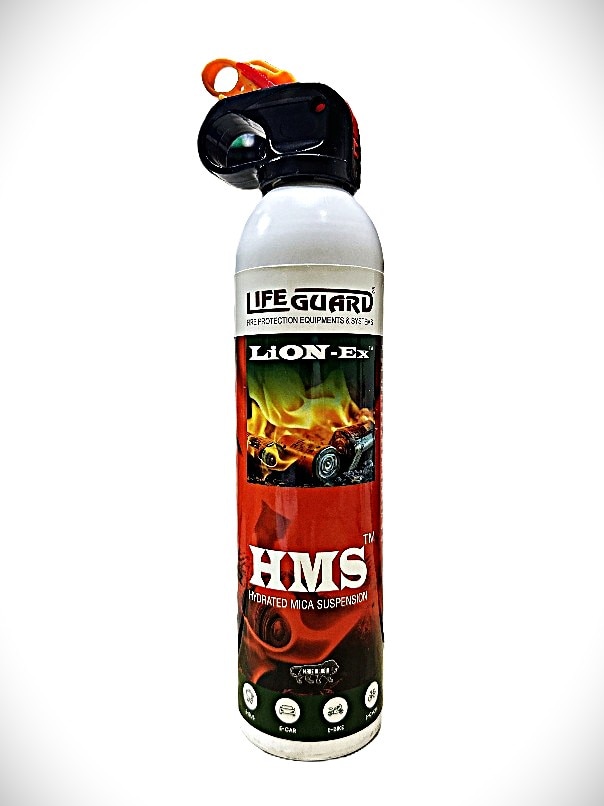 | Lithium Ion Fire Extinguisher EV Battery fire extinguisher ₹4500 Lifeguard EV Fire Extinguisher Manufacturer – Complete Safety for Electric Vehicles The future of mobility is electric. |
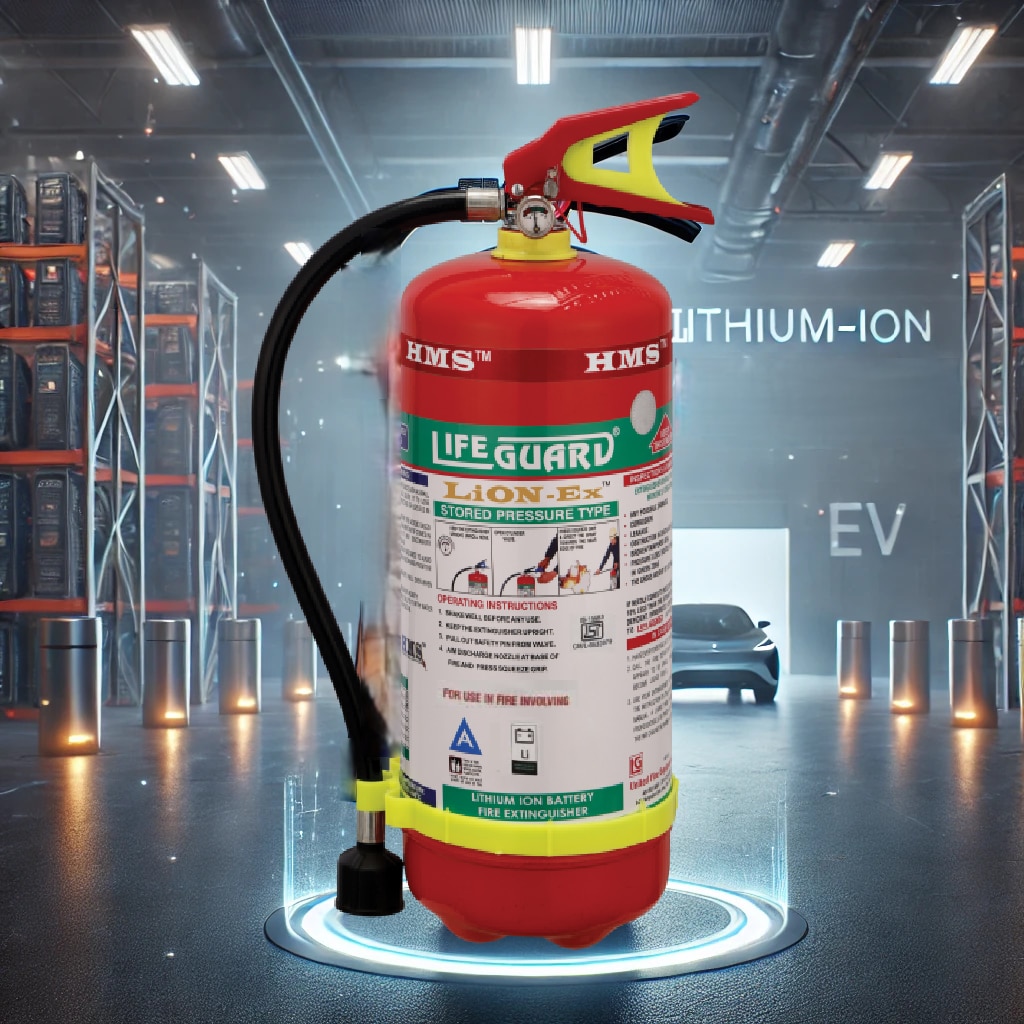 | EV FIRE EV FIRE EXTINGUISHER ₹54000 Lifeguard EV Fire Extinguisher Manufacturer – Complete Safety for Electric Vehicles The future of mobility is electric. |
Frequently asked questions
Why is a standard Class A or Class B rating insufficient for a lithium-ion battery fire?
A standard rating identifies the test fire, not the battery’s stored energy, thermal runaway behaviour, cell-to-cell propagation or reignition risk.
What evidence should you request for a lithium-ion battery fire extinguisher?
Request documented test evidence showing cooling performance, control of fire propagation and resistance to reignition for the battery hazards you need to protect.
What should you do when a lithium-ion battery shows smoke, flames or venting?
Raise the alarm, evacuate people, isolate the area if you can do so safely, and call emergency services. Use an extinguisher only when the incident fits its stated scope and you have a safe escape route.
How do you match an extinguisher to a battery-related hazard?
Compare the extinguisher’s tested battery type and size with the equipment, installation location, access conditions and response plan before procurement.
Related products
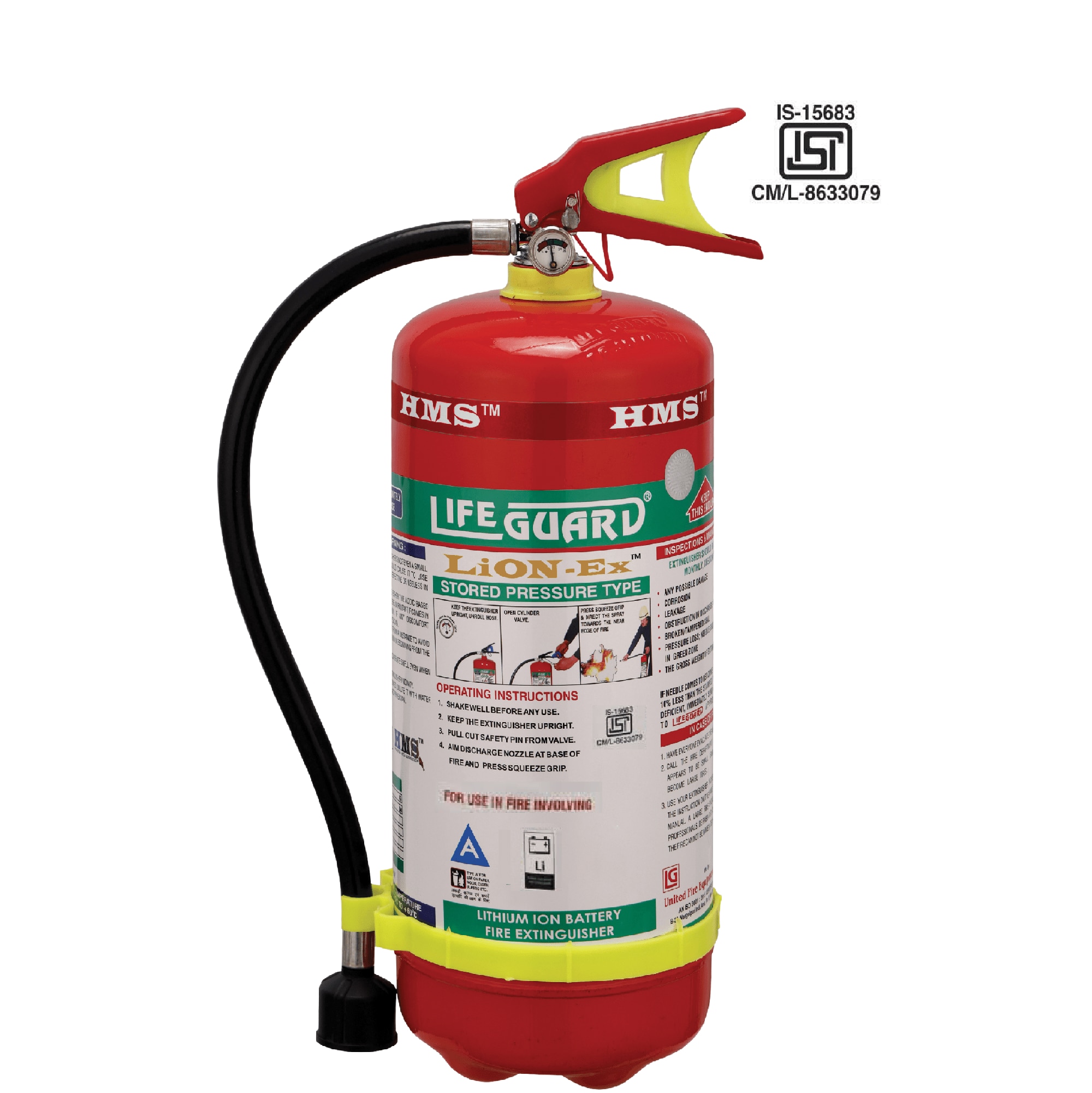 | Lithium Ion Fire Extinguisher LiON-Ex 6 Liters Lithium Battery Fire Extinguisher ₹58500 LiON-Ex Fire Extinguisher for Lithium Ion Battery fire, capacity 6 liters. |
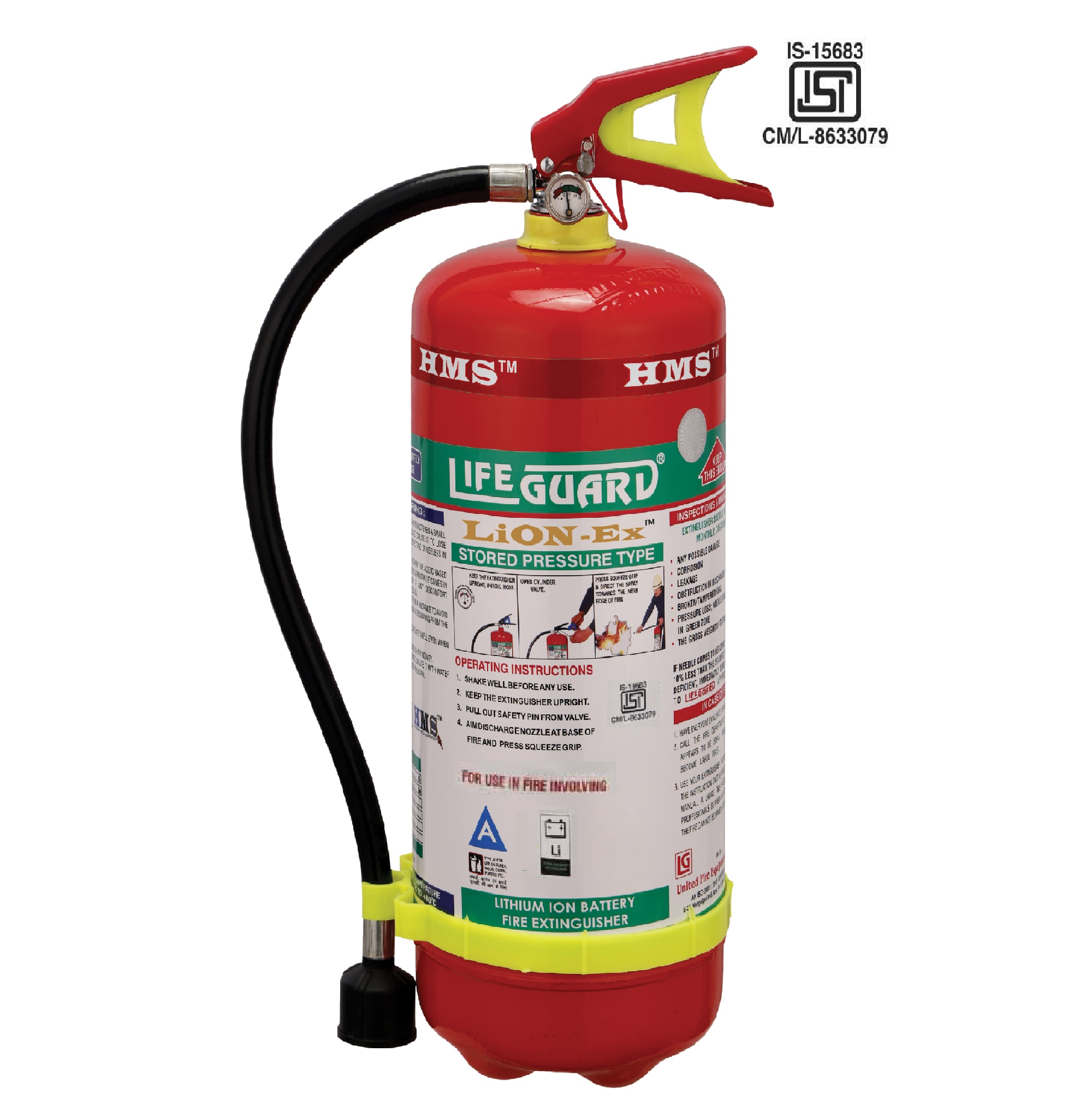 | Lithium Ion Fire Extinguisher LiON-Ex 9 Liters Lithium Fire Extinguisher ₹72000 LiON-Ex Fire Extinguisher for Lithium Ion Battery fire, capacity 9 liters filled with HMS agent, duly ISI marked, tested as per IS : 15683. |
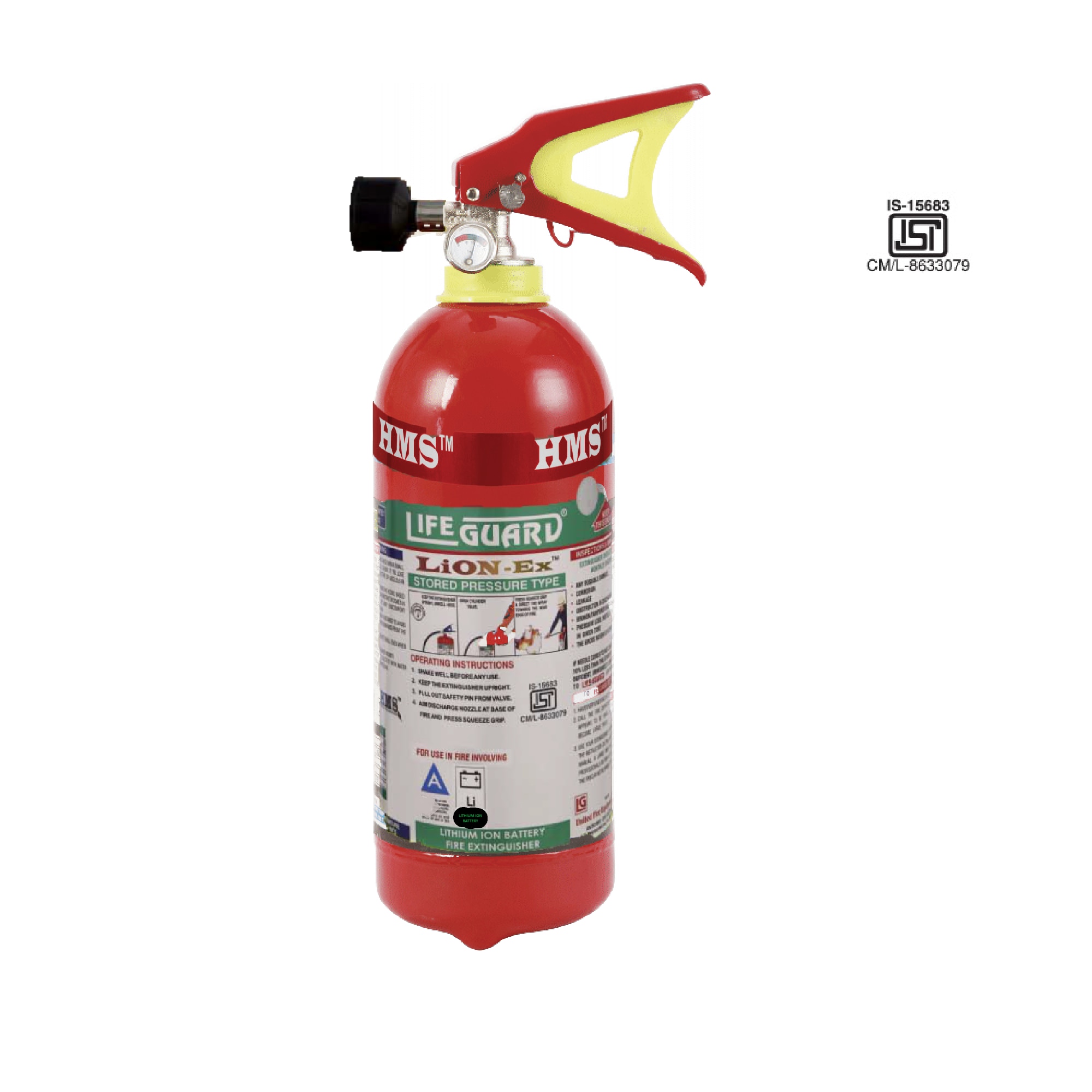 | Lithium Ion Fire Extinguisher LiON-Ex 2 litres ₹18000 LiON-Ex Fire Extinguisher for Lithium Ion Battery fire, capacity 2ltrs. filled with HMS agent, duly ISI marked, tested as per IS : 15683. |
 | Lithium Ion Fire Extinguisher LiON-Ex ₹6500 Fire Extinguisher for Lithium Ion Battery fire, capacity 500 ml filled with HMS agent, duly tested as per IS : 15683. |