
4-Hour Fire Rating Powered by Agni-Rodhak® – 240-Minute Passive Fire Protection | LIFEGUARD
BUY NOW!
4-HOUR FIRE RATING
Powered by Agni-Rodhak | ISRO technology for Advanced Passive Fire Protection by LIFEGUARD
240 MINUTES OF FIRE RESISTANCE. TIME THAT CAN PROTECT STRUCTURE, COMPARTMENTS & CRITICAL INFRASTRUCTURE.
Fire does not wait for emergency teams to arrive.
It does not distinguish between a structural member, cable route, service penetration or critical electrical installation. Once heat begins to build, temperature, fire spread and structural exposure begin working against the building.
This is where passive fire protection becomes fundamental.
LIFEGUARD's Agni-Rodhak technology is developed for suitable passive fire protection applications where enhanced resistance to fire exposure is required. For projects requiring a 4-hour / 240-minute fire-resistance performance, Agni-Rodhak® may be evaluated as part of a suitably designed and appropriately verified fire-protection assembly.
AGNI-RODHAK® — CREATING TIME BETWEEN FIRE AND FAILURE.
What Does a 4-Hour Fire Rating Mean?
A 4-hour fire rating generally refers to a specified 240-minute fire-resistance duration for a particular construction element, protection system or complete assembly under defined fire-test or assessment conditions.
It is intended to describe how long the specific tested, assessed or engineered assembly can provide its required fire-resistance performance under the applicable conditions.
However, a critical principle must be understood:
A 4-hour fire rating is not automatically a property of a standalone coating or material.
The actual performance depends upon the complete system, including:
- Substrate
- Protected element
- Material/system thickness
- Geometry
- Construction
- Installation method
- Fire exposure
- Joints and interfaces
- Penetrations
- Supporting components
- Applicable test or assessment methodology
Therefore, a 240-minute fire-resistance claim must always relate to a specific configuration supported by appropriate technical evidence.
Agni-Rodhak for 4-Hour Passive Fire Protection
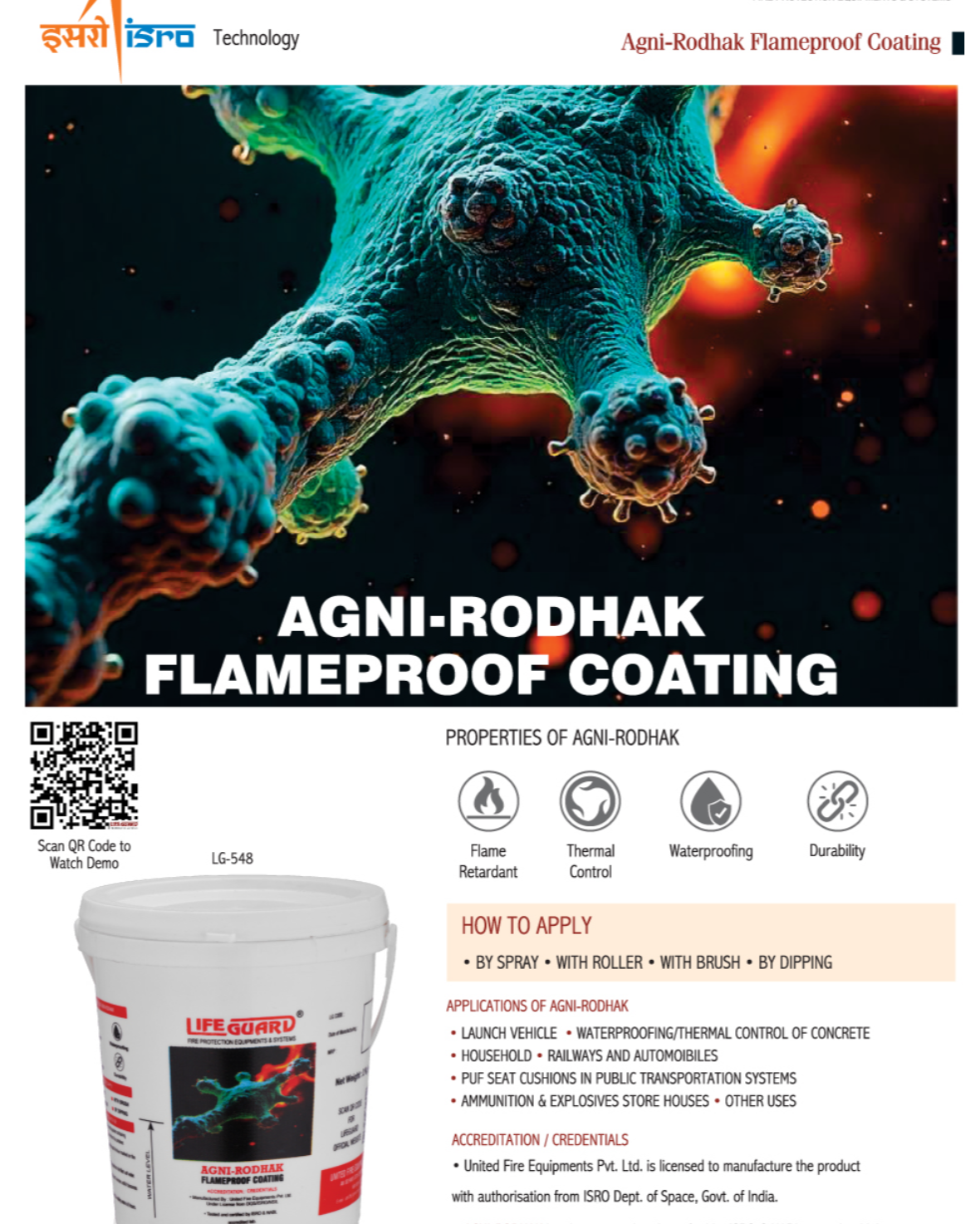
Agni-Rodhak, a LIFEGUARD fire-protection technology, is designed around a mineral-based approach to passive fire protection.
It can be considered for suitable applications where a protective layer forms part of an engineered fire-resistance system.
Where a project specification calls for 4-hour / 240-minute fire resistance, Agni-Rodhak can be evaluated according to:
Substrate + Required Performance + Protection System + Thickness + Fire Exposure + Verification
The result is not simply a coating.
It is a fire-protection system engineered around a defined performance requirement.
WHY 4 HOURS MATTERS
Four hours may sound like a simple number.
In a major fire, it represents 240 minutes of potential time for critical fire-safety functions to operate.
DETECT
Identify the fire.
ALARM
Warn occupants and emergency teams.
EVACUATE
Move people away from danger.
ISOLATE
Shut down or isolate affected systems where appropriate.
RESPOND
Enable emergency responders to reach and manage the incident.
CONTAIN
Limit fire and smoke movement.
PROTECT
Delay the effects of fire on designated structures and infrastructure.
Passive fire protection therefore contributes to something extremely valuable:
TIME.
4-HOUR PASSIVE FIRE PROTECTION
Active fire protection responds to a fire.
Passive fire protection is already present.
That distinction is fundamental.
A passive system does not wait for:
- A detector signal
- An electrical command
- A pump to start
- A manual release
- A person to operate it
Once correctly installed, the passive protection remains incorporated into the protected assembly.
Fire begins → Passive protection is already there.
4-HOUR FIRE PROTECTION FOR STRUCTURAL STEEL
Structural steel can be significantly affected by elevated temperatures during a fire.
As steel temperature rises, its mechanical properties can deteriorate, potentially affecting structural performance.
Passive fire protection systems can be designed to delay temperature rise and provide the required fire-resistance performance for designated structural elements.
Potential applications include:
- Steel columns
- Steel beams
- Structural frames
- Industrial structures
- Plant structures
- Infrastructure buildings
- Critical structural steelwork
Engineering Note
A 4-hour requirement does not mean that one universal coating thickness will apply to every steel section.
Thickness and system design can depend on:
- Steel section geometry
- Section factor
- Exposure
- Required steel temperature
- Protection configuration
- Application conditions
The required specification must therefore be established from appropriate technical evidence.
4-HOUR FIRE PROTECTION FOR CABLES
Cables can become important pathways for fire propagation because electrical infrastructure often passes between rooms, floors and fire compartments.
A 240-minute passive fire protection requirement may apply to selected cable systems or protected routes depending on the project's fire strategy.
Potential applications include:
- Power cables
- Control cables
- Communication cables
- Instrumentation cables
- Cable trays
- Cable ladders
- Cable trenches
- Cable tunnels
- Cable penetrations
Agni-Rodhak can be considered for appropriate engineered passive protection applications.
4-HOUR FIRESTOP MATERIAL
A fire-rated wall or floor can lose its intended compartmentation if services create unprotected openings.
This is why firestop protection is an essential component of many passive fire protection strategies.
A suitable 240-minute firestop system may address:
- Cable penetrations
- Cable tray openings
- Pipe penetrations
- Conduit penetrations
- Service openings
- Wall penetrations
- Floor penetrations
- Utility openings
The firestop performance belongs to the complete system configuration, not merely the material placed into the opening.
4-HOUR FIRE PROTECTION FOR CABLE TRAYS
Large industrial and infrastructure facilities can contain extensive cable-tray networks.
Where prolonged fire resistance is required, passive protection may be designed around selected cable-tray configurations.
Engineering considerations may include:
- Tray width and dimensions
- Cable loading
- Cable construction
- Cable arrangement
- Tray support system
- Surrounding structure
- Protection thickness
- Installation methodology
- Required fire exposure
The final system should be selected and verified for the intended application.
4-HOUR FIRE PROTECTION FOR ELECTRICAL INFRASTRUCTURE
Electrical infrastructure can contain significant energy and high-value equipment.
Passive protection can form part of a broader fire safety strategy for suitable:
- Electrical rooms
- Switchgear rooms
- Control rooms
- Substations
- Cable galleries
- Cable trenches
- Utility buildings
- Power facilities
Agni-Rodhak® passive protection should be coordinated with appropriate electrical isolation, detection and active fire suppression strategies.
4-HOUR FIRE PROTECTION FOR DATA CENTRES
Data centres demand a sophisticated combination of active and passive fire protection.
Critical areas can include:
- Server rooms
- UPS rooms
- Battery rooms
- Electrical rooms
- Cable pathways
- Service shafts
- Power distribution areas
A 4-hour fire-resistance requirement may be specified for particular building elements or compartments according to the project's fire strategy.
Agni-Rodhak® can form part of the passive protection layer, alongside:
Fire Detection + Alarm + Suppression + Compartmentation + Emergency Response
4-HOUR FIRE PROTECTION FOR BESS
Battery Energy Storage Systems require specialized fire engineering because lithium-ion battery incidents can involve:
- Thermal runaway
- Rapid heat generation
- Combustible gas release
- Cell-to-cell propagation
- Module-to-module propagation
- Re-ignition potential
Where a project requires extended fire-resistance performance for a BESS enclosure, barrier or associated infrastructure, passive fire protection can form one layer of the overall strategy.
PASSIVE PROTECTION
Agni-Rodhak
DETECTION
Heat / smoke / temperature / gas detection as appropriate
ACTIVE SUPPRESSION
HMS® Technology for suitable engineered applications
CONTROL
Alarm and BMS integration where specified
RESPONSE
Emergency isolation and firefighting procedures
A critical principle:
Passive fire protection does not replace an engineered BESS detection and suppression system.
4-HOUR FIRE PROTECTION FOR SOLAR PV SYSTEMS
Large solar installations can include extensive electrical infrastructure, including:
- PV modules
- DC cables
- AC cables
- Inverters
- Cable trays
- Junction boxes
- Switchgear
- Transformers
- Energy-storage systems
For selected applications, passive fire protection can be incorporated into the protection strategy for cable infrastructure, electrical rooms, service penetrations and associated construction.
Where batteries are integrated with solar generation, Agni-Rodhak passive protection and HMS active suppression technology can be considered as complementary layers of a broader fire safety strategy.
4-HOUR FIRE COMPARTMENTATION
Compartmentation is one of the foundations of passive fire protection.
The principle is simple:
KEEP THE FIRE WHERE IT STARTED.
A building can be divided into protected compartments using fire-resisting walls, floors, doors and other barriers.
But services can cross those barriers.
Therefore:
FIRE BARRIER
PROTECTED PENETRATION
=
CONTINUOUS FIRE COMPARTMENTATION
Where a 4-hour requirement applies, each component of the relevant fire-resisting assembly must be appropriately designed and verified.
FIRESTOP MATERIAL: THE HIDDEN FIRE BARRIER
Many fire protection systems are visible.
Fire extinguishers are visible.
Fire alarms are visible.
Sprinkler systems are visible.
Firestop systems often are not.
They sit quietly around cables, pipes and service penetrations.
But when a fire occurs, those seemingly insignificant gaps can become critical.
A few millimetres of unprotected space can become a pathway.
This is why professional fire safety treats penetration protection as an integral part of compartmentation.
4-HOUR FIRE RATING — MATERIAL vs SYSTEM
This distinction is essential when specifying passive fire protection.
Standalone MaterialComplete Fire-Protection SystemMaterial properties can be evaluatedComplete assembly is evaluatedThickness alone is insufficientConfiguration is criticalGeneric application cannot establish ratingSpecific application determines performanceSubstrate mattersSubstrate + service + installation matterCannot automatically claim 240 minutes240-minute performance requires supporting evidence
The fire rating belongs to the tested, assessed or engineered configuration.
FACTORS THAT INFLUENCE 240-MINUTE PERFORMANCE
1. SUBSTRATE
Concrete, masonry, steel, cable or another protected element.
2. THICKNESS
Required protective thickness for the particular application.
3. GEOMETRY
Dimensions and shape of the protected element.
4. FIRE EXPOSURE
The applicable fire-test exposure and conditions.
5. ASSEMBLY
The complete construction configuration.
6. INSTALLATION
Surface preparation, application, curing and workmanship.
7. INTERFACES
Edges, joints, penetrations and transitions.
8. VERIFICATION
Appropriate testing, certification, assessment or engineering documentation.
BENEFITS OF 4-HOUR PASSIVE FIRE PROTECTION
When incorporated into an appropriately designed and verified system, 240-minute fire resistance can support:
- Extended resistance to fire exposure
- Enhanced fire compartmentation
- Delayed heat transfer
- Protection of selected critical infrastructure
- Reduced opportunity for early fire propagation
- Additional evacuation time
- Additional emergency response time
- Protection of valuable assets
- Improved resilience of critical facilities
- Integration with active fire protection systems
APPLICATION AREAS
Agni-Rodhak powered passive fire protection solutions can be evaluated for suitable applications in:
Commercial Buildings
Offices, hotels, malls and commercial complexes.
Industrial Facilities
Manufacturing and process plants.
Power Infrastructure
Power plants, substations and utility buildings.
Data Centres
Server, UPS and critical infrastructure areas.
Warehouses
Storage and logistics facilities.
Energy Infrastructure
Solar PV and energy-storage installations.
BESS
Battery rooms, cabinets and suitable energy-storage enclosures.
Telecommunication
Critical communication infrastructure.
Infrastructure Projects
Utility and service installations.
LIFEGUARD'S LAYERED FIRE PROTECTION APPROACH
Fire protection becomes stronger when different technologies work together.
PREVENT
Reduce ignition risks through proper design, installation and maintenance.
PROTECT
Apply Agni-Rodhak passive fire protection to appropriate elements.
DETECT
Identify fire conditions early.
CONTAIN
Maintain fire compartments and protected boundaries.
SUPPRESS
Use appropriate active suppression technology.
RESPOND
Implement emergency isolation, evacuation and firefighting procedures.
PREVENT → PROTECT → DETECT → CONTAIN → SUPPRESS → RESPOND
WHY CHOOSE LIFEGUARD AGNI-RODHAK?
LIFEGUARD views passive fire protection as an engineered part of the building and infrastructure—not an afterthought.
Agni-Rodhak® provides a technology platform for suitable applications involving:
- Passive fire protection
- Fire-resistant coatings
- Cable protection
- Firestop applications
- Electrical infrastructure
- Industrial infrastructure
- Energy infrastructure
- Critical facilities
The technology can also complement LIFEGUARD's active fire protection portfolio, including HMS technology for suitable lithium-ion battery fire suppression applications.
240 MINUTES OF PROTECTION. ONE OBJECTIVE: BUY TIME.
A fire can change a building in minutes.
Passive fire protection is designed to slow that change.
A 4-hour / 240-minute fire-resistance requirement represents a demanding level of performance that, when achieved by the complete applicable system, can provide valuable time for detection, evacuation, response and containment.
That is the true meaning behind a fire rating.
Not merely a number.
TIME.
Time for people.
Time for firefighters.
Time for containment.
Time for critical infrastructure.
Time to protect what cannot be replaced.
AGNI-RODHAK
PASSIVE FIRE PROTECTION POWERED BY LIFEGUARD
BUILD THE BARRIER.
DELAY THE FIRE.
CONTAIN THE SPREAD.
PROTECT WHAT MATTERS.
When every minute matters, passive protection begins before the first flame.
Technical Fire-Rating Disclaimer
A 4-hour / 240-minute fire rating is not a universal standalone property of Agni-Rodhak. Fire resistance depends upon the specific substrate, protection thickness, geometry, construction, application method, fire exposure and complete assembly. Any claim of 240-minute fire resistance must be supported by appropriate testing, certification, assessment or engineering documentation applicable to the exact intended configuration. Product selection, thickness and installation should be determined according to project-specific requirements and applicable codes and standards.
SEO META TITLE
4 Hour Fire Rating | 240 Minute Fire Protection | Agni-Rodhak®
SEO META DESCRIPTION
Explore Agni-Rodhak powered passive fire protection for applications requiring 4-hour or 240-minute fire resistance, including structural, cable, firestop and critical infrastructure protection.
PRIMARY SEO KEYWORDS
4 Hour Fire Rating, 4 Hour Fire Rated Material, 4 Hour Fire Resistant Material, 4 Hour Fire Protection, 240 Minute Fire Rating, 240 Minute Fire Resistance, 240 Minute Fire Protection, 4 Hour Passive Fire Protection, 4 Hour Firestop, 4 Hour Firestop Material, 4 Hour Firestop System, 4 Hour Fire Rated Coating, 4 Hour Fire Resistant Coating, 4 Hour Fire Protection Material, 4 Hour Fireproof Material, Fire Rated Material, Fire Resistant Material, Fire Rating Material, Fire Resistance Material, Passive Fire Protection, Passive Fire Protection Material, Agni-Rodhak, Agni-Rodhak Fire Protection, Agni-Rodhak Passive Fire Protection, Agni-Rodhak Fire Resistant Material, Agni-Rodhak Fire Rated Coating, Fire Protection Coating, Fire Resistant Coating India, 4 Hour Fire Protection India, 240 Minute Fire Protection India, Cable Fire Protection, 4 Hour Cable Fire Protection, Cable Tray Fire Protection, Cable Tray Firestop, Cable Penetration Firestop, 4 Hour Firestop for Cables, 4 Hour Firestop for Pipes, Fire Penetration Protection, Fire Compartmentation, Fire Barrier Material, Structural Fire Protection, 4 Hour Structural Fire Protection, Steel Fire Protection, 4 Hour Steel Fire Protection, Data Centre Fire Protection, Industrial Fire Protection, Electrical Room Fire Protection, BESS Fire Protection, Solar PV Fire Protection, Energy Infrastructure Fire Protection, Fire Safety Material, LIFEGUARD Fire Protection.
Recommended URL Slug
/4-hour-fire-rating-agni-rodhak