
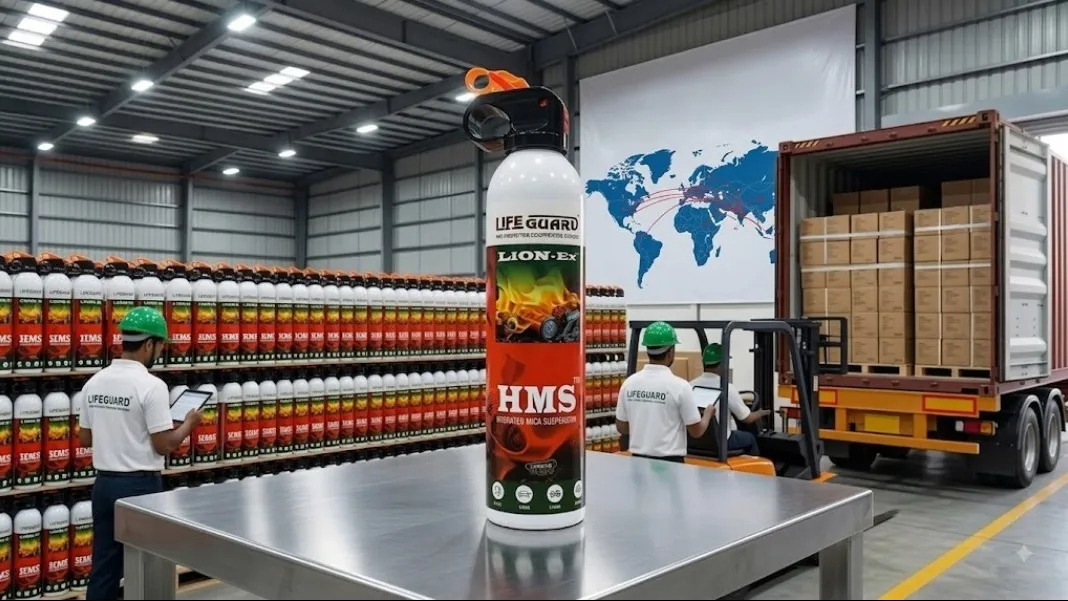
EV Battery Fire Safety Manufacturer India
Advanced Lithium-Ion Battery Fire Protection & Thermal Runaway Safety Solutions
India’s electric mobility sector is undergoing rapid transformation. Electric cars, buses, trucks, two-wheelers, three-wheelers, battery swapping facilities, EV charging stations and lithium-ion battery manufacturing units are becoming an integral part of the country’s transportation and energy ecosystem.
Along with this growth comes a critical safety concern: lithium-ion battery fire and thermal runaway.
Unlike many conventional fires, an EV battery incident may involve internal cell heating, flammable gas generation, rapid temperature escalation, cell-to-cell propagation and the possibility of re-ignition. This makes specialized battery fire protection essential for EV manufacturers, fleet operators, battery companies and charging infrastructure providers.
LIFEGUARD® – United Fire Equipments Pvt. Ltd. provides engineered solutions as an EV Battery Fire Safety Manufacturer in India, offering customized fire detection, suppression, cooling, alarm, control and thermal runaway protection systems for electric vehicles and lithium-ion battery applications.
Leading EV Battery Fire Safety Manufacturer in India
An effective EV battery fire safety solution must be engineered according to the actual battery risk.
Battery chemistry, energy capacity, enclosure size, operating temperature, charging conditions and vehicle configuration can significantly influence the required fire protection strategy.
LIFEGUARD® provides application-specific solutions that may incorporate:
- Early heat detection
- Linear heat sensing
- Smoke detection
- Gas detection
- Multi-criteria detection
- Thermal runaway monitoring
- Automatic fire suppression
- Direct battery compartment protection
- Local application suppression
- Battery cooling arrangements
- Manual emergency activation
- Audible and visual alarms
- Fire releasing control panels
- Electrical isolation interfaces
- BMS integration
- Customized piping and tubing
- Engineered nozzle placement
- Remote system monitoring
Our objective is to provide an integrated fire safety strategy rather than relying only on conventional firefighting equipment.
Why EV Battery Fire Safety Is Critical
Lithium-ion batteries contain significant stored electrical and chemical energy.
Under normal operating conditions, sophisticated battery management and thermal management systems help maintain safe operation. However, abnormal conditions can lead to battery failure.
Potential causes include:
- Internal electrical short circuit
- Cell manufacturing defect
- Mechanical impact
- Vehicle collision
- Overcharging
- Excessive discharge
- External heating
- Charging equipment failure
- Battery cooling system malfunction
- Electrical wiring faults
- Physical deformation
- Battery Management System malfunction
A severe battery fault can initiate thermal runaway, one of the principal hazards associated with lithium-ion technology.
What Is Thermal Runaway in an EV Battery?
Thermal runaway is a self-accelerating process in which a lithium-ion cell generates heat faster than it can dissipate it.
As temperature continues to rise, internal chemical reactions may release additional heat and gases. In severe cases, the event may spread from one cell to neighbouring cells and subsequently across an entire battery module.
Possible consequences include:
- Excessive temperature rise
- Battery venting
- Smoke formation
- Flammable gas release
- Toxic gas release
- Cell rupture
- Fire
- Cell-to-cell propagation
- Module-to-module propagation
- Damage to surrounding equipment
- Re-ignition
Therefore, an effective EV battery fire safety system should focus on more than extinguishing visible flames.
The strategy should consider:
Detection + Suppression + Cooling + Isolation + Propagation Control
Early Detection of EV Battery Failure
Early detection can provide critical time for alarm generation, system activation and emergency intervention.
Battery failure may be preceded by:
- Unusual temperature rise
- Localized overheating
- Smoke
- Off-gas generation
- Electrical abnormalities
- Abnormal battery voltage
- Battery management system alarms
LIFEGUARD® can integrate suitable detection technology according to the application.
Heat Detection
Heat detectors and temperature sensors can identify abnormal temperature conditions around:
- EV battery packs
- Battery modules
- Battery cabinets
- Charging equipment
- Battery racks
Linear Heat Sensing
Linear Heat Sensing systems can provide continuous thermal monitoring along battery installations.
Applications may include:
- Electric bus battery compartments
- EV battery racks
- Lithium-ion battery warehouses
- Battery cabinets
- Charging stations
- Battery manufacturing areas
Linear sensing can be especially useful where monitoring is required across an extended physical area.
Smoke Detection
Smoke detection may be used in enclosed battery installations where environmental conditions permit reliable operation.
Suitable applications may include:
- Battery rooms
- Charging rooms
- Battery warehouses
- Laboratories
- Manufacturing facilities
Aspirating Smoke Detection
High-sensitivity aspirating smoke detection can provide early warning in critical battery environments.
It may be considered for:
- Battery testing laboratories
- High-value battery installations
- Battery storage facilities
- Control rooms
- Critical electrical environments
Gas Detection
Lithium-ion batteries may release gases during certain stages of failure.
Suitable gas detection can therefore supplement heat and smoke detection where project risk assessment identifies a requirement.
Automatic EV Battery Fire Suppression System
Automatic suppression can provide rapid intervention when access to a battery compartment is difficult or when the incident develops quickly.
An engineered system may incorporate:
- Detection sensors
- Fire releasing control unit
- Suppression agent storage cylinder
- Automatic valve
- Solenoid actuator
- Distribution piping
- Flexible tubing
- Discharge nozzles
- Pressure monitoring
- Manual release
- Alarm indication
- Electrical shutdown outputs
- BMS or vehicle interfaces
The system can be designed to protect individual battery zones or multiple high-risk compartments.
EV Battery Fire Suppression and Cooling
One of the major challenges with lithium-ion battery incidents is continued heat generation after the initial flames have been controlled.
For this reason, cooling can be a critical part of the protection strategy.
Effective cooling can help:
- Reduce battery temperature
- Limit heat transfer between cells
- Slow thermal runaway propagation
- Protect neighbouring battery modules
- Reduce the possibility of re-ignition
- Minimize secondary damage
The most appropriate approach depends on battery chemistry, enclosure design and the objectives of the protection system.
EV Battery Compartment Fire Protection
Vehicle battery compartments often present difficult fire protection conditions because of:
- Restricted space
- Limited accessibility
- Internal obstructions
- Dense battery module arrangement
- Ventilation openings
- Complex geometry
A customized system should therefore evaluate:
- Compartment dimensions
- Battery module arrangement
- Detector positions
- Nozzle placement
- Piping and tubing routes
- Ventilation
- Agent distribution
- Cooling requirement
- Expected fire location
Proper engineering helps ensure the protection is directed toward the actual hazard.
Electric Car Battery Fire Safety
Modern electric passenger vehicles can contain high-capacity battery packs installed beneath the floor structure.
Fire safety solutions may include:
- Battery temperature monitoring
- Gas monitoring
- Automatic detection
- Local suppression
- Battery cooling
- Driver warning
- Manual emergency activation
- Vehicle shutdown interface
- Battery isolation signals
LIFEGUARD® can support EV developers and vehicle manufacturers with customized fire safety arrangements.
Electric Bus Battery Fire Safety System
Electric buses may contain multiple battery packs located:
- On the roof
- Under the floor
- Behind the passenger compartment
- Within dedicated battery enclosures
The protection strategy may need to divide these locations into separate detection and suppression zones.
Important parameters include:
- Battery capacity
- Number of battery packs
- Compartment dimensions
- Vehicle length
- Operating temperature
- Dust
- Vibration
- Air movement
- Available equipment space
LIFEGUARD® can support customized battery fire protection for electric bus applications.
Electric Truck Battery Fire Safety
Heavy commercial electric vehicles can operate under more demanding conditions than passenger EVs.
Relevant factors may include:
- Larger battery capacity
- Extended operating hours
- Heavy vehicle loads
- Mechanical vibration
- Dust
- High ambient temperatures
- Multiple battery enclosures
Customized protection can be developed around these specific risks.
Electric Two-Wheeler Battery Fire Safety
Electric scooters and motorcycles represent a large part of the Indian EV ecosystem.
Battery packs are often located:
- Under the seat
- Beneath the floorboard
- Inside the frame
- In removable enclosures
Because of limited available space, these applications may require compact detection and suppression arrangements.
LIFEGUARD® can support EV two-wheeler OEMs with application-specific fire safety concepts.
Electric Three-Wheeler Fire Safety
Electric three-wheelers are widely used for passenger transport and last-mile commercial logistics.
Suitable safety measures may include:
- Battery heat monitoring
- Battery enclosure protection
- Charging safety
- Fire detection
- Automatic suppression
- Manual activation
- Alarm indication
The system can be configured according to the individual vehicle platform.
EV Charging Station Fire Safety
EV charging infrastructure introduces both battery and electrical fire risks.
Areas requiring evaluation can include:
- EV chargers
- Charging connectors
- Power cables
- Electrical panels
- Distribution boards
- Transformers
- Power conversion equipment
- Vehicles being charged
Suitable protection may include:
- Heat detection
- Smoke detection
- Fire alarm systems
- Automatic suppression
- Portable extinguishing equipment
- Emergency shutdown
- Power isolation
LIFEGUARD® can provide solutions for public, commercial, industrial and fleet charging facilities.
Battery Swapping Station Fire Protection
Battery swapping stations can contain multiple battery packs undergoing:
- Charging
- Storage
- Handling
- Inspection
- Replacement
This can create a concentrated lithium-ion battery hazard.
A comprehensive protection strategy may include:
- Temperature monitoring
- Battery rack detection
- Smoke detection
- Gas monitoring
- Automatic suppression
- Cooling
- Fire alarm
- Emergency electrical isolation
- Manual fire protection equipment
Lithium-Ion Battery Warehouse Fire Safety
Warehouses containing lithium-ion batteries require careful risk management.
Important factors include:
- Battery quantity
- Battery chemistry
- State of charge
- Rack arrangement
- Storage density
- Battery spacing
- Detection sensitivity
- Fire compartmentation
- Cooling
- Suppression coverage
- Emergency access
- Damaged battery isolation
Early detection and effective separation strategies can help reduce propagation risks.
Battery Manufacturing Plant Fire Safety
Battery manufacturing facilities may contain different hazards throughout the production process.
Protection may be required in:
- Cell storage
- Cell assembly
- Battery module assembly
- Battery pack assembly
- Charging areas
- Formation areas
- Battery testing
- Research laboratories
- Finished battery storage
- Electrical rooms
LIFEGUARD® can support integrated detection, alarm and suppression systems for these environments.
Battery Testing Laboratory Fire Safety
Battery testing laboratories can expose lithium-ion batteries to demanding conditions.
Tests may involve:
- Charging and discharging
- High temperatures
- Electrical loading
- Mechanical stress
- Performance evaluation
Suitable fire protection measures can include:
- Early temperature detection
- Gas detection
- Smoke detection
- Automatic suppression
- Local application systems
- Emergency shutdown
- Audible and visual alarms
Battery Recycling Facility Fire Safety
Battery recycling sites may receive batteries in unpredictable physical and electrical conditions.
Hazards may involve:
- Damaged cells
- Used battery packs
- Defective batteries
- Partially charged batteries
- Mechanically compromised batteries
Suitable protection strategies may include:
- Battery segregation
- Temperature monitoring
- Fire detection
- Cooling
- Suppression
- Emergency response measures
EV Fleet Charging Depot Fire Safety
Large electric fleet operators may charge several vehicles simultaneously.
Fire safety planning can include:
- Vehicle charging bays
- Battery systems
- Charger equipment
- Electrical panels
- Transformers
- Battery storage
- Maintenance workshops
- Control rooms
An integrated approach can address both vehicle-level and infrastructure-level risks.
BMS Integration for EV Battery Fire Protection
Where technically compatible, the fire safety system may interface with the Battery Management System (BMS) or vehicle controller.
Potential functions can include:
- High-temperature notification
- Fire alarm output
- Battery isolation
- Charging shutdown
- Main electrical isolation
- Ventilation control
- Vehicle controller notification
- Central monitoring
- Remote alarm communication
Final integration depends on the vehicle or facility control architecture.
EV Battery Fire Safety for OEM Manufacturers
LIFEGUARD® can work with electric vehicle and battery OEMs during product development.
Our OEM support can include:
- Battery hazard assessment
- Fire protection concept
- Detector selection
- Suppression system configuration
- Cylinder selection
- Nozzle positioning
- Piping and tubing layout
- Control logic
- Mounting arrangement
- Prototype integration
- Technical drawings
- Testing support
This approach allows battery fire safety to be incorporated during the design stage rather than being considered only after product development.
Customized Manufacturing Solutions
Different EV platforms require different hardware arrangements.
Customization can include:
- Suppression cylinder capacities
- Mounting brackets
- Valve configurations
- Nozzle quantities
- Nozzle orientations
- Tubing lengths
- Piping configurations
- Detection layouts
- Control arrangements
- Wiring
- Identification labels
- Installation drawings
This can be particularly beneficial for OEMs requiring repeatable system configurations across vehicle production.
Applications of LIFEGUARD® EV Battery Fire Safety Systems
Our solutions can be considered for:
- Electric passenger cars
- Electric buses
- Electric trucks
- Electric scooters
- Electric motorcycles
- Electric rickshaws
- Electric forklifts
- Electric mining equipment
- Electric construction machinery
- Battery swapping stations
- EV charging stations
- Charging hubs
- Fleet charging depots
- Battery warehouses
- Battery manufacturing plants
- Battery assembly facilities
- Battery testing laboratories
- Battery recycling facilities
- Battery cabinets
- Industrial lithium-ion battery installations
Industries We Serve
LIFEGUARD® can support organizations involved in:
- Electric vehicle manufacturing
- Automobile manufacturing
- Battery cell manufacturing
- Battery pack assembly
- Electric bus manufacturing
- Electric truck manufacturing
- Two-wheeler manufacturing
- Three-wheeler manufacturing
- EV component manufacturing
- EV charging infrastructure
- Battery swapping
- Fleet operations
- Logistics
- Public transportation
- Battery storage
- Research and development
- Industrial manufacturing
- Renewable energy
- Government and institutional projects
EV Battery Fire Safety Manufacturer Delhi NCR
LIFEGUARD® can support customers across:
- Delhi
- Gurugram
- Manesar
- Noida
- Greater Noida
- Faridabad
- Ghaziabad
EV Battery Fire Safety Manufacturer Maharashtra
Suitable projects can be supported across industrial locations such as:
- Mumbai
- Navi Mumbai
- Pune
- Nashik
- Nagpur
- Chhatrapati Sambhajinagar
EV Battery Fire Safety Manufacturer Gujarat
LIFEGUARD® can support requirements across:
- Ahmedabad
- Vadodara
- Surat
- Rajkot
- Gandhinagar
- Sanand
- Dholera
EV Battery Fire Safety Manufacturer South India
Project-specific fire safety solutions can also be developed for customers in:
- Bengaluru
- Chennai
- Hyderabad
- Hosur
- Coimbatore
- Kochi
Pan-India EV Battery Fire Safety Support
LIFEGUARD® can support suitable projects throughout India, covering major EV, automotive and industrial regions.
Our objective is to provide application-specific engineering support from concept development to system integration, installation guidance and testing assistance.
Why Choose LIFEGUARD® as an EV Battery Fire Safety Manufacturer in India?
Specialized Fire Protection Engineering
Our approach emphasizes application-specific engineering for high-risk and special-hazard fire protection.
Customized Solutions
Every battery platform is different. System selection can therefore be based on the actual battery configuration and risk.
Integrated Detection & Suppression
Solutions can combine:
- Detection
- Alarm
- Suppression
- Cooling
- Control systems
- Cylinders
- Nozzles
- Piping
- Tubing
- Manual activation
- Emergency interfaces
OEM Support
LIFEGUARD® can work with vehicle and battery manufacturers during prototype and production stages.
Technical Support
Our services can include:
- Technical evaluation
- System concept
- Equipment selection
- Design drawings
- System layouts
- Installation guidance
- Testing support
Pan-India Reach
We can support suitable EV battery fire safety requirements in major industrial regions across India.
EV Battery Fire Safety System Design Process
Step 1 – Application Study
The vehicle, battery system, charging facility or protected installation is reviewed.
Step 2 – Technical Data Collection
Battery chemistry, capacity, voltage, dimensions and module configuration are assessed.
Step 3 – Hazard Analysis
Potential overheating, electrical failure and thermal runaway scenarios are considered.
Step 4 – Detection Selection
Suitable detection methods are selected based on project objectives.
Step 5 – Suppression & Cooling Strategy
An appropriate fire control strategy is developed.
Step 6 – Engineering Layout
Detectors, cylinders, nozzles, piping and control equipment are positioned.
Step 7 – Integration
The system is integrated with the vehicle, battery or facility controls where required.
Step 8 – Testing & Commissioning
Detection logic, alarms, manual activation, release functions and system interfaces are checked.
Frequently Asked Questions
What is an EV battery fire safety system?
It is an engineered combination of detection, suppression, cooling, alarm and control technologies intended to help manage lithium-ion battery fire and thermal runaway hazards.
Why are EV battery fires challenging?
Lithium-ion cells may generate internal heat during thermal runaway, allowing the incident to propagate between cells and potentially creating a risk of re-ignition.
Can the system operate automatically?
Yes. Depending on the application, detection technology can be configured to initiate alarms, shutdown functions and automatic suppression.
Can the system be customized for EV OEMs?
Yes. Fire protection solutions can be developed according to battery configuration, vehicle design and available installation space.
Can electric buses and trucks be protected?
Yes. Customized solutions can be developed for identified battery compartments and other high-risk areas in electric commercial vehicles.
Can EV charging stations be protected?
Yes. Charging infrastructure can be evaluated for suitable fire detection, alarms, suppression and emergency isolation measures.
Can lithium-ion battery warehouses be protected?
Yes. Protection strategies can be developed according to battery chemistry, quantity, storage configuration and associated fire risks.
Does LIFEGUARD® provide EV battery fire safety solutions throughout India?
Yes. Suitable EV and lithium-ion battery fire safety projects can be supported across multiple industrial regions of India.
LIFEGUARD® – EV Battery Fire Safety Manufacturer India
As India accelerates toward electric mobility, specialized battery fire safety will remain a critical consideration for manufacturers, fleet operators, charging companies and industrial facilities.
LIFEGUARD® – United Fire Equipments Pvt. Ltd. provides engineered EV Battery Fire Safety Solutions in India, combining early detection, automatic suppression, cooling concepts, alarms, emergency controls and customized system integration.
From electric vehicles and buses to lithium-ion battery manufacturing, storage, testing and charging infrastructure, LIFEGUARD® can assist customers in developing fire safety solutions based on their specific application requirements.
Contact LIFEGUARD®
United Fire Equipments Pvt. Ltd.
Manufacturer of ISI Certified Fire Safety Equipment
📞 8048034226
📧 ufe126@gmail.com | info@lifeguardindia.in
SEO Meta Title
EV Battery Fire Safety Manufacturer India | LIFEGUARD®
SEO Meta Description
LIFEGUARD® is an EV Battery Fire Safety Manufacturer in India providing customized lithium-ion battery fire detection, suppression, cooling and thermal runaway protection solutions for electric vehicles, charging stations, battery storage and manufacturing applications.
Suggested URL Slug
/ev-battery-fire-safety-manufacturer-india/
Primary Keyword
EV battery fire safety manufacturer India
Secondary SEO Keywords
EV battery fire safety India, EV battery fire protection manufacturer India, lithium battery fire safety manufacturer India, lithium-ion battery fire suppression India, electric vehicle battery fire protection system, EV thermal runaway protection system India, EV battery fire suppression manufacturer, electric bus battery fire safety India, EV charging station fire protection India, battery fire safety solutions India, EV battery cooling system India, lithium-ion battery fire protection company India, EV battery safety system manufacturer India.
Suggested Long-Tail SEO Keywords
best EV battery fire safety manufacturer in India, lithium-ion battery thermal runaway protection manufacturer India, automatic EV battery fire suppression system India, electric bus battery fire protection manufacturer India, EV battery compartment fire suppression system manufacturer, battery swapping station fire safety solutions India, EV charging station fire suppression system India, lithium-ion battery warehouse fire protection manufacturer India.
Keywords






